

 |
市場調查報告書
商品編碼
1998782
嬰兒背帶市場商機、成長要素、產業趨勢分析及2026-2035年預測。Baby Sling Market Opportunity, Growth Drivers, Industry Trend Analysis, and Forecast 2026 - 2035 |
||||||

全球嬰兒背帶市場預計到 2025 年將價值 25 億美元,預計到 2035 年將以 6.1% 的複合年成長率成長至 45 億美元。
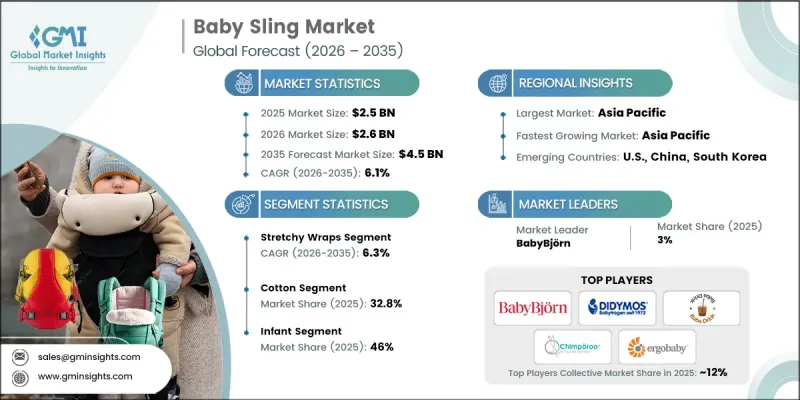
市場成長的驅動力在於父母對背巾使用益處的認知不斷提高,以及對符合人體工學、便捷安全的嬰兒產品需求日益成長。製造商正抓住這一趨勢,拓展分銷管道,並推出符合當地偏好的創新設計。 BabyBjorn 和 Ergobaby 等公司提供採用透氣布料、可調節且符合人體工學設計的背巾,以滿足現代父母的需求。印度和印尼等新興地區的本土製造商則為中等收入家庭提供更親民的選擇。研究表明,背巾使用能夠加強親子關係,促進嬰兒的情感發展,並為照顧者提供解放雙手的便利。此外,背巾還具有促進肌膚接觸、穩定嬰兒心率和調節體溫等生理性益處。注重環保的父母擴大選擇有機棉、竹纖維和再生纖維等永續材料。人們對無害、親膚和環保產品的興趣日益濃厚,也是推動市場成長的重要因素。
| 市場規模 | |
|---|---|
| 開始年份 | 2025 |
| 預測期 | 2026-2035 |
| 上市時的市場規模 | 25億美元 |
| 預測金額 | 45億美元 |
| 複合年成長率 | 6.1% |
預計到2025年,彈性嬰兒背巾市場規模將達到10億美元,並在2035年之前以6.3%的複合年成長率成長。彈性嬰兒背巾憑藉其舒適性、易用性和對新生兒的適用性,在市場上佔據領先地位。彈性布料能提供貼身舒適的包裹感,如同在子宮內一般,增強嬰兒的安全感,並促進親子關係。其靈活的彈性減少了使用過程中的失誤,使其成為新手父母的理想選擇。此外,拉伸背巾比結構式背帶更經濟實惠,並且適合各種體型和多位看護者使用,因此廣受歡迎,尤其是在尋求經濟實惠且符合人體工學產品的都市區市場。
預計到2025年,棉質布料市佔率將達到32.8%,並以6.9%的複合年成長率成長至2035年。棉質布料透氣、柔軟且低致敏,深受家長青睞。即使長時間穿著,棉質布料也能有效調節體溫,並適用於各種氣候。棉質布料用途廣泛、經久耐用,且能呈現鮮豔的色彩和豐富的圖案,使製造商能夠在保持高品質標準的同時,生產出外觀精美的產品。
美國嬰兒背巾市場預計到2025年將達到6億美元,並在2026年至2035年間以6.3%的複合年成長率成長。這一成長主要得益於消費者意識的提高、購買力的增強以及對優質、符合人體工學的嬰兒護理產品的偏好。父母優先考慮舒適性、安全認證和便利性,這推動了對高品質背巾和背帶的需求。美國市場受益於成熟的品牌、廣泛的零售網路以及電子商務的普及。活躍的育兒社群、社群媒體的影響力以及專家的推薦,透過提高父母對嬰兒背巾在發展和健康方面益處的認知,進一步推動了嬰兒背巾的普及。
目錄
第1章:調查方法和範圍
第2章執行摘要
第3章業界考察
- 生態系分析
- 供應商情況
- 利潤率
- 每個階段增加的價值
- 影響價值鏈的因素
- 影響產業的因素
- 促進因素
- 出生率上升
- 消費者對嬰兒背帶的認知度不斷提高
- 日益忙碌的生活方式
- 陷阱與挑戰
- 激烈的競爭與市場飽和
- 安全隱患
- 機會
- 環保有機產品的成長
- 人體工學和智慧功能的創新
- 促進因素
- 成長潛力分析
- 未來市場趨勢
- 科技與創新趨勢
- 當前技術趨勢
- 新興技術
- 價格趨勢
- 按地區
- 依產品
- 監理情勢
- 北美洲
- 美國:消費品安全委員會(CPSC)聯邦法規(CFR)第16篇第1512節
- 加拿大:國際標準化組織(ISO)4210
- 歐洲
- 德國:德國標準化協會 (DIN)、歐洲標準 (EN)、ISO 4210
- 英國:歐洲標準 (EN) ISO 4210 /英國合格評定 (UKCA)
- 法國:歐洲標準 (EN) ISO 4210
- 亞太地區
- 中國:國家標誌(GB)3565
- 印度:印度標準 (IS) 10613
- 日本:日本工業標準(JIS)D 9110
- 拉丁美洲
- 巴西:巴西技術標準協會 (ABNT)、巴西標準局 (NBR)、ISO 4210
- 墨西哥:國際標準化組織(ISO)4210
- 中東和非洲
- 南非:南非國家標準 (SANS) 311
- 沙烏地阿拉伯:沙烏地阿拉伯標準、計量和品質組織 (SASO)、海灣標準化組織 (GSO)、ISO 4210
- 北美洲
- 貿易資料分析(HS編碼 - 6209)
- 進出口量及進口額趨勢
- 主要貿易路線及關稅的影響
- 人工智慧和生成式人工智慧對市場的影響
- 利用人工智慧改造現有經營模式
- Genai 各細分市場的應用案例與實施藍圖
- 風險、限制和監管考量
- 波特五力分析
- PESTEL 分析
- 消費者購買行為分析
- 人口趨勢
- 影響購買決策的因素
- 消費品滲透率
- 首選分銷管道
第4章 競爭情勢
- 介紹
- 企業市佔率分析
- 按地區
- 企業矩陣分析
- 主要市場公司的競爭分析
- 競爭定位矩陣
- 主要進展
- 併購
- 夥伴關係與合作
- 新產品發布
- 業務拓展計劃
第5章 市場估計與預測:依類型分類,2022-2035年
- 拉伸膜
- 混合包裝
- 紡織吊帶
- 環形背帶
- 其他
第6章 市場估計與預測:依材料分類,2022-2035年
- 棉布
- 亞麻布
- 絲綢
- 混合
- 其他
第7章 市場估計與預測:依年齡層別分類,2022-2035年
- 新生兒(0-3個月大)
- 嬰兒(3-10個月大)
- 嬰兒(10個月以上)
第8章 市場估算與預測:依價格區間分類,2022-2035年
- 低價位
- 中價位
- 高的
第9章 市場估價與預測:依銷售管道分類,2022-2035年
- 線上
- 電子商務
- 企業網站
- 離線
- 專賣店
- 百貨公司
- 其他(母嬰用品專賣店等)
第10章 市場估價與預測:依地區分類,2022-2035年
- 北美洲
- 美國
- 加拿大
- 歐洲
- 德國
- 英國
- 法國
- 義大利
- 西班牙
- 亞太地區
- 中國
- 印度
- 日本
- 韓國
- 澳洲
- 拉丁美洲
- 巴西
- 墨西哥
- 阿根廷
- 中東和非洲(MEA)
- 沙烏地阿拉伯
- 阿拉伯聯合大公國
- 南非
第11章:公司簡介
- BabyBjorn
- Boba
- Chimparoo
- Didymos
- Ergobaby
- Hip Baby Wrap
- Infantino
- Lenny Lamb
- Lillebaby
- Moby
- Nalakai
- Onya Baby
- Sakura Bloom
- Solly Baby
- Tula
The Global Baby Sling Market was valued at USD 2.5 billion in 2025 and is estimated to grow at a CAGR of 6.1% to reach USD 4.5 billion by 2035.
Market growth is fueled by rising parental awareness of the benefits of baby wearing and increasing demand for ergonomic, convenient, and safe infant care products. Manufacturers are leveraging this momentum by expanding distribution channels and introducing innovative designs that cater to regional preferences. Companies such as BabyBjorn and Ergobaby are offering slings with breathable fabrics, adjustable features, and ergonomic designs to meet modern parenting needs. Local producers in emerging regions, including India and Indonesia, provide affordable alternatives for middle-income households. Research shows that baby wearing enhances parent-infant bonding, supports emotional development, and provides caregivers with hands-free convenience. Additionally, slings offer physiological benefits such as promoting skin-to-skin contact, stabilizing infants' heart rates, and regulating body temperature. Environmentally conscious parents are increasingly driving the adoption of sustainable materials like organic cotton, bamboo fibers, and recycled textiles. The market is also shaped by rising interest in non-toxic, skin-friendly, and eco-friendly options.
| Market Scope | |
|---|---|
| Start Year | 2025 |
| Forecast Year | 2026-2035 |
| Start Value | $2.5 Billion |
| Forecast Value | $4.5 Billion |
| CAGR | 6.1% |
The stretchy wraps segment generated USD 1 billion in 2025 and is projected to grow at a CAGR of 6.3% through 2035. Stretchy wraps dominate due to their comfort, ease of use, and suitability for newborns. Elastic fabrics allow a snug, womb-like fit that enhances infant security and parent bonding. Their forgiving stretch reduces user error, making them ideal for first-time parents. The adaptability of stretchy wraps to various body types and shared caregivers, along with their affordability compared to structured carriers, drives high adoption, particularly in urban markets seeking cost-effective yet ergonomic options.
The cotton segment held a 32.8% share in 2025 and is expected to grow at a CAGR of 6.9% through 2035. Cotton's breathability, softness, and hypoallergenic properties make it highly preferred by parents. It regulates temperature for long periods of wear and is suitable across diverse climates. Cotton's versatility, durability, and ability to support vibrant colors and designs allow manufacturers to maintain high-quality standards while producing visually appealing products.
U.S. Baby Sling Market accounted for USD 0.6 billion in 2025 and is projected to grow at a CAGR of 6.3% from 2026 to 2035. Growth is supported by high consumer awareness, strong purchasing power, and preference for premium, ergonomic baby care products. Parents prioritize comfort, safety certifications, and convenience, fueling demand for quality slings and wraps. The U.S. market benefits from established brands, expansive retail networks, and widespread e-commerce adoption. Active parenting communities, social media influence, and expert endorsements educate caregivers on developmental and health benefits, further driving adoption.
Key players in the Global Baby Sling Market include Tula, Didymos, Chimparoo, Boba, Lenny Lamb, Moby, Infantino, Ergobaby, BabyBjorn, Onya Baby, Hip Baby Wrap, Solly Baby, Lillebaby, Nalakai, and Sakura Bloom. Companies in the Global Baby Sling Market are implementing strategies to strengthen their foothold and market presence by investing in research and development to improve ergonomic designs, comfort, and safety. They are expanding distribution networks and e-commerce channels to reach broader audiences. Brands are incorporating sustainable and eco-friendly materials to meet consumer demand for non-toxic, skin-friendly options. Partnerships with pediatric experts, parenting communities, and influencers help raise product awareness and build trust. Customization, innovative design features, and competitive pricing strategies also allow companies to target both premium and mid-income segments, enhancing brand loyalty and long-term growth potential.
Table of Contents
Chapter 1 Methodology & Scope
- 1.1 Market scope & definitions
- 1.2 Research design
- 1.2.1 Research approach
- 1.2.2 Data collection methods
- 1.3 Base estimates and calculations
- 1.3.1 Base year calculation
- 1.3.2 Market estimates & forecasts parameters
- 1.4 Forecast Model
- 1.4.1 Key trends for market estimates
- 1.4.2 Quantified market impact analysis
- 1.4.2.1 Mathematical impact of growth parameters on forecast
- 1.4.3 Scenario analysis framework
- 1.5 Primary research and validation
- 1.5.1 Some of the primary sources (but not limited to)
- 1.6 Data mining sources
- 1.6.1 Paid Sources
- 1.7 Primary research and validation
- 1.7.1 Primary sources
- 1.8 Research Trail & confidence scoring
- 1.8.1 Research trail components
- 1.8.2 Scoring components
- 1.9 Research transparency addendum
- 1.9.1 Source attribution framework
- 1.9.2 Quality assurance metrics
- 1.9.3 Our commitment to trust
- 1.10 Market Definitions
Chapter 2 Executive Summary
- 2.1 Industry 360° synopsis
- 2.2 Key market trends
- 2.2.1 Regional
- 2.2.2 Product type
- 2.2.3 Material
- 2.2.4 Age group
- 2.2.5 Price range
- 2.2.6 Distribution channel
Chapter 3 Industry Insights
- 3.1 Industry ecosystem analysis
- 3.1.1 Supplier landscape
- 3.1.2 Profit margin
- 3.1.3 Value addition at each stage
- 3.1.4 Factor affecting the value chain
- 3.2 Industry impact forces
- 3.2.1 Growth drivers
- 3.2.1.1 Increasing number of birth rates.
- 3.2.1.2 Increasing consumer awareness about baby wearing.
- 3.2.1.3 Increasing busy lifestyle trends
- 3.2.2 Pitfalls & Challenges
- 3.2.2.1 Intense competition and market saturation.
- 3.2.2.2 Safety concerns.
- 3.2.3 Opportunities
- 3.2.3.1 Growth in eco friendly and organic products
- 3.2.3.2 Innovation in ergonomic and smart features
- 3.2.1 Growth drivers
- 3.3 Growth potential analysis
- 3.4 Future market trends
- 3.5 Technology and innovation landscape
- 3.5.1 Current technological trends
- 3.5.2 Emerging technologies
- 3.6 Price trends
- 3.6.1 By region
- 3.6.2 By product
- 3.7 Regulatory landscape
- 3.7.1 North America
- 3.7.1.1 US: Consumer Product Safety Commission (CPSC) 16 Code of Federal Regulations (CFR) part 1512
- 3.7.1.2 Canada: International Organization for Standardization (ISO) 4210
- 3.7.2 Europe
- 3.7.2.1 Germany: Deutsches Institut fur Normung (DIN) European Norm (EN) ISO 4210
- 3.7.2.2 UK: European Norm (EN) ISO 4210 / United Kingdom Conformity Assessed (UKCA)
- 3.7.2.3 France: European Norm (EN) ISO 4210
- 3.7.3 Asia Pacific
- 3.7.3.1 China: Guobiao (GB) 3565
- 3.7.3.2 India: Indian Standard (IS) 10613
- 3.7.3.3 Japan: Japanese Industrial Standard (JIS) D 9110
- 3.7.4 Latin America
- 3.7.4.1 Brazil: Associacao Brasileira de Normas Tecnicas (ABNT) Norma Brasileira (NBR) ISO 4210
- 3.7.4.2 Mexico: International Organization for Standardization (ISO) 4210
- 3.7.5 Middle East & Africa
- 3.7.5.1 South Africa: South African National Standard (SANS) 311
- 3.7.5.2 Saudi Arabia: Saudi Standards, Metrology and Quality Organization (SASO) Gulf Standardization Organization (GSO) ISO 4210
- 3.7.1 North America
- 3.8 Trade data analysis (HS Code - 6209)
- 3.8.1 Import/export volume & value trends
- 3.8.2 Key trade corridors & tariff impact
- 3.9 Impact of ai & generative ai on the market
- 3.9.1 AI-driven disruption of existing business models
- 3.9.2 Genai use cases & adoption roadmap by segment
- 3.9.3 Risks, limitations & regulatory considerations
- 3.10 Porter's analysis
- 3.11 PESTEL analysis
- 3.12 Consumer buying behaviour analysis
- 3.12.1 Demographic trends
- 3.12.2 Factors affecting buying decisions
- 3.12.3 Consumer product adoption
- 3.12.4 Preferred distribution channel
Chapter 4 Competitive Landscape, 2025
- 4.1 Introduction
- 4.2 Company market share analysis
- 4.2.1 By Region
- 4.2.1.1 North America
- 4.2.1.2 Europe
- 4.2.1.3 Asia Pacific
- 4.2.1.4 Latin America
- 4.2.1.5 Middle East & Africa
- 4.2.1 By Region
- 4.3 Company matrix analysis
- 4.4 Competitive analysis of major market players
- 4.5 Competitive positioning matrix
- 4.6 Key developments
- 4.6.1 Mergers & acquisitions
- 4.6.2 Partnerships & collaborations
- 4.6.3 New product launches
- 4.6.4 Expansion plans
Chapter 5 Market Estimates & Forecast, By Type, 2022 - 2035, (USD Billion) (Million Units)
- 5.1 Key trends
- 5.2 Stretchy wraps
- 5.3 Hybrid wraps
- 5.4 Woven wraps
- 5.5 Ring slings
- 5.6 Others
Chapter 6 Market Estimates & Forecast, By Material, 2022 - 2035, (USD Billion) (Million Units)
- 6.1 Key trends
- 6.2 Cotton
- 6.3 Linen
- 6.4 Silk
- 6.5 Blends
- 6.6 Others
Chapter 7 Market Estimates & Forecast, By Age Group, 2022 - 2035, (USD Billion) (Million Units)
- 7.1 Key trends
- 7.2 Newborn (0-3months old)
- 7.3 Infant (3-10 months old)
- 7.4 Toddler (above 10 months old)
Chapter 8 Market Estimates & Forecast, By Price Range, 2022 - 2035, (USD Billion) (Million Units)
- 8.1 Key trends
- 8.2 Low
- 8.3 Mid
- 8.4 High
Chapter 9 Market Estimates & Forecast, By Distribution Channel, 2022 - 2035, (USD Billion) (Million Units)
- 9.1 Key trends
- 9.2 Online
- 9.2.1 E-commerce
- 9.2.2 Company websites
- 9.3 Offline
- 9.3.1 Specialty stores
- 9.3.2 Department stores
- 9.3.3 Others (Maternity & parenting boutiques, etc.)
Chapter 10 Market Estimates & Forecast, By Region, 2022 - 2035, (USD Billion) (Million Units)
- 10.1 Key trends
- 10.2 North America
- 10.2.1 U.S.
- 10.2.2 Canada
- 10.3 Europe
- 10.3.1 Germany
- 10.3.2 UK
- 10.3.3 France
- 10.3.4 Italy
- 10.3.5 Spain
- 10.4 Asia Pacific
- 10.4.1 China
- 10.4.2 India
- 10.4.3 Japan
- 10.4.4 South Korea
- 10.4.5 Australia
- 10.5 Latin America
- 10.5.1 Brazil
- 10.5.2 Mexico
- 10.5.3 Argentina
- 10.6 MEA
- 10.6.1 Saudi Arabia
- 10.6.2 UAE
- 10.6.3 South Africa
Chapter 11 Company Profiles
- 11.1 BabyBjorn
- 11.2 Boba
- 11.3 Chimparoo
- 11.4 Didymos
- 11.5 Ergobaby
- 11.6 Hip Baby Wrap
- 11.7 Infantino
- 11.8 Lenny Lamb
- 11.9 Lillebaby
- 11.10 Moby
- 11.11 Nalakai
- 11.12 Onya Baby
- 11.13 Sakura Bloom
- 11.14 Solly Baby
- 11.15 Tula

 嬰兒背帶市場規模、佔有率和成長分析:按產品類型、承重能力、年齡層、分銷通路、最終用戶和地區分類-2026-2033年產業預測
 嬰兒背帶市場-2026-2032年全球市場預測
 全球嬰兒背帶市場規模、佔有率、趨勢和成長分析報告(2026-2034)
 嬰兒背帶市場報告:趨勢、預測和競爭分析(至2035年)
 2026-2030年全球嬰兒背帶市場
 嬰兒背帶市場規模、佔有率和趨勢:按產品類型、分銷管道和地區分類,並預測至2026-2034年嬰兒背帶市場規模、佔有率、成長及全球產業分析:按類型、應用和地區分類的洞察,2026-2034 年預測
 嬰兒背帶市場 - 全球產業規模、佔有率、趨勢、機會及預測(按類型、價格範圍、分銷管道、地區和競爭格局分類,2021-2031年)嬰幼兒枕頭市場:依產品類型、材質類型、尺寸、最終用戶和通路分類,全球預測(2026-2032年)
 嬰兒背帶及配件市場機會、成長促進因素、產業趨勢分析及預測(2026-2035)