


 |
市場調查報告書
商品編碼
1998778
支架市場機會、成長要素、產業趨勢分析及2026-2035年預測。Stents Market Opportunity, Growth Drivers, Industry Trend Analysis, and Forecast 2026 - 2035 |
||||||

預計到 2025 年,全球支架市場價值將達到 101 億美元,並預計以 8.4% 的複合年成長率成長,到 2035 年達到 223 億美元。
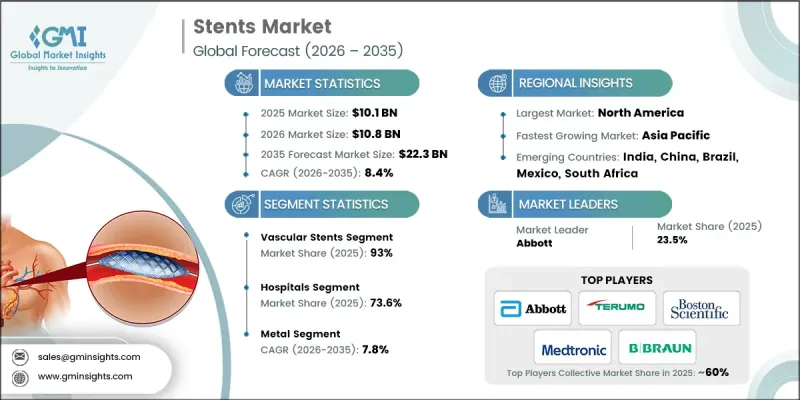
市場成長的促進因素包括心血管疾病盛行率上升、微創手術的日益普及、支架設計技術的進步以及新興地區醫療基礎設施的擴建。支架是一種小型管狀醫療設備,能夠維持狹窄或阻塞血管的通暢性,確保血流穩定並防止血管閉塞。冠狀動脈疾病、周邊動脈疾病和動脈瘤發生率的不斷上升,以及久坐不動的生活方式、不良飲食和吸煙等不良習慣,共同推動了支架治療的需求。藥物釋放型支架、生物可吸收支架和生物可分解聚合物塗層等技術創新正在改善患者預後、降低再狹窄血管再阻塞並提高手術安全性。此外,以患者為中心的解決方案、與數位醫療的融合以及智慧支架的研發也促進了市場發展,從而拓展了治療選擇,並提高了全球範圍內的支架應用。
| 市場範圍 | |
|---|---|
| 開始年份 | 2025 |
| 預測期 | 2026-2035 |
| 上市時的市場規模 | 101億美元 |
| 預測金額 | 223億美元 |
| 複合年成長率 | 8.4% |
預計到2025年,血管支架市佔率將達到93%,這主要得益於冠狀動脈疾病盛行率的上升以及對微創心血管治療需求的成長。與開胸搭橋手術相比,血管內支架置入術術因其恢復時間更短、併發症風險更低、住院時間更短而更受歡迎。心血管護理中心的擴建、技術嫻熟的專家團隊的增多以及人們對早期檢測意識的提高,尤其是在亞太地區、拉丁美洲和中東地區,都促進了血管支架的廣泛應用。
預計到2025年,醫院市場將佔據73.6%的市場佔有率,達到160億美元。由於支架植入可以縮短恢復時間、降低手術風險並提高病患處理效率,醫院擴大進行經皮冠狀動脈介入治療和血管內手術。人口老化和生活方式相關風險因素導致心血管疾病患者數量不斷增加,從而推動了心臟和周邊血管介入治療中支架需求的成長。
預計到2025年,美國支架市場規模將達35億美元。冠狀動脈和周邊動脈疾病盛行率的不斷上升,以及與老化、肥胖、高血壓和糖尿病相關的風險因素,正在推動文明病的成長。先進的醫療設施、專業的心臟中心和導管檢查室的普及,使得支架植入術得以高頻進行。此外,美國和加拿大的保險覆蓋範圍和報銷政策也鼓勵患者接受擇期手術和急診手術,進一步促進了市場成長。
目錄
第1章:調查方法
- 研究途徑
- 品質改進計劃
- GMI人工智慧政策和資料完整性計劃
- 資訊來源一致性通訊協定
- GMI人工智慧政策和資料完整性計劃
- 調查過程和可靠性評分
- 調查過程的組成部分
- 評分組成部分
- 數據收集
- 主要來源部分列表
- 資料探勘資訊來源
- 付費資訊來源
- 區域資訊來源
- 付費資訊來源
- 基本估算和計算方法
- 每種方法中基準年的計算
- 預測模型
- 量化市場影響分析
- 生長參數對預測的數學影響
- 量化市場影響分析
- 關於調查透明度的補充信息
- 資訊來源歸屬框架
- 品質保證指標
- 對信任的承諾
第2章執行摘要
第3章業界考察
- 生態系分析
- 影響產業的因素
- 促進因素
- 心血管疾病盛行率增加
- 支架技術的進步
- 微創手術增加
- 提高對早期診斷和治療的認知
- 產業潛在風險與挑戰
- 支架治療高成本
- 併發症和血管再阻塞的風險
- 市場機遇
- 生物可吸收支架和下一代支架的研發
- 在診斷領域不斷擴大數位醫療和人工智慧的應用
- 促進因素
- 成長潛力分析
- 監理情勢(基於初步調查)
- 北美洲
- 歐洲
- 亞太地區
- 科技趨勢
- 當前技術趨勢
- 新興技術
- 還款方案(基於初步調查)
- 未來市場趨勢
- 價值鏈分析
- 消費者洞察(基於初步研究)
- 波特五力分析
- PESTEL 分析
- 差距分析
第4章 競爭情勢
- 介紹
- 企業矩陣分析
- 企業市佔率分析(基於初步研究)
- 世界
- 北美洲
- 歐洲
- 亞太地區
- 競爭定位矩陣
- 主要市場公司的競爭分析
- 主要進展
- 併購
- 夥伴關係與合作
- 新產品發布
- 業務拓展計劃
第5章 市場估價與預測:依產品分類,2022-2035年
- 血管支架
- 冠狀動脈支架
- 藥物釋放型支架
- 生物可吸收血管支架(BVS)
- 裸金屬支架
- 外周支架
- 腎
- 髂骨
- 股膕窩
- 頸動脈
- 神經血管支架
- 冠狀動脈支架
- 非血管支架
第6章 市場估計與預測:依材料分類,2022-2035年
- 金屬
- 聚合物
第7章 市場估計與預測:依類型分類,2022-2035年
- 球囊擴張型
- 自膨脹
第8章 市場估算與預測:依最終用途分類,2022-2035年
- 醫院
- 門診手術中心
- 其他最終用戶
第9章 市場估計與預測:依地區分類,2022-2035年
- 北美洲
- 美國
- 加拿大
- 歐洲
- 德國
- 英國
- 法國
- 西班牙
- 義大利
- 荷蘭
- 亞太地區
- 中國
- 日本
- 印度
- 澳洲
- 韓國
- 拉丁美洲
- 巴西
- 墨西哥
- 阿根廷
- 中東和非洲
- 南非
- 沙烏地阿拉伯
- 阿拉伯聯合大公國
第10章:公司簡介
- Abbott
- B. Braun
- Becton, Dickinson and Company
- Biosensors International Group
- Biotronik
- Boston Scientific
- Elixir Medical
- Medtronic
- Meril Life Science
- MicroPort Scientific
- SLTL Group
- Stryker
- Terumo
- Veryan Medical
- WL Gore &Associates
The Global Stents Market was valued at USD 10.1 billion in 2025 and is estimated to grow at a CAGR of 8.4% to reach USD 22.3 billion by 2035.
Market growth is driven by the rising prevalence of cardiovascular diseases, increasing adoption of minimally invasive procedures, technological advancements in stent design, and expanding healthcare infrastructure in emerging regions. Stents are small, tubular medical devices that maintain the patency of narrowed or blocked blood vessels, ensuring consistent blood flow and preventing vessel collapse. The growing incidence of coronary artery disease, peripheral artery disease, and aneurysms, combined with lifestyle factors such as sedentary behavior, poor diet, and smoking, fuels demand for stent procedures. Innovations, including drug-eluting stents, bioresorbable stents, and biodegradable polymer coatings, enhance patient outcomes, reduce restenosis, and improve procedural safety. The market is further propelled by patient-centric solutions, digital health integration, and the development of smart stents, which collectively expand treatment options and adoption globally.
| Market Scope | |
|---|---|
| Start Year | 2025 |
| Forecast Year | 2026-2035 |
| Start Value | $10.1 Billion |
| Forecast Value | $22.3 Billion |
| CAGR | 8.4% |
The vascular stents segment held a share of 93% in 2025, driven by the widespread prevalence of coronary artery disease and preference for minimally invasive cardiovascular interventions. Endovascular stenting is favored over open surgical bypass due to shorter recovery times, lower complication risks, and reduced hospital stays. Expansion of cardiovascular care centers, availability of trained specialists, and growing awareness of early detection, particularly in Asia-Pacific, Latin America, and the Middle East, contribute to increasing adoption of vascular stents.
The hospitals segment accounted for 73.6% share in 2025, reaching USD 16 billion. Hospitals are increasingly performing percutaneous coronary interventions and endovascular procedures, as stent implantation shortens recovery periods, reduces procedural risks, and improves patient throughput. The rising number of patients with cardiovascular conditions due to aging populations and lifestyle-related risk factors is driving higher demand for stents in both cardiac and peripheral interventions.
U.S. Stents Market reached USD 3.5 billion in 2025. The increasing prevalence of coronary artery disease and peripheral artery disease, combined with aging demographics and lifestyle-related risks such as obesity, hypertension, and diabetes, drives procedural volumes. The presence of advanced hospitals, specialized cardiac centers, and catheterization labs facilitates high-volume stent implantation. Insurance coverage and reimbursement policies in the U.S. and Canada also encourage patients to undergo both elective and emergency procedures, further supporting market growth.
Prominent players in the Global Stents Market include Abbott, Medtronic, Boston Scientific, Biotronik, MicroPort Scientific, Stryker, W.L Gore & Associates, B. Braun, Biosensors International Group, Terumo, Veryan Medical, Elixir Medical, Johnson & Johnson, and SLTL Group. Companies in the Global Stents Market strengthen their presence by focusing on continuous research and development to improve stent design, durability, and safety features. They are expanding production capacities, forming strategic partnerships with hospitals and healthcare providers, and entering emerging markets to reach underserved populations. Firms emphasize minimally invasive and patient-specific solutions, integrate digital health technologies with smart stents, and launch drug-eluting and bioresorbable products to enhance clinical outcomes. Marketing initiatives, training programs for clinicians, and collaborations with key cardiovascular centers help companies build brand trust, drive adoption, and maintain a competitive edge in the global market.
Table of Contents
Chapter 1 Research Methodology
- 1.1 Research approach
- 1.2 Quality commitments
- 1.2.1 GMI AI policy & data integrity commitment
- 1.2.1.1 Source consistency protocol
- 1.2.1 GMI AI policy & data integrity commitment
- 1.3 Research trail & confidence scoring
- 1.3.1 Research trail components
- 1.3.2 Scoring components
- 1.4 Data collection
- 1.4.1 Partial list of primary sources
- 1.5 Data mining sources
- 1.5.1 Paid sources
- 1.5.1.1 Sources, by region
- 1.5.1 Paid sources
- 1.6 Base estimates and calculations
- 1.6.1 Base year calculation for any one approach
- 1.7 Forecast model
- 1.7.1 Quantified market impact analysis
- 1.7.1.1 Mathematical impact of growth parameters on forecast
- 1.7.1 Quantified market impact analysis
- 1.8 Research transparency addendum
- 1.8.1 Source attribution framework
- 1.8.2 Quality assurance metrics
- 1.8.3 Our commitment to trust
Chapter 2 Executive Summary
- 2.1 Industry 3600 synopsis
- 2.2 Key market trends
- 2.2.1 Regional trends
- 2.2.2 Product trends
- 2.2.3 Material trends
- 2.2.4 Type trends
- 2.2.5 End use trends
- 2.3 CXO perspectives: Strategic imperatives
Chapter 3 Industry Insights
- 3.1 Industry ecosystem analysis
- 3.2 Industry impact forces
- 3.2.1 Growth drivers
- 3.2.1.1 Rising prevalence of cardiovascular diseases
- 3.2.1.2 Advancements in stent technology
- 3.2.1.3 Increasing number of minimally invasive procedures
- 3.2.1.4 Growing awareness about early diagnosis and treatment
- 3.2.2 Industry pitfalls and challenges
- 3.2.2.1 High cost of stent procedures
- 3.2.2.2 Risk of complications and restenosis
- 3.2.3 Market opportunities
- 3.2.3.1 Development of bioresorbable and next-gen stents
- 3.2.3.2 Increasing adoption of digital health and AI in diagnostics
- 3.2.1 Growth drivers
- 3.3 Growth potential analysis
- 3.4 Regulatory landscape (Driven by primary research)
- 3.4.1 North America
- 3.4.2 Europe
- 3.4.3 Asia Pacific
- 3.5 Technology landscape
- 3.5.1 Current technological trends
- 3.5.2 Emerging technologies
- 3.6 Reimbursement scenario (Driven by primary research)
- 3.7 Future market trends
- 3.8 Value chain analysis
- 3.9 Consumer insights (Driven by primary research)
- 3.10 Porter's analysis
- 3.11 PESTEL analysis
- 3.12 Gap analysis
Chapter 4 Competitive Landscape, 2025
- 4.1 Introduction
- 4.2 Company matrix analysis
- 4.3 Company market share analysis (Driven by primary research)
- 4.3.1 Global
- 4.3.2 North America
- 4.3.3 Europe
- 4.3.4 Asia Pacific
- 4.4 Competitive positioning matrix
- 4.5 Competitive analysis of major market players
- 4.6 Key developments
- 4.6.1 Mergers & acquisitions
- 4.6.2 Partnerships & collaborations
- 4.6.3 New product launches
- 4.6.4 Expansion plans
Chapter 5 Market Estimates and Forecast, By Product, 2022 - 2035 ($ Mn)
- 5.1 Key trends
- 5.2 Vascular stents
- 5.2.1 Coronary stents
- 5.2.1.1 Drug eluting stent
- 5.2.1.2 Bioresorbable vascular scaffold (BVS)
- 5.2.1.3 Bare metal stent
- 5.2.2 Peripheral stents
- 5.2.2.1 Renal
- 5.2.2.2 Iliac
- 5.2.2.3 Femoral-popliteal
- 5.2.2.4 Carotid
- 5.2.3 Neurovascular stents
- 5.2.1 Coronary stents
- 5.3 Non-vascular stents
Chapter 6 Market Estimates and Forecast, By Material, 2022 - 2035 ($ Mn)
- 6.1 Key trends
- 6.2 Metal
- 6.3 Polymer
Chapter 7 Market Estimates and Forecast, By Type, 2022 - 2035 ($ Mn)
- 7.1 Key trends
- 7.2 Balloon expandable
- 7.3 Self expandable
Chapter 8 Market Estimates and Forecast, By End Use, 2022 - 2035 ($ Mn)
- 8.1 Key trends
- 8.2 Hospitals
- 8.3 Ambulatory surgical centers
- 8.4 Other end users
Chapter 9 Market Estimates and Forecast, By Region, 2022 - 2035 ($ Mn)
- 9.1 Key trends
- 9.2 North America
- 9.2.1 U.S.
- 9.2.2 Canada
- 9.3 Europe
- 9.3.1 Germany
- 9.3.2 UK
- 9.3.3 France
- 9.3.4 Spain
- 9.3.5 Italy
- 9.3.6 Netherlands
- 9.4 Asia Pacific
- 9.4.1 China
- 9.4.2 Japan
- 9.4.3 India
- 9.4.4 Australia
- 9.4.5 South Korea
- 9.5 Latin America
- 9.5.1 Brazil
- 9.5.2 Mexico
- 9.5.3 Argentina
- 9.6 Middle East and Africa
- 9.6.1 South Africa
- 9.6.2 Saudi Arabia
- 9.6.3 UAE
Chapter 10 Company Profiles
- 10.1 Abbott
- 10.2 B. Braun
- 10.3 Becton, Dickinson and Company
- 10.4 Biosensors International Group
- 10.5 Biotronik
- 10.6 Boston Scientific
- 10.7 Elixir Medical
- 10.8 Medtronic
- 10.9 Meril Life Science
- 10.10 MicroPort Scientific
- 10.11 SLTL Group
- 10.12 Stryker
- 10.13 Terumo
- 10.14 Veryan Medical
- 10.15 W.L Gore & Associates

 全球自膨式覆膜支架市場規模、佔有率、趨勢和成長分析報告(2026-2034)
 血管支架市場:全球市場按產品類型、材質、輸送系統、應用和最終用戶分類的預測——2026-2032年支架市場:2026-2032年全球市場預測(依產品類型、材料、輸送方式、應用及最終用戶分類)
 自膨式覆膜支架市場規模、佔有率和趨勢分析報告:按解剖部位、適應症、材料和細分市場分類(2026-2033 年)覆膜支架市場規模、佔有率和趨勢分析報告:按器材類型、解剖部位、地區和細分市場預測(2026-2033 年)
 血管支架市場報告:按產品類型、材料、輸送方式、最終用戶和地區分類(2026-2034 年)
 胃腸道支架市場報告:趨勢、預測和競爭分析(至2035年)裸金屬支架市場:按類型、材質、長度、應用和最終用戶分類-2026-2032年全球市場預測頸動脈支架市場:依產品類型、材料、輸送方式、最終用戶和通路分類-2026-2032年全球市場預測
 獸用支架市場機會、成長要素、產業趨勢分析及2026-2035年預測