


 |
市場調查報告書
商品編碼
1982348
摩托車配件市場:商機、成長要素、產業趨勢分析及2026-2035年預測Motorcycle Accessories Market Opportunity, Growth Drivers, Industry Trend Analysis, and Forecast 2026 - 2035 |
||||||

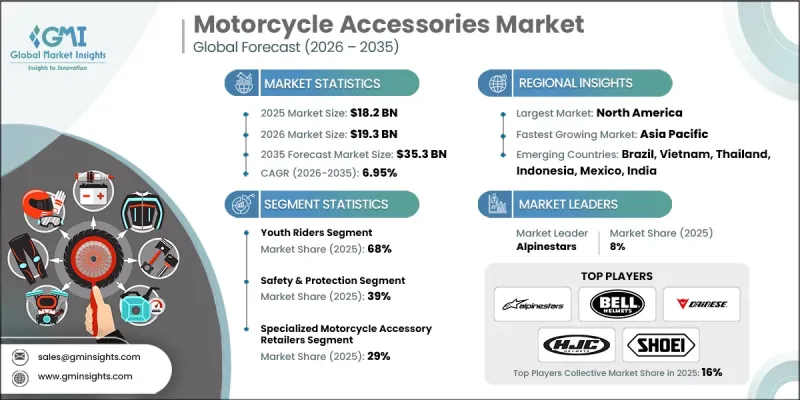
2025 年全球摩托車配件市場價值 182 億美元,預計到 2035 年將達到 353 億美元,年複合成長率為 6.95%。
摩托車配件顯著提升了不同摩托車類型的騎乘安全性、車輛性能、舒適性和美觀性。這些產品直接影響騎乘品質、設備耐用性、個人化客製選項以及尖端技術的整合。製造商正致力於研發高性能安全裝備、互聯電子設備和高階客製化產品,以滿足不斷變化的騎乘者需求。隨著消費者偏好的演變,各大品牌紛紛引入先進材料、符合人體工學的設計以及整合數位功能,以提升安全性和騎乘效率。全球摩托車保有量的成長、可支配收入的增加以及人們對休閒日益成長的興趣,都進一步推動了市場需求。個人化文化的盛行,以及長途旅行和探險旅行參與度的提高,持續推動市場的發展。此外,數位化零售通路的拓展擴大了產品供應範圍,使騎乘者能夠更有效率地比較不同產品的功能、價格和品牌。在持續創新和生活方式主導的需求推動下,摩托車配件正逐漸成為更廣泛的強力運動生態系統中不可或缺的一部分。
| 市場範圍 | |
|---|---|
| 開始年份 | 2025 |
| 預測期 | 2026-2035 |
| 上市時的市場規模 | 182億美元 |
| 預測金額 | 353億美元 |
| 複合年成長率 | 6.95% |
該市場涵蓋多種產品系列,包括防護頭盔、專業騎行服、儲物系統、煞車部件、照明系統、性能提升部件、通訊工具和防盜解決方案。原廠配套 (OEM) 產品和售後市場產品均對總銷售額貢獻顯著。技術進步正在推動智慧頭盔、無線連接系統、導航設備、先進照明技術和性能提升部件的普及應用。這些創新提升了整體騎乘體驗,增強了騎士的感知能力、連接性和運作可靠性。
預計到2025年,年輕騎士群將佔據68%的市場佔有率,並在2026年至2035年間以7.1%的複合年成長率成長。由於年輕騎士積極的騎乘習慣和對創新產品的接受度,他們在摩托車配件消費中佔據了很大比例。受數位媒體趨勢和社區參與的影響,這群人對個人化和高級功能表現出濃厚的興趣。可支配收入的成長和對摩托車文化的熱情持續推動著這個細分市場的穩定消費。
預計到2025年,安全防護類產品將佔據39%的市場佔有率,複合年成長率達7%。此細分市場涵蓋專為最大限度降低受傷風險和提升騎乘者在各種路況下的安全而設計的裝備。人們對道路安全標準的日益重視、監管措施的支持以及全球摩托車市場的不斷擴張,都在推動對防護配件的需求。
美國摩托車配件市場預計在2026年至2035年間以6.3%的複合年成長率成長。消費者對高階騎乘裝備的強勁需求、成熟的摩托車社群以及日益成長的旅行和探險騎行參與度,都將持續推動市場擴張。在美國營運的品牌正透過推出多層防護系統、空氣動力學最佳化頭盔以及適用於各種騎乘環境的連網配件,不斷提升自身的技術實力。
目錄
第1章:調查方法
第2章執行摘要
第3章業界考察
- 生態系分析
- 供應商情況
- 利潤率分析
- 成本結構
- 每個階段增加的價值
- 影響價值鏈的因素
- 中斷
- 影響產業的因素
- 促進因素
- 全球摩托車銷售和擁有量增加
- 人們越來越關注騎行者的安全和保護。
- 可支配所得和個人消費的增加
- 摩托車旅遊和探險騎行的激增
- 電子商務和線上分銷管道的成長
- 客製化和個人化趨勢
- 產業潛在風險與挑戰
- 仿冒品仿冒品
- 奢華配件高成本
- 成熟市場摩托車銷量下降
- 複雜的監管和認證要求
- 市場機遇
- 電動汽車摩托車配件市場不斷擴大
- 智慧互聯配件的開發
- 滲透新興市場
- 訂閱式配件服務的成長
- 永續環保產品的創新
- 電動自行車市場發展迅速,需要對車架進行加固。
- 促進因素
- 成長潛力分析
- 監理情勢
- 北美洲
- 美國 - 摩托車配件安全法規
- 加拿大 - 安全合規框架
- 歐洲
- 德國 - 技術和品質認證標準
- 英國—脫歐後的合規要求
- 法國 - 行動安全認證
- 義大利—工業和交通運輸整合標準
- 亞太地區
- 中國—汽車零件製造法規
- 印度 - 產品認證及符合安全標準
- 日本-先進的安全與品管標準
- 澳洲 - 消費者保護和產品品質標準
- 拉丁美洲
- 墨西哥 - 道路安全配件標準
- 阿根廷 - 交通安全法規
- 中東和非洲
- 南非-遵守道路交通安全法規
- 沙烏地阿拉伯 - 出行安全措施
- 北美洲
- 波特的分析
- PESTEL 分析
- 科技與創新趨勢
- 當前技術趨勢
- 感測器技術的發展(攝影機、LiDAR、雷達、超音波)
- 整合感測器融合
- 人工智慧和機器學習在行人偵測的應用
- 新興技術
- V2X 通訊可提高偵測能力
- 夜間和弱光偵測技術
- 當前技術趨勢
- 專利趨勢(基於初步調查)
- 投資與資金籌措分析
- 創投創業投資
- 主要企業在研發方面的投資
- 價格分析(基於初步調查)
- 對過去價格趨勢的分析
- 按業務類型分類的定價策略
- 貿易數據分析(基於初步調查)
- 進出口量及進口額趨勢
- 主要貿易路線及關稅的影響
- 人工智慧和生成式人工智慧對市場的影響(基於初步研究)
- 利用人工智慧改造現有經營模式
- GenAI 各細分市場的應用案例與部署藍圖
- 風險、局限性和監管考量
- 使用案例和成功案例
- 案例研究
- 永續性和環境方面
- 永續計劃
- 減少廢棄物策略
- 生產中的能源效率
- 環保意識的舉措
- 關於碳足跡的考量
- 生產能力和生產趨勢(基於初步調查)
- 按地區和主要生產商分類的設備產能
- 運轉率和擴張計劃
- 預測假設和情境分析(基於初步研究)
- 基本案例-驅動複合年成長率的關鍵宏觀經濟與產業變量
- 看漲情景-向上修正的前提條件與觸發條件
- 看跌情景-下調的假設與風險因素
- 敏感度分析-最容易預測的變數。
第4章 競爭情勢
- 介紹
- 企業市佔率分析
- 北美洲
- 歐洲
- 亞太地區
- 拉丁美洲
- 中東和非洲(MEA)
- 主要市場公司的競爭分析
- 競爭定位矩陣
- 戰略展望矩陣
- 主要進展
- 併購
- 夥伴關係和聯盟
- 新產品發布
- 業務拓展計劃及資金籌措
- 企業級分層基準測試
- 層級分類標準與選擇標準
- 按收入、地區和創新能力分類的層級定位矩陣。
第5章 市場估價與預測:依產品分類,2022-2035年
- 安全設備
- 防護裝備
- 性能部件
- 加工配件
- 行李箱和儲物用品
- 電子配件
- 服飾及相關產品
- 保養和護理產品
- 舒適和便利
第6章 市場估價與預測:依車輛類型分類,2022-2035年
- 巡洋艦
- 運動摩托車
- 標準型/通勤自行車
- 越野/探險摩托車
- Scooter
第7章 市場估算與預測:LiDAR年齡層,2022-2035年
- 年輕騎手
- 成人騎士
- 高級騎士
第8章 市場估算與預測:依銷售管道分類,2022-2035年
- 摩托車配件專賣店
- 授權零售商
- 線上/電子商務平台
- 獨立零售店
- 超級市場和大賣場
第9章 市場估計與預測:依應用領域分類,2022-2035年
- 安全/防護
- 性能提升
- 舒適和便利
- 風格和外觀客製化
第10章 市場估價與預測:依地區分類,2022-2035年
- 北美洲
- 美國
- 加拿大
- 歐洲
- 德國
- 英國
- 法國
- 義大利
- 西班牙
- 俄羅斯
- 荷蘭
- 瑞典
- 丹麥
- 波蘭
- 亞太地區
- 中國
- 印度
- 日本
- 澳洲
- 韓國
- 新加坡
- 泰國
- 印尼
- 越南
- 拉丁美洲
- 巴西
- 墨西哥
- 阿根廷
- 哥倫比亞
- 中東和非洲(MEA)
- 南非
- 沙烏地阿拉伯
- 阿拉伯聯合大公國
- 以色列
第11章:公司簡介
- 世界公司
- Alpinestars
- Bell Helmets
- Brembo
- Cardo
- Fox Racing
- Garmin
- Givi
- GoPro
- Icon
- Shoei
- 本地球員
- Airhawk
- Arlen Ness
- Corbin
- Dynojet
- Kryptonite
- Nelson-Rigg
- Roland Sands Design(RSD)
- Saddlemen
- Speed and Strength
- 新興企業和技術基礎設施公司
- Xena
The Global Motorcycle Accessories Market was valued at USD 18.2 billion in 2025 and is estimated to grow at a CAGR of 6.95% to reach USD 35.3 billion by 2035.
Motorcycle accessories significantly enhance rider safety, vehicle performance, comfort, and visual appeal across multiple bike categories. These products directly influence riding quality, equipment durability, personalization options, and integration of modern technology. Manufacturers are placing strong emphasis on high-performance safety equipment, connected electronics, and premium customization offerings to align with shifting rider expectations. As consumer preferences evolve, brands are introducing advanced materials, ergonomic designs, and integrated digital features that improve protection and riding efficiency. Expanding global motorcycle ownership, rising disposable income levels, and growing interest in recreational riding are further supporting demand. The market continues to benefit from increasing participation in long-distance touring and adventure-oriented travel, alongside a strong culture of personalization. Additionally, digital retail channels are broadening product access, enabling riders to compare features, pricing, and brands more efficiently. Continuous innovation and lifestyle-driven demand are positioning motorcycle accessories as a critical component of the broader powersports ecosystem.
| Market Scope | |
|---|---|
| Start Year | 2025 |
| Forecast Year | 2026-2035 |
| Start Value | $18.2 Billion |
| Forecast Value | $35.3 Billion |
| CAGR | 6.95% |
The market spans a diverse product portfolio, including protective headgear, technical riding apparel, storage systems, braking components, illumination systems, performance upgrades, communication tools, and anti-theft solutions. Both original equipment manufacturer offerings and aftermarket products contribute substantially to overall revenue. Technological progress is driving the adoption of intelligent headgear, wireless connectivity systems, navigation-enabled devices, advanced lighting technologies, and performance-enhancing components. These innovations improve rider awareness, connectivity, and operational reliability while enhancing overall riding functionality.
The youth riders segment accounted for 68% share in 2025 and is forecast to grow at a CAGR of 7.1% between 2026 and 2035. Younger riders represent a significant portion of accessory spending, supported by active riding habits and openness to innovation. This demographic demonstrates a strong interest in personalization and advanced features, often influenced by digital media trends and community engagement. Higher discretionary income and enthusiasm for motorcycling culture continue to drive consistent purchasing within this segment.
The safety and protection category held 39% share in 2025 and is expanding at a CAGR of 7%. This segment includes gear specifically designed to minimize injury risk and improve rider security in various conditions. Increasing awareness regarding road safety standards, supportive regulatory measures, and rising global two-wheeler adoption are reinforcing demand for protective accessories.
United States Motorcycle Accessories Market is projected to grow at a CAGR of 6.3% from 2026 to 2035. Strong consumer demand for premium riding equipment, a well-established motorcycling community, and growing participation in touring and adventure riding continue to support expansion. Brands operating in the U.S. are advancing engineering capabilities by introducing multi-layer protective systems, aerodynamically optimized headgear, and connectivity-enabled accessories suited for diverse riding environments.
Key players operating in the Global Motorcycle Accessories Market include Shoei, Alpinestars, Brembo, Cardo, Givi, Fox Racing, Garmin, Bell Helmets, Icon, and GoPro. These companies compete through innovation in safety engineering, material technology, performance optimization, and digital integration. Companies in the Motorcycle Accessories Market are strengthening their competitive position by investing in advanced protective technologies, lightweight materials, and smart connectivity features. Many brands are expanding premium product lines while maintaining accessible pricing tiers to reach diverse rider segments. Strategic collaborations with motorcycle manufacturers and motorsport communities enhance product credibility and brand visibility. Firms are also leveraging e-commerce growth, direct-to-consumer platforms, and data-driven marketing to increase global reach. Continuous research into aerodynamics, impact resistance, and wearable technology improves product differentiation.
Table of Contents
Chapter 1 Methodology
- 1.1 Research approach
- 1.2 Quality commitments
- 1.3 Research trail and confidence scoring
- 1.3.1 Research trail components
- 1.3.2 Scoring components
- 1.4 Data collection
- 1.4.1 Partial list of primary sources
- 1.5 Data mining sources
- 1.5.1 Paid sources
- 1.6 Best estimates and calculations
- 1.6.1 Base year calculation for any one approach
- 1.7 Forecast model
- 1.8 Research transparency addendum
Chapter 2 Executive Summary
- 2.1 Industry 360° synopsis, 2022 - 2035
- 2.2 Key market trends
- 2.2.1 Regional
- 2.2.2 Product
- 2.2.3 Vehicle
- 2.2.4 Rider Age
- 2.2.5 Sales Channel
- 2.2.6 Usage
- 2.3 TAM Analysis, 2026-2035
- 2.4 CXO perspectives: Strategic imperatives
Chapter 3 Industry Insights
- 3.1 Industry ecosystem analysis
- 3.1.1 Supplier landscape
- 3.1.2 Profit margin analysis
- 3.1.3 Cost structure
- 3.1.4 Value addition at each stage
- 3.1.5 Factor affecting the value chain
- 3.1.6 Disruptions
- 3.2 Industry impact forces
- 3.2.1 Growth drivers
- 3.2.1.1 Rising global motorcycle sales and ownership
- 3.2.1.2 Growing emphasis on rider safety and protection
- 3.2.1.3 Increasing disposable income and consumer spending
- 3.2.1.4 Surge in motorcycle tourism and adventure riding
- 3.2.1.5 Growth of e-commerce and online distribution channels
- 3.2.1.6 Rising trends in customization and personalization
- 3.2.2 Industry pitfalls and challenges
- 3.2.2.1 Availability of counterfeit and low-quality products
- 3.2.2.2 High cost of premium accessories
- 3.2.2.3 Declining motorcycle sales in mature markets
- 3.2.2.4 Complex regulatory and certification requirements
- 3.2.3 Market opportunities
- 3.2.3.1 Expansion of the electric motorcycle accessories market
- 3.2.3.2 Development of smart and connected accessories
- 3.2.3.3 Penetration into emerging markets
- 3.2.3.4 Growth of subscription-based accessory services
- 3.2.3.5 Innovation in sustainable and eco-friendly products
- 3.2.3.6 Growing e-bike segment requiring reinforced frames.
- 3.2.1 Growth drivers
- 3.3 Growth potential analysis
- 3.4 Regulatory landscape
- 3.4.1 North America
- 3.4.1.1 US- Motorcycle accessory safety regulations
- 3.4.1.2 Canada - Safety compliance framework
- 3.4.2 Europe
- 3.4.2.1 Germany- Technical and quality certification standards
- 3.4.2.2 UK- Post-Brexit compliance requirements
- 3.4.2.3 France- Mobility safety certification
- 3.4.2.4 Italy- Industrial and mobility integration standards
- 3.4.3 Asia Pacific
- 3.4.3.1 China- Manufacturing and vehicle accessory regulations
- 3.4.3.2 India- Product certification and safety compliance
- 3.4.3.3 Japan- Advanced safety quality control standards
- 3.4.3.4 Australia- Consumer protection and product quality norms
- 3.4.4 LATAM
- 3.4.4.1 Mexico- Road safety accessory standards
- 3.4.4.2 Argentina- Traffic safety regulation
- 3.4.5 MEA
- 3.4.5.1 South Africa- Road safety compliance
- 3.4.5.2 Saudi Arabia- Mobility safety initiatives
- 3.4.1 North America
- 3.5 Porter’s analysis
- 3.6 PESTEL analysis
- 3.7 Technology and innovation landscape
- 3.7.1 Current technological trends
- 3.7.1.1 Sensor technology evolution (camera, LiDAR, RADAR, ultrasonic)
- 3.7.1.2 Sensor fusion & integration
- 3.7.1.3 AI & machine learning in pedestrian detection
- 3.7.2 Emerging technologies
- 3.7.2.1 V2X communication for enhanced detection
- 3.7.2.2 Nighttime & low-light detection technologies
- 3.7.1 Current technological trends
- 3.8 Patent landscape (Driven by Primary Research)
- 3.8.1 Investment and funding analysis
- 3.8.2 Venture capital investment trends
- 3.8.3 R&D investment by key players
- 3.9 Price analysis (Driven by Primary Research)
- 3.9.1 Historical price trend analysis
- 3.9.2 Pricing strategy by player type
- 3.10 Trade data analysis (Driven by Primary Research)
- 3.10.1 Import/export volume and value trends
- 3.10.2 Key trade corridors and tariff impact
- 3.11 Impact of AI and generative AI on the market (Driven by Primary Research)
- 3.11.1 AI-driven disruption of existing business models
- 3.11.2 GenAI use cases and adoption roadmap by segment
- 3.11.3 Risks, limitations and regulatory considerations
- 3.12 Use cases & success stories
- 3.13 Case studies
- 3.14 Sustainability and environmental aspects
- 3.14.1 Sustainable practices
- 3.14.2 Waste reduction strategies
- 3.14.3 Energy efficiency in production
- 3.14.4 Eco-friendly Initiatives
- 3.14.5 Carbon footprint considerations
- 3.15 Capacity & production landscape (Driven by Primary Research)
- 3.15.1 Installed capacity by region & key producer
- 3.15.2 Capacity utilization rates & expansion pipelines
- 3.16 Forecast assumptions & scenario analysis (Driven by Primary Research)
- 3.16.1 Base Case - key macro & industry variables driving CAGR
- 3.16.2 Bull Scenario - upside assumptions & trigger conditions
- 3.16.3 Bear Scenario - downside assumptions & risk factors
- 3.16.4 Sensitivity Analysis - variables the forecast is most sensitive to
Chapter 4 Competitive Landscape, 2025
- 4.1 Introduction
- 4.2 Company market share analysis
- 4.2.1 North America
- 4.2.2 Europe
- 4.2.3 Asia Pacific
- 4.2.4 LATAM
- 4.2.5 MEA
- 4.3 Competitive analysis of major market players
- 4.4 Competitive positioning matrix
- 4.5 Strategic outlook matrix
- 4.6 Key developments
- 4.6.1 Mergers & acquisitions
- 4.6.2 Partnerships & collaborations
- 4.6.3 New product launches
- 4.6.4 Expansion plans and funding
- 4.7 Company tier benchmarking
- 4.7.1 Tier classification criteria and qualifying thresholds
- 4.7.2 Tier positioning matrix by revenue, geography, and innovation
Chapter 5 Market Estimates & Forecast, By Product, 2022 - 2035 ($Bn, Units)
- 5.1 Key trends
- 5.2 Safety gear
- 5.3 Protective gear
- 5.4 Performance parts
- 5.5 Customization accessories
- 5.6 Luggage and storage
- 5.7 Electronic accessories
- 5.8 Apparel and merchandise
- 5.9 Maintenance and care products
- 5.10 Comfort and convenience
Chapter 6 Market Estimates & Forecast, By Vehicles, 2022 - 2035 ($Bn, Units)
- 6.1 Key trends
- 6.2 Cruiser
- 6.3 Sports bike
- 6.4 Standard/commuter bike
- 6.5 Off-road/adventure bike
- 6.6 Scooters
Chapter 7 Market Estimates & Forecast, By Rider Age, 2022 - 2035 ($Bn, Units)
- 7.1 Key trends
- 7.2 Youth Riders
- 7.3 Adult Riders
- 7.4 Senior Riders
Chapter 8 Market Estimates & Forecast, By Sales Channel, 2022 - 2035 ($Bn, Units)
- 8.1 Key trends
- 8.2 Specialized motorcycle accessory retailers
- 8.3 Authorized dealerships
- 8.4 Online/e-commerce platforms
- 8.5 Independent outlets
- 8.6 Supermarkets & hypermarkets
Chapter 9 Market Estimates & Forecast, By Usage, 2022 - 2035 ($Bn, Units)
- 9.1 Key trends
- 9.2 Safety & protection
- 9.3 Performance enhancement
- 9.4 Comfort & convenience
- 9.5 Style & aesthetic customization
Chapter 10 Market Estimates & Forecast, By Region, 2022 - 2035 ($Bn, Units)
- 10.1 Key trends
- 10.2 North America
- 10.2.1 US
- 10.2.2 Canada
- 10.3 Europe
- 10.3.1 Germany
- 10.3.2 UK
- 10.3.3 France
- 10.3.4 Italy
- 10.3.5 Spain
- 10.3.6 Russia
- 10.3.7 Netherlands
- 10.3.8 Sweden
- 10.3.9 Denmark
- 10.3.10 Poland
- 10.4 Asia Pacific
- 10.4.1 China
- 10.4.2 India
- 10.4.3 Japan
- 10.4.4 Australia
- 10.4.5 South Korea
- 10.4.6 Singapore
- 10.4.7 Thailand
- 10.4.8 Indonesia
- 10.4.9 Vietnam
- 10.5 Latin America
- 10.5.1 Brazil
- 10.5.2 Mexico
- 10.5.3 Argentina
- 10.5.4 Colombia
- 10.6 MEA
- 10.6.1 South Africa
- 10.6.2 Saudi Arabia
- 10.6.3 UAE
- 10.6.4 Israel
Chapter 11 Company Profiles
- 11.1 Global Players
- 11.1.1 Alpinestars
- 11.1.2 Bell Helmets
- 11.1.3 Brembo
- 11.1.4 Cardo
- 11.1.5 Fox Racing
- 11.1.6 Garmin
- 11.1.7 Givi
- 11.1.8 GoPro
- 11.1.9 Icon
- 11.1.10 Shoei
- 11.2 Regional Players
- 11.2.1 Airhawk
- 11.2.2 Arlen Ness
- 11.2.3 Corbin
- 11.2.4 Dynojet
- 11.2.5 Kryptonite
- 11.2.6 Nelson-Rigg
- 11.2.7 Roland Sands Design (RSD)
- 11.2.8 Saddlemen
- 11.2.9 Speed and Strength
- 11.3 Emerging Players & Technology Enablers
- 11.3.1 Xena

 摩托車配件市場-2026-2032年全球市場預測
 摩托車配件市場分析與預測(至2035年):按類型、產品、服務、技術、組件、應用、材料類型、最終用戶和安裝方式分類
 2026-2030年全球摩托車騎乘配件市場摩托車零件及配件市場:按產品類型、摩托車類型、安裝類型、銷售管道和最終用戶分類-2026-2032年全球預測摩托車配件市場按產品類型、車輛類型、應用、分銷管道和最終用戶分類,全球預測(2026-2032年)
 摩托車頂箱市場機會、成長動力、產業趨勢分析及 2025 - 2034 年預測
 全球機車零件及配件市場全球摩托車配件市場
 2024-2028年全球摩托車配件市場