

 |
市場調查報告書
商品編碼
1982287
2026 年至 2035 年含維生素 C護膚品的市場機會、成長要素、產業趨勢與預測。Vitamin C Based Skincare Product Market Opportunity, Growth Drivers, Industry Trend Analysis, and Forecast 2026 - 2035 |
||||||

2025年全球含維生素C護膚品市場價值47億美元,預計2035年將以10.3%的複合年成長率成長至124億美元。
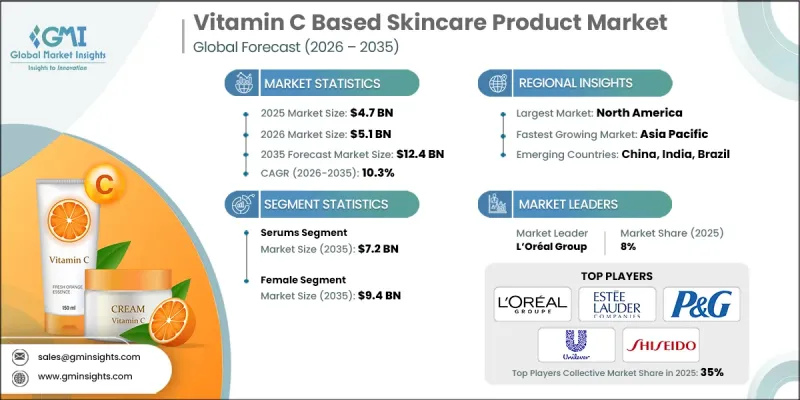
產業成長的驅動力在於消費者對兼具清潔形象和臨床驗證功效的高效配方產品的強烈偏好。消費者越來越重視經證實的亮白、均勻膚色和抗衰老功效,這推動了臉部保養品類的持續需求。社群媒體主導的產品發現通路的快速擴張、藥妝店主導的皮膚護理產品分銷管道的成長,以及老牌美容產品製造商不斷豐富產品系列併推出涵蓋不同價位的穩定衍生產品,進一步鞏固了這一成長勢頭。主要企業之間的策略整合和投資活動正在加速配方技術、保護性包裝解決方案和全通路分銷網路的創新。儘管北美和歐洲市場仍是成熟的收入來源,但亞太地區憑藉著不斷提升的護膚意識和優質化趨勢,正成為強勁的成長引擎。在整個品類中,消費者正從基礎護膚轉向旨在顯著改善和維持整體膚質的高效護膚系統。
| 市場範圍 | |
|---|---|
| 開始年份 | 2025 |
| 預測期 | 2026-2035 |
| 上市時的市場規模 | 47億美元 |
| 預計金額 | 124億美元 |
| 複合年成長率 | 10.3% |
傳統的低濃度美白霜正逐漸被更先進的維生素C複合物所取代,這些複合物旨在提供更高的穩定性和更佳的功效。最新的配方融合了高純度左旋維生素C以及新一代衍生物,旨在增強其相容性和持久性。這些系統通常與互補的抗氧化劑和屏障支持成分相結合,以最佳化功效並延長使用壽命。諸如微囊包裹、無水配方、精確控制的pH環境以及保護性包裝等技術進步有助於抑制氧化並保持產品品質。輕盈的液體、快速吸收的濃縮液和細膩的乳霜質地進一步提升了用戶體驗,同時保留了活性成分並最大限度地減少了皮膚刺激。
預計到2025年,精華液市場規模將達27億美元,2035年將達72億美元。這個細分市場之所以能推動整體需求成長,是因為濃縮型產品能夠快速吸收,顯著改善肌膚光澤、均勻膚色,並增強肌膚抵禦環境壓力的能力。消費者之所以青睞精華液,是因為與傳統乳霜相比,精華液更容易疊加使用,而且能夠更快地帶來可見的效果。
預計到2025年,女性消費者市場規模將達到36億美元,佔總市場佔有率的76%,並預計在2035年達到94億美元。由於女性對改善膚色和預防性護膚策略的意識較高,她們仍然是維生素C護膚品的主要使用者。在多步驟的美容護膚流程中,維生素C護理通常被視為基本步驟,特別適用於解決色素沉澱和長期皮膚彈性問題。
美國維生素C護膚市場預計到2025年將達到15億美元,到2035年將達到45億美元。在消費者信賴皮膚科醫生推薦產品、成熟的數位化零售生態系統以及強大的藥房分銷管道的推動下,美國市場持續穩定成長。消費者尤其青睞高效穩定的維生素C產品,這類產品旨在平衡功效和皮膚刺激性,進一步鞏固了美國在全球市場的主導地位。
目錄
第1章:調查方法和範圍
第2章執行摘要
第3章業界考察
- 生態系分析
- 供應商情況
- 利潤率
- 每個階段增加的價值
- 影響價值鏈的因素
- 影響產業的因素
- 促進因素
- 臨床級美白溶液的應用日益普及
- 清潔美容運動和成分透明度
- 皮膚科和專業護膚的效果
- 產業潛在風險與挑戰
- 維生素C的不穩定性及氧化
- 對刺激和致敏的擔憂
- 機會
- 多活性和混合配方的興起
- 亞太地區「美白護膚」文化的興起
- 促進因素
- 成長潛力分析
- 未來市場趨勢
- 科技與創新趨勢
- 當前技術趨勢
- 新興技術
- 價格趨勢
- 按地區
- 依產品
- 監理情勢
- 標準和合規要求
- 區域法規結構
- 認證標準
- 波特五力分析
- PESTEL 分析
- 貿易數據分析
- 進出口量及進口額趨勢
- 主要貿易走廊及關稅的影響
- 人工智慧和生成式人工智慧對市場的影響
- 利用人工智慧改造現有經營模式
- 預測分析在產品開發的應用
第4章 競爭情勢
- 介紹
- 企業市佔率分析
- 按地區
- 企業矩陣分析
- 主要市場公司的競爭分析
- 競爭定位矩陣
- 主要進展
- 併購
- 夥伴關係與合作
- 新產品發布
- 業務拓展計劃
第5章 市場估價與預測:依產品分類,2022-2035年
- 美容精華液
- 乳霜和保濕霜
- 安瓿濃縮液
- 眼科治療
- 面膜治療
- 其他
第6章 市場估計與預測:依維生素C衍生物分類,2022-2035年
- L-抗壞血酸(純產品)
- 抗壞血酸葡糖苷
- 乙基抗壞血酸
- SAP/MAP
- THD/四異棕櫚酸
- 其他
第7章 市場估計與預測:依價格區間分類,2022-2035年
第8章 主要趨勢
- 大眾市場(10-40美元)
- 高級版(40-150 美元)
- 奢侈品(超過 150 美元)
第9章 市場估計與預測:性別,2022-2035年
- 男性
- 女士
第10章 市場估價與預測:依通路分類,2022-2035年
- 線上
- 電子商務
- 企業網站
- 離線
- 大賣場和超級市場
- 藥房/皮膚化妝品
- 專賣店
- 其他(直銷、美容院、水療中心、免稅店)
第11章 市場估價與預測:按地區分類,2022-2035年
- 北美洲
- 美國
- 加拿大
- 歐洲
- 德國
- 英國
- 法國
- 義大利
- 西班牙
- 亞太地區
- 中國
- 日本
- 印度
- 澳洲
- 韓國
- 拉丁美洲
- 巴西
- 墨西哥
- 阿根廷
- 中東和非洲
- 南非
- 沙烏地阿拉伯
- 阿拉伯聯合大公國
第12章:公司簡介
- Amorepacific Corporation
- Beiersdorf AG
- 雅詩蘭黛公司
- Johnson & Johnson Consumer Inc.
- L'Oreal Group
- Mad Hippie Skin Care Products
- Murad LLC
- Paula's Choice Skincare
- Peter Thomas Roth Labs LLC
- Procter & Gamble Co.
- Shiseido Company, Limited
- Sunday Riley Modern Skincare LLC
- Timeless Skin Care
- TruSkin Naturals LLC
- Unilever PLC
The Global Vitamin C Based Skincare Product Market was valued at USD 4.7 billion in 2025 and is estimated to grow at a CAGR of 10.3% to reach USD 12.4 billion by 2035.
Industry growth is fueled by a pronounced consumer preference for results-driven formulations that combine clean positioning with clinically supported performance. Buyers increasingly prioritize proven brightening, tone-evening, and age-defying benefits, driving sustained demand across facial care categories. Momentum is further reinforced by the rapid rise of social-driven product discovery, the expansion of pharmacy-led dermo-cosmetic distribution, and continuous portfolio diversification by established beauty manufacturers introducing stabilized derivatives across varied price points. Strategic consolidation and investment activity among leading companies are accelerating innovation in formulation technologies, protective packaging solutions, and omnichannel distribution networks. North America and Europe remain mature revenue generators, while Asia Pacific represents a strong growth engine supported by rising skincare awareness and premiumization trends. Across the category, consumers are transitioning away from basic skincare toward high-performance systems designed for visible, measurable improvements in overall skin quality and long-term maintenance.
| Market Scope | |
|---|---|
| Start Year | 2025 |
| Forecast Year | 2026-2035 |
| Start Value | $4.7 Billion |
| Forecast Value | $12.4 Billion |
| CAGR | 10.3% |
Conventional low-strength brightening creams are steadily giving way to advanced vitamin C complexes engineered for higher stability and performance. Modern formulations incorporate pure L-ascorbic acid alongside next-generation derivatives designed to enhance compatibility and longevity. These systems are often combined with complementary antioxidants and barrier-support ingredients to optimize effectiveness and durability. Technological advancements such as encapsulation delivery methods, water-free compositions, carefully calibrated pH environments, and protective packaging formats help reduce oxidation and maintain product integrity. Lightweight liquids, fast-absorbing concentrates, and refined cream textures further improve user experience while preserving potency and minimizing sensitivity concerns.
The serums category generated USD 2.7 billion in 2025 and is forecast to reach USD 7.2 billion by 2035. This segment leads overall demand because concentrated formats deliver rapid absorption and noticeable improvements in radiance, uneven tone, and environmental stress defense. Consumers gravitate toward these formulations due to their efficient layering compatibility and reputation for faster visible transformation compared with traditional creams.
The female consumers segment accounted for USD 3.6 billion, holding 76% share in 2025, and is expected to reach USD 9.4 billion by 2035. Women remain the primary adopters of vitamin C skincare solutions, supported by strong awareness of complexion enhancement and preventative skin health strategies. Multi-step beauty regimens frequently position vitamin C treatments as foundational components, particularly for concerns related to discoloration and long-term dermal resilience.
United States Vitamin C Based Skincare Product Market reached USD 1.5 billion in 2025 and is projected to reach USD 4.5 billion by 2035. The country continues to demonstrate consistent growth driven by confidence in dermatologist-supported products, a well-established digital retail ecosystem, and strong pharmacy distribution channels. Consumers show a marked preference for high-efficacy, stabilized vitamin C solutions designed to balance strength with skin tolerance, reinforcing the nation's leadership position within the global landscape.
Key industry participants shaping the competitive environment include Beiersdorf AG, Amorepacific Corporation, Procter & Gamble Co., L'Oreal Group, Estee Lauder Companies Inc., Unilever PLC, Shiseido Company, Limited, Johnson & Johnson Consumer Inc., Murad LLC, Peter Thomas Roth Labs LLC, Paula's Choice Skincare, Sunday Riley Modern Skincare LLC, Timeless Skin Care, TruSkin Naturals LLC, and Mad Hippie Skin Care Products. These companies compete through formulation innovation, clinical positioning, premium branding, and expansion across both mass and prestige retail channels. Companies operating in the vitamin C-based skincare products market are prioritizing research-driven formulation upgrades, strategic mergers, and targeted geographic expansion to reinforce competitive positioning. Many brands are investing in advanced stabilization technologies and proprietary delivery systems to differentiate product performance and extend shelf life. Portfolio diversification across premium and accessible price tiers allows companies to capture a broader consumer base while maintaining brand equity. Partnerships with dermatology professionals and pharmacy networks strengthen clinical credibility, while digital-first marketing strategies and influencer collaborations amplify visibility and conversion rates.
Table of Contents
Chapter 1 Methodology and Scope
- 1.1 Market scope and definition
- 1.2 Research design
- 1.2.1 Research approach
- 1.2.2 Data collection methods
- 1.3 Data mining sources
- 1.3.1 Global
- 1.3.2 Regional/Country
- 1.4 Base estimates and calculations
- 1.4.1 Base year calculation
- 1.4.2 Key trends for market estimation
- 1.5 Primary research and validation
- 1.5.1 Primary sources
- 1.6 Forecast model
- 1.7 Research assumptions and limitations
Chapter 2 Executive Summary
- 2.1 Industry 360° synopsis
- 2.2 Key market trends
- 2.2.1 Regional
- 2.2.2 Product
- 2.2.3 Vitamin C Derivative
- 2.2.4 Price Tier
- 2.2.5 Gender
- 2.2.6 Distribution Channel
- 2.3 CXO perspectives: Strategic imperatives
- 2.3.1 Key decision points for industry executives
- 2.3.2 Critical success factors for market players
- 2.4 Future outlook and strategic recommendations
Chapter 3 Industry Insights
- 3.1 Industry ecosystem analysis
- 3.1.1 Supplier landscape
- 3.1.2 Profit margin
- 3.1.3 Value addition at each stage
- 3.1.4 Factor affecting the value chain
- 3.2 Industry impact forces
- 3.2.1 Growth drivers
- 3.2.1.1 Rising adoption of clinical grade brightening solutions
- 3.2.1.2 Clean-beauty movement & ingredient transparency
- 3.2.1.3 Dermatology & professional skincare influence
- 3.2.2 Industry pitfalls & challenges
- 3.2.2.1 Instability & oxidation of Vitamin C
- 3.2.2.2 Irritation & sensitivity concerns
- 3.2.3 Opportunities
- 3.2.3.1 Rise of multi active & hybrid formulations
- 3.2.3.2 Growth of APAC brightening skincare culture
- 3.2.1 Growth drivers
- 3.3 Growth potential analysis
- 3.4 Future market trends
- 3.5 Technology and innovation landscape
- 3.5.1 Current technological trends
- 3.5.2 Emerging technologies
- 3.6 Price trends
- 3.6.1 By region
- 3.6.2 By Product
- 3.7 Regulatory landscape
- 3.7.1 Standards and compliance requirements
- 3.7.2 Regional regulatory frameworks
- 3.7.3 Certification standards
- 3.8 Porter's analysis
- 3.9 PESTEL analysis
- 3.10 Trade Data Analysis
- 3.10.1 Import & Export Volume & Value Trends
- 3.10.2 Key Trade Corridors & Tariff Impact
- 3.11 Impact of AI & Generative AI on the Market
- 3.11.1 AI-Driven Disruption of Existing Business Models
- 3.11.2 Predictive Analytics for Product Development
Chapter 4 Competitive Landscape, 2025
- 4.1 Introduction
- 4.2 Company market share analysis
- 4.2.1 By region
- 4.2.1.1 North America
- 4.2.1.2 Europe
- 4.2.1.3 Asia Pacific
- 4.2.1.4 Latin America
- 4.2.1.5 Middle East and Africa
- 4.2.1 By region
- 4.3 Company matrix analysis
- 4.4 Competitive analysis of major market players
- 4.5 Competitive positioning matrix
- 4.6 Key developments
- 4.6.1 Mergers & acquisitions
- 4.6.2 Partnerships & collaborations
- 4.6.3 New product launches
- 4.6.4 Expansion plans
Chapter 5 Market Estimates and Forecast, By Product, 2022 - 2035 (USD Billion) (Thousand Units)
- 5.1 Key trends
- 5.2 Serums
- 5.3 Creams & Moisturizers
- 5.4 Ampoules & Concentrates
- 5.5 Eye Treatments
- 5.6 Masks & Treatments
- 5.7 Others
Chapter 6 Market Estimates and Forecast, By Vitamin C Derivative, 2022 - 2035 (USD Billion) (Thousand Units)
- 6.1 Key trends
- 6.2 L-Ascorbic Acid (Pure)
- 6.3 Ascorbyl Glucoside
- 6.4 Ethyl Ascorbic Acid
- 6.5 SAP/MAP
- 6.6 THD/Tetraisopalmitate
- 6.7 Others
Chapter 7 Market Estimates and Forecast, By Price Tier, 2022 - 2035 (USD Billion) (Thousand Units)
Chapter 8 Key trends
- 8.1 Mass Market (USD10-40)
- 8.2 Premium (USD40-150)
- 8.3 Luxury (>USD150)
Chapter 9 Market Estimates and Forecast, By Gender, 2022 - 2035 (USD Billion) (Thousand Units)
- 9.1 Key trends
- 9.2 Male
- 9.3 Female
Chapter 10 Market Estimates and Forecast, By Distribution Channel, 2022 - 2035 (USD Billion) (Thousand Units)
- 10.1 Key trends
- 10.2 Online
- 10.2.1 E-Commerce
- 10.2.2 Company Website
- 10.3 Offline
- 10.3.1 Hypermarkets & Supermarkets
- 10.3.2 Pharmacy/Dermocosmetics
- 10.3.3 Specialty Stores
- 10.3.4 Others (Direct Sales, Salons, Spas, Duty-Free)
Chapter 11 Market Estimates and Forecast, By Region, 2022 - 2035 (USD Billion) (Thousand Units)
- 11.1 Key trends
- 11.2 North America
- 11.2.1 U.S.
- 11.2.2 Canada
- 11.3 Europe
- 11.3.1 Germany
- 11.3.2 UK
- 11.3.3 France
- 11.3.4 Italy
- 11.3.5 Spain
- 11.4 Asia Pacific
- 11.4.1 China
- 11.4.2 Japan
- 11.4.3 India
- 11.4.4 Australia
- 11.4.5 South Korea
- 11.5 Latin America
- 11.5.1 Brazil
- 11.5.2 Mexico
- 11.5.3 Argentina
- 11.6 Middle East and Africa
- 11.6.1 South Africa
- 11.6.2 Saudi Arabia
- 11.6.3 UAE
Chapter 12 Company Profiles
- 12.1 Amorepacific Corporation
- 12.2 Beiersdorf AG
- 12.3 Estee Lauder Companies Inc.
- 12.4 Johnson & Johnson Consumer Inc.
- 12.5 L'Oreal Group
- 12.6 Mad Hippie Skin Care Products
- 12.7 Murad LLC
- 12.8 Paula's Choice Skincare
- 12.9 Peter Thomas Roth Labs LLC
- 12.10 Procter & Gamble Co.
- 12.11 Shiseido Company, Limited
- 12.12 Sunday Riley Modern Skincare LLC
- 12.13 Timeless Skin Care
- 12.14 TruSkin Naturals LLC
- 12.15 Unilever PLC

 更年期護膚市場報告:趨勢、預測及競爭分析(至2035年)護膚品市場報告:趨勢、預測及競爭分析(至2035年)
 護膚市場:按應用、產品類型、銷售管道、包裝、產品類型、性別、成分和地區分類的趨勢和預測(至2035年)
 美國水護膚市場規模、佔有率和成長分析:按產品類型、膚質、分銷管道、最終用戶、應用和地區分類-2026-2033年產業預測
 藻類護膚品市場規模、佔有率及成長分析:按產品類型、藻類成分類型、應用、分銷管道、終端用戶和地區分類-2026-2033年產業預測
 2034年生物活性護膚成分市場預測-按成分類型、原料、功能、應用、最終用戶和地區分類的全球分析
 護膚品市場洞察、競爭格局及市場預測 - 2034 年
 醫用級護膚市場:全球市場預測,2026-2032年
 皮膚微生物組市場規模、佔有率和成長分析:按產品類型、產品形式、應用、分銷管道、最終用戶和地區分類-2026-2033年產業預測皮膚微生物組護理產品市場:預測至2034年-按產品類型、成分類型、皮膚類型、通路、應用和地區分類的全球分析