


 |
市場調查報告書
商品編碼
1959592
眼霜市場機會、成長要素、產業趨勢分析及2026年至2035年預測。Eye Cream Market Opportunity, Growth Drivers, Industry Trend Analysis, and Forecast 2026 - 2035 |
||||||

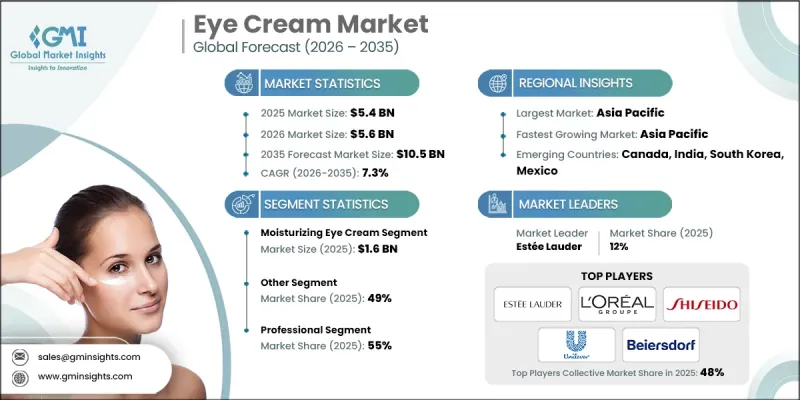
2025 年全球眼霜市場價值 54 億美元,預計到 2035 年將達到 105 億美元,年複合成長率為 7.3%。
在消費者對嬌嫩眼周肌膚專業護理需求的日益重視推動下,眼霜市場正迅速崛起,成為整個護膚行業中一個成長迅速且極具影響力的細分市場。消費者對老齡化、黑眼圈、眼袋、細紋以及整體臉部美觀的日益關注,正在影響他們的購買行為。眼霜因其針對性功效而備受青睞,例如保濕、抗衰老、美白和環境防護。受預防性和科學驗證的護膚方案的偏好,消費者越來越傾向於將眼霜視為長期肌膚健康的重要組成部分,而非奢侈品。價格、可見效果和配方功效是消費者選擇的關鍵因素,而全球對優質、經皮膚科醫生推薦且能輕鬆融入日常護膚流程的產品的需求不斷成長,也持續推動著眼霜市場的發展。
| 市場範圍 | |
|---|---|
| 開始年份 | 2025 |
| 預測年份 | 2026-2035 |
| 起始值 | 54億美元 |
| 預測金額 | 105億美元 |
| 複合年成長率 | 7.3% |
預計到2025年,保濕眼霜市佔率將達到29.7%,銷售額將達16億美元。這些產品因其緊緻肌膚的功效而備受青睞。含有胜肽和膠原蛋白促進成分的配方越來越受歡迎,因為這些成分能夠強化皮膚結構並提高彈性。消費者優先考慮那些能夠帶來明顯緊緻效果、改善眼周肌膚外觀並有助於實現抗衰老目標的護膚產品。
受消費者對高度專業化照護的需求驅動,專業護理市場預計到2025年將佔據55%的市場。專業眼霜含有高濃度的活性成分,旨在解決諸如深層皺紋、嚴重眼袋和明顯黑眼圈等特定問題。這些產品通常在受控環境下,由專業護膚師監督使用,這反映了消費者對個人化護膚的追求。消費者對專業護理和客製化美容方案卓越功效的日益認可,也推動了專業護理市場的成長。
預計2025年,北美眼霜市場規模將達到13億美元,並將以7.6%的複合年成長率持續成長至2035年。該地區以高度成熟的市場著稱,以創新和高階定位為特徵,這得益於消費者較高的知識水平、較高的可支配收入以及皮膚科醫生推薦產品的高滲透率。北美擁有先進的個人護理生態系統、完善的零售基礎設施,並受到皮膚病學研究、化妝品科學和社交媒體主導趨勢的強大影響。這些因素共同推動了市場擴張和專業眼霜的出現。
目錄
第1章:調查方法和範圍
第2章執行摘要
第3章業界考察
- 生態系分析
- 供應商情況
- 利潤率
- 每個階段增加的價值
- 影響價值鏈的因素
- 影響產業的因素
- 促進因素
- 人們對針對性護膚的意識日益增強
- 抗衰老和預防性護膚市場成長
- 社群媒體與美妝部落客的影響力
- 產業潛在風險與挑戰
- 產品價格高
- 對產品功效持懷疑態度
- 機會
- 成分純淨、有機,並經皮膚科醫生測試。
- 先進原料的創新
- 促進因素
- 成長潛力分析
- 未來市場趨勢
- 科技與創新趨勢
- 當前技術趨勢
- 新興技術
- 價格趨勢
- 按地區
- 按類型
- 監管環境
- 標準和合規要求
- 區域法規結構
- 認證標準
- 波特的分析
- PESTEL 分析
第4章 競爭情勢
- 介紹
- 企業市佔率分析
- 企業矩陣分析
- 主要市場公司的競爭分析
- 競爭定位矩陣
- 主要進展
- 併購
- 夥伴關係與合作
- 新產品發布
- 擴張計劃
第5章 估價與預測:依類型分類,2022-2035年
- 保濕眼霜
- 具有緊緻效果的眼霜
- 抗老眼霜
- 抗過敏眼霜
- 亮眼霜
- 眼霜可減輕眼部腫脹
第6章 估價與預測:依原料分類,2022-2035年
- 維生素E
- 菸鹼醯胺
- 維生素A
- 視網醇
- 其他(例如透明質酸)
第7章 市場估價與預測:依膚質分類,2022-2035年
- 乾性皮膚
- 油性肌膚
- 其他(所有膚質,包括敏感肌膚)
第8章 估算與預測:2022-2035年價格區間
- 低價位
- 中等的
- 高的
第9章 估價與預測:依應用領域分類,2022-2035年
- 面向專業人士
- 對於個人
第10章 估價與預測:依通路分類,2022-2035年
- 線上
- 電子商務網站
- 公司網站
- 離線
- 大賣場/超級市場
- 百貨公司
- 其他
第11章 市場估價與預測:按地區分類,2022-2035年
- 北美洲
- 美國
- 加拿大
- 歐洲
- 英國
- 德國
- 法國
- 義大利
- 西班牙
- 其他歐洲地區
- 亞太地區
- 中國
- 印度
- 日本
- 韓國
- 澳洲
- 亞太其他地區
- 拉丁美洲
- 巴西
- 墨西哥
- 其他拉丁美洲地區
- 中東和非洲
- 沙烏地阿拉伯
- 阿拉伯聯合大公國
- 南非
- 其他中東和非洲地區
第12章:公司簡介
- Amorepacific Corporation
- Avon Products, Inc.
- Beiersdorf AG
- Cadila Pharmaceuticals
- 雅詩蘭黛公司
- Eye Care Cosmetics
- Johnson &Johnson
- Kao Corporation
- L'Oreal SA
- Mary Kay Inc.
- The Procter &Gamble Company
- Shiseido Company, Limited
- The Body Shop International Limited
- Unilever
The Global Eye Cream Market was valued at USD 5.4 billion in 2025 and is estimated to grow at a CAGR of 7.3% to reach USD 10.5 billion by 2035.
The market has emerged as a fast-growing and influential segment of the broader skincare industry, driven by rising consumer awareness around specialized care for the delicate eye area. Growing concerns about aging, dark circles, puffiness, fine lines, and overall facial aesthetics are shaping purchasing behavior. Eye creams are recognized for their targeted benefits, including hydration, anti-aging, brightening, and environmental protection. Consumers are increasingly treating eye creams as essential for long-term skin health rather than a luxury, influenced by a preference for preventive and science-backed skincare solutions. Affordability, visible results, and formulation efficacy are key factors in consumer choices, while the market continues to benefit from rising global interest in premium and dermatologist-approved products that integrate seamlessly into daily skincare routines.
| Market Scope | |
|---|---|
| Start Year | 2025 |
| Forecast Year | 2026-2035 |
| Start Value | $5.4 Billion |
| Forecast Value | $10.5 Billion |
| CAGR | 7.3% |
The moisturizing eye cream segment held 29.7% share and generated USD 1.6 billion in 2025. These products are highly demanded for their skin-tightening and firming effects. Formulations containing peptides and collagen-boosting ingredients are increasingly popular, as they strengthen the skin structure and improve elasticity. Consumers prioritize products that deliver visible tightening and enhance the appearance of the eye area, supporting anti-aging goals.
The professional segment held 55% share in 2025, driven by demand for highly specialized treatments. Professional-grade eye creams contain concentrated active ingredients designed for targeted issues, including deep wrinkles, severe puffiness, and pronounced dark circles. These products are often used in controlled conditions under the supervision of skincare professionals, reflecting consumer interest in personalized skincare regimens. The professional segment benefits from growing awareness of the superior efficacy of expert-administered treatments and tailored cosmetic programs.
North America Eye Cream Market accounted for USD 1.3 billion in 2025 and is anticipated to grow at a CAGR of 7.6% through 2035. The region is recognized as highly mature, innovation-driven, and premium-oriented, supported by widespread consumer knowledge, high disposable incomes, and strong adoption of dermatologist-recommended products. North America benefits from an advanced personal care ecosystem, robust retail infrastructure, and strong influence from dermatology research, cosmetic science, and social media-driven trends. These factors collectively drive market expansion and adoption of specialized eye creams.
Key players in the Global Eye Cream Market include Beiersdorf AG, Johnson & Johnson, Shiseido Company, Limited, L'Oreal S.A., Estee Lauder Companies Inc., The Procter & Gamble Company, Amorepacific Corporation, Mary Kay Inc., Avon Products, Inc., Eye Care Cosmetics, The Body Shop International Limited, Kao Corporation, and Unilever. Companies in the eye cream market are strengthening their positions by investing in R&D to develop innovative formulations that target multiple skin concerns simultaneously. Strategic collaborations with dermatologists, influencers, and beauty clinics help enhance credibility and reach. Expanding premium product portfolios and launching region-specific solutions allow firms to cater to diverse consumer preferences. Marketing campaigns emphasizing scientific validation, anti-aging efficacy, and sustainable ingredients are being leveraged to capture consumer trust.
Table of Contents
Chapter 1 Methodology and Scope
- 1.1 Market scope and definition
- 1.2 Research design
- 1.2.1 Research approach
- 1.2.2 Data collection methods
- 1.3 Data mining sources
- 1.3.1 Region
- 1.3.2 Regional/Country
- 1.4 Base estimates and calculations
- 1.4.1 Base year calculation
- 1.4.2 Key trends for market estimation
- 1.5 Primary research and validation
- 1.5.1 Primary sources
- 1.6 Forecast model
- 1.7 Research assumptions and limitations
Chapter 2 Executive Summary
- 2.1 Industry 360° synopsis
- 2.2 Key market trends
- 2.2.1 Country
- 2.2.2 Type
- 2.2.3 Ingredient
- 2.2.4 Skin Type
- 2.2.5 Price
- 2.2.6 Application
- 2.2.7 Distribution Channel
- 2.3 CXO perspectives: Strategic imperatives
- 2.3.1 Key decision points for industry executives
- 2.3.2 Critical success factors for market players
- 2.4 Future outlook and strategic recommendations
Chapter 3 Industry Insights
- 3.1 Industry ecosystem analysis
- 3.1.1 Supplier landscape
- 3.1.2 Profit margin
- 3.1.3 Value addition at each stage
- 3.1.4 Factor affecting the value chain
- 3.2 Industry impact forces
- 3.2.1 Growth drivers
- 3.2.1.1 Rising awareness of targeted skincare
- 3.2.1.2 Growth of anti-aging and preventive skincare
- 3.2.1.3 Influence of social media & beauty influencers
- 3.2.2 Industry pitfalls & challenges
- 3.2.2.1 High product pricing
- 3.2.2.2 Product efficacy skepticism
- 3.2.3 Opportunities
- 3.2.3.1 Clean, organic & dermatologist tested formulations
- 3.2.3.2 Advanced ingredient innovation
- 3.2.1 Growth drivers
- 3.3 Growth potential analysis
- 3.4 Future market trends
- 3.5 Technology and innovation landscape
- 3.5.1 Current technological trends
- 3.5.2 Emerging technologies
- 3.6 Price trends
- 3.6.1 By Region
- 3.6.2 By Type
- 3.7 Regulatory landscape
- 3.7.1 Standards and compliance requirements
- 3.7.2 Regional regulatory frameworks
- 3.7.3 Certification standards
- 3.8 Porter’s analysis
- 3.9 PESTEL analysis
Chapter 4 Competitive Landscape, 2025
- 4.1 Introduction
- 4.2 Company market share analysis
- 4.3 Company matrix analysis
- 4.4 Competitive analysis of major market players
- 4.5 Competitive positioning matrix
- 4.6 Key developments
- 4.6.1 Mergers & acquisitions
- 4.6.2 Partnerships & collaborations
- 4.6.3 New product launches
- 4.6.4 Expansion plans
Chapter 5 Estimates & Forecast, By Type, 2022 - 2035 (USD Billion) (Thousand Units)
- 5.1 Key trends
- 5.2 Moisturizing eye cream
- 5.3 Firming eye cream
- 5.4 Anti-aging eye cream
- 5.5 Anti-allergy eye cream
- 5.6 Brightening eye cream
- 5.7 De-puffing eye cream
Chapter 6 Estimates & Forecast, By Ingredient, 2022 - 2035 (USD Billion) (Thousand Units)
- 6.1 Key trends
- 6.2 Vitamin E
- 6.3 Niacinamide
- 6.4 vitamin A
- 6.5 Retinol
- 6.6 Other (hyaluronic acid, etc)
Chapter 7 Market Estimates and Forecast, By Skin Type, 2022 - 2035 (USD Billion) (Thousand Units)
- 7.1 Key trends
- 7.2 Dry skin
- 7.3 Oily skin
- 7.4 Other (all skin, sensitive skin)
Chapter 8 Estimates & Forecast, By Price 2022 - 2035 (USD Billion) (Thousand Units)
- 8.1 Key trends
- 8.2 Low
- 8.3 Medium
- 8.4 High
Chapter 9 Estimates & Forecast, By Application, 2022 - 2035 (USD Billion) (Thousand Units)
- 9.1 Key trends
- 9.2 Professional
- 9.3 Personal
Chapter 10 Estimates & Forecast, By Distribution Channel, 2022 - 2035 (USD Billion) (Thousand Units)
- 10.1 Key trends
- 10.2 Online
- 10.2.1 E-commerce websites
- 10.2.2 Company websites
- 10.3 Offline
- 10.3.1 Hypermarket/supermarket
- 10.3.2 Departmental stores
- 10.3.3 Others
Chapter 11 Market Estimates and Forecast, By Region, 2022 - 2035 (USD Billion) (Thousand Units)
- 11.1 Key trends
- 11.2 North America
- 11.2.1 U.S.
- 11.2.2 Canada
- 11.3 Europe
- 11.3.1 UK
- 11.3.2 Germany
- 11.3.3 France
- 11.3.4 Italy
- 11.3.5 Spain
- 11.3.6 Rest of Europe
- 11.4 Asia Pacific
- 11.4.1 China
- 11.4.2 India
- 11.4.3 Japan
- 11.4.4 South Korea
- 11.4.5 Australia
- 11.4.6 Rest of Asia Pacific
- 11.5 Latin America
- 11.5.1 Brazil
- 11.5.2 Mexico
- 11.5.3 Rest of Latin America
- 11.6 MEA
- 11.6.1 Saudi Arabia
- 11.6.2 UAE
- 11.6.3 South Africa
- 11.6.4 Rest of MEA
Chapter 12 Company Profiles
- 12.1 Amorepacific Corporation
- 12.2 Avon Products, Inc.
- 12.3 Beiersdorf AG
- 12.4 Cadila Pharmaceuticals
- 12.5 Estee Lauder Companies Inc.
- 12.6 Eye Care Cosmetics
- 12.7 Johnson & Johnson
- 12.8 Kao Corporation
- 12.9 L'Oreal S.A.
- 12.10 Mary Kay Inc.
- 12.11 The Procter & Gamble Company
- 12.12 Shiseido Company, Limited
- 12.13 The Body Shop International Limited
- 12.14 Unilever

 電子商務個人保健產品市場報告:趨勢、預測和競爭分析(至2035年)
 舒緩壓力護膚市場規模、佔有率及成長分析:依產品類型、活性成分、膚質、價格範圍、通路、最終用戶及地區分類-2026-2033年產業預測
 化學換膚市場:按化學試劑、最終用戶、應用和分銷管道分類的全球市場預測,2026-2032年護膚品市場:2026-2032年全球市場預測(依產品類型、肌膚問題、銷售管道及最終用戶分類)醫用級護膚市場:2026-2032年全球市場預測(按產品類型、原料來源、膚質、配方、活性成分類型、價格範圍、包裝、功能、應用、分銷管道和最終用戶分類)皮膚健康市場:全球市場按產品類型、分銷管道、應用和最終用戶分類的預測——2026-2032年
 全球足部面膜市場規模、佔有率、趨勢和成長分析報告(2026-2034年)高級臨床護膚產品市場:2026-2032年全球市場預測(按產品類型、皮膚問題、劑型、價格範圍、分銷管道和最終用戶分類)
 2026-2030年全球視網醇護膚品市場潔面霜市場:依產品形態、膚質、年齡層、性別、價格範圍、應用領域、包裝類型、成分類型和分銷管道分類-全球預測,2026-2032年