

 |
市場調查報告書
商品編碼
1982275
商用車及車隊數位雙胞胎市場:成長機會、成長要素、產業趨勢分析及2026-2035年預測Commercial Vehicle and Fleet Digital Twin Market Opportunity, Growth Drivers, Industry Trend Analysis, and Forecast 2026 - 2035 |
||||||

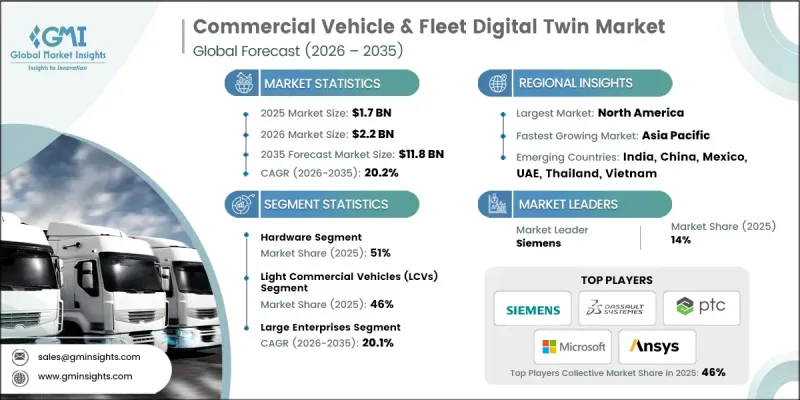
2025 年全球商用車和車隊數位雙胞胎市場價值 17 億美元,預計到 2035 年將以 20.2% 的複合年成長率成長至 118 億美元。
該市場專注於建立基於互聯感測器、人工智慧、高級分析和可擴展雲端環境的整個商用車和車隊生態系統的動態虛擬副本。這些數位化框架使原始設備製造商 (OEM)、車隊所有者和承運商能夠即時監控資產狀態、提升生命週期性能並最佳化營運效率。最初只是一個簡單的車輛資料監控平台,如今已發展成為一個智慧的、模擬主導的系統,能夠支援預測性維護、運轉率預測和成本管理策略。物流網路日益數位化、合規要求日益嚴格以及車隊營運日益複雜化,都推動了市場需求的成長。企業正在大力投資雲端架構,以確保集中化的可視性、最大限度地減少停機時間並提高資產可靠性。隨著車隊現代化和先進技術的應用,數位雙胞胎平台正成為全球運輸網路中風險緩解、永續性評估和長期資本規劃的關鍵工具。
| 市場範圍 | |
|---|---|
| 開始年份 | 2025 |
| 預測期 | 2026-2035 |
| 上市時的市場規模 | 17億美元 |
| 預計金額 | 118億美元 |
| 複合年成長率 | 20.2% |
現代數位雙胞胎平台的功能遠遠超過基礎監控,提供人工智慧驅動的建模環境,能夠模擬大規模運行工況和效能變數。車隊營運商利用這些系統制定效率提升策略、分析資產利用模式、預測長期維護需求,並比較不同動力傳動系統配置的總成本。先進的分析引擎還支援基於場景的路線最佳化、負載容量分佈建模、排放氣體分析和法規文件管理。與聯網汽車技術的整合進一步增強了安全檢驗流程,並提升了各種運行工況下的效能基準測試。由於法規結構的不斷改進和對營運透明度日益成長的期望,市場應用正在加速推進。美國國家公路交通安全管理局 (NHTSA) 正在擴大採用先進技術的商用車隊的安全監控和數據報告標準,從而推動對支持即時合規性追蹤、車輛診斷和營運風險評估的數位基礎設施的投資增加。
預計到2025年,輕型商用車市佔率將達到46%,複合年成長率(CAGR)為20.2%。總噸位在3.5噸至7.5噸之間的車輛因其高運轉率和高營運負載而成為市場成長的主要驅動力。隨著車隊營運商尋求更高的調度精度、更精準的配送績效追蹤、更全面的駕駛員分析以及更最佳化的資產配置策略,該細分市場的需求正在迅速成長。數位雙胞胎解決方案能夠增強協調性、減少停機時間,並提高高密度配送環境中的路線效率。
預計到2025年,大型企業市佔率將達到66%,並在2026年至2035年間以20.1%的複合年成長率成長。這些大型企業正在其龐大的車隊中部署數位雙胞胎孿生生態系統,並將其與企業平台整合,用於資源規劃、運輸管理、倉庫協調和勞動力管理。混合雲端和邊緣運算模型支援進階分析處理,而集中式營運框架則提供了跨地理分佈網路的標準化視覺性。這些組織依靠預測智慧進行網路最佳化、監管報告和永續性評估,旨在降低碳排放強度並增強環境課責。
美國商用車和車隊數位雙胞胎市場預計到2025年將達到4.7億美元,並在2026年至2035年間以19.5%的複合年成長率成長。美國憑藉嚴格的排放氣體法規、加速推進的車隊現代化計劃以及人工智慧驅動的車隊分析技術的廣泛應用,保持其全球領先地位。對長途運輸和基礎設施現代化的需求正推動營運商和原始設備製造商(OEM)部署先進的數位雙胞胎系統,以實現持續的性能監控和預測性維護。在不斷擴展的聯網汽車基礎設施、有利於試點項目的法規結構以及集中的工程投資的支持下,德克薩斯州和亞利桑那州等州正在崛起為創新中心。
目錄
第1章:調查方法
第2章執行摘要
第3章業界考察
- 生態系分析
- 供應商情況
- 利潤率分析
- 成本結構
- 每個階段增加的價值
- 影響價值鏈的因素
- 中斷
- 影響產業的因素
- 促進因素
- 物聯網和聯網汽車技術的廣泛應用。
- 對預測性維護解決方案的需求日益成長
- 推動旨在提高車輛安全性和減少排放氣體的法規
- 人們越來越關注車隊的營運效率。
- 加速推廣電動汽車車隊
- 產業潛在風險與挑戰
- 較高的初始設定成本
- 資料隱私和安全問題
- 缺乏標準化和互通性
- 熟練人員短缺
- 市場機遇
- 新興市場的擴張
- 與自動駕駛汽車開發結合
- 車輛電氣化情境規劃
- 開發產業專用的解決方案
- 車隊數據分析的商業化
- 促進因素
- 成長潛力分析
- 監理情勢
- 北美洲
- 美國聯邦政府關於數位雙胞胎和車隊管理的法規
- 加拿大 - 連網和自動駕駛汽車安全框架 (CASF)
- 歐洲
- 德國 - 歐盟智慧交通系統和國家數位雙胞胎計劃
- 英國:脫歐後車隊ADAS與數位雙胞胎技術指南
- 法國——國家ADAS測試和智慧交通系統戰略
- 義大利——智慧交通系統試點計畫和智慧基礎設施
- 亞太地區
- 中國——工信部關於C-V2X的法規和標準
- 印度—ADAS和汽車互聯的新法規
- 日本——智慧交通系統連結性與頻率政策
- 澳洲—技術中立的智慧交通系統政策
- 拉丁美洲
- 墨西哥 - NOM 汽車安全標準
- 阿根廷 - 交通法第 24.449 號
- 中東和非洲
- 南非 - 道路交通法(1996 年)
- 沙烏地阿拉伯—2030願景的交通運輸法律與交通運輸舉措
- 北美洲
- 波特五力分析
- PESTEL 分析
- 科技與創新趨勢
- 當前技術趨勢
- 物聯網和感測器技術
- 邊緣運算基礎設施
- 雲端運算平台
- 人工智慧和機器學習演算法
- 新興技術
- 5G和V2X整合
- 數位線程架構
- 區塊鏈保障資料完整性
- 擴增實境(AR)介面
- 當前技術趨勢
- 專利分析
- 專利申請趨勢(2021-2025)
- 專利的地理分佈
- 主要專利擁有者
- 主要技術叢集
- 價格分析
- 每輛車的訂閱模式
- 每項功能的定價
- 付費使用制
- 企業授權合約
- 不同地區的價格差異
- 價格趨勢和預測
- 使用案例和成功案例
- 永續性和環境方面
- 永續計劃
- 減少廢棄物策略
- 生產中的能源效率
- 具有環保意識的舉措
- 碳足跡考量
- 數位雙胞胎成熟度模型
- 一級:基本連接和數據採集
- 二級:即時監控和視覺化
- 第三級:預測分析與模擬
- 第四級:自主最佳化與控制
- 第五級:生態系整合與認知孿生
- 區域產業成熟度評估
- 互通性和整合挑戰
- 舊有系統整合
- 多廠商平台相容性
- 數據標準化的挑戰
- API 和中間件要求
- 制定互通性標準
第4章 競爭情勢
- 介紹
- 企業市佔率分析
- 北美洲
- 歐洲
- 亞太地區
- 拉丁美洲
- 中東和非洲(MEA)
- 主要市場公司的競爭分析
- 競爭定位矩陣
- 戰略展望矩陣
- 主要進展
- 併購
- 夥伴關係與合作
- 新產品發布
- 業務拓展計劃及資金籌措
第5章 市場估計與預測:依組件分類,2022-2035年
- 硬體
- 物聯網感測器和遠端資訊處理設備
- 車載計算單元
- GPS和連接模組
- 軟體
- 數位雙胞胎平台與模擬軟體
- 車隊管理和分析軟體
- 預測性維護和營運最佳化軟體
- 服務
- 專業服務
- 託管服務
第6章 市場估價與預測:依車輛類型分類,2022-2035年
- 輕型商用車(LCV)
- 中型商用車(MCV)
- 重型商用車(HCV)
第7章 市場估計與預測:依公司規模分類,2022-2035年
- 主要企業
- 中小企業
第8章 市場估算與預測:依部署類型分類,2022-2035年
- 現場
- 基於雲端的
- 混合
第9章 市場估計與預測:依最終用途分類,2022-2035年
- OEM
- 車輛所有者和物流公司
- 一級和二級供應商
- 汽車軟體和技術供應商
- 售後市場及服務中心
- 其他
第10章 市場估價與預測:依地區分類,2022-2035年
- 北美洲
- 美國
- 加拿大
- 歐洲
- 德國
- 英國
- 法國
- 義大利
- 西班牙
- 俄羅斯
- 荷蘭
- 瑞典
- 丹麥
- 波蘭
- 亞太地區
- 中國
- 印度
- 日本
- 澳洲
- 韓國
- 新加坡
- 泰國
- 印尼
- 越南
- 拉丁美洲
- 巴西
- 墨西哥
- 阿根廷
- 哥倫比亞
- 中東和非洲(MEA)
- 南非
- 沙烏地阿拉伯
- 阿拉伯聯合大公國
- 以色列
第11章:公司簡介
- 世界公司
- ANSYS
- Dassault Systemes
- General Electric(GE Digital)
- Hexagon
- IBM
- Microsoft
- PTC
- Siemens
- 當地公司
- Descartes Systems
- Daimler Truck
- Geotab
- NVIDIA
- Robert Bosch
- Motive(KeepTruckin)
- Samsara
- SAP
- Tata Consultancy Services
- Trimble
- Volvo
- 新興企業
- Altair Engineering
- Intangles
The Global Commercial Vehicle & Fleet Digital Twin Market was valued at USD 1.7 billion in 2025 and is estimated to grow at a CAGR of 20.2% to reach USD 11.8 billion by 2035.
The market focuses on creating dynamic virtual replicas of commercial vehicles and entire fleet ecosystems, powered by connected sensors, artificial intelligence, advanced analytics, and scalable cloud environments. These digital frameworks allow OEMs, fleet owners, and transportation companies to monitor asset health in real time, improve lifecycle performance, and streamline operational efficiency. What began as simple vehicle data monitoring platforms has transformed into intelligent, simulation-driven systems capable of supporting predictive maintenance, utilization forecasting, and cost control strategies. Growing demand is being fueled by increasing digitization across logistics networks, stronger compliance requirements, and the rising complexity of fleet operations. Companies are investing heavily in cloud-based architecture to gain centralized visibility, minimize downtime, and enhance asset reliability. As fleets modernize and incorporate advanced technologies, digital twin platforms are becoming essential tools for risk mitigation, sustainability measurement, and long-term capital planning across global transportation networks.
| Market Scope | |
|---|---|
| Start Year | 2025 |
| Forecast Year | 2026-2035 |
| Start Value | $1.7 Billion |
| Forecast Value | $11.8 Billion |
| CAGR | 20.2% |
Modern digital twin platforms now extend far beyond basic monitoring capabilities, offering AI-enabled modeling environments that simulate large-scale operational conditions and performance variables. Fleet operators use these systems to evaluate efficiency strategies, asset utilization patterns, long-term maintenance forecasting, and total cost comparisons across diverse powertrain configurations. Advanced analytics engines also enable scenario-based route optimization, load distribution modeling, emissions analysis, and regulatory documentation management. Integration with connected vehicle technologies further strengthens safety validation processes and performance benchmarking under varied operating conditions. Market adoption continues to accelerate due to evolving regulatory frameworks and heightened expectations around operational transparency. The National Highway Traffic Safety Administration has expanded safety oversight and data reporting standards for commercial fleets deploying advanced technologies, prompting increased investment in digital infrastructure that supports real-time compliance tracking, vehicle diagnostics, and operational risk assessment.
The light commercial vehicles segment accounted for 46% share in 2025 and is forecast to grow at a CAGR of 20.2%. Vehicles within the gross weight range of 3.5 to 7.5 metric tons led adoption due to their high utilization rates and operational intensity. Demand within this segment is expanding rapidly as fleet operators seek enhanced scheduling precision, delivery performance tracking, driver analytics, and optimized asset deployment strategies. Digital twin solutions enable improved coordination, reduced downtime, and higher route efficiency within dense distribution environments.
The large enterprises segment held 66% share in 2025 and is projected to grow at a CAGR of 20.1% from 2026 to 2035. Major corporations are deploying digital twin ecosystems across extensive fleets while integrating them with enterprise platforms for resource planning, transportation management, warehouse coordination, and workforce administration. Hybrid cloud and edge computing models support advanced analytics processing, while centralized operational frameworks provide standardized visibility across geographically dispersed networks. These organizations rely on predictive intelligence for network optimization, regulatory reporting, and sustainability measurement initiatives aimed at reducing carbon intensity and strengthening environmental accountability.
United States Commercial Vehicle & Fleet Digital Twin Market generated USD 470 million in 2025 and is expected to grow at a CAGR of 19.5% between 2026 and 2035. The country maintains global leadership due to stringent emissions policies, accelerating fleet modernization programs, and widespread adoption of AI-driven fleet analytics. Long-haul transportation demand and infrastructure modernization are encouraging operators and OEMs to deploy advanced digital twin systems for continuous performance monitoring and predictive servicing. States such as Texas and Arizona are emerging as innovation corridors supported by expanding connected vehicle infrastructure, pilot-friendly regulatory frameworks, and concentrated engineering investments.
Key participants shaping the Global Commercial Vehicle & Fleet Digital Twin Market include Siemens, IBM, NVIDIA, Dassault Systems, ANSYS, Microsoft, Hexagon, PTC, General Electric, and Descartes Systems. These companies compete through advanced simulation platforms, cloud-native architectures, AI acceleration technologies, and deep integration capabilities tailored for fleet-scale deployments. Companies operating in the Commercial Vehicle & Fleet Digital Twin Market are strengthening their foothold through continuous platform innovation, ecosystem partnerships, and vertical integration strategies. Providers are enhancing AI-driven predictive analytics, expanding cloud interoperability, and investing in scalable digital architectures to accommodate growing fleet complexity. Strategic alliances with OEMs, telematics providers, and logistics platforms are enabling seamless data exchange and end-to-end visibility. Many vendors are also prioritizing cybersecurity, regulatory alignment, and sustainability reporting capabilities to meet enterprise requirements. Geographic expansion, targeted acquisitions, and industry-specific solution customization further reinforce competitive positioning.
Table of Contents
Chapter 1 Methodology
- 1.1 Research approach
- 1.2 Quality commitments
- 1.3 Research trail and confidence scoring
- 1.3.1 Research trail components
- 1.3.2 Scoring components
- 1.4 Data collection
- 1.4.1 Partial list of primary sources
- 1.5 Data mining sources
- 1.5.1 Paid sources
- 1.6 Best estimates and calculations
- 1.6.1 Base year calculation for any one approach
- 1.7 Forecast model
- 1.8 Research transparency addendum
Chapter 2 Executive Summary
- 2.1 Industry 360° synopsis, 2022 - 2035
- 2.2 Key market trends
- 2.2.1 Regional
- 2.2.2 Components
- 2.2.3 Vehicles
- 2.2.4 Enterprise Size
- 2.2.5 Deployment Mode
- 2.2.6 End Use
- 2.3 TAM Analysis, 2026-2035
Chapter 3 Industry Insights
- 3.1 Industry ecosystem analysis
- 3.1.1 Supplier landscape
- 3.1.2 Profit margin analysis
- 3.1.3 Cost structure
- 3.1.4 Value addition at each stage
- 3.1.5 Factor affecting the value chain
- 3.1.6 Disruptions
- 3.2 Industry impact forces
- 3.2.1 Growth drivers
- 3.2.1.1 Increasing adoption of IoT & connected vehicle technology
- 3.2.1.2 Rising demand for predictive maintenance solutions
- 3.2.1.3 Regulatory push for fleet safety & emissions reduction
- 3.2.1.4 Growing focus on fleet operational efficiency
- 3.2.1.5 Accelerating electric vehicle fleet adoption
- 3.2.2 Industry pitfalls and challenges
- 3.2.2.1 High initial implementation costs
- 3.2.2.2 Data privacy & security concerns
- 3.2.2.3 Lack of standardization & interoperability
- 3.2.2.4 Limited availability of skilled workforce
- 3.2.3 Market opportunities
- 3.2.3.1 Expansion in emerging markets
- 3.2.3.2 Integration with autonomous vehicle development
- 3.2.3.3 Scenario planning for fleet electrification
- 3.2.3.4 Development of industry-specific solutions
- 3.2.3.5 Monetization of fleet data analytics
- 3.2.1 Growth drivers
- 3.3 Growth potential analysis
- 3.4 Regulatory landscape
- 3.4.1 North America
- 3.4.1.1 US- Federal digital twin and fleet management regulations
- 3.4.1.2 Canada - Connected and autonomous fleet safety framework (CASF)
- 3.4.2 Europe
- 3.4.2.1 Germany- EU ITS & national digital twin initiatives
- 3.4.2.2 UK- Post-Brexit ADAS and fleet digital twin guidance
- 3.4.2.3 France- National ADAS testing & ITS strategy
- 3.4.2.4 Italy- ITS pilots & smart infrastructure
- 3.4.3 Asia Pacific
- 3.4.3.1 China- MIIT C-V2X mandates & standards
- 3.4.3.2 India- Emerging ADAS & automotive connectivity regulations
- 3.4.3.3 Japan- ITS connect & spectrum policy
- 3.4.3.4 Australia- Technology neutral ITS policies
- 3.4.4 LATAM
- 3.4.4.1 Mexico- NOM vehicle safety standards
- 3.4.4.2 Argentina- National traffic law 24.449
- 3.4.5 MEA
- 3.4.5.1 South Africa- National road traffic act (1996)
- 3.4.5.2 Saudi Arabia- Traffic law & vision 2030 transport initiatives
- 3.4.1 North America
- 3.5 Porter's analysis
- 3.6 PESTEL analysis
- 3.7 Technology and innovation landscape
- 3.7.1 Current technological trends
- 3.7.1.1 IoT & sensor technology
- 3.7.1.2 Edge computing infrastructure
- 3.7.1.3 Cloud computing platforms
- 3.7.1.4 AI & machine learning algorithms
- 3.7.2 Emerging technologies
- 3.7.2.1 5G & V2X integration
- 3.7.2.2 Digital thread architecture
- 3.7.2.3 Blockchain for data integrity
- 3.7.2.4 Augmented reality interfaces
- 3.7.1 Current technological trends
- 3.8 Patent analysis
- 3.8.1 Patent filing trends (2021-2025)
- 3.8.2 Geographic distribution of patents
- 3.8.3 Top patent holders
- 3.8.4 Key technology clusters
- 3.9 Pricing analysis
- 3.9.1 Per-vehicle subscription model
- 3.9.2 Per-feature pricing
- 3.9.3 Usage-based pricing
- 3.9.4 Enterprise license agreements
- 3.9.5 Regional price variations
- 3.9.6 Price trends & forecasts
- 3.10 Use cases & success stories
- 3.11 Sustainability and environmental aspects
- 3.11.1 Sustainable practices
- 3.11.2 Waste reduction strategies
- 3.11.3 Energy efficiency in production
- 3.11.4 Eco-friendly Initiatives
- 3.11.5 Carbon footprint considerations
- 3.12 Digital twin maturity model
- 3.12.1 Level 1: Basic connectivity & data collection
- 3.12.2 Level 2: Real-time monitoring & visualization
- 3.12.3 Level 3: Predictive analytics & simulation
- 3.12.4 Level 4: Autonomous optimization & control
- 3.12.5 Level 5: Ecosystem integration & cognitive twins
- 3.13 Industry maturity assessment by region
- 3.13.1 Interoperability & integration challenges
- 3.13.2 Legacy system integration
- 3.13.3 Multi-vendor platform compatibility
- 3.13.4 Data standardization issues
- 3.13.5 API & middleware requirements
- 3.13.6 Interoperability standards development
Chapter 4 Competitive Landscape, 2025
- 4.1 Introduction
- 4.2 Company market share analysis
- 4.2.1 North America
- 4.2.2 Europe
- 4.2.3 Asia Pacific
- 4.2.4 LATAM
- 4.2.5 MEA
- 4.3 Competitive analysis of major market players
- 4.4 Competitive positioning matrix
- 4.5 Strategic outlook matrix
- 4.6 Key developments
- 4.6.1 Mergers & acquisitions
- 4.6.2 Partnerships & collaborations
- 4.6.3 New product launches
- 4.6.4 Expansion plans and funding
Chapter 5 Market Estimates & Forecast, By Components, 2022 - 2035 ($Bn, Units)
- 5.1 Key trends
- 5.2 Hardware
- 5.2.1 IoT sensors & telematics devices
- 5.2.2 Onboard computing units
- 5.2.3 GPS and connectivity modules
- 5.3 Software
- 5.3.1 Digital twin platform & simulation software
- 5.3.2 Fleet management and analytics software
- 5.3.3 Predictive maintenance & operational optimization software
- 5.4 Services
- 5.4.1 Professional services
- 5.4.2 Managed services
Chapter 6 Market Estimates & Forecast, By Vehicles, 2022 - 2035 ($Bn)
- 6.1 Key trends
- 6.2 Light commercial vehicles (LCVs)
- 6.3 Medium commercial vehicles (MCVs)
- 6.4 Heavy commercial vehicles (HCVs)
Chapter 7 Market Estimates & Forecast, By Enterprise Size, 2022 - 2035 ($Bn)
- 7.1 Key trends
- 7.2 Large enterprises
- 7.3 Small & medium enterprises (SMEs)
Chapter 8 Market Estimates & Forecast, By Deployment Mode, 2022 - 2035 ($Bn)
- 8.1 Key trends
- 8.2 On premises
- 8.3 Cloud-based
- 8.4 Hybrid
Chapter 9 Market Estimates & Forecast, By End Use, 2022 - 2035 ($Bn)
- 9.1 Key trends
- 9.2 OEMs
- 9.3 Fleet operators & logistics companies
- 9.4 Tier 1 & Tier 2 suppliers
- 9.5 Automotive software & technology providers
- 9.6 Aftermarket & service centers
- 9.7 Others
Chapter 10 Market Estimates & Forecast, By Region, 2022 - 2035 ($Bn)
- 10.1 Key trends
- 10.2 North America
- 10.2.1 US
- 10.2.2 Canada
- 10.3 Europe
- 10.3.1 Germany
- 10.3.2 UK
- 10.3.3 France
- 10.3.4 Italy
- 10.3.5 Spain
- 10.3.6 Russia
- 10.3.7 Netherlands
- 10.3.8 Sweden
- 10.3.9 Denmark
- 10.3.10 Poland
- 10.4 Asia Pacific
- 10.4.1 China
- 10.4.2 India
- 10.4.3 Japan
- 10.4.4 Australia
- 10.4.5 South Korea
- 10.4.6 Singapore
- 10.4.7 Thailand
- 10.4.8 Indonesia
- 10.4.9 Vietnam
- 10.5 Latin America
- 10.5.1 Brazil
- 10.5.2 Mexico
- 10.5.3 Argentina
- 10.5.4 Colombia
- 10.6 MEA
- 10.6.1 South Africa
- 10.6.2 Saudi Arabia
- 10.6.3 UAE
- 10.6.4 Israel
Chapter 11 Company Profiles
- 11.1 Global Players
- 11.1.1 ANSYS
- 11.1.2 Dassault Systemes
- 11.1.3 General Electric (GE Digital)
- 11.1.4 Hexagon
- 11.1.5 IBM
- 11.1.6 Microsoft
- 11.1.7 PTC
- 11.1.8 Siemens
- 11.2 Regional Players
- 11.2.1 Descartes Systems
- 11.2.2 Daimler Truck
- 11.2.3 Geotab
- 11.2.4 NVIDIA
- 11.2.5 Robert Bosch
- 11.2.6 Motive (KeepTruckin)
- 11.2.7 Samsara
- 11.2.8 SAP
- 11.2.9 Tata Consultancy Services
- 11.2.10 Trimble
- 11.2.11 Volvo
- 11.3 Emerging Players & Technology Enablers
- 11.3.1 Altair Engineering
- 11.3.2 Intangles

 2026年全球數位雙胞胎孿生即服務市場報告2026年全球數位雙胞胎技術市場報告2026年全球物流數位雙胞胎市場報告2026年全球人工智慧(AI)增強數位雙胞胎品質指數市場報告2026年全球數位雙胞胎市場報告
 全機械化採礦作業的數位雙胞胎系統市場:按組件、部署類型、應用和最終用戶分類——2026-2032年全球預測
 工業數位化技術展望:2026
 數位雙胞胎市場分析及預測(至2035年):按類型、產品、服務、技術、組件、應用、部署類型、最終用戶、功能和解決方案分類
 數位雙胞胎(DT):市場佔有率分析、產業趨勢與統計、成長預測(2026-2031)
 全球數位雙胞胎市場規模、佔有率、趨勢和成長分析報告(2026-2034年)