

 |
市場調查報告書
商品編碼
1982269
貨物追蹤平台市場機會、成長要素、產業趨勢分析及2026-2035年預測。Shipment Tracking Platform Market Opportunity, Growth Drivers, Industry Trend Analysis, and Forecast 2026 - 2035 |
||||||

全球貨運追蹤平台市場預計到 2025 年將達到 26.1 億美元,年複合成長率為 8.3%,到 2035 年將達到 56.2 億美元。
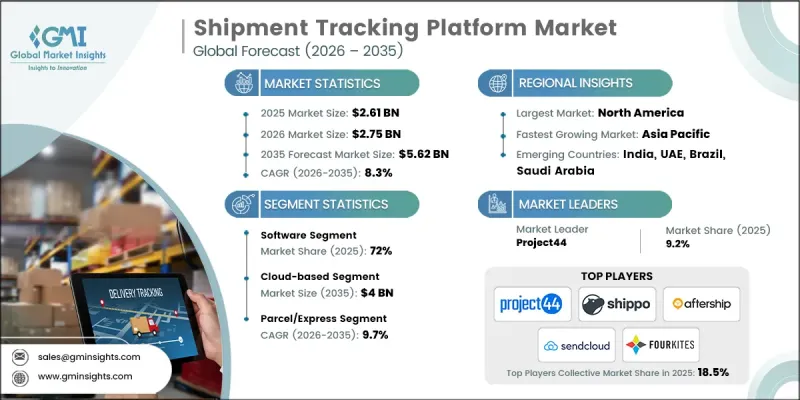
隨著先進技術重新定義貨物可視性和營運效率,物流業正經歷快速的數位轉型。現代化的追蹤平台能夠即時監控貨物運輸,提升整個供應鏈的透明度。物聯網、雲端基礎設施的整合以及即時分析技術的普及,正在增強平台功能並提高服務可靠性。物流業者擴大採用能夠監控貨物位置以及溫度、濕度和物理衝擊等環境條件的解決方案,以降低風險並保障貨物的完整性。由於其精準性和與行動介面的無縫相容性,GPS系統在即時追蹤中繼續發揮核心作用。在需要高度貨物監控和營運課責的行業中,先進的追蹤工具正日益普及。預測分析和自動警報的整合正在幫助企業簡化工作流程並主動應對突發狀況。投資者對追蹤技術提供者日益成長的興趣以及持續的資金流入,進一步凸顯了市場對貨物追蹤平台市場長期成長潛力的信心。
| 市場範圍 | |
|---|---|
| 開始年份 | 2025 |
| 預測期 | 2026-2035 |
| 上市時的市場規模 | 26.1億美元 |
| 預測金額 | 56.2億美元 |
| 複合年成長率 | 8.3% |
到2025年,軟體領域將佔據72%的市場。收入主要來自訂閱式SaaS模式、API驅動的定價以及模組化服務層級。這些靈活的模組支援預計到達時間預測、永續性指標和協作式供應鏈工具,使客戶能夠在不增加營運複雜性的前提下客製化解決方案。
預計2026年至2035年,小包裹和快遞業務將以9.7%的複合年成長率成長。全球線上零售和D2C(直接面對消費者)分銷管道的快速擴張正在加速該領域的需求成長。由於貨運量龐大、交貨前置作業時間縮短以及對頻繁更新物流狀態的需求,即時追蹤已成為關鍵的營運要素。提供準確的物流資訊能夠提升客戶滿意度、簡化退貨管理並提高零售商的整體業績,因此,先進的追蹤平台在最後一公里履約和客戶參與策略中發揮核心作用。
預計到2025年,美國貨運追蹤平台市場規模將達到8.379億美元。貨運視覺化解決方案已成為各種規模企業不可或缺的一部分。雖然大型企業仍是主要用戶,但由於部署時間更短、基礎設施要求更低,中小企業也正快速轉向基於雲端的追蹤平台。將多家承運商的服務整合到單一系統中,能夠提升營運協調性,並改善美國物流業的終端用戶體驗。
目錄
第1章:調查方法
第2章執行摘要
第3章業界考察
- 生態系分析
- 供應商情況
- 利潤率
- 成本結構
- 每個階段增加的價值
- 影響價值鏈的因素
- 中斷
- 影響產業的因素
- 促進因素
- 電子商務和線上零售的成長
- 對即時物流可視性的需求日益成長
- 物聯網和智慧物流解決方案的廣泛應用
- 供應鏈最佳化和效率提升的必要性
- 產業潛在風險與挑戰
- 資料安全和隱私問題
- 缺乏標準化的追蹤通訊協定
- 市場機遇
- 電子商務日益普及的新興市場
- 人工智慧和預測分析的進展
- 拓展最後一公里配送解決方案
- 與物流和宅配公司建立策略夥伴關係
- 促進因素
- 成長潛力分析
- 監理情勢
- 北美洲
- 聯邦汽車運輸安全管理局(FMCSA)
- 美國運輸部(USDOT)
- 運輸安全局(TSA)
- 加拿大邊境服務局(CBSA)
- 加拿大運輸部
- 歐洲
- 歐盟委員會
- 歐洲網路安全局(ENISA)
- 歐洲資料保護委員會(EDPB)
- 國際道路運輸聯盟(IRU-Europe)
- 亞太地區
- 中國交通運輸部
- 國土交通省
- 民航局(DGCA)
- 澳洲基礎設施、交通和區域發展部
- 拉丁美洲
- 基礎設施、通訊和交通局(SICT)
- 國家陸路運輸局(ANTT)
- 智利交通運輸部
- 美洲港委員會(CIP-OAS)
- 中東和非洲
- 波灣合作理事會
- 沙烏地阿拉伯交通運輸總局(TGA)
- 民航局(GACA)
- 非洲民航委員會(AFCAC)
- 北美洲
- 波特五力分析
- PESTEL 分析
- 科技與創新趨勢
- 當前技術趨勢
- 即時GPS和遠端資訊處理追蹤
- 基於雲端的物流平台
- 行動追蹤和司機應用程式
- API 與供應鏈系統的整合
- 新興技術
- 物聯網(IoT)感測器網路
- 人工智慧(AI)和機器學習(ML)
- 利用區塊鏈技術提升供應鏈透明度
- 數位雙胞胎與預測模擬模型
- 當前技術趨勢
- 價格趨勢
- 按地區
- 依產品
- 成本細分分析
- 永續性和環境影響
- 環境影響評估
- 社會影響和對社區的益處
- 公司管治與企業社會責任
- 永續金融與投資趨勢
- 基礎架構和部署分析
- 連接基礎設施的要求
- GPS和衛星技術的局限性
- 雲端基礎設施與本地部署基礎設施
- 實施進度和複雜性
- 網路安全漏洞對業務營運的影響
- 追蹤系統遭受勒索軟體攻擊
- 資料外洩的影響及其對服務等級協定的影響
- OT/IT融合中的漏洞
- 物聯網設備的安全挑戰
- 最後一公里配送指標與績效管理
- ETA預測的準確性
- 客戶通知的有效性
- 未交付率分析
- 最後一公里配送成本
- 案例研究
第4章 競爭情勢
- 介紹
- 企業市佔率分析
- 北美洲
- 歐洲
- 亞太地區
- 拉丁美洲
- 中東和非洲(MEA)
- 主要市場公司的競爭分析
- 競爭定位矩陣
- 主要進展
- 併購
- 夥伴關係與合作
- 新產品發布
- 業務拓展計劃及資金籌措
第5章 市場估計與預測:依組件分類,2022-2035年
- 軟體
- 獨立追蹤平台
- 整合物流/TMS平台
- 支援多家承運商的配送平台
- 購買後體驗平台
- 即時交通視覺化平台(RTTVP)
- 服務
- 專業服務
- 託管服務
第6章 市場估算與預測:依部署類型分類,2022-2035年
- 基於雲端的
- 混合
- 現場
第7章 市場估計與預測:依運輸方式分類,2022-2035年
- 多模態
- 公路和陸路運輸
- 整車運輸 (FTL) 趨勢
- 追蹤零擔(大件貨物)運輸
- 最後一公里配送追蹤
- 海上運輸
- 空運
- 小包裹和快遞
第8章 市場估算與預測:依組織規模分類,2022-2035年
- 小型企業
- 主要企業
第9章 市場估計與預測:依最終用途分類,2022-2035年
- 零售與電子商務
- 第三方物流(3PL) 和合約物流
- 製造業
- 醫療和藥品
- 車
- 貨運/航運
- 其他
第10章 市場估價與預測:依地區分類,2022-2035年
- 北美洲
- 美國
- 加拿大
- 歐洲
- 德國
- 英國
- 法國
- 義大利
- 西班牙
- 捷克共和國
- 比利時
- 俄羅斯
- 荷蘭
- 亞太地區
- 中國
- 印度
- 日本
- 韓國
- 澳洲
- 新加坡
- 馬來西亞
- 印尼
- 越南
- 泰國
- 拉丁美洲
- 巴西
- 墨西哥
- 阿根廷
- 哥倫比亞
- 中東和非洲(MEA)
- 南非
- 沙烏地阿拉伯
- 阿拉伯聯合大公國
第11章:公司簡介
- 世界公司
- project44
- FourKites
- Shippeo
- Oracle
- SAP
- Descartes Systems
- Freightos
- Trimble
- 本地球員
- Shippo
- LogiNext
- Magaya
- FreightPOP
- Narvar
- Easyship
- AfterShip
- ParcelLab
- 新興企業
- GPX
- Shipup
- ClickPost
- Freightify
The Global Shipment Tracking Platform Market was valued at USD 2.61 billion in 2025 and is estimated to grow at a CAGR of 8.3% to reach USD 5.62 billion by 2035.
The logistics sector is undergoing rapid digital transformation as advanced technologies redefine shipment visibility and operational efficiency. Modern tracking platforms are enabling real-time shipment monitoring, enhancing transparency across supply chains. Widespread adoption of IoT integration, cloud-based infrastructure, and real-time analytics is strengthening platform capabilities and improving service reliability. Logistics providers are increasingly deploying solutions that monitor not only shipment location but also environmental conditions such as temperature, humidity, and physical impact to mitigate risks and protect cargo integrity. GPS-enabled systems remain central to live tracking due to their precision and seamless compatibility with mobile interfaces. Advanced tracking tools are gaining traction across industries that require high levels of shipment oversight and operational accountability. The integration of predictive analytics and automated alerts is helping businesses streamline workflows and proactively address disruptions. Growing investor interest and continued capital inflows into tracking technology providers further underscore confidence in the long-term growth potential of the shipment tracking platform market.
| Market Scope | |
|---|---|
| Start Year | 2025 |
| Forecast Year | 2026-2035 |
| Start Value | $2.61 Billion |
| Forecast Value | $5.62 Billion |
| CAGR | 8.3% |
In 2025, the software segment accounted for 72% share. Revenue generation is primarily driven by subscription-based SaaS models, API-driven pricing structures, and modular service tiers. These flexible modules support predictive estimated arrival insights, sustainability metrics, and collaborative supply chain tools, enabling customers to tailor solutions without introducing operational complexity.
The parcel and express segment is forecast to grow at a CAGR of 9.7% between 2026 and 2035. Strong expansion in global online retail and direct-to-consumer distribution channels is accelerating demand within this segment. High shipment volumes, compressed delivery timelines, and the need for frequent status updates have made real-time tracking a critical operational component. Advanced tracking platforms now play a central role in last-mile fulfillment and customer engagement strategies, as accurate delivery communication enhances buyer satisfaction, streamlines returns management and improves overall retailer performance.
U.S. Shipment Tracking Platform Market reached USD 837.9 million in 2025. Shipment visibility solutions have become essential across enterprises of all sizes. Large organizations remain primary adopters, while small and medium-sized businesses are rapidly transitioning toward cloud-based tracking platforms due to faster deployment timelines and lower infrastructure requirements. The ability to consolidate multiple carrier services into a unified system is improving operational coordination and strengthening the end-customer experience across the U.S. logistics landscape.
Key companies operating in the Global Shipment Tracking Platform Market include Project44, FourKites, AfterShip, ShipStation, Shippo, Narvar, Parcel Perform, Shippeo, ClickPost, and Sendcloud. Companies in the Shipment Tracking Platform Market are reinforcing their competitive position through continuous product innovation and strategic expansion. Providers are investing in AI-powered analytics, predictive delivery intelligence, and advanced API integrations to enhance platform functionality and scalability. Strategic partnerships with carriers, e-commerce marketplaces, and enterprise retailers are strengthening ecosystem connectivity and long-term contract pipelines. Firms are also expanding globally to capture emerging logistics markets while enhancing multilingual and multi-carrier capabilities. Subscription-based pricing models and modular platform architectures enable flexible adoption across business sizes.
Table of Contents
Chapter 1 Methodology
- 1.1 Research approach
- 1.2 Quality commitments
- 1.2.1 GMI AI policy & data integrity commitment
- 1.3 Research trail & confidence scoring
- 1.3.1 Research trail components
- 1.3.2 Scoring components
- 1.4 Data collection
- 1.4.1 Partial list of primary sources
- 1.5 Data mining sources
- 1.5.1 Paid sources
- 1.6 Base estimates and calculations
- 1.6.1 Base year calculation
- 1.7 Forecast model
- 1.8 Research transparency addendum
Chapter 2 Executive Summary
- 2.1 Industry 360° synopsis
- 2.2 Key market trends
- 2.2.1 Regional
- 2.2.2 Component
- 2.2.3 Deployment Mode
- 2.2.4 Transportation Mode
- 2.2.5 Organization Size
- 2.2.6 End Use
- 2.3 TAM analysis, 2026-2035
- 2.4 CXO perspectives: Strategic imperatives
Chapter 3 Industry Insights
- 3.1 Industry ecosystem analysis
- 3.1.1 Supplier landscape
- 3.1.2 Profit margin
- 3.1.3 Cost structure
- 3.1.4 Value addition at each stage
- 3.1.5 Factor affecting the value chain
- 3.1.6 Disruptions
- 3.2 Industry impact forces
- 3.2.1 Growth drivers
- 3.2.1.1 Rising e-commerce and online retail growth
- 3.2.1.2 Increasing demand for real-time shipment visibility
- 3.2.1.3 Growing adoption of IoT and smart logistics solutions
- 3.2.1.4 Need for supply chain optimization and efficiency
- 3.2.2 Industry pitfalls and challenges
- 3.2.2.1 Data security and privacy concerns
- 3.2.2.2 Lack of standardized tracking protocols
- 3.2.3 Market opportunities
- 3.2.3.1 Emerging markets with growing e-commerce penetration
- 3.2.3.2 Advancements in AI and predictive analytics
- 3.2.3.3 Expansion of last-mile delivery solutions
- 3.2.3.4 Strategic partnerships with logistics and courier companies
- 3.2.1 Growth drivers
- 3.3 Growth potential analysis
- 3.4 Regulatory landscape
- 3.4.1 North America
- 3.4.1.1 Federal Motor Carrier Safety Administration (FMCSA)
- 3.4.1.2 U.S. Department of Transportation (USDOT)
- 3.4.1.3 Transportation Security Administration (TSA)
- 3.4.1.4 Canada Border Services Agency (CBSA)
- 3.4.1.5 Transport Canada
- 3.4.2 Europe
- 3.4.2.1 European Commission
- 3.4.2.2 European Union Agency for Cybersecurity (ENISA)
- 3.4.2.3 European Data Protection Board (EDPB)
- 3.4.2.4 International Road Transport Union (IRU - Europe)
- 3.4.3 Asia Pacific
- 3.4.3.1 Ministry of Transport (China)
- 3.4.3.2 Ministry of Land, Infrastructure, Transport and Tourism (MLIT)
- 3.4.3.3 Directorate General of Civil Aviation (DGCA)
- 3.4.3.4 Australian Department of Infrastructure, Transport, Regional Development
- 3.4.4 Latin America
- 3.4.4.1 Secretariat of Infrastructure, Communications and Transport (SICT)
- 3.4.4.2 National Land Transport Agency (ANTT)
- 3.4.4.3 Ministry of Transport and Telecommunications (Chile)
- 3.4.4.4 Inter-American Committee on Ports (CIP - OAS)
- 3.4.5 Middle East & Africa
- 3.4.5.1 Gulf Cooperation Council
- 3.4.5.2 Saudi Transport General Authority (TGA)
- 3.4.5.3 General Authority of Civil Aviation (GACA)
- 3.4.5.4 African Civil Aviation Commission (AFCAC)
- 3.4.1 North America
- 3.5 Porter's analysis
- 3.6 PESTEL analysis
- 3.7 Technology and innovation landscape
- 3.7.1 Current technological trends
- 3.7.1.1 Real-time GPS & telematics tracking
- 3.7.1.2 Cloud-based logistics platforms
- 3.7.1.3 Mobile tracking & driver apps
- 3.7.1.4 API Integration with supply chain systems
- 3.7.2 Emerging technologies
- 3.7.2.1 Internet of Things (IoT) sensor networks
- 3.7.2.2 Artificial Intelligence (AI) & Machine Learning (ML)
- 3.7.2.3 Blockchain for supply chain transparency
- 3.7.2.4 Digital Twin & predictive simulation models
- 3.7.1 Current technological trends
- 3.8 Price trends
- 3.8.1 By region
- 3.8.2 By product
- 3.9 Cost breakdown analysis
- 3.10 Sustainability and environmental impact
- 3.10.1 Environmental impact assessment
- 3.10.2 Social impact & community benefits
- 3.10.3 Governance & corporate responsibility
- 3.10.4 Sustainable finance & investment trends
- 3.11 Infrastructure & implementation analysis
- 3.11.1 Connectivity infrastructure requirements
- 3.11.2 GPS & satellite technology limitations
- 3.11.3 Cloud vs. on-premise infrastructure
- 3.11.4 Implementation timelines & complexity
- 3.12 Impact of cybersecurity breaches on operations
- 3.12.1 Ransomware attacks on tracking systems
- 3.12.2 Data breach consequences & SLA impacts
- 3.12.3 OT/IT convergence vulnerabilities
- 3.12.4 IoT device security challenges
- 3.13 Last-mile delivery metrics & performance management
- 3.13.1 ETA prediction accuracy
- 3.13.2 Customer notification effectiveness
- 3.13.3 Failed delivery rate analysis
- 3.13.4 Last-mile cost per delivery
- 3.14 Case studies
Chapter 4 Competitive Landscape, 2025
- 4.1 Introduction
- 4.2 Company market share analysis
- 4.2.1 North America
- 4.2.2 Europe
- 4.2.3 Asia Pacific
- 4.2.4 LATAM
- 4.2.5 MEA
- 4.3 Competitive analysis of major market players
- 4.4 Competitive positioning matrix
- 4.5 Key developments
- 4.5.1 Mergers & acquisitions
- 4.5.2 Partnerships & collaborations
- 4.5.3 New product launches
- 4.5.4 Expansion plans and funding
Chapter 5 Market Estimates & Forecast, By Component, 2022 - 2035 ($Mn)
- 5.1 Key trends
- 5.2 Software
- 5.2.1 Standalone tracking platforms
- 5.2.2 Integrated logistics/TMS platforms
- 5.2.3 Multi-carrier shipping platforms
- 5.2.4 Post-purchase experience platforms
- 5.2.5 Real-time transportation visibility platforms (RTTVP)
- 5.3 Services
- 5.3.1 Professional services
- 5.3.2 Managed services
Chapter 6 Market Estimates & Forecast, By Deployment mode, 2022 - 2035 ($Mn)
- 6.1 Key trends
- 6.2 Cloud-based
- 6.3 Hybrid
- 6.4 On-premises
Chapter 7 Market Estimates & Forecast, By Transportation mode, 2022 - 2035 ($Mn)
- 7.1 Key trends
- 7.2 Multimodal
- 7.3 Road/ground transportation
- 7.3.1 FTL (Full Truckload) tracking
- 7.3.2 LTL (Less Than Truckload) tracking
- 7.3.3 Last-mile delivery tracking
- 7.4 Ocean/maritime
- 7.5 Air freight
- 7.6 Parcel/express
Chapter 8 Market Estimates & Forecast, By Organization size, 2022 - 2035 ($Mn)
- 8.1 Key trends
- 8.2 SMEs
- 8.3 Large enterprises
Chapter 9 Market Estimates & Forecast, By End use, 2022 - 2035 ($Mn)
- 9.1 Key trends
- 9.2 Retail & e-commerce
- 9.3 Third-Party Logistics (3PL) & contract logistics
- 9.4 Manufacturing
- 9.5 Healthcare & pharmaceuticals
- 9.6 Automotive
- 9.7 Freight forwarding & shipping
- 9.8 Others
Chapter 10 Market Estimates & Forecast, By Region, 2022 - 2035 ($Mn)
- 10.1 Key trends
- 10.2 North America
- 10.2.1 US
- 10.2.2 Canada
- 10.3 Europe
- 10.3.1 Germany
- 10.3.2 UK
- 10.3.3 France
- 10.3.4 Italy
- 10.3.5 Spain
- 10.3.6 Czech Republic
- 10.3.7 Belgium
- 10.3.8 Russia
- 10.3.9 Netherlands
- 10.4 Asia Pacific
- 10.4.1 China
- 10.4.2 India
- 10.4.3 Japan
- 10.4.4 South Korea
- 10.4.5 Australia
- 10.4.6 Singapore
- 10.4.7 Malaysia
- 10.4.8 Indonesia
- 10.4.9 Vietnam
- 10.4.10 Thailand
- 10.5 Latin America
- 10.5.1 Brazil
- 10.5.2 Mexico
- 10.5.3 Argentina
- 10.5.4 Colombia
- 10.6 MEA
- 10.6.1 South Africa
- 10.6.2 Saudi Arabia
- 10.6.3 UAE
Chapter 11 Company Profiles
- 11.1 Global players
- 11.1.1 project44
- 11.1.2 FourKites
- 11.1.3 Shippeo
- 11.1.4 Oracle
- 11.1.5 SAP
- 11.1.6 Descartes Systems
- 11.1.7 Freightos
- 11.1.8 Trimble
- 11.2 Regional players
- 11.2.1 Shippo
- 11.2.2 LogiNext
- 11.2.3 Magaya
- 11.2.4 FreightPOP
- 11.2.5 Narvar
- 11.2.6 Easyship
- 11.2.7 AfterShip
- 11.2.8 ParcelLab
- 11.3 Emerging players
- 11.3.1 GPX
- 11.3.2 Shipup
- 11.3.3 ClickPost
- 11.3.4 Freightify

 交通運輸監控市場分析及預測(至2035年):依類型、產品類型、服務、技術、組件、應用、部署狀態、最終使用者及運輸方式分類即時包裹追蹤市場分析與預測(至2035年):按類型、產品、服務、技術、組件、應用、部署方式、最終用戶和功能分類
 嵐追蹤應用市場規模、佔有率和趨勢分析報告:按平台、應用、部署模式、最終用途、地區和細分市場預測(2026-2033 年)貨物追蹤平台市場規模、佔有率和趨勢分析報告:按組件、部署類型、組織規模、最終用戶、地區和細分市場預測(2026-2033 年)基於半導體的動物追蹤設備市場分析及預測至 2035 年:按類型、產品、服務、技術、組件、應用、最終用戶、功能和安裝類型分類。
 使用者追蹤軟體市場按解決方案類型、部署模式、組織規模和行業分類 - 全球預測,2026-2032 年
 按產品類型、技術、應用、部署類型、最終用戶和地區分類的入住率追蹤市場規模、佔有率和成長分析 - 2026-2033 年產業預測
 全球工具追蹤軟體市場:按組件、公司規模、部署方式、作業系統、應用、產業和地區劃分 - 市場預測與分析 (2025-2033)
 風暴追蹤應用市場機會、成長動力、產業趨勢分析及 2025 - 2034 年預測
 全球交通監控市場