

 |
市場調查報告書
商品編碼
1959664
醫療旅遊市場機會、成長要素、產業趨勢分析及2026年至2035年預測Medical Tourism Market Opportunity, Growth Drivers, Industry Trend Analysis, and Forecast 2026 - 2035 |
||||||

2025 年全球醫療旅遊市場價值 761 億美元,預計到 2035 年將達到 1,741 億美元,年複合成長率為 8.4%。
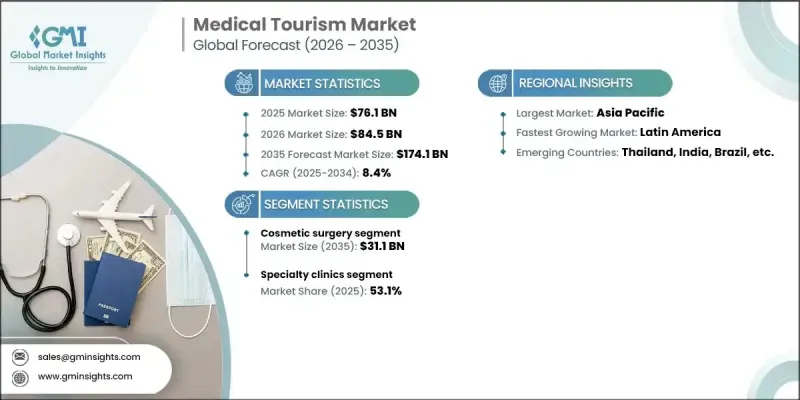
推動這一成長的因素有很多,包括慢性病患病率上升、開發中國家醫療成本降低以及外科手術程序對國際標準的遵守程度提高。數位化術前術後護理、目的地專屬的專業知識以及綜合服務模式正在降低患者的出行風險並加速其普及。已開發國家高昂的醫療成本、高額的自付費用以及龐大的醫療支出,持續促使病患尋求出國就醫。遠距遠端醫療的整合加強了當地專家與家庭醫生之間的協作,同時減少了患者多次就診的需求。後疫情時代遠端醫療的成熟使其角色從便利轉變為必需,預計未來將增加對遠端監測和安全數據共用的投資。醫療旅遊涵蓋預防保健、擇期手術、複雜手術和遠距康復,能夠以更低的成本和更短的等待時間,為患者提供高品質的醫療保健服務。
| 市場範圍 | |
|---|---|
| 開始年份 | 2025 |
| 預測年份 | 2026-2035 |
| 起始值 | 761億美元 |
| 預測金額 | 1741億美元 |
| 複合年成長率 | 8.4% |
預計到2025年,整形外科產業將佔據17.1%的市場。在植髮、塑形和臉部整形等項目的推動下,全球對整形手術的需求仍然強勁。透明的價格、較短的恢復時間和具成本效益的方案對患者,尤其是自費患者,極具吸引力。社群媒體的影響以及人們對自身外觀日益成長的關注,持續推動著整形手術的普及,使其成為醫療旅遊的重要組成部分。
預計到2025年,專科診所將佔據53.1%的市場。這些診所提供特定治療領域的專業技術,例如生育、心臟病、腫瘤、牙科、整形外科和美容醫學。由於其個人化的照護、較短的等待時間和經濟實惠的治療方案,專科診所深受醫療旅客的青睞。許多診所正在投資最尖端科技、微創手術和國際培訓的專家。他們還透過為國際患者提供高效的流程來改善整體就醫體驗,包括配備專門的協調員來管理後勤、預約和後續事宜。
預計到2025年,亞太地區醫療旅遊市場規模將達337億美元,在病患數量和專科醫療服務方面均位居世界前列。印度、泰國、新加坡、馬來西亞和韓國等國家擁有完善的醫院網路、多語言醫護人員以及在心臟病學、整形外科、腫瘤學和美容醫學等領域的區域特色專科。公共和私人機構對數位醫療和智慧旅遊基礎設施的投資正在提升病患體驗,而利用遠端醫療醫療的治療前後照護計畫則進一步提高了醫療服務的可近性。醫療機構認證和健康服務的整合確保了該地區對尋求價格合理、高品質醫療服務的國際患者保持極高的吸引力。
目錄
第1章:調查方法和範圍
第2章執行摘要
第3章業界考察
- 生態系分析
- 影響產業的因素
- 促進因素
- 發展中國家醫療保健成本低廉
- 外科手術程序越來越符合國際標準。
- 慢性病發生率呈上升趨勢
- 產業潛在風險與挑戰
- 某些醫療程序的等待時間過長
- 與患者後續觀察和術後併發症相關的挑戰
- 機會
- 遠端醫療
- 個人化治療方案
- 美容手術和擇期手術的成長
- 促進因素
- 成長潛力分析
- 監管環境
- 科技與創新趨勢
- 當前技術趨勢
- 人工智慧翻譯工具
- 數位健康平台
- 電子健康記錄(EMR)的整合
- 新興技術
- 基於區塊鏈的健康資料安全
- AR/VR在醫療旅遊中的應用
- 當前技術趨勢
- 目前醫療保險覆蓋狀況
- 消費者洞察
- 按地區分類的醫院數量
- 各國具體趨勢與舉措
- 患者和遊客人口統計數據
- 投資環境
- 波特五力分析
- PESTEL 分析
- 差距分析
- 未來市場趨勢
第4章 競爭情勢
- 介紹
- 公司矩陣分析
- 主要市場公司的競爭分析
- 競爭定位矩陣
- 主要進展
- 併購
- 夥伴關係與合作
- 新產品發布
- 擴張計劃
第5章 市場估計與預測:依應用領域分類,2022-2035年
- 整形手術
- 植髮
- 隆乳手術
- 其他美容手術
- 心血管外科
- 整形外科手術
- 全膝關節關節重建
- 全髖關節置換術
- 脊椎手術
- 肩關節關節重建
- 踝置換術
- 其他整形外科手術
- 腫瘤治療
- 外科手術
- 放射治療
- 化療
- 其他治療方法
- 牙科手術
- 人工植牙
- 正畸
- 美容牙科治療
- 牙科修補
- 其他牙科服務
- 減重手術
- 不孕症治療
- 其他用途
第6章 市場估算與預測:依最終用途分類,2022-2035年
- 專科診所
- 醫院
- 其他用途
第7章 市場估計與預測:依地區分類,2022-2035年
- 北美洲
- 美國
- 加拿大
- 歐洲
- 德國
- 英國
- 西班牙
- 波蘭
- 土耳其
- 匈牙利
- 捷克共和國
- 亞太地區
- 中國
- 日本
- 印度
- 泰國
- 韓國
- 新加坡
- 馬來西亞
- 拉丁美洲
- 巴西
- 墨西哥
- 哥倫比亞
- 哥斯大黎加
- 中東和非洲
- 沙烏地阿拉伯
- 阿拉伯聯合大公國
- 埃及
第8章:公司簡介
- Anadolu Medical Center
- Apollo Hospitals Group
- Asklepios Kliniken GmbH &Co. KGaA
- Bumrungrad International Hospital
- Clemenceau Medical Center
- Cleveland Clinic
- Fortis Healthcare Limited
- Gleneagles Hospital
- Johns Hopkins Hospital
- Karolinska University Hospital
- KPJ Healthcare Berhad
- Mahkota Medical Centre
- Makati Medical Center
- MANIPAL HEALTH ENTERPRISES PVT LTD
- Max Healthcare
- Mayo Clinic
- Mount Elizabeth Hospitals
- Narayana Health
- Proton Therapy Center
- Raffles Medical Group
- Samitivej Hospital
- Shouldice Hospital
- St. Luke's Medical Center
- Vera Smile
- Vera Clinic
The Global Medical Tourism Market was valued at USD 76.1 billion in 2025 and is estimated to grow at a CAGR of 8.4% to reach USD 174.1 billion by 2035.
The growth is driven by multiple factors, including rising prevalence of chronic diseases, lower treatment costs in developing nations, and increasing compliance with international standards for surgical procedures. Digital pre- and post-treatment care, destination specialization, and bundled service models are making travel for patients less risky, accelerating adoption. High healthcare costs, larger deductibles, and significant out-of-pocket expenses in developed economies continue to push patients to seek care abroad. Telemedicine integration is reducing the need for multiple physical visits while improving continuity between destination specialists and home-based physicians. The post-COVID maturity of telehealth has shifted it from convenience to necessity, with further investments in remote monitoring and secure data sharing expected. Medical tourism spans preventive treatments, elective surgeries, complex procedures, and remote rehabilitation, providing patients with high-quality care at lower costs and reduced wait times.
| Market Scope | |
|---|---|
| Start Year | 2025 |
| Forecast Year | 2026-2035 |
| Start Value | $76.1 Billion |
| Forecast Value | $174.1 Billion |
| CAGR | 8.4% |
In 2025, the cosmetic surgery segment held a 17.1% share. Global demand for cosmetic procedures remains strong, fueled by procedures such as hair restoration, body contouring, and facial enhancements. Patients are drawn to destinations offering transparent pricing, shorter recovery times, and high perceived value, particularly among self-paying clients. Social media influence and growing awareness of personal appearance continue to drive the popularity of cosmetic surgery, making it a critical component of medical tourism.
The specialty clinics segment accounted for 53.1% share in 2025. These clinics provide focused expertise across therapeutic areas such as fertility, cardiology, oncology, dentistry, orthopedics, and aesthetics. Specialty clinics appeal to medical tourists due to personalized care, shorter wait times, and cost-effective treatment options. Many clinics invest in state-of-the-art technology, minimally invasive procedures, and internationally trained specialists. They offer streamlined processes for international patients, including dedicated coordinators to manage logistics, appointments, and follow-ups, enhancing the overall patient experience.
Asia Pacific Medical Tourism Market reached USD 33.7 billion in 2025, leading in both volume and specialized offerings. Countries in the region, including India, Thailand, Singapore, Malaysia, and South Korea, offer extensive hospital networks, multilingual staff, and destination-specific expertise spanning cardiac, orthopedic, oncology, and aesthetic procedures. Public-private investment in digital health and smart tourism infrastructure has strengthened patient experiences, while telehealth-enabled pre- and post-treatment care programs further enhance accessibility. Accreditation of facilities and integration of wellness services continue to make the region highly attractive for international patients seeking high-quality care at lower costs.
Prominent players in the Global Medical Tourism Market include Bumrungrad International Hospital, Cleveland Clinic, Max Healthcare, St. Luke's Medical Center, Vera Clinic, Fortis Healthcare Limited, Asklepios Kliniken GmbH & Co. KGaA, Raffles Medical Group, Karolinska University Hospital, Apollo Hospitals Group, MANIPAL HEALTH ENTERPRISES PVT LTD, Johns Hopkins Hospital, Mount Elizabeth Hospitals, Mahkota Medical Centre, Shouldice Hospital, Proton Therapy Center, Makati Medical Center, Gleneagles Hospital, Clemenceau Medical Center, and Anadolu Medical Center. Key strategies adopted by companies in the medical tourism market focus on enhancing patient experience, expanding global reach, and maintaining competitive advantages. Providers invest heavily in cutting-edge technology, telemedicine solutions, and digital care platforms to streamline pre- and post-treatment processes. Strategic partnerships with travel agencies, insurance companies, and international facilitators allow for bundled offerings and smoother logistics. Clinics emphasize personalized care, multilingual staff, and international accreditation to build trust. Marketing campaigns highlight affordability, quality, and reduced waiting times, while continuous staff training ensures adherence to global healthcare standards. Expanding specialty services and wellness programs further strengthen market positioning and foster long-term patient loyalty.
Table of Contents
Chapter 1 Methodology and Scope
- 1.1 Market scope and definition
- 1.2 Research design
- 1.2.1 Research approach
- 1.2.2 Data collection methods
- 1.3 Data mining sources
- 1.3.1 Global
- 1.3.2 Regional/Country
- 1.4 Base estimates and calculations
- 1.4.1 Base year calculation
- 1.4.2 Key trends for market estimation
- 1.5 Primary research and validation
- 1.5.1 Primary sources
- 1.6 Forecast model
- 1.7 Research assumptions and limitations
Chapter 2 Executive Summary
- 2.1 Industry 3600 synopsis
- 2.2 Key market trends
- 2.2.1 Regional trends
- 2.2.2 Application trends
- 2.2.3 End use trends
- 2.3 CXO perspectives: Strategic imperatives
- 2.3.1 Key decision points for industry executives
- 2.3.2 Critical success factors for market players
- 2.4 Future outlook and strategic recommendations
Chapter 3 Industry Insights
- 3.1 Industry ecosystem analysis
- 3.2 Industry impact forces
- 3.2.1 Growth drivers
- 3.2.1.1 Low cost of medical treatment in developing countries
- 3.2.1.2 Growing compliance towards international standards for surgical procedures
- 3.2.1.3 Increasing prevalence of chronic diseases
- 3.2.2 Industry pitfalls and challenges
- 3.2.2.1 Long wait time for certain medical procedures
- 3.2.2.2 Issue with patient follow-up and post-surgery complications
- 3.2.3 Opportunities
- 3.2.3.1 Rise of telemedicine
- 3.2.3.2 Personalized treatment packages
- 3.2.3.3 Growth in cosmetic and elective surgeries
- 3.2.1 Growth drivers
- 3.3 Growth potential analysis
- 3.4 Regulatory landscape
- 3.4.1 North America
- 3.4.2 Europe
- 3.4.3 Asia Pacific
- 3.4.4 Latin America
- 3.4.5 MEA
- 3.5 Technology and innovation landscape
- 3.5.1 Current technological trends
- 3.5.1.1 AI-powered translation tools
- 3.5.1.2 Digital wellness platforms
- 3.5.1.3 Electronic medical records (EMR) integration
- 3.5.2 Emerging technologies
- 3.5.2.1 Blockchain-based health data security
- 3.5.2.2 AR/VR for medical tourism
- 3.5.1 Current technological trends
- 3.6 Medical coverage scenario
- 3.7 Consumer insights
- 3.8 Number of hospitals by region
- 3.9 Developments and initiatives by country
- 3.10 Demographics of patients/tourists
- 3.11 Investment landscape
- 3.12 Porter's analysis
- 3.13 PESTEL analysis
- 3.14 Gap analysis
- 3.15 Future market trends
Chapter 4 Competitive Landscape, 2025
- 4.1 Introduction
- 4.2 Company matrix analysis
- 4.3 Competitive analysis of major market players
- 4.4 Competitive positioning matrix
- 4.5 Key developments
- 4.5.1 Mergers & acquisitions
- 4.5.2 Partnerships & collaborations
- 4.5.3 New product launches
- 4.5.4 Expansion plans
Chapter 5 Market Estimates and Forecast, By Application, 2022 - 2035 ($ Mn)
- 5.1 Key trends
- 5.2 Cosmetic surgery
- 5.2.1 Hair transplant
- 5.2.2 Breast augmentation
- 5.2.3 Other cosmetic surgeries
- 5.3 Cardiovascular surgery
- 5.4 Orthopedic surgery
- 5.4.1 Knee replacement
- 5.4.2 Hip replacement
- 5.4.3 Spinal surgeries
- 5.4.4 Shoulder replacement
- 5.4.5 Ankle replacement
- 5.4.6 Other orthopedic surgeries
- 5.5 Oncology treatment
- 5.5.1 Surgery
- 5.5.2 Radiation therapy
- 5.5.3 Chemotherapy
- 5.5.4 Other therapies
- 5.6 Dental surgery
- 5.6.1 Dental implants
- 5.6.2 Orthodontics
- 5.6.3 Dental cosmetics
- 5.6.4 Dental prosthetics
- 5.6.5 Other dental services
- 5.7 Bariatric surgery
- 5.8 Fertility treatment
- 5.9 Other applications
Chapter 6 Market Estimates and Forecast, By End Use, 2022 - 2035 ($ Mn)
- 6.1 Key trends
- 6.2 Specialty clinics
- 6.3 Hospitals
- 6.4 Other end use
Chapter 7 Market Estimates and Forecast, By Region, 2022 - 2035 ($ Mn)
- 7.1 Key trends
- 7.2 North America
- 7.2.1 U.S.
- 7.2.2 Canada
- 7.3 Europe
- 7.3.1 Germany
- 7.3.2 UK
- 7.3.3 Spain
- 7.3.4 Poland
- 7.3.5 Turkey
- 7.3.6 Hungary
- 7.3.7 Czech Republic
- 7.4 Asia Pacific
- 7.4.1 China
- 7.4.2 Japan
- 7.4.3 India
- 7.4.4 Thailand
- 7.4.5 South Korea
- 7.4.6 Singapore
- 7.4.7 Malaysia
- 7.5 Latin America
- 7.5.1 Brazil
- 7.5.2 Mexico
- 7.5.3 Columbia
- 7.5.4 Costa Rica
- 7.6 MEA
- 7.6.1 Saudi Arabia
- 7.6.2 UAE
- 7.6.3 Egypt
Chapter 8 Company Profiles
- 8.1 Anadolu Medical Center
- 8.2 Apollo Hospitals Group
- 8.3 Asklepios Kliniken GmbH & Co. KGaA
- 8.4 Bumrungrad International Hospital
- 8.5 Clemenceau Medical Center
- 8.6 Cleveland Clinic
- 8.7 Fortis Healthcare Limited
- 8.8 Gleneagles Hospital
- 8.9 Johns Hopkins Hospital
- 8.10 Karolinska University Hospital
- 8.11 KPJ Healthcare Berhad
- 8.12 Mahkota Medical Centre
- 8.13 Makati Medical Center
- 8.14 MANIPAL HEALTH ENTERPRISES PVT LTD
- 8.15 Max Healthcare
- 8.16 Mayo Clinic
- 8.17 Mount Elizabeth Hospitals
- 8.18 Narayana Health
- 8.19 Proton Therapy Center
- 8.20 Raffles Medical Group
- 8.21 Samitivej Hospital
- 8.22 Shouldice Hospital
- 8.23 St. Luke's Medical Center
- 8.24 Vera Smile
- 8.25 Vera Clinic

 醫療旅遊市場:按服務類型和地區分類
 2026-2030年全球醫療旅遊市場
 入境醫療旅遊市場-全球產業規模、佔有率、趨勢、機會與預測:按類型、服務、地區和競爭格局分類,2021-2031年睡眠旅遊市場-全球產業規模、佔有率、趨勢、機會和預測:按旅行類型、住宿設施、地區和競爭格局分類,2021-2031年醫療旅遊市場-全球產業規模、佔有率、趨勢、機會、預測:按治療類型、類型、地區和競爭格局分類,2021-2031年
 全球醫療旅遊市場規模、佔有率、趨勢和成長分析報告(2026-2034)
 醫療旅遊市場規模、佔有率、趨勢和預測:按治療類型和地區分類,2026-2034 年
 全球醫療旅遊市場:按治療類型、服務提供者和地區分類-市場動態、市場規模、機會和預測(2026-2035 年)
 醫療旅遊服務市場:依治療類型、服務類型、設施類型、套裝類型、性別和年齡層別分類-2026年至2032年全球預測醫療旅遊市場規模、佔有率、成長及全球產業分析:依類型、應用和地區劃分的洞察,以及2025年至2034年的預測