

 |
市場調查報告書
商品編碼
1959596
露營家具市場機會、成長要素、產業趨勢分析及2026年至2035年預測Camping Furniture Market Opportunity, Growth Drivers, Industry Trend Analysis, and Forecast 2026 - 2035 |
||||||

2025 年全球露營家具市場價值 54 億美元,預計到 2035 年將達到 99 億美元,年複合成長率為 6.1%。
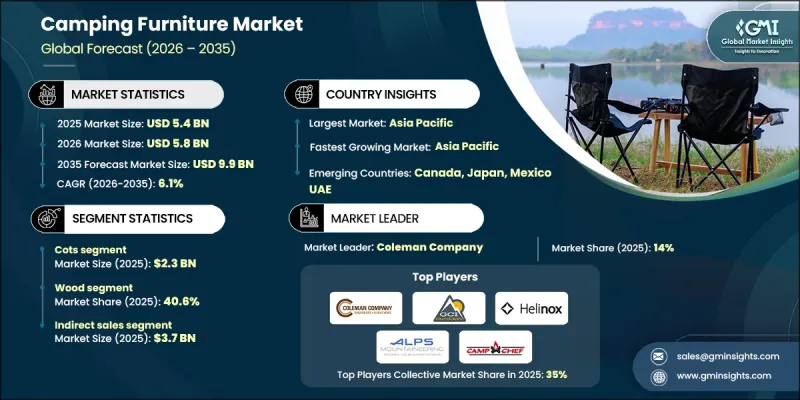
市場成長的驅動力在於人們對戶外休閒和親近大自然的休閒活動日益濃厚的興趣。都市區的壓力、長時間的螢幕使用以及遠距辦公的普及,促使越來越多的人尋求與家人朋友一起短暫親近大自然,例如週末露營、公路旅行和野餐。露營已從一項以冒險為中心的愛好發展成為一項主流休閒活動,受到都市區家庭、露營新手和戶外愛好者的青睞,從而為露營裝備創造了更廣泛的客戶群。這種轉變推動了對便攜、適合臨時使用且功能齊全的戶外家具的需求,這些家具能夠提升舒適性和易用性。露營家具在支持人們參與戶外活動方面發揮著至關重要的作用,它使消費者能夠輕鬆地從入門級的基本裝備過渡到更高級的戶外生活環境,從而鼓勵重複購買和長期參與。
| 市場範圍 | |
|---|---|
| 開始年份 | 2025 |
| 預測年份 | 2026-2035 |
| 起始值 | 54億美元 |
| 預測金額 | 99億美元 |
| 複合年成長率 | 6.1% |
預計到2025年,攜帶式床市場規模將達到23億美元,成為最受歡迎的露營家具之一。攜帶式床能讓露營者遠離地面,隔絕寒冷的地面,改善通風,提升舒適度。這些特點使其尤其受到家庭、自駕露營者和老年人的青睞,他們更傾向於選擇支撐性更強、使用更便捷的睡眠解決方案,而非簡約型床。攜帶式床的便利性、耐用性和舒適性使其成為追求高品質露營體驗且不願犧牲易用性的露營者的必備之選。
預計到2025年,木製家具市佔率將達到40.6%。木材兼具美觀性和功能性,是桌子、儲物櫃、長凳和豪華露營床等對剛性和穩定性要求極高的家具的理想材料。與金屬和塑膠相比,木材給人溫暖自然的感受,吸引追求更精緻露營環境的消費者。憑藉其耐用性、設計多樣性和視覺吸引力,木材預計將在露營家具市場(從入門級到高階系列)保持熱銷地位。
預計到2025年,美國露營家具市佔率將達到89%。美國市場高度發達,深受包括自駕露營和戶外活動在內的濃厚休閒文化的影響。消費者在選擇露營家具時,越來越重視舒適性、便攜性、功能性和美觀性。從折疊式椅到豪華露營床和組合桌,對各種露營家具的需求反映了消費者多樣化的偏好以及家庭露營和戶外休閒的持續成長。
目錄
第1章:調查方法和範圍
第2章執行摘要
第3章業界考察
- 生態系分析
- 供應商情況
- 利潤率
- 每個階段增加的價值
- 影響價值鏈的因素
- 影響產業的因素
- 促進因素
- 過渡到戶外活動
- 對戶外環境舒適度的需求
- 國內旅行增加
- 產業潛在風險與挑戰
- 市場區隔程度高,價格競爭激烈
- 強烈的季節性和需求波動
- 機會
- 多功能混合家具
- 模組化和節省空間的設計
- 促進因素
- 成長潛力分析
- 未來市場趨勢
- 科技與創新趨勢
- 當前技術趨勢
- 新興技術
- 價格趨勢
- 按地區
- 依產品
- 監管環境
- 標準和合規要求
- 區域法規結構
- 認證標準
- 波特五力分析
- PESTEL 分析
第4章 競爭情勢
- 介紹
- 企業市佔率分析
- 按地區
- 公司矩陣分析
- 主要市場公司的競爭分析
- 競爭定位矩陣
- 主要進展
- 併購
- 夥伴關係與合作
- 新產品發布
- 擴張計劃
第5章 市場估價與預測:依產品分類,2022-2035年
- 椅子和凳子
- 桌子
- 嬰兒床
- 吊床
- 其他
第6章 市場估計與預測:依材料分類,2022-2035年
- 金屬
- 木頭
- 塑膠
- 纖維
- 其他
第7章 市場估計與預測:依價格區間分類,2022-2035年
- 低價位
- 中價位
- 高價位範圍
第8章 市場估算與預測:依通路分類,2022-2035年
- 線下超級市場/專賣店/其他(百貨公司等)/線上/電子商務/企業網站
- 超級市場
- 專賣店
- 其他(百貨公司等)
- 線上
- 電子商務
- 公司網站
第9章 市場估計與預測:依地區分類,2022-2035年
- 北美洲
- 美國
- 加拿大
- 歐洲
- 德國
- 英國
- 法國
- 義大利
- 西班牙
- 亞太地區
- 中國
- 日本
- 印度
- 澳洲
- 韓國
- 拉丁美洲
- 巴西
- 墨西哥
- 阿根廷
- 中東和非洲
- 南非
- 沙烏地阿拉伯
- 阿拉伯聯合大公國
第10章:公司簡介
- ALPS Mountaineering
- Big Agnes
- Camp Chef
- Coleman Company
- GCI Outdoor
- Helinox
- Kampa
- Kelty
- Kijaro
- Lippert
- NEMO Equipment
- Outwell
- QuikShade
- Snow Peak
- Vango
The Global Camping Furniture Market was valued at USD 5.4 billion in 2025 and is estimated to grow at a CAGR of 6.1% to reach USD 9.9 billion by 2035.
The market growth is driven by a rising interest in outdoor recreation and nature-focused leisure activities. Urban stress, prolonged screen exposure, and the expansion of remote work arrangements are motivating individuals to seek short-term escapes into nature with family and friends, including weekend camping, road trips, and picnicking. Camping has evolved from an adventure-focused pastime into a mainstream leisure activity embraced by urban families, first-time campers, and casual outdoor enthusiasts, creating a broader audience for camping products. This shift is generating increasing demand for portable, temporary, and functional outdoor furniture that enhances comfort and usability. Camping furniture plays a vital role in supporting participation, offering consumers a seamless transition from basic entry-level setups to more sophisticated outdoor living arrangements, encouraging repeat purchases and long-term engagement.
| Market Scope | |
|---|---|
| Start Year | 2025 |
| Forecast Year | 2026-2035 |
| Start Value | $5.4 Billion |
| Forecast Value | $9.9 Billion |
| CAGR | 6.1% |
In 2025, the cots segment generated USD 2.3 billion, becoming one of the most sought-after camping furniture items. Cots elevate campers above the ground, offering insulation from cold surfaces, better airflow, and enhanced comfort. These features make them particularly attractive for family campers, car campers, and older adults who prefer supportive and easy-to-use sleeping solutions rather than minimalistic options. The convenience, durability, and comfort of cots have made them a staple for those seeking a premium camping experience without compromising on usability.
The wooden furniture segment held 40.6% share in 2025. Wood provides a blend of aesthetic appeal and functional strength, making it an ideal material for tables, storage units, benches, and high-end cots where rigidity and stability are essential. Compared to metal or plastic, wood offers a warmer and more natural look, which attracts consumers desiring a more elegant camping setup. Its combination of durability, design versatility, and visual appeal ensures its continued popularity in both entry-level and premium camping furniture lines.
U.S. Camping Furniture Market accounted for 89% share in 2025. The market in the U.S. is highly developed and influenced by a strong culture of recreational activities, including car-based camping and outdoor events. Consumers place increasing importance on comfort, portability, functionality, and aesthetics when selecting camping furniture. The demand spans a wide spectrum of products, from folding chairs to premium cots and modular tables, reflecting diverse consumer preferences and the continued expansion of family-oriented camping and outdoor leisure.
Leading companies in the Global Camping Furniture Market include Camp Chef, Big Agnes, QuikShade, NEMO Equipment, Coleman Company, Helinox, Vango, Lippert, Outwell, Kampa, ALPS Mountaineering, Kijaro, Kelty, GCI Outdoor, and Snow Peak. Key strategies adopted by companies in the camping furniture market focus on innovation, product differentiation, and expanding consumer reach. Firms are developing lightweight, portable, and multi-functional furniture to appeal to casual and family campers. They invest in premium designs using materials such as wood, aluminum, and high-grade fabrics to target upscale segments. Companies leverage online and offline retail channels to enhance accessibility while offering customization options to increase brand loyalty. Marketing efforts emphasize comfort, convenience, and lifestyle appeal, and partnerships with outdoor events, resorts, and recreational service providers strengthen market visibility.
Table of Contents
Chapter 1 Methodology and Scope
- 1.1 Market scope and definition
- 1.2 Research design
- 1.2.1 Research approach
- 1.2.2 Data collection methods
- 1.3 Data mining sources
- 1.3.1 Global
- 1.3.2 Regional/Country
- 1.4 Base estimates and calculations
- 1.4.1 Base year calculation
- 1.4.2 Key trends for market estimation
- 1.5 Primary research and validation
- 1.5.1 Primary sources
- 1.6 Forecast model
- 1.7 Research assumptions and limitations
Chapter 2 Executive Summary
- 2.1 Industry 360° synopsis
- 2.2 Key market trends
- 2.2.1 Regional
- 2.2.2 Product
- 2.2.3 Material
- 2.2.4 Price range
- 2.2.5 Distribution channel
- 2.3 CXO perspectives: Strategic imperatives
- 2.3.1 Key decision points for industry executives
- 2.3.2 Critical success factors for market players
- 2.4 Future outlook and strategic recommendations
Chapter 3 Industry Insights
- 3.1 Industry ecosystem analysis
- 3.1.1 Supplier landscape
- 3.1.2 Profit margin
- 3.1.3 Value addition at each stage
- 3.1.4 Factor affecting the value chain
- 3.2 Industry impact forces
- 3.2.1 Growth drivers
- 3.2.1.1 Shift toward outdoor activities
- 3.2.1.2 Demand for comfort in outdoor settings
- 3.2.1.3 Rise in domestic travel
- 3.2.2 Industry pitfalls & challenges
- 3.2.2.1 High market fragmentation & price competition
- 3.2.2.2 Strong seasonality & demand volatility
- 3.2.3 Opportunities
- 3.2.3.1 Multi-use & hybrid furniture
- 3.2.3.2 Modular & space-efficient designs
- 3.2.1 Growth drivers
- 3.3 Growth potential analysis
- 3.4 Future market trends
- 3.5 Technology and innovation landscape
- 3.5.1 Current technological trends
- 3.5.2 Emerging technologies
- 3.6 Price trends
- 3.6.1 By region
- 3.6.2 By product
- 3.7 Regulatory landscape
- 3.7.1 Standards and compliance requirements
- 3.7.2 Regional regulatory frameworks
- 3.7.3 Certification standards
- 3.8 Porter's analysis
- 3.9 PESTEL analysis
Chapter 4 Competitive Landscape, 2025
- 4.1 Introduction
- 4.2 Company market share analysis
- 4.2.1 By region
- 4.2.1.1 North America
- 4.2.1.2 Europe
- 4.2.1.3 Asia Pacific
- 4.2.1.4 Latin America
- 4.2.1.5 Middle East and Africa
- 4.2.1 By region
- 4.3 Company matrix analysis
- 4.4 Competitive analysis of major market players
- 4.5 Competitive positioning matrix
- 4.6 Key developments
- 4.6.1 Mergers & acquisitions
- 4.6.2 Partnerships & collaborations
- 4.6.3 New product launches
- 4.6.4 Expansion plans
Chapter 5 Market Estimates and Forecast, By Product, 2022 - 2035 (USD Billion) (Thousand Units)
- 5.1 Key trends
- 5.2 Chairs and stools
- 5.3 Tables
- 5.4 Cots
- 5.5 Hammocks
- 5.6 Others
Chapter 6 Market Estimates and Forecast, By Material, 2022 - 2035 (USD Billion) (Thousand Units)
- 6.1 Key trends
- 6.2 Metal
- 6.3 Wood
- 6.4 Plastic
- 6.5 Textile
- 6.6 Others
Chapter 7 Market Estimates and Forecast, By Price Range, 2022 - 2035 (USD Billion) (Thousand Units)
- 7.1 Key trends
- 7.2 Low
- 7.3 Medium
- 7.4 High
Chapter 8 Market Estimates and Forecast, By Distribution Channel, 2022 - 2035 (USD Billion) (Thousand Units)
- 8.1 Key trends
- 8.1.1 Offline
- 8.1.1.1 Supermarkets
- 8.1.1.2 Specialty stores
- 8.1.1.3 Others (Departmental stores. Etc.)
- 8.1.2 Online
- 8.1.2.1 E-commerce
- 8.1.2.2 Company websites
- 8.1.1 Offline
Chapter 9 Market Estimates and Forecast, By Region, 2022 - 2035 (USD Billion) (Thousand Units)
- 9.1 Key trends
- 9.2 North America
- 9.2.1 U.S.
- 9.2.2 Canada
- 9.3 Europe
- 9.3.1 Germany
- 9.3.2 UK
- 9.3.3 France
- 9.3.4 Italy
- 9.3.5 Spain
- 9.4 Asia Pacific
- 9.4.1 China
- 9.4.2 Japan
- 9.4.3 India
- 9.4.4 Australia
- 9.4.5 South Korea
- 9.5 Latin America
- 9.5.1 Brazil
- 9.5.2 Mexico
- 9.5.3 Argentina
- 9.6 Middle East and Africa
- 9.6.1 South Africa
- 9.6.2 Saudi Arabia
- 9.6.3 UAE
Chapter 10 Company Profiles
- 10.1 ALPS Mountaineering
- 10.2 Big Agnes
- 10.3 Camp Chef
- 10.4 Coleman Company
- 10.5 GCI Outdoor
- 10.6 Helinox
- 10.7 Kampa
- 10.8 Kelty
- 10.9 Kijaro
- 10.10 Lippert
- 10.11 NEMO Equipment
- 10.12 Outwell
- 10.13 QuikShade
- 10.14 Snow Peak
- 10.15 Vango

 露營裝備市場:按產品類型、銷售管道和消費者類型分類的全球市場預測,2026-2032年房車市場:2026-2032年全球市場預測(按房車類型、銷售管道和應用分類)露營廚房市場:2026-2032年全球市場預測(按產品類型、燃料類型、價格範圍、活動類型、材料類型、分銷管道和最終用戶分類)露營椅市場:2026-2032年全球市場預測(依產品類型、材料、價格範圍、承重能力、銷售管道及最終用戶分類)露營冷藏箱市場:全球市場按產品類型、容量、材料、應用和銷售管道分類的預測 - 2026-2032 年露營和房車市場:2026-2032年全球市場預測(按露營方式、產品類型、活動、最終用戶和分銷管道分類)
 露營裝備市場規模、佔有率、趨勢和預測:按產品類型、分銷管道和地區分類,2026-2034年
 露營家具市場規模、佔有率、成長及全球產業分析:按類型、應用和地區分類,並預測至2026-2034年露營裝備市場規模、佔有率、成長及全球產業分析:按類型、應用和地區分類,並預測至2026-2034年
 露營裝備市場機會、成長要素、產業趨勢分析及2026年至2035年預測