


 |
市場調查報告書
商品編碼
1959342
人工智慧車載駕駛座助理市場:機會、成長要素、產業趨勢分析及預測(2026-2035年)AI-Powered In-Vehicle Cockpit and Assistant Market Opportunity, Growth Drivers, Industry Trend Analysis, and Forecast 2026 - 2035 |
||||||

2025 年全球人工智慧車載駕駛座輔助系統市場價值 71 億美元,預計到 2035 年將以 22.2% 的複合年成長率成長至 501 億美元。
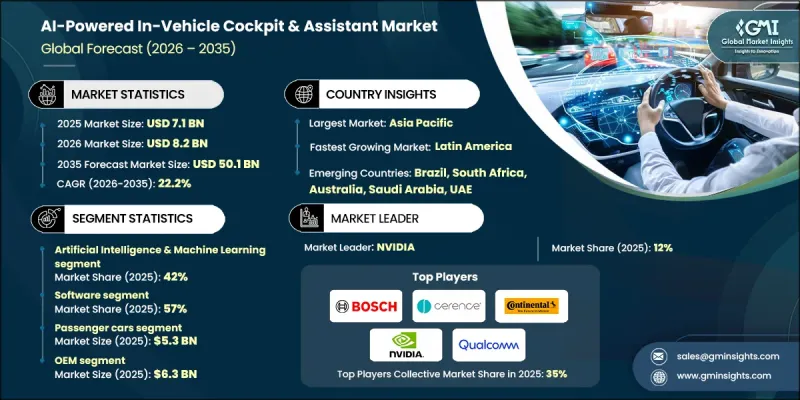
消費者對直覺的語音控制車輛互動和智慧駕駛輔助系統的期望日益成長,推動了市場成長。汽車製造商和一級供應商持續增加對人工智慧、機器學習和自然語言技術的投資,以創造高度個人化和情境察覺的駕駛座環境。這些平台將導航、媒體、通訊和車輛控制整合到一個智慧介面中。向軟體定義車輛和靈活駕駛座架構的轉變將使製造商能夠更快地部署新的人工智慧驅動功能。人工智慧也透過先進的內容管理和偏好的建議,正在改變資訊娛樂系統,從而提升駕駛員和乘客的參與度。同時,可擴展的高效能運算平台支援人工智慧在駕駛座系統和駕駛輔助功能中的應用,隨著以軟體為中心的設計成為汽車行業的標準,這將縮短開發週期並提高車輛的長期適應性。
| 市場範圍 | |
|---|---|
| 開始年份 | 2025 |
| 預測年份 | 2026-2035 |
| 起始金額 | 71億美元 |
| 預測金額 | 501億美元 |
| 複合年成長率 | 22.2% |
預計到2025年,軟體領域將佔據57%的市場佔有率,並在2026年至2035年間以23.8%的複合年成長率成長。以人工智慧為核心的駕駛座軟體,採用模組化和服務導向架構,可提供智慧、互聯和自適應的使用者體驗。這些平台支援無縫系統整合,並透過空中下載更新快速啟動功能,從而提升車輛的長期性能。
預計到2025年,乘用車市場規模將達53億美元。這一市場將受益於消費者對連網、智慧和個人化車載環境日益成長的需求。人工智慧語音互動、先進的人機互動介面和預測智慧技術,將使用戶能夠在以乘客為中心的出行平台上,無縫存取導航、通訊、娛樂和車輛操控等功能。
預計2025年,中國人工智慧車載駕駛座輔助系統市場規模將達22億美元。中國在該領域的主導地位得益於快速的數位轉型、國內汽車製造商的強勁創新以及人工智慧技術在全系車型中的大規模應用。憑藉消費者對數位生態系統的高度接受度以及有利的政策框架,駕駛座智慧已成為中國汽車市場的關鍵競爭優勢。
目錄
第1章:調查方法和範圍
第2章執行摘要
第3章業界考察
- 生態系分析
- 供應商情況
- 零件供應商
- 技術平台提供者
- 系統整合商
- 汽車製造商
- 售後市場銷售代理
- 最終用戶
- 成本結構
- 利潤率
- 每個階段增加的價值
- 垂直整合趨勢
- 顛覆者
- 供應商情況
- 影響因素
- 促進因素
- 聯網汽車和軟體定義汽車的廣泛應用。
- 消費者對個人化和免持操作的需求日益成長。
- 電動車 (EV) 和自動駕駛汽車領域的擴張
- 拓展售後軟體升級機會
- 市場機遇
- AI驅動的預測和生成助手
- 多模態人機互動的引入
- 雲端連線和OTA更新
- 智慧駕駛座的區域部署
- 促進因素
- 技術趨勢與創新生態系統
- 目前技術
- 新興技術
- 成長潛力分析
- 監理情勢
- 北美洲
- FMVSS駕駛分心預防指南
- 加拿大運輸部連網車輛與資訊娛樂系統指南
- 歐洲
- 歐盟通用安全法規(GSR)
- 汽車資訊娛樂系統的CE認證
- 亞太地區
- 日本汽車電子設備安全標準
- 中國GB標準(用於聯網汽車)
- 印度AIS/EMC指南
- 拉丁美洲
- 巴西 INMETRO 標準
- 哥倫比亞汽車互聯系統指南
- 阿根廷關於汽車電子產品和資訊娛樂系統的法規
- 中東和非洲
- 阿拉伯聯合大公國聯網汽車和語音控制汽車的標準
- 阿曼汽車電子產品指南
- 南非SABS汽車語音與資訊娛樂標準
- 北美洲
- 波特的分析
- PESTEL 分析
- 價格趨勢
- OEM定價模式
- 售後市場價格趨勢
- 訂閱模式與一次性購買模式的比較
- 區域價格波動
- 專利分析
- 永續性和環境方面
- 永續實踐
- 減少廢棄物策略
- 生產中的能源效率
- 具有環保意識的舉措
- 碳足跡考量
- 供應鏈分析
- 零件籌資策略
- 半導體晶片供應限制
- 對雲端基礎架構的依賴
- 區域供應鏈趨勢
- 商業性可行性及開發
- 比較成本競爭力和高階音訊的附加價值效應。
- OEM採購和平台擴充性的吸引力
- 售後升級的潛力以及經銷商安裝的成本效益
- 本地化、供應鏈韌性和物流實用性
- 人機介面 (HMI) 和使用者體驗基準測試
第4章 競爭情勢
- 介紹
- 企業市佔率分析
- 北美洲
- 歐洲
- 亞太地區
- 拉丁美洲
- 中東和非洲
- 競爭定位矩陣
- 戰略展望矩陣
- 主要進展
- 併購
- 夥伴關係與合作
- 新產品發布
- 業務拓展計劃及資金籌措
第5章 市場估計與預測:依技術分類,2022-2035年
- 語音辨識
- 自然語言處理(NLP)
- 人工智慧(AI)
第6章 市場估計與預測:依組件分類,2022-2035年
- 軟體
- 內建軟體
- 基於雲端的軟體
- 人工智慧驅動的應用
- 其他
- 硬體
- 麥克風和揚聲器
- 顯示面板/螢幕
- 控制單元處理器
- 感應器和攝影機
- 其他
- 服務
- 整合與實施
- 維護和支援
- 諮詢服務
第7章 市場估價與預測:依車輛類型分類,2022-2035年
- 搭乘用車
- 轎車
- 掀背車車
- SUV
- 商用車輛
- 輕型商用車(LCV)
- 中型商用車(MCV)
- 重型商用車(HCV)
第8章 市場估計與預測:依應用領域分類,2022-2035年
- 導航地圖
- 娛樂媒體
- 溝通
- 車輛控制和設置
- 其他
第9章 市場估價與預測:依銷售管道分類,2022-2035年
- OEM
- 售後市場
第10章 市場估價與預測:依地區分類,2022-2035年
- 北美洲
- 美國
- 加拿大
- 歐洲
- 英國
- 德國
- 法國
- 義大利
- 西班牙
- 比利時
- 荷蘭
- 瑞典
- 俄羅斯
- 亞太地區
- 中國
- 印度
- 日本
- 澳洲
- 新加坡
- 韓國
- 越南
- 印尼
- 拉丁美洲
- 巴西
- 墨西哥
- 阿根廷
- 中東和非洲
- 南非
- 沙烏地阿拉伯
- 阿拉伯聯合大公國
第11章:公司簡介
- 世界公司
- Aptiv
- Continental
- DENSO
- Harman International Industries(Samsung)
- NVIDIA
- Panasonic Automotive Systems
- Qualcomm Technologies
- Robert Bosch
- Valeo
- Visteon
- 當地公司
- Alps Alpine
- Cerence
- Desay SV Automotive
- FORVIA
- Garmin
- Hyundai Mobis
- Pateo Connect Technology
- Pioneer
- 新興企業
- 42dot
- AEye
- Arbe Robotics
- Prophesee
- Sonatus
- StradVision
The Global AI-Powered In-Vehicle Cockpit & Assistant Market was valued at USD 7.1 billion in 2025 and is estimated to grow at a CAGR of 22.2% to reach USD 50.1 billion by 2035.
Rising consumer expectations for intuitive, voice-enabled vehicle interaction and intelligent driver support fuel growth. Automakers and Tier 1 suppliers continue to accelerate investment in artificial intelligence, machine learning, and natural language technologies to deliver highly personalized and context-aware cockpit environments. These platforms unify navigation, media, communication, and vehicle controls into a single intelligent interface. The shift toward software-defined vehicles and flexible cockpit architectures allows manufacturers to introduce new AI-driven functions at a much faster pace. AI is also reshaping infotainment through advanced content management and preference-based recommendations, increasing engagement for both drivers and passengers. In parallel, scalable high-performance computing platforms are supporting AI deployment across cockpit systems and driver assistance features, enabling quicker development cycles and long-term vehicle adaptability as software-centric design becomes standard across the automotive industry.
| Market Scope | |
|---|---|
| Start Year | 2025 |
| Forecast Year | 2026-2035 |
| Start Value | $7.1 Billion |
| Forecast Value | $50.1 Billion |
| CAGR | 22.2% |
The software segment held a 57% share in 2025 and is forecast to grow at a CAGR of 23.8% from 2026 to 2035. AI-focused cockpit software enables intelligent, connected, and adaptive user experiences by supporting modular and service-oriented architectures. These platforms allow seamless system integration and faster feature activation through over-the-air updates, enhancing long-term vehicle functionality.
The passenger vehicles segment generated USD 5.3 billion in 2025. This segment benefits from strong consumer demand for connected, intelligent, and personalized in-vehicle environments. AI-powered voice interaction, advanced human-machine interfaces, and predictive intelligence support smooth access to navigation, communication, entertainment, and vehicle operation within passenger-focused mobility platforms.
China AI-Powered In-Vehicle Cockpit & Assistant Market reached USD 2.2 billion in 2025. The country's leadership is driven by rapid digital transformation, strong innovation among domestic automakers, and large-scale integration of AI technologies across vehicle lineups. High consumer acceptance of digital ecosystems and supportive policy frameworks have made cockpit intelligence a key competitive differentiator in the Chinese automotive market.
Key companies active in the Global AI-Powered In-Vehicle Cockpit & Assistant Market include Qualcomm Technologies, NVIDIA, Harman International Industries, Robert Bosch, Continental, Aptiv, Visteon, Valeo, DENSO, and Panasonic Automotive Systems. Companies operating in the AI-Powered In-Vehicle Cockpit & Assistant Market focus on strengthening their position through software-centric innovation and ecosystem partnerships. Automakers and suppliers invest heavily in proprietary AI platforms and scalable computing architectures to support long-term feature expansion. Strategic collaboration with semiconductor and software firms improves processing efficiency and accelerates product development. Many players emphasize modular cockpit designs that can be deployed across multiple vehicle platforms. Over-the-air update capabilities are prioritized to ensure continuous performance enhancement and personalization. Firms also concentrate on improving voice intelligence accuracy, user data security, and seamless integration with digital services.
Table of Contents
Chapter 1 Methodology & Scope
- 1.1 Research approach
- 1.2 Quality Commitments
- 1.2.1 GMI AI policy & data integrity commitment
- 1.2.1.1 Source consistency protocol
- 1.2.1 GMI AI policy & data integrity commitment
- 1.3 Research Trail & Confidence Scoring
- 1.3.1 Research Trail Components
- 1.3.2 Scoring Components
- 1.4 Data Collection
- 1.4.1 Partial list of primary sources
- 1.5 Data mining sources
- 1.5.1 Paid sources
- 1.5.1.1 Sources, by region
- 1.5.1 Paid sources
- 1.6 Base estimates and calculations
- 1.6.1 Base year calculation for any one approach
- 1.7 Forecast
- 1.7.1 Quantified market impact analysis
- 1.7.1.1 Mathematical impact of growth parameters on forecast
- 1.7.1 Quantified market impact analysis
- 1.8 Research transparency addendum
- 1.8.1 Source attribution framework
- 1.8.2 Quality assurance metrics
- 1.8.3 Our commitment to trust
Chapter 2 Executive Summary
- 2.1 Industry 360° synopsis
- 2.2 Key market trends
- 2.2.1 Regional
- 2.2.2 Technology
- 2.2.3 Component
- 2.2.4 Vehicle
- 2.2.5 Application
- 2.2.6 Sales Channel
- 2.3 TAM Analysis, 2026-2035
- 2.4 CXO perspectives: Strategic imperatives
- 2.4.1 Key decision points for industry executives
- 2.4.2 Critical success factors for market players
- 2.5 Future outlook and strategic recommendations
Chapter 3 Industry Insights
- 3.1 Industry ecosystem analysis
- 3.1.1 Supplier landscape
- 3.1.1.1 Component suppliers
- 3.1.1.2 Technology platform providers
- 3.1.1.3 System integrators
- 3.1.1.4 Automotive OEMs
- 3.1.1.5 Aftermarket distributors
- 3.1.1.6 End-users
- 3.1.2 Cost structure
- 3.1.3 Profit margin
- 3.1.4 Value addition at each stage
- 3.1.5 Vertical integration trends
- 3.1.6 Disruptors
- 3.1.1 Supplier landscape
- 3.2 Impact on forces
- 3.2.1 Growth drivers
- 3.2.1.1 Growing adoption of connected and software-defined vehicles.
- 3.2.1.2 Rising consumer demand for personalization and hands-free operation
- 3.2.1.3 Expansion of EV and autonomous vehicle segments
- 3.2.1.4 Increasing aftermarket and software upgrade opportunities
- 3.2.2 Industry pitfalls & challenges
- 3.2.2.1 Growing adoption of connected and software-defined vehicles.
- 3.2.2.2 Rising consumer demand for personalization and hands-free operation
- 3.2.3 Market opportunities
- 3.2.3.1 AI-driven predictive and generative assistants
- 3.2.3.2 Multimodal HMI adoption
- 3.2.3.3 Cloud connectivity and OTA updates
- 3.2.3.4 Regional adoption of intelligent cockpits
- 3.2.1 Growth drivers
- 3.3 Technology trends & innovation ecosystem
- 3.3.1 Current technologies
- 3.3.2 Emerging technologies
- 3.4 Growth potential analysis
- 3.5 Regulatory landscape
- 3.5.1 North America
- 3.5.1.1 FMVSS Driver Distraction Guidelines
- 3.5.1.2 Transport Canada Connected Vehicle & Infotainment Guidelines
- 3.5.2 Europe
- 3.5.2.1 EU General Safety Regulation (GSR)
- 3.5.2.2 CE Certification for Automotive Infotainment
- 3.5.3 Asia-Pacific
- 3.5.3.1 Japan Automotive Electronics Safety Standards
- 3.5.3.2 China GB Standards for Connected Vehicles
- 3.5.3.3 India AIS / EMC Guidelines
- 3.5.4 Latin America
- 3.5.4.1 Brazil INMETRO Standards
- 3.5.4.2 Colombia Automotive Connected Systems Guidelines
- 3.5.4.3 Argentina Vehicle Electronics & Infotainment Regulations
- 3.5.5 Middle East & Africa
- 3.5.5.1 UAE Standards for Connected & Voice-Enabled Vehicles
- 3.5.5.2 Oman Automotive Electronics Guidelines
- 3.5.5.3 South Africa SABS Automotive Voice & Infotainment Standards
- 3.5.1 North America
- 3.6 Porter's analysis
- 3.7 PESTEL analysis
- 3.8 Price trends
- 3.8.1 OEM Pricing models
- 3.8.2 Aftermarket pricing trends
- 3.8.3 Subscription vs one-time purchase models
- 3.8.4 Regional price variations
- 3.9 Patent analysis
- 3.10 Sustainability and environmental aspects
- 3.10.1 Sustainable practices
- 3.10.2 Waste reduction strategies
- 3.10.3 Energy efficiency in production
- 3.10.4 Eco-friendly initiatives
- 3.10.5 Carbon footprint considerations
- 3.11 Supply chain analysis
- 3.11.1 Component sourcing strategies
- 3.11.2 Semiconductor chip supply constraints
- 3.11.3 Cloud infrastructure dependencies
- 3.11.4 Regional supply chain dynamics
- 3.12 Commercial viability & deployment
- 3.12.1 Cost competitiveness vs. premium audio upsells value.
- 3.12.2 OEM sourcing attractiveness and platform scalability
- 3.12.3 Aftermarket upgrade potential and dealer fitment economics
- 3.12.4 Localization, supply resilience, and logistics practicality
- 3.13 Human-Machine Interface (HMI) & User Experience Benchmarking
Chapter 4 Competitive Landscape, 2025
- 4.1 Introduction
- 4.2 Company market share analysis
- 4.2.1 North America
- 4.2.2 Europe
- 4.2.3 Asia-Pacific
- 4.2.4 Latin America
- 4.2.5 Middle East & Africa
- 4.3 Competitive positioning matrix
- 4.4 Strategic outlook matrix
- 4.5 Key developments
- 4.5.1 Mergers & acquisitions
- 4.5.2 Partnerships & collaborations
- 4.5.3 New product launches
- 4.5.4 Expansion plans and funding
Chapter 5 Market Estimates & Forecast, By Technology, 2022 - 2035 ($Bn, Units)
- 5.1 Key trends
- 5.2 Speech Recognition
- 5.3 Natural Language Processing (NLP)
- 5.4 Artificial Intelligence (AI)
Chapter 6 Market Estimates & Forecast, By Component, 2022 - 2035 ($Bn, Units)
- 6.1 Key trends
- 6.2 Software
- 6.2.1 Embedded Software
- 6.2.2 Cloud-based Software
- 6.2.3 AI-powered Applications
- 6.2.4 Others
- 6.3 Hardware
- 6.3.1 Microphones & Speakers
- 6.3.2 Display Panels & Screens
- 6.3.3 Control Units & Processors
- 6.3.4 Sensors & Cameras
- 6.3.5 Others
- 6.4 Services
- 6.4.1 Integration & Deployment
- 6.4.2 Maintenance & Support
- 6.4.3 Consulting Services
Chapter 7 Market Estimates & Forecast, By Vehicle, 2022 - 2035 ($Bn, Units)
- 7.1 Key trends
- 7.2 Passenger Cars
- 7.2.1 Sedans
- 7.2.2 Hatchbacks
- 7.2.3 SUVs
- 7.3 Commercial Vehicles
- 7.3.1 Light commercial vehicles (LCV)
- 7.3.2 Medium commercial vehicles (MCV)
- 7.3.3 Heavy commercial vehicles (HCV)
Chapter 8 Market Estimates & Forecast, By Application, 2022 - 2035 ($Bn, Units)
- 8.1 Key trends
- 8.2 Navigation & Mapping
- 8.3 Entertainment & Media
- 8.4 Communication
- 8.5 Vehicle Control & Settings
- 8.6 Others
Chapter 9 Market Estimates & Forecast, By Sales Channel, 2022 - 2035 ($Bn, Units)
- 9.1 Key trends
- 9.2 OEM
- 9.3 Aftermarket
Chapter 10 Market Estimates & Forecast, By Region, 2022 - 2035 ($Bn, Units)
- 10.1 North America
- 10.1.1 US
- 10.1.2 Canada
- 10.2 Europe
- 10.2.1 UK
- 10.2.2 Germany
- 10.2.3 France
- 10.2.4 Italy
- 10.2.5 Spain
- 10.2.6 Belgium
- 10.2.7 Netherlands
- 10.2.8 Sweden
- 10.2.9 Russia
- 10.3 Asia Pacific
- 10.3.1 China
- 10.3.2 India
- 10.3.3 Japan
- 10.3.4 Australia
- 10.3.5 Singapore
- 10.3.6 South Korea
- 10.3.7 Vietnam
- 10.3.8 Indonesia
- 10.4 Latin America
- 10.4.1 Brazil
- 10.4.2 Mexico
- 10.4.3 Argentina
- 10.5 MEA
- 10.5.1 South Africa
- 10.5.2 Saudi Arabia
- 10.5.3 UAE
Chapter 11 Company Profiles
- 11.1 Global Players
- 11.1.1 Aptiv
- 11.1.2 Continental
- 11.1.3 DENSO
- 11.1.4 Harman International Industries (Samsung)
- 11.1.5 NVIDIA
- 11.1.6 Panasonic Automotive Systems
- 11.1.7 Qualcomm Technologies
- 11.1.8 Robert Bosch
- 11.1.9 Valeo
- 11.1.10 Visteon
- 11.2 Regional players
- 11.2.1 Alps Alpine
- 11.2.2 Cerence
- 11.2.3 Desay SV Automotive
- 11.2.4 FORVIA
- 11.2.5 Garmin
- 11.2.6 Hyundai Mobis
- 11.2.7 Pateo Connect Technology
- 11.2.8 Pioneer
- 11.3 Emerging players
- 11.3.1 42dot
- 11.3.2 AEye
- 11.3.3 Arbe Robotics
- 11.3.4 Prophesee
- 11.3.5 Sonatus
- 11.3.6 StradVision

 搭載GPT技術的智慧駕駛座市場:全球市場預測,2026-2032年
 中國智慧駕駛座專利分析報告(2026)OEM和一級供應商的智慧駕駛座平台(硬體和軟體)創新策略(2026年)
 人工智慧汽車駕駛座及助理市場:依車輛類型、應用、組件、技術、銷售管道、國家及地區分類-全球產業分析、市場規模、市場佔有率及2026年至2033年預測汽車智慧駕駛座SoC(2026年)
 2026-2030年全球汽車駕駛座模組市場
 2026年全球汽車轉向電子市場報告智慧駕駛座模擬測試系統市場按組件、模擬類型、測試類型、部署類型和最終用途分類,全球預測(2026-2032年)
 汽車駕駛座系統市場規模、佔有率和成長分析(按設備、車輛類型、電動車和地區分類)-2026-2033年產業預測中國商用車物聯網及智慧座艙產業(2025)