


 |
市場調查報告書
商品編碼
1959308
AI驅動的工業機器人市場機會、成長要素、產業趨勢分析以及2026年至2035年的預測。AI-Powered Industrial Robot Market Opportunity, Growth Drivers, Industry Trend Analysis, and Forecast 2026 - 2035 |
||||||

2025 年人工智慧驅動的工業機器人市場價值 168 億美元,預計到 2035 年將達到 333 億美元,年複合成長率為 7.1%。
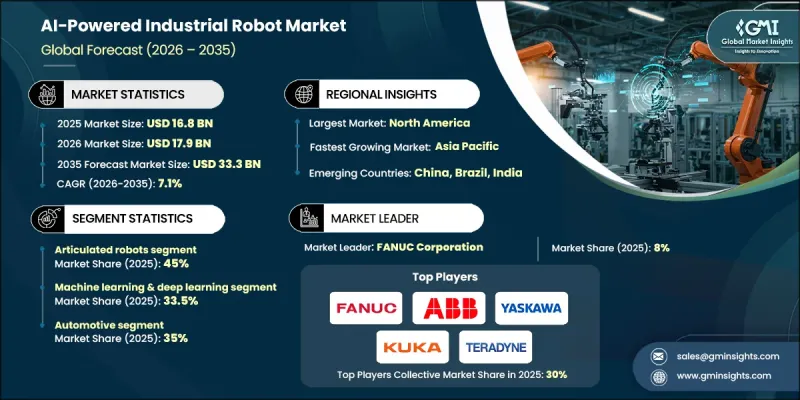
這一成長主要得益於軟體定義自動化技術的快速發展以及機器人系統中先進智慧的日益普及。製造商正從傳統的固定式自動化轉向能夠即時學習和最佳化的自適應、以數據為中心的機器人平台。透過併購實現的市場整合正在加速技術進步,並增強全球部署能力。人工智慧驅動的機器人能夠持續分析營運和環境數據,從而提高整個生產環境的效率、柔軟性和回應能力。這一轉變與全球向客製化、可變生產模式的轉變密切相關。對智慧工廠計畫的投資增加、已開發市場擴大回流以及多個地區自動化支出的成長,都有助於提高人工智慧驅動的工業機器人的商業性可行性,並增強其長期市場發展勢頭。
| 市場範圍 | |
|---|---|
| 開始年份 | 2025 |
| 預測年份 | 2026-2035 |
| 起始值 | 168億美元 |
| 預測金額 | 333億美元 |
| 複合年成長率 | 7.1% |
預計到2025年,關節型機器人將佔據45%的市場。該領域的需求主要源自於對高操作精度、多方向柔軟性和智慧路徑最佳化的要求。這些系統能夠處理複雜的操作任務,同時保持穩定的效能和擴充性,因此持續吸引投資並鞏固其強大的市場地位。
預計到2025年,機器學習和深度學習領域將佔據33.5%的市場佔有率,並創造56億美元的市場規模。隨著製造商日益重視自主決策、持續改善和預測系統智慧,該領域正引領相關技術的應用。先進的學習演算法使機器人能夠適應不斷變化的環境,隨著時間的推移提高準確性,並支援數據驅動的營運策略。
預計到2025年,北美人工智慧驅動的工業機器人市場規模將達到53億美元,並在2035年之前以7.3%的複合年成長率成長。美國佔該地區市場收入的84%以上,這得益於其強大的製造業能力和旨在增強國內生產韌性的戰略舉措。對先進人工智慧軟體和自主系統智慧的需求持續推動著全部區域人工智慧技術的應用。
目錄
第1章:調查方法和範圍
第2章執行摘要
第3章業界考察
- 生態系分析
- 供應商情況
- 利潤率
- 每個階段增加的價值
- 影響價值鏈的因素
- 影響產業的因素
- 促進因素
- 青年和婦女的參與度提高
- 勞動力短缺和回流
- 生成式人工智慧與大規模語言模式(LLM)的融合
- IT/OT整合
- 產業潛在風險與挑戰
- 高階整合的複雜性
- 資料隱私和網路安全
- 機會
- 機器人即服務 (RaaS)
- 人類通用機器人
- 促進因素
- 成長潛力分析
- 未來市場趨勢
- 技術與創新展望
- 當前技術趨勢
- 新興技術
- 價格趨勢
- 按地區
- 按機器人類型
- 監理情勢
- 標準和合規要求
- 區域法規結構
- 認證標準
- 波特五力分析
- PESTEL 分析
第4章 競爭情勢
- 介紹
- 企業市佔率分析
- 按地區
- 公司矩陣分析
- 主要市場公司的競爭分析
- 競爭定位矩陣
- 主要進展
- 併購
- 夥伴關係與合作
- 新產品發布
- 擴張計劃
第5章 市場估價與預測:依機器人類型分類,2022-2035年
- 關節機器人
- SCARA機器人
- Delta機器人
- 其他
第6章 市場估計與預測:依技術分類,2022-2035年
- 機器學習和深度學習
- 電腦視覺成像
- 自然語言處理(NLP)
- 其他
第7章 市場估計與預測:依應用領域分類,2022-2035年
- 組裝和物料輸送
- 焊接和機械加工
- 包裝和托盤堆垛
- 品質檢測和視覺系統
- 物流/倉儲管理
- 油漆和塗層
- 其他
第8章 市場估算與預測:依最終使用者分類,2022-2035年
- 車
- 電子電器設備
- 食品/飲料
- 藥品和醫療保健
- 消費品
- 物流/倉儲業
- 其他
第9章 市場估計與預測:依地區分類,2022-2035年
- 北美洲
- 美國
- 加拿大
- 歐洲
- 德國
- 英國
- 法國
- 義大利
- 西班牙
- 亞太地區
- 中國
- 日本
- 印度
- 澳洲
- 韓國
- 拉丁美洲
- 巴西
- 墨西哥
- 阿根廷
- 中東和非洲
- 南非
- 沙烏地阿拉伯
- 阿拉伯聯合大公國
第10章:公司簡介
- ABB Ltd
- Agility Robotics, Inc.
- Boston Dynamics, Inc.
- FANUC Corporation
- Figure AI, Inc.
- Kawasaki Heavy Industries Ltd.
- Keyence Corporation
- KUKA SE & Co. KGaA
- NVIDIA Corporation
- Omron Corporation
- Standard Bots
- Symbiotic Inc.
- Teradyne, Inc.
- Tesla, Inc.
- Yaskawa Electric Corporation
The AI-Powered Industrial Robot Market was valued at USD 16.8 billion in 2025 and is estimated to grow at a CAGR of 7.1% to reach USD 33.3 billion by 2035.
Growth is driven by rapid progress in software-defined automation and the increasing use of advanced intelligence within robotic systems. Manufacturers are shifting away from traditional fixed automation toward adaptive, data-centric robotic platforms capable of real-time learning and optimization. Market consolidation through mergers and acquisitions is accelerating technological advancement and strengthening global deployment capabilities. AI-enabled robots that continuously analyze operational and environmental data enable higher efficiency, flexibility, and responsiveness across production environments. This transition aligns closely with the global shift toward customized, variable-output manufacturing models. Rising investment in smart factory initiatives, growing reshoring efforts in developed markets, and increased automation spending across multiple regions are collectively improving the commercial viability of AI-powered industrial robotics and reinforcing long-term market momentum.
| Market Scope | |
|---|---|
| Start Year | 2025 |
| Forecast Year | 2026-2035 |
| Start Value | $16.8 Billion |
| Forecast Value | $33.3 Billion |
| CAGR | 7.1% |
The articulated robots segment held 45% share in 2025. Demand for this segment is supported by requirements for advanced motion precision, multi-directional flexibility, and intelligent path optimization. These systems continue to attract investment due to their ability to handle complex operational tasks while maintaining consistent performance and scalability, reinforcing their strong market position.
The machine learning and deep learning segment held a 33.5% share in 2025 and generated USD 5.6 billion. This segment leads adoption as manufacturers increasingly prioritize autonomous decision-making, continuous improvement, and predictive system intelligence. Advanced learning algorithms enable robots to adapt to changing conditions, improve accuracy over time, and support data-driven operational strategies.
North America AI-Powered Industrial Robot Market reached USD 5.3 billion in 2025 and will grow at a CAGR of 7.3% through 2035. The U.S. accounted for more than 84% of regional revenue, supported by strong manufacturing capabilities and strategic initiatives focused on domestic production resilience. Demand for advanced AI software and autonomous system intelligence continues to support widespread adoption across the region.
Key companies operating in the Global AI-Powered Industrial Robot Market include FANUC Corporation, ABB Ltd, KUKA SE & Co. KGaA, Yaskawa Electric Corporation, Kawasaki Heavy Industries Ltd., NVIDIA Corporation, Omron Corporation, Teradyne, Inc., Boston Dynamics, Inc., Tesla, Inc., Figure AI, Inc., Agility Robotics, Inc., Symbiotic Inc., Standard Bots, and Keyence Corporation. Companies in the AI-powered industrial robot market focus on technological leadership, ecosystem expansion, and strategic collaboration to strengthen their market position. Significant investment is directed toward AI software development, advanced sensing, and real-time analytics to enhance robot intelligence and adaptability. Partnerships and acquisitions are used to broaden capabilities and accelerate innovation cycles. Firms emphasize modular, scalable platforms to support diverse operational needs and faster deployment. Expansion into new geographic markets and localized support networks improves customer reach. Strong focus on reliability, system interoperability, and long-term service offerings helps build trust and sustain competitive advantage.
Table of Contents
Chapter 1 Methodology and Scope
- 1.1 Market scope and definition
- 1.2 Research design
- 1.2.1 Research approach
- 1.2.2 Data collection methods
- 1.3 Data mining sources
- 1.3.1 Global
- 1.3.2 Regional/Country
- 1.4 Base estimates and calculations
- 1.4.1 Base year calculation
- 1.4.2 Key trends for market estimation
- 1.5 Primary research and validation
- 1.5.1 Primary sources
- 1.6 Forecast model
- 1.7 Research assumptions and limitations
Chapter 2 Executive Summary
- 2.1 Industry 360° synopsis
- 2.2 Key market trends
- 2.2.1 Regional
- 2.2.2 Robot Type
- 2.2.3 Price
- 2.3 CXO perspectives: Strategic imperatives
- 2.3.1 Key decision points for industry executives
- 2.3.2 Critical success factors for market players
- 2.4 Future outlook and strategic recommendations
Chapter 3 Industry Insights
- 3.1 Industry ecosystem analysis
- 3.1.1 Supplier landscape
- 3.1.2 Profit margin
- 3.1.3 Value addition at each stage
- 3.1.4 Factor affecting the value chain
- 3.2 Industry impact forces
- 3.2.1 Growth drivers
- 3.2.1.1 Rising Participation Among Youth & Women
- 3.2.1.2 Labor shortages & reshoring
- 3.2.1.3 Generative AI & LLM Integration
- 3.2.1.4 IT/OT Convergence
- 3.2.2 Industry pitfalls & challenges
- 3.2.2.1 High Integration Complexity
- 3.2.2.2 Data Privacy & Cybersecurity
- 3.2.3 Opportunities
- 3.2.3.1 Robot-as-a-Service (RaaS)
- 3.2.3.2 Humanoid General-Purpose Robots
- 3.2.1 Growth drivers
- 3.3 Growth potential analysis
- 3.4 Future market trends
- 3.5 Technology and innovation landscape
- 3.5.1 Current technological trends
- 3.5.2 Emerging technologies
- 3.6 Price trends
- 3.6.1 By region
- 3.6.2 By Robot type
- 3.7 Regulatory landscape
- 3.7.1 Standards and compliance requirements
- 3.7.2 Regional regulatory frameworks
- 3.7.3 Certification standards
- 3.8 Porter's analysis
- 3.9 PESTEL analysis
Chapter 4 Competitive Landscape, 2025
- 4.1 Introduction
- 4.2 Company market share analysis
- 4.2.1 By region
- 4.2.1.1 North America
- 4.2.1.2 Europe
- 4.2.1.3 Asia Pacific
- 4.2.1.4 Latin America
- 4.2.1.5 Middle East and Africa
- 4.2.1 By region
- 4.3 Company matrix analysis
- 4.4 Competitive analysis of major market players
- 4.5 Competitive positioning matrix
- 4.6 Key developments
- 4.6.1 Mergers & acquisitions
- 4.6.2 Partnerships & collaborations
- 4.6.3 New product launches
- 4.6.4 Expansion plans
Chapter 5 Market Estimates and Forecast, By Robot Type, 2022 - 2035 (USD Billion) (Thousand Units)
- 5.1 Key trends
- 5.2 Articulated Robots
- 5.3 SCARA Robots
- 5.4 Delta Robots
- 5.5 Others
Chapter 6 Market Estimates and Forecast, By Technology, 2022 - 2035 (USD Billion) (Thousand Units)
- 6.1 Key trends
- 6.2 Machine Learning & Deep Learning
- 6.3 Computer Vision & Imaging
- 6.4 Natural Language Processing (NLP)
- 6.5 Others
Chapter 7 Market Estimates and Forecast, By Application, 2022 - 2035 (USD Billion) (Thousand Units)
- 7.1 Key trends
- 7.2 Assembly & Material Handling
- 7.3 Welding & Machining
- 7.4 Packaging & Palletizing
- 7.5 Quality Inspection & Vision Systems
- 7.6 Logistics & Warehousing
- 7.7 Painting & Coating
- 7.8 Others
Chapter 8 Market Estimates and Forecast, By End User, 2022 - 2035 (USD Billion) (Thousand Units)
- 8.1 Key trends
- 8.2 Automotive
- 8.3 Electronics & Electrical
- 8.4 Food & Beverage
- 8.5 Pharmaceuticals & Healthcare
- 8.6 Consumer Goods
- 8.7 Logistics & Warehousing
- 8.8 Others
Chapter 9 Market Estimates and Forecast, By Region, 2022 - 2035 (USD Billion) (Thousand Units)
- 9.1 Key trends
- 9.2 North America
- 9.2.1 U.S.
- 9.2.2 Canada
- 9.3 Europe
- 9.3.1 Germany
- 9.3.2 UK
- 9.3.3 France
- 9.3.4 Italy
- 9.3.5 Spain
- 9.4 Asia Pacific
- 9.4.1 China
- 9.4.2 Japan
- 9.4.3 India
- 9.4.4 Australia
- 9.4.5 South Korea
- 9.5 Latin America
- 9.5.1 Brazil
- 9.5.2 Mexico
- 9.5.3 Argentina
- 9.6 Middle East and Africa
- 9.6.1 South Africa
- 9.6.2 Saudi Arabia
- 9.6.3 UAE
Chapter 10 Company Profiles
- 10.1 ABB Ltd
- 10.2 Agility Robotics, Inc.
- 10.3 Boston Dynamics, Inc.
- 10.4 FANUC Corporation
- 10.5 Figure AI, Inc.
- 10.6 Kawasaki Heavy Industries Ltd.
- 10.7 Keyence Corporation
- 10.8 KUKA SE & Co. KGaA
- 10.9 NVIDIA Corporation
- 10.10 Omron Corporation
- 10.11 Standard Bots
- 10.12 Symbiotic Inc.
- 10.13 Teradyne, Inc.
- 10.14 Tesla, Inc.
- 10.15 Yaskawa Electric Corporation

 人工智慧驅動的工業機器人市場預測至2034年——全球產品、機器人類型、部署模式、技術、最終用戶和區域分析
 2026年全球表面目視檢測市場報告
 表面視覺與檢測市場 - 全球產業規模、佔有率、趨勢、機會及預測(按組件、應用、地區和競爭格局分類,2021-2031年)
 表面視覺與檢測市場(按組件、技術、類型、應用、最終用途產業和部署模式)—全球預測 2025-20322032 年人工智慧工業視覺市場預測:按組件、部署模式、技術、應用、最終用戶和地區進行的全球分析標籤檢測機市場預測(至 2032 年):按產品類型、組件、機器類型、技術、應用、最終用戶和地區進行的全球分析
 表面視覺與檢測設備:市場佔有率分析、產業趨勢與統計、成長預測(2025-2030)
 表面視覺檢測市場:按組件、類型、應用和地區分類
 表面視覺和檢測市場規模、佔有率、趨勢分析報告:按組件、按表麵類型、按系統、按應用、按地區、細分市場預測,2024-2030 年