

 |
市場調查報告書
商品編碼
1959299
K-12雙語沉浸式教育市場機會、成長要素、產業趨勢分析及預測(2026-2035年)K-12 Dual Language Immersion Market Opportunity, Growth Drivers, Industry Trend Analysis, and Forecast 2026 - 2035 |
||||||

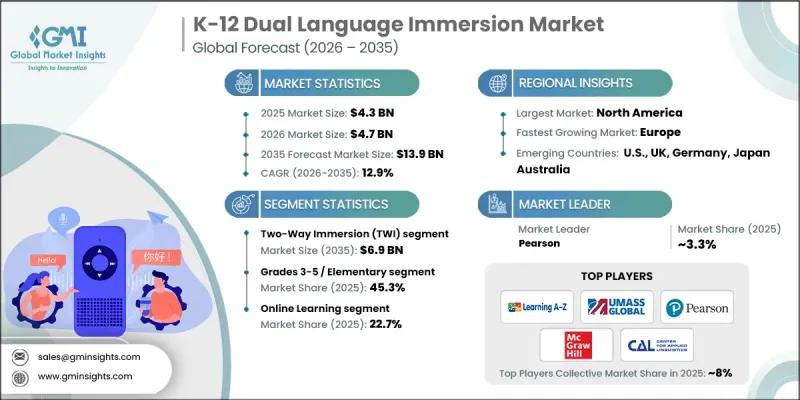
2025 年全球 K-12 雙語沉浸式教育市場價值 43 億美元,預計到 2035 年將達到 139 億美元,年複合成長率為 12.9%。
市場擴張的驅動力在於人們日益認知到雙語和雙語讀寫能力是重要的學術、社交和職業優勢。學校系統、私立機構和特許學校正在加速將雙語沉浸式課程融入K-12課程體系,以提高語言能力,促進認知發展和跨文化理解。全球的普及速度正在加快,這得益於家長對具有全球視野的人才的需求不斷成長,以及政府政策對多語言教育的重視。對雙語教師培訓、課程開發和數位化學習工具的投資進一步提升了課程的品質和擴充性。公共教育系統正在各年級推廣雙語課程,而社區參與和政策協調則持續支持雙語課程的長期發展。隨著全球化的推進和教育系統對適應國際社會能力的日益重視,雙語沉浸式課程正成為現代K-12教育策略的核心要素。
| 市場範圍 | |
|---|---|
| 開始年份 | 2025 |
| 預測年份 | 2026-2035 |
| 起始金額 | 43億美元 |
| 預測金額 | 139億美元 |
| 複合年成長率 | 12.9% |
預計2035年,互動沉浸式教育市場規模將達69億美元。這個市場的成長主要得益於人們對包容性雙語教育模式的日益關注,這種模式旨在讓母語者和非母語者在同一課堂環境中學習。這些項目因其能夠促進均衡的語言能力、文化理解和學業成績的提升而廣泛應用。支持性的教育政策和強大的社區計劃持續推動著這一領域的發展,尤其是在文化多元的地區,雙語教育與人口需求和長期勞動力發展目標相契合。
到2025年,小學3-5年級市場將佔據45.3%的佔有率,這反映出市場對早期雙語讀寫能力培養的強勁需求。小學階段的沉浸式課程在核心學科學習的同時,培養學生的基礎語言技能,從而幫助其長期的學業成就。早期接觸雙語教學能提升學習效果,並持續推動全球公立和私立教育系統採用雙語教學模式。
預計到2025年,北美K-12雙語沉浸式教育市場將佔據34.7%的市場。這一區域成長的驅動力包括多語言學生人數的增加、有利的教育政策以及對雙語畢業生的強勁需求。此外,全部區域成熟的公立、私立和特許學校體係也進一步促進了市場的持續擴張。
目錄
第1章:調查方法和範圍
第2章執行摘要
第3章業界考察
- 生態系分析
- 供應商情況
- 利潤率分析
- 成本結構
- 每個階段增加的價值
- 影響價值鏈的因素
- 中斷
- 影響產業的因素
- 促進因素
- 對雙語和雙語讀寫能力的需求日益成長。
- 教育與勞動力全球化
- 數位學習資源的廣泛應用
- 國際磁校的擴張
- 透過雙重學習(DLI)取得的高學業成就
- 產業潛在風險與挑戰
- 合格雙語教師短缺
- 課程發展的複雜性
- 市場機遇
- 教師培訓和認證服務的發展
- 未開發市場中快速發展的教育體系
- 促進因素
- 監理情勢
- 北美洲
- 歐洲
- 亞太地區
- 拉丁美洲
- 中東和非洲
- 波特的分析
- PESTEL 分析
- 科技與創新趨勢
- 當前技術趨勢
- 新興技術
- 新興經營模式
- 合規要求
- 專利和智慧財產權分析
- 地緣政治和貿易趨勢
第4章 競爭情勢
- 介紹
- 企業市佔率分析
- 按地區
- 北美洲
- 歐洲
- 亞太地區
- 拉丁美洲
- 中東和非洲
- 按地區
- 主要企業的競爭標竿分析
- 財務績效比較
- 收入
- 利潤率
- 研究與開發
- 產品系列比較
- 產品線廣度
- 科技
- 創新
- 地理位置比較
- 全球擴張分析
- 服務網路覆蓋
- 按地區分類的市場滲透率
- 競爭定位矩陣
- 領導者
- 挑戰者
- 追蹤者
- 小眾玩家
- 戰略展望矩陣
- 財務績效比較
- 2021-2024 年重大發展
- 併購
- 夥伴關係與合作
- 技術進步
- 擴張和投資策略
- 數位轉型計劃
- 新興/Start-Ups競爭對手的發展趨勢
第5章 市場估計與預測:依提供的語言分類,2022-2035年
- 西班牙語
- 法語
- 德文
- 中國人
- 日本人
- 葡萄牙語
- 夏威夷語
- 韓國人
- 俄文
- 義大利語
- 其他
第6章 市場估計與預測:依專案模式分類,2022-2035年
- 雙向沉浸式(TWI)
- 單向沉浸式(OWI)
- 母語沉浸式教育(HLI)(FMCW)
第7章 市場估計與預測:依學年分類,2022-2035年
- 幼兒園至小學二年級
- 小學學生(3-5年級)
- 6-8年級/國中
- 9-12年級/高中
第8章 市場估算與預測:以交付方式分類,2022-2035年
- 傳統課堂學習
- 線上學習
- 混合式學習模型
第9章 市場估計與預測:依教育機構類型分類,2022-2035年
- 走廊公立學校
- 私立學校
- 特許學校
- 在家教育/獨立學習者
第10章 市場估價與預測:依地區分類,2022-2035年
- 北美洲
- 美國
- 加拿大
- 歐洲
- 德國
- 英國
- 法國
- 西班牙
- 義大利
- 荷蘭
- 亞太地區
- 中國
- 印度
- 日本
- 澳洲
- 韓國
- 拉丁美洲
- 巴西
- 墨西哥
- 阿根廷
- 中東和非洲
- 南非
- 沙烏地阿拉伯
- 阿拉伯聯合大公國
第11章:公司簡介
- Learning AZ
- UMASS GLOBAL
- Goethe-Institut
- Pearson
- McGraw Hill, Inc
- Houghton Mifflin Harcourt(HMH)
- Imagine Learning LLC.
- Cengage Learning, Inc.
- Avant Assessment
- ACTFL
- Center for Applied Linguistics(CAL)
- Dual Language Education of New Mexico
- East Carolina University College of Education
- Washington State University
- Scholastic Corporation
- Renaissance Learning, Inc.
- IXL Learning
The Global K-12 Dual Language Immersion Market was valued at USD 4.3 billion in 2025 and is estimated to grow at a CAGR of 12.9% to reach USD 13.9 billion by 2035.
Market expansion is driven by the growing recognition of bilingual and biliterate skills as essential academic, social, and professional advantages. School systems, private education providers, and charter institutions are increasingly embedding dual language immersion programs into mainstream K-12 curricula to strengthen language proficiency while supporting cognitive development and cross-cultural understanding. Rising parental demand for globally prepared students, combined with government initiatives focused on multilingual education, is accelerating adoption worldwide. Investments in bilingual teacher preparation, curriculum development, and digital learning tools are further enhancing program quality and scalability. Public education systems are expanding program availability across grade levels, while community engagement and policy alignment continue to support long-term growth. As globalization increases and education systems prioritize global readiness, dual language immersion programs are becoming a core component of modern K-12 education strategies.
| Market Scope | |
|---|---|
| Start Year | 2025 |
| Forecast Year | 2026-2035 |
| Start Value | $4.3 Billion |
| Forecast Value | $13.9 Billion |
| CAGR | 12.9% |
The two-way immersion segment is expected to reach USD 6.9 billion by 2035. Growth in this segment is supported by increasing emphasis on inclusive bilingual education models that serve both native and non-native language learners within the same classroom environment. These programs are widely adopted for their ability to promote balanced language proficiency, cultural awareness, and improved academic outcomes. Supportive education policies and strong community advocacy continue to reinforce expansion, particularly in culturally diverse regions where bilingual instruction aligns with demographic needs and long-term workforce goals.
The grades 3-5 elementary segment accounted for 45.3% share in 2025, reflecting strong demand for early bilingual literacy development. Immersion programs at the elementary level focus on building foundational language skills alongside core academic subjects, supporting long-term educational achievement. Early exposure to dual language instruction enhances learning outcomes and continues to drive global adoption across public and private education systems.
North America K-12 Dual Language Immersion Market held a 34.7% share in 2025. Regional growth is supported by rising multilingual student populations, favorable education policies, and strong demand for bilingual graduates. The presence of well-established public, private, and charter school systems further contributes to consistent market expansion across the region.
Key organizations operating in the Global K-12 Dual Language Immersion Market include Pearson, Scholastic Corporation, McGraw Hill, Inc., Houghton Mifflin Harcourt (HMH), Learning A-Z, Imagine Learning LLC., Renaissance Learning, Inc., IXL Learning, Cengage Learning, Inc., Avant Assessment, ACTFL, UMASS Global, Goethe-Institut, Center for Applied Linguistics (CAL), Dual Language Education of New Mexico, East Carolina University College of Education, and Washington State University. Companies in the K-12 dual language immersion market are strengthening their market position through curriculum innovation, digital learning integration, and strategic partnerships with school districts. Many players are investing in adaptive learning platforms, assessment tools, and teacher training resources to enhance instructional effectiveness. Expansion of bilingual content libraries and alignment with education standards help support large-scale adoption. Organizations are also focusing on professional development programs to address teacher shortages in bilingual education.
Table of Contents
Chapter 1 Methodology and Scope
- 1.1 Market scope and definition
- 1.2 Research design
- 1.2.1 Research approach
- 1.2.2 Data collection methods
- 1.3 Data mining sources
- 1.3.1 Global
- 1.3.2 Regional/Country
- 1.4 Base estimates and calculations
- 1.4.1 Base year calculation
- 1.4.2 Key trends for market estimation
- 1.5 Primary research and validation
- 1.5.1 Primary sources
- 1.6 Forecast model
- 1.7 Research assumptions and limitations
Chapter 2 Executive Summary
- 2.1 Industry 360° synopsis, 2022 - 2035
- 2.2 Key market trends
- 2.2.1 System type trends
- 2.2.2 Deployment model trends
- 2.2.3 End-user industry trends
- 2.2.4 Regional trends
- 2.3 TAM analysis, 2026-2035
- 2.4 CXO perspectives: Strategic imperatives
- 2.4.1 Executive decision points
- 2.4.2 Critical success factors
- 2.5 Future outlook and strategic recommendations
Chapter 3 Industry Insights
- 3.1 Industry ecosystem analysis
- 3.1.1 Supplier landscape
- 3.1.2 Profit margin analysis
- 3.1.3 Cost structure
- 3.1.4 Value addition at each stage
- 3.1.5 Factor affecting the value chain
- 3.1.6 Disruptions
- 3.2 Industry impact forces
- 3.2.1 Growth drivers
- 3.2.1.1 Rising demand for bilingual & biliterate graduates
- 3.2.1.2 Globalization of education & workforce
- 3.2.1.3 Rising availability of digital learning resources
- 3.2.1.4 Expansion of international & magnet schools
- 3.2.1.5 Strong academic outcomes linked to DLI
- 3.2.2 Industry pitfalls and challenges
- 3.2.2.1 Shortage of qualified bilingual teachers
- 3.2.2.2 Curriculum development complexity
- 3.2.3 Market opportunities
- 3.2.3.1 Growth in teacher training and credentialing services
- 3.2.3.2 Rapidly developing education systems in underpenetrated markets
- 3.2.1 Growth drivers
- 3.3 Regulatory landscape
- 3.3.1 North America
- 3.3.2 Europe
- 3.3.3 Asia Pacific
- 3.3.4 Latin America
- 3.3.5 Middle East & Africa
- 3.4 Porter’s analysis
- 3.5 PESTEL analysis
- 3.6 Technology and innovation landscape
- 3.6.1 Current technological trends
- 3.6.2 Emerging technologies
- 3.7 Emerging business models
- 3.8 Compliance requirements
- 3.9 Patent and IP analysis
- 3.10 Geopolitical and trade dynamics
Chapter 4 Competitive Landscape, 2024
- 4.1 Introduction
- 4.2 Company market share analysis
- 4.2.1 By region
- 4.2.1.1 North America
- 4.2.1.2 Europe
- 4.2.1.3 Asia Pacific
- 4.2.1.4 Latin America
- 4.2.1.5 Middle East & Africa
- 4.2.1 By region
- 4.3 Competitive benchmarking of key players
- 4.3.1 Financial performance comparison
- 4.3.1.1 Revenue
- 4.3.1.2 Profit margin
- 4.3.1.3 R&D
- 4.3.2 Product portfolio comparison
- 4.3.2.1 Product range breadth
- 4.3.2.2 Technology
- 4.3.2.3 Innovation
- 4.3.3 Geographic presence comparison
- 4.3.3.1 Global footprint analysis
- 4.3.3.2 Service network coverage
- 4.3.3.3 Market penetration by region
- 4.3.4 Competitive positioning matrix
- 4.3.4.1 Leaders
- 4.3.4.2 Challengers
- 4.3.4.3 Followers
- 4.3.4.4 Niche players
- 4.3.5 Strategic outlook matrix
- 4.3.1 Financial performance comparison
- 4.4 Key developments, 2021-2024
- 4.4.1 Mergers and acquisitions
- 4.4.2 Partnerships and collaborations
- 4.4.3 Technological advancements
- 4.4.4 Expansion and investment strategies
- 4.4.5 Digital transformation initiatives
- 4.5 Emerging/ startup competitors’ landscape
Chapter 5 Market Estimates and Forecast, By Language Offered, 2022 - 2035 (USD Mn)
- 5.1 Key trends
- 5.2 Spanish
- 5.3 French
- 5.4 German
- 5.5 Chinese
- 5.6 Japanese
- 5.7 Portuguese
- 5.8 Hawaiian
- 5.9 Korean
- 5.10 Russian
- 5.11 Italian
- 5.12 Others
Chapter 6 Market Estimates and Forecast, By Program Model, 2022 - 2035 (USD Mn)
- 6.1 Key trends
- 6.2 Two-Way Immersion (TWI)
- 6.3 One-Way Immersion (OWI)
- 6.4 Heritage Language Immersion (HLI) (FMCW)
Chapter 7 Market Estimates and Forecast, By Grade Level, 2022 - 2035 (USD Mn)
- 7.1 Key trends
- 7.2 Pre-K to Grade 2
- 7.3 Grades 3-5 / Elementary
- 7.4 Grades 6-8 / Middle School
- 7.5 Grades 9-12 / High School
Chapter 8 Market Estimates and Forecast, By Delivery Model, 2022 - 2035 (USD Mn)
- 8.1 Key trends
- 8.2 Traditional Classroom-based Learning
- 8.3 Online Learning
- 8.4 Hybrid Models Learning
Chapter 9 Market Estimates and Forecast, By Institution Type, 2022 - 2035 (USD Mn)
- 9.1 Key trends
- 9.2 Corridor Public Schools
- 9.3 Private Schools
- 9.4 Charter Schools
- 9.5 Home Schooling & Individual Learners
Chapter 10 Market Estimates and Forecast, By Region, 2022 - 2035 (USD Mn)
- 10.1 Key trends
- 10.2 North America
- 10.2.1 U.S.
- 10.2.2 Canada
- 10.3 Europe
- 10.3.1 Germany
- 10.3.2 UK
- 10.3.3 France
- 10.3.4 Spain
- 10.3.5 Italy
- 10.3.6 Netherlands
- 10.4 Asia Pacific
- 10.4.1 China
- 10.4.2 India
- 10.4.3 Japan
- 10.4.4 Australia
- 10.4.5 South Korea
- 10.5 Latin America
- 10.5.1 Brazil
- 10.5.2 Mexico
- 10.5.3 Argentina
- 10.6 Middle East and Africa
- 10.6.1 South Africa
- 10.6.2 Saudi Arabia
- 10.6.3 UAE
Chapter 11 Company Profiles
- 11.1 Learning A-Z
- 11.2 UMASS GLOBAL
- 11.3 Goethe-Institut
- 11.4 Pearson
- 11.5 McGraw Hill, Inc
- 11.6 Houghton Mifflin Harcourt (HMH)
- 11.7 Imagine Learning LLC.
- 11.8 Cengage Learning, Inc.
- 11.9 Avant Assessment
- 11.10 ACTFL
- 11.11 Center for Applied Linguistics (CAL)
- 11.12 Dual Language Education of New Mexico
- 11.13 East Carolina University College of Education
- 11.14 Washington State University
- 11.15 Scholastic Corporation
- 11.16 Renaissance Learning, Inc.
- 11.17 IXL Learning

 2026年K-12雙語沉浸式教育全球市場報告
 語言學習市場:預測至 2034 年 - 按學習模式、語言、課程類型、交付模式、經營模式、最終用戶和地區分類的全球分析
 2026-2030年全球商務英語語言培訓市場
 全球外語學習市場規模、佔有率、趨勢和成長分析報告(2026-2034)語言學習和溝通技巧平台市場預測至2034年:按組成部分、學習形式、語言類型、最終用戶、應用和地區分類的全球分析
 講師主導語言培訓:市場佔有率分析、行業趨勢和統計數據、成長預測(2026-2031 年)雲端英語學習:市場佔有率分析、產業趨勢與統計及成長預測(2026-2031)
 基於雲端的語言學習市場:按培訓類型、語言和地區分類
 阿拉伯語學習市場:依學習風格、年齡層、學習目標、定價模式和學習者類型分類-2026-2032年全球市場預測
 語言學習應用市場規模、佔有率和成長分析:按語言類型、部署模式、技術類型、收入模式、內容類型、使用者類型和地區分類 - 2026-2033 年產業預測