


 |
市場調查報告書
商品編碼
1959289
植物來源酪蛋白替代品市場機會、成長要素、產業趨勢分析及預測(2026-2035年)Plant-based Casein Analogs Market Opportunity, Growth Drivers, Industry Trend Analysis, and Forecast 2026 - 2035 |
||||||

2025年全球植物來源酪蛋白替代品市值為17.7億美元,預計2035年將以22.5%的複合年成長率成長至132.7億美元。
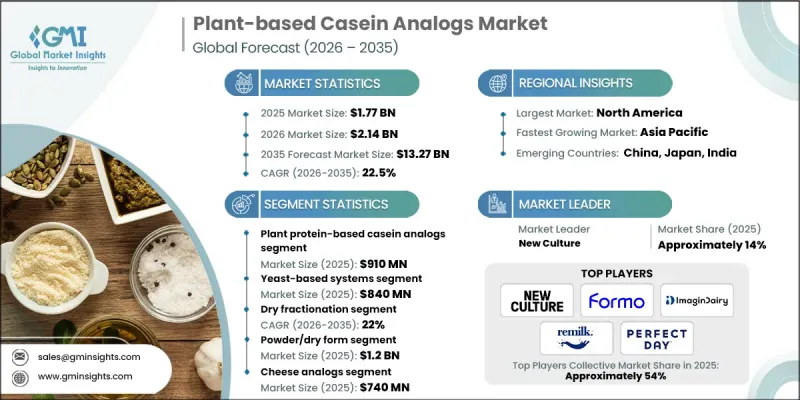
全球植物來源和純素飲食的加速普及推動了整個市場的持續成長。消費者越來越重視符合道德規範的採購、環境責任和低碳影響,促使他們逐漸拋棄乳製品蛋白。食品製造商正積極回應,重新設計產品,採用植物來源酪蛋白替代品,以滿足消費者對潔淨標示和負責任採購標準的期望。健康因素也發揮重要作用,人們對乳糖不耐症、乳蛋白質過敏和膽固醇管理的擔憂持續影響購買行為。植物來源酪蛋白替代品在提供功能性蛋白質性能的同時,避免了傳統乳製品酪蛋白常見的消化器官系統和過敏相關問題。人們對高蛋白、功能性營養的日益關注,進一步推動了包括純素、彈性素食者和注重健康的人群在內的更廣泛消費群體對植物性酪蛋白替代品的接受度。蛋白質萃取、發酵和配方技術的不斷改進顯著提升了植物性酪蛋白替代品的功能性,使其能夠應用於各種先進的乳製品替代品,同時又不影響其質地或性能。
| 市場範圍 | |
|---|---|
| 開始年份 | 2025 |
| 預測年份 | 2026-2035 |
| 起始金額 | 17.7億美元 |
| 預測金額 | 132.7億美元 |
| 複合年成長率 | 22.5% |
預計到2025年,酵母基系統市場將創造8.4億美元的收入,並在2026年至2035年間以21.9%的複合年成長率成長。該市場持續成長的動力源於其與現有食品級發酵基礎設施的高度相容性以及可擴展的生產模式。製造商受益於穩定的加工條件和可預測的蛋白質質量,從而支持可靠的商業化生產。同時,替代微生物系統的創新正在拓展生產途徑,使供應商能夠提高生產速度、成本效益和蛋白質特異性。這些進步正在推動產量管理和生產經濟性最佳化策略的重組。
2025年,乾式分餾市場規模預計達到6.6億美元,並預計在2035年之前以22%的複合年成長率成長。乾式分餾透過減少用水量和提高製作流程效率,支持永續性生產。該方法與優先考慮效率和環境績效的不斷發展的製造模式高度契合。乾式分餾正擴大應用於需要均衡功能的領域。同時,濕法萃取方法繼續為對純度和性能要求更高的應用提供支援。製程效率和產品特定利用率的不斷提高,正在增強這兩種方法的競爭力。
預計2025年,北美植物來源酪蛋白替代品市場規模將達到6.5億美元,並在預測期內保持強勁成長。先進的食品加工技術、強大的創新生態系統以及消費者對乳製品替代品的高接受度,都為該地區的擴張提供了支持。飲料、營養產品和改良乳製品替代品對功能性蛋白質的需求持續成長。在美國,產品改良工作主要集中在改善質地和感官特性,力求接近傳統乳製品的特性。製造商正在加速整合發酵衍生的酪蛋白替代品和混合蛋白解決方案,以滿足功能性能的要求。
目錄
第1章:調查方法
第2章執行摘要
第3章業界考察
- 生態系分析
- 供應商情況
- 利潤率
- 每個階段增加的價值
- 影響價值鏈的因素
- 中斷
- 影響產業的因素
- 促進因素
- 產業潛在風險與挑戰
- 市場機遇
- 成長潛力分析
- 監理情勢
- 北美洲
- 歐洲
- 亞太地區
- 拉丁美洲
- 中東和非洲
- 波特的分析
- PESTEL 分析
- 價格趨勢
- 按地區
- 依產品
- 未來市場趨勢
- 科技與創新趨勢
- 當前技術趨勢
- 新興技術
- 專利狀態
- 貿易統計(註:僅提供主要國家的貿易統計)
- 主要進口國
- 主要出口國
- 永續性和環境方面
- 永續計劃
- 減少廢棄物策略
- 生產中的能源效率
- 具有環保意識的舉措
- 碳足跡考量
第4章 競爭情勢
- 介紹
- 企業市佔率分析
- 按地區
- 北美洲
- 歐洲
- 亞太地區
- 拉丁美洲
- 中東和非洲
- 按地區
- 公司矩陣分析
- 主要市場公司的競爭分析
- 競爭定位矩陣
- 主要進展
- 併購
- 夥伴關係與合作
- 新產品發布
- 業務拓展計劃
第5章 市場估算與預測:依原料類型分類,2022-2035年
- 微發酵衍生的酪蛋白替代品
- 源自植物性蛋白質的酪蛋白替代品
- 豌豆蛋白
- 大豆蛋白
- 乳清蛋白
- 其他
- 混合配方
- 其他
第6章 市場估算與預測:依微生物宿主分類,2022-2035年
- 基於酵母的系統
- 細菌系統
- 真菌系統
- 其他
第7章 市場估算與預測:依加工技術分類,2022-2035年
- 乾分餾
- 濕式萃取
- 酵素處理與修飾
- 超臨界二氧化碳萃取
- 其他
第8章 市場估算與預測:依類型分類,2022-2035年
- 粉末/乾粉
- 濃縮液液
- 即用型製劑
第9章 市場估計與預測:依應用領域分類,2022-2035年
- 起司替代品
- 莫札瑞拉起司起司替代品
- 切達乾酪替代品
- 奶油乳酪替代品
- 特色起司替代品
- 優格和發酵乳替代品
- 牛奶飲料和咖啡伴侶
- 冰淇淋和冷凍甜點
- 麵包糖果甜點
- 其他
第10章 市場估價與預測:依地區分類,2022-2035年
- 北美洲
- 美國
- 加拿大
- 歐洲
- 德國
- 英國
- 法國
- 義大利
- 西班牙
- 其他歐洲地區
- 亞太地區
- 中國
- 印度
- 日本
- 澳洲
- 韓國
- 亞太其他地區
- 拉丁美洲
- 巴西
- 墨西哥
- 阿根廷
- 其他拉丁美洲地區
- 中東和非洲
- 沙烏地阿拉伯
- 南非
- 阿拉伯聯合大公國
- 其他中東和非洲地區
第11章:公司簡介
- Change Foods
- Eden Brew
- Formo
- Imagindairy
- New Culture
- Nobell Foods
- Perfect Day
- Remilk
- Standing Ovation
The Global Plant-based Casein Analogs Market was valued at USD 1.77 billion in 2025 and is estimated to grow at a CAGR of 22.5% to reach USD 13.27 billion by 2035.
Consistent growth across the market is driven by the accelerating adoption of plant-based and vegan dietary patterns worldwide. Consumers are increasingly prioritizing ethical sourcing, environmental responsibility, and lower carbon impact, which is encouraging a shift away from dairy-derived proteins. Food manufacturers are responding by reformulating products with plant-based casein analogs to align with clean-label expectations and responsible sourcing standards. Health considerations also play a major role, as concerns around lactose intolerance, milk protein sensitivities, and cholesterol management continue to influence purchasing behavior. Plant-based casein analogs provide functional protein performance while avoiding common digestive and allergen-related limitations associated with conventional dairy casein. Rising interest in high-protein and functional nutrition further supports market adoption across a broader consumer base that includes vegans, flexitarians, and health-focused individuals. Continuous improvements in protein extraction, fermentation, and formulation technologies are significantly enhancing functional properties, enabling wider application across advanced dairy-alternative formats without compromising texture or performance.
| Market Scope | |
|---|---|
| Start Year | 2025 |
| Forecast Year | 2026-2035 |
| Start Value | $1.77 Billion |
| Forecast Value | $13.27 Billion |
| CAGR | 22.5% |
The yeast-based systems segment generated USD 0.84 billion in 2025 and is projected to grow at a CAGR of 21.9% from 2026 to 2035. This segment continues to gain momentum due to strong compatibility with established food-grade fermentation infrastructure and scalable production models. Manufacturers benefit from consistent processing conditions and predictable protein quality, which supports reliable commercial output. At the same time, innovation in alternative microbial systems is diversifying production pathways, allowing suppliers to improve speed, cost efficiency, and protein specificity. These developments are reshaping optimization strategies across yield management and manufacturing economics.
The dry fractionation segment was valued at USD 0.66 billion in 2025 and is expected to grow at a CAGR of 22% through 2035. Adoption of dry fractionation supports sustainability-driven production by reducing water usage and streamlining processing steps. This method aligns well with evolving manufacturing models that emphasize efficiency and environmental performance. Dry fractionation is increasingly applied where balanced functionality is required, while wet extraction continues to support applications that demand higher purity and refined performance. Ongoing improvements in process efficiency and byproduct utilization are strengthening both approaches.
North America Plant-based Casein Analogs Market accounted for USD 0.65 billion in 2025 and is expected to record attractive growth over the forecast period. Regional expansion is supported by advanced food processing capabilities, strong innovation ecosystems, and high consumer acceptance of dairy alternatives. Demand continues to rise for functional proteins across beverages, nutrition-focused products, and reformulated dairy substitutes. In the U.S., product redevelopment efforts emphasize improved texture, sensory performance, and closer alignment with traditional dairy characteristics. Manufacturers increasingly integrate fermentation-derived casein analogs and hybrid protein solutions to address functional performance requirements.
Key companies operating in the Global Plant-based Casein Analogs Market include Perfect Day, Remilk, Formo, New Culture, Imagindairy, and other emerging innovators shaping the competitive landscape. Companies active in the plant-based casein analogs market pursue targeted strategies to strengthen market foothold and accelerate growth. Heavy investment in research and development enables continuous improvement in protein functionality, texture performance, and production scalability. Strategic partnerships with food brands and ingredient suppliers support faster commercialization and broader application reach. Many players focus on fermentation-based production to achieve consistency and cost efficiency while meeting clean-label expectations. Portfolio diversification across multiple food categories helps mitigate risk and expand addressable markets. Companies also prioritize regulatory alignment and transparent labeling to build consumer trust. Geographic expansion and capacity scaling further support long-term competitiveness and global market penetration.
Table of Contents
Chapter 1 Methodology
- 1.1 Market scope and definition
- 1.2 Research design
- 1.2.1 Research approach
- 1.2.2 Data collection methods
- 1.3 Data mining sources
- 1.3.1 Global
- 1.3.2 Regional/Country
- 1.4 Base estimates and calculations
- 1.4.1 Base year calculation
- 1.4.2 Key trends for market estimation
- 1.5 Primary research and validation
- 1.5.1 Primary sources
- 1.6 Forecast model
- 1.7 Research assumptions and limitations
Chapter 2 Executive Summary
- 2.1 Industry 360° synopsis
- 2.2 Key market trends
- 2.2.1 Regional
- 2.2.2 Source Type
- 2.2.3 Microbial Host
- 2.2.4 Processing Technology
- 2.2.5 Form
- 2.2.6 Application
- 2.3 TAM Analysis, 2026-2035
- 2.4 CXO perspectives: Strategic imperatives
- 2.4.1 Executive decision points
- 2.4.2 Critical success factors
- 2.5 Future Outlook and Strategic Recommendations
Chapter 3 Industry Insights
- 3.1 Industry ecosystem analysis
- 3.1.1 Supplier Landscape
- 3.1.2 Profit Margin
- 3.1.3 Value addition at each stage
- 3.1.4 Factor affecting the value chain
- 3.1.5 Disruptions
- 3.2 Industry impact forces
- 3.2.1 Growth drivers
- 3.2.2 Industry pitfalls and challenges
- 3.2.3 Market opportunities
- 3.3 Growth potential analysis
- 3.4 Regulatory landscape
- 3.4.1 North America
- 3.4.2 Europe
- 3.4.3 Asia Pacific
- 3.4.4 Latin America
- 3.4.5 Middle East & Africa
- 3.5 Porter’s analysis
- 3.6 PESTEL analysis
- 3.7 Price trends
- 3.7.1 By region
- 3.7.2 By product
- 3.8 Future market trends
- 3.9 Technology and Innovation landscape
- 3.9.1 Current technological trends
- 3.9.2 Emerging technologies
- 3.10 Patent Landscape
- 3.11 Trade statistics (Note: the trade statistics will be provided for key countries only)
- 3.11.1 Major importing countries
- 3.11.2 Major exporting countries
- 3.12 Sustainability and Environmental Aspects
- 3.12.1 Sustainable Practices
- 3.12.2 Waste Reduction Strategies
- 3.12.3 Energy Efficiency in Production
- 3.12.4 Eco-friendly Initiatives
- 3.13 Carbon Footprint Considerations
Chapter 4 Competitive Landscape, 2025
- 4.1 Introduction
- 4.2 Company market share analysis
- 4.2.1 By region
- 4.2.1.1 North America
- 4.2.1.2 Europe
- 4.2.1.3 Asia Pacific
- 4.2.1.4 LATAM
- 4.2.1.5 MEA
- 4.2.1 By region
- 4.3 Company matrix analysis
- 4.4 Competitive analysis of major market players
- 4.5 Competitive positioning matrix
- 4.6 Key developments
- 4.6.1 Mergers & acquisitions
- 4.6.2 Partnerships & collaborations
- 4.6.3 New Product Launches
- 4.6.4 Expansion Plans
Chapter 5 Market Estimates and Forecast, By Source Type, 2022- 2035 (USD Billion, Kilo Tons)
- 5.1 Key trends
- 5.2 Precision Fermentation-derived Casein Analogs
- 5.3 Plant Protein-based Casein Analogs
- 5.3.1 Pea Protein
- 5.3.2 Soy Protein
- 5.3.3 Whey Protein
- 5.3.4 Other plant proteins
- 5.4 Hybrid Formulations
- 5.5 Others
Chapter 6 Market Estimates and Forecast, By Microbial Host, 2022 - 2035 (USD Billion, Kilo Tons)
- 6.1 Key trends
- 6.2 Yeast-based Systems
- 6.3 Bacterial Systems
- 6.4 Fungal Systems
- 6.5 Others
Chapter 7 Market Estimates and Forecast, By Processing Technology, 2022 - 2035 (USD Billion, Kilo Tons)
- 7.1 Key trends
- 7.2 Dry Fractionation
- 7.3 Wet Extraction
- 7.4 Enzymatic Treatment & Modification
- 7.5 Supercritical CO2 Extraction
- 7.6 Others
Chapter 8 Market Estimates and Forecast, By Form, 2022 - 2035 (USD Billion, Kilo Tons)
- 8.1 Key trends
- 8.2 Powder/Dry Form
- 8.3 Liquid Concentrate
- 8.4 Ready-to-use Formulations
Chapter 9 Market Estimates and Forecast, By Application, 2022 - 2035 (USD Billion, Kilo Tons)
- 9.1 Key trends
- 9.2 Cheese Analogs
- 9.2.1 Mozzarella Analogs
- 9.2.2 Cheddar Analogs
- 9.2.3 Cream Cheese Analogs
- 9.2.4 Specialty Cheese Analogs
- 9.3 Yogurt & Fermented Dairy Analogs
- 9.4 Milk Beverages & Coffee Creamers
- 9.5 Ice Cream & Frozen Desserts
- 9.6 Bakery & Confectionery
- 9.7 Others
Chapter 10 Market Estimates and Forecast, By Region, 2022 - 2035 (USD Billion, Kilo Tons)
- 10.1 Key trends
- 10.2 North America
- 10.2.1 U.S.
- 10.2.2 Canada
- 10.3 Europe
- 10.3.1 Germany
- 10.3.2 UK
- 10.3.3 France
- 10.3.4 Italy
- 10.3.5 Spain
- 10.3.6 Rest of Europe
- 10.4 Asia Pacific
- 10.4.1 China
- 10.4.2 India
- 10.4.3 Japan
- 10.4.4 Australia
- 10.4.5 South Korea
- 10.4.6 Rest of Asia Pacific
- 10.5 Latin America
- 10.5.1 Brazil
- 10.5.2 Mexico
- 10.5.3 Argentina
- 10.5.4 Rest of Latin America
- 10.6 Middle East & Africa
- 10.6.1 Saudi Arabia
- 10.6.2 South Africa
- 10.6.3 UAE
- 10.6.4 Rest of Middle East & Africa
Chapter 11 Company Profiles
- 11.1 Change Foods
- 11.2 Eden Brew
- 11.3 Formo
- 11.4 Imagindairy
- 11.5 New Culture
- 11.6 Nobell Foods
- 11.7 Perfect Day
- 11.8 Remilk
- 11.9 Standing Ovation

