


 |
市場調查報告書
商品編碼
1936634
船舶裝卸機市場成長機會、成長要素、產業趨勢分析及2026年至2035年預測Ship Loader and Unloader Market Opportunity, Growth Drivers, Industry Trend Analysis, and Forecast 2026 - 2035 |
||||||

全球船舶裝卸設備市場預計到 2025 年將達到 437 億美元,到 2035 年將達到 708 億美元,年複合成長率為 5%。
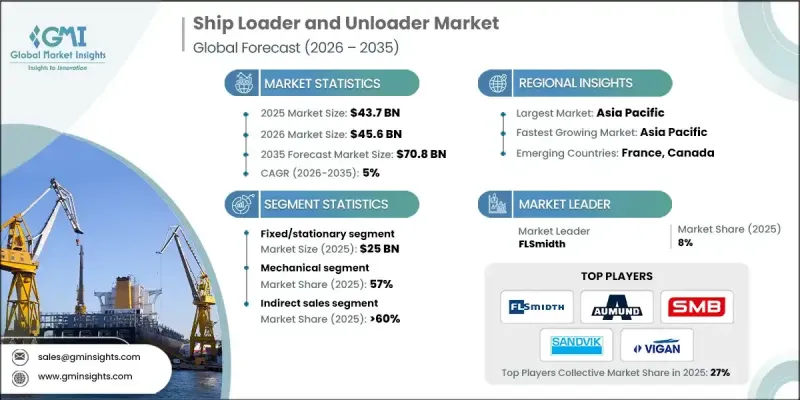
國際貿易的不斷擴張,尤其是對煤炭、鐵礦石、糧食和化肥等大宗商品需求的日益成長,推動了對高容量裝卸解決方案的需求。港口面臨著高效處理更大貨運量的壓力,促使營運商採用自動化和先進的設備。大型船舶的出現以及對快速裝卸的更高期望,使得高性能系統成為現代港口運作的必要條件。全球化和新興市場的崛起進一步凸顯了可靠的散裝物料輸送基礎設施的重要性。此外,營運商正在採用物聯網感測器、預測性維護演算法和遠端監控等數位化和智慧技術,以最佳化營運效率、減少停機時間、降低成本,同時提高全球港口設施的安全標準和可靠性。
| 市場覆蓋範圍 | |
|---|---|
| 開始年份 | 2025 |
| 預測年份 | 2026-2035 |
| 起始值 | 437億美元 |
| 預測金額 | 708億美元 |
| 複合年成長率 | 5% |
市場正日益採用環保節能的系統。電動和混合動力裝卸船機正在研發中,旨在減少碳排放並符合國際環境法規。最新的設備整合了自動化和人工智慧工具,以提高效能並最大限度地減少人工操作,使港口能夠在滿足不斷成長的吞吐量需求的同時,保持永續性。
預計到2025年,固定式裝船機市場規模將達250億美元。大規模港口作業者青睞固定式裝船機,因為它們吞吐量高、經久耐用,並且能夠處理連續的散裝物料流。其堅固的設計確保了長期可靠性和最小的停機時間,儘管初始投資較高,但從整個設備生命週期來看,它們仍然具有成本效益。
預計2025年,機械式物料輸送系統將佔據57%的市場。機械式系統憑藉其在散裝物料處理方面久經考驗的可靠性、適應性和成本效益而佔據主導地位。這些系統採用輸送帶、螺旋輸送機和斗式提昇機等設備,廣泛應用於港口,用於處理煤炭、礦物和穀物。它們能夠以極低的能耗處理大批量作業,因此成為大型設施的首選。
預計到2025年,亞太地區船舶裝卸設備市場將佔據全球40%的市場佔有率,並在2026年至2035年間以5.3%的複合年成長率成長。中國憑藉其龐大的港口基礎設施和國際貿易中的強大地位,引領著該地區的市場發展。快速的工業化進程、龐大的出口量以及對先進貨物裝卸系統的持續投資,都在推動市場需求。策略性的港口現代化計畫和自動化技術的應用進一步鞏固了市場地位。此外,監管合規和環境永續性措施也推動了節能抑塵設備的普及應用。
目錄
第1章調查方法和範圍
第2章執行摘要
第3章業界考察
- 生態系分析
- 供應商情況
- 利潤率
- 每個階段的附加價值
- 影響價值鏈的因素
- 產業影響因素
- 促進要素
- 全球貿易及散裝物料物料輸送不斷拓展
- 自動化和技術進步
- 環境法規與永續性目標
- 產業潛在風險與挑戰
- 高昂的資本投資和維護成本
- 港口的空間和基礎設施限制
- 機會
- 新興經濟體擴張與新港口開發
- 引入綠色節能解決方案
- 促進要素
- 成長潛力分析
- 未來市場趨勢
- 科技與創新趨勢
- 當前技術趨勢
- 新興技術
- 價格趨勢
- 按地區
- 按作業系統
- 監管環境
- 標準和合規要求
- 區域法規結構
- 認證標準
- 波特五力分析
- PESTEL 分析
第4章 競爭情勢
- 介紹
- 公司市佔率分析
- 按地區
- 企業矩陣分析
- 主要市場公司的競爭分析
- 競爭定位矩陣
- 重大進展
- 併購
- 夥伴關係與合作
- 新產品發布
- 擴張計劃
第5章 依產品類型分類的市場估算與預測,2022-2035年
- 固定/固定類型
- 移動的
第6章 按技術分類的市場估計與預測,2022-2035年
- 自動的
- 機械的
- 氣動
第7章 2022-2035年散裝市場估算與預測
- 乾型
- 液體
第8章 依產能分類的市場估計與預測,2022-2035年
- 5000噸/小時或更少
- 每小時5000噸至10000噸
- 每小時10,000噸至20,000噸
- 超過2萬噸/小時
第9章 按應用領域分類的市場估算與預測,2022-2035年
- 礦業
- 港口/航運
- 建造
- 機器
- 其他(發電廠業等)
第10章 按分銷管道分類的市場估算與預測,2022-2035年
- 直銷
- 間接銷售
第11章 2022-2035年各地區市場估計與預測
- 北美洲
- 美國
- 加拿大
- 歐洲
- 德國
- 英國
- 法國
- 義大利
- 西班牙
- 亞太地區
- 中國
- 日本
- 印度
- 澳洲
- 韓國
- 拉丁美洲
- 巴西
- 墨西哥
- 阿根廷
- 中東和非洲
- 南非
- 沙烏地阿拉伯
- 阿拉伯聯合大公國
第12章:公司簡介
- AMECO
- AUMUND
- BEUMER
- Buhler
- Dana
- EMS-Tech
- FAM Forderanlagen Magdeburg
- FLSmidth
- Liebherr
- NEUERO
- Sandvik
- Shanghai Zhenhua Heavy Industries
- SMB
- TAKRAF
- VIGAN Engineering
The Global Ship Loader and Unloader Market was valued at USD 43.7 billion in 2025 and is estimated to grow at a CAGR of 5% to reach USD 70.8 billion by 2035.
The expansion of international trade, particularly in bulk commodities like coal, iron ore, grains, and fertilizers, is driving demand for high-capacity loading and unloading solutions. Ports are facing increasing pressure to handle larger shipments efficiently, prompting operators to adopt automated and technologically advanced equipment. Larger vessels and faster turnaround expectations have made high-performance systems essential for modern port operations. The rise of globalization and emerging markets further emphasizes the need for reliable bulk material handling infrastructure. Additionally, operators are embracing digital and smart technologies, including IoT-enabled sensors, predictive maintenance algorithms, and remote monitoring, which optimize operational efficiency, reduce downtime, and lower costs while improving safety standards and reliability across port facilities worldwide.
| Market Scope | |
|---|---|
| Start Year | 2025 |
| Forecast Year | 2026-2035 |
| Start Value | $43.7 Billion |
| Forecast Value | $70.8 Billion |
| CAGR | 5% |
The market is witnessing a growing adoption of eco-friendly and energy-efficient systems. Electric and hybrid ship loaders and unloaders are increasingly developed to reduce carbon emissions and comply with international environmental regulations. Modern equipment integrates automation and AI-powered tools to enhance performance and minimize manual intervention, helping ports maintain sustainability while meeting rising throughput demands.
The fixed/stationary segment generated USD 25 billion in 2025. Fixed ship loaders and unloaders are preferred in large-scale port operations due to their high capacity, durability, and ability to handle continuous bulk material flow. Their robust design ensures long-term reliability and minimal downtime, making them cost-efficient over the lifecycle of the equipment despite higher initial investment.
The mechanical segment accounted for 57% share in 2025. Mechanical systems dominate due to their proven dependability, adaptability, and cost-effectiveness in handling bulk materials. Utilizing conveyor belts, screw conveyors, and bucket elevators, these systems are extensively deployed in ports for coal, mineral, and grain handling. Their ability to manage high-volume operations with minimal energy consumption makes them the preferred choice for large facilities.
Asia Pacific Ship Loader and Unloader Market held 40% share in 2025 and is expected to grow at a CAGR of 5.3% from 2026 to 2035. China leads the region due to its vast port infrastructure and strong position in international trade. Rapid industrialization, high export volumes, and continuous investment in advanced cargo handling systems are driving demand. Strategic port modernization initiatives and automation adoption further strengthen the market. Additionally, regulatory compliance and environmental sustainability measures encourage the use of energy-efficient and dust-suppressing equipment.
Major companies operating in the Global Ship Loader and Unloader Market include AMECO, AUMUND, BEUMER, Dana, Buhler, FLSmidth, EMS-Tech, FAM Forderanlagen Magdeburg, Liebherr, NEUERO, Sandvik, Shanghai Zhenhua Heavy Industries, TAKRAF, SMB, and VIGAN Engineering. Companies in the ship loader and unloader market focus on innovation, sustainability, and strategic expansion to reinforce their presence. They invest in R&D to develop high-capacity, automated, and eco-friendly systems that meet global trade demands and regulatory requirements. Collaborations with port operators and technology partners help integrate smart monitoring and predictive maintenance solutions, enhancing operational efficiency. Market players also expand geographically by targeting emerging markets with growing industrial trade and port infrastructure.
Table of Contents
Chapter 1 Methodology and Scope
- 1.1 Market scope and definition
- 1.2 Research design
- 1.2.1 Research approach
- 1.2.2 Data collection methods
- 1.3 Data mining sources
- 1.3.1 Global
- 1.3.2 Regional/Country
- 1.4 Base estimates and calculations
- 1.4.1 Base year calculation
- 1.4.2 Key trends for market estimation
- 1.5 Primary research and validation
- 1.5.1 Primary sources
- 1.6 Forecast model
- 1.7 Research assumptions and limitations
Chapter 2 Executive Summary
- 2.1 Industry 360° synopsis
- 2.2 Key market trends
- 2.2.1 Regional
- 2.2.2 Type
- 2.2.3 Technology
- 2.2.4 Bulk
- 2.2.5 Capacity
- 2.2.6 Application
- 2.2.7 Distribution channel
- 2.3 CXO perspectives: Strategic imperatives
- 2.3.1 Key decision points for industry executives
- 2.3.2 Critical success factors for market players
- 2.4 Future outlook and strategic recommendations
Chapter 3 Industry Insights
- 3.1 Industry ecosystem analysis
- 3.1.1 Supplier landscape
- 3.1.2 Profit margin
- 3.1.3 Value addition at each stage
- 3.1.4 Factor affecting the value chain
- 3.2 Industry impact forces
- 3.2.1 Growth drivers
- 3.2.1.1 Rising global trade and bulk material handling
- 3.2.1.2 Automation and technological advancements
- 3.2.1.3 Environmental regulations and sustainability goals
- 3.2.2 Industry pitfalls & challenges
- 3.2.2.1 High capital investment and maintenance costs
- 3.2.2.2 Space and infrastructure limitations at ports
- 3.2.3 Opportunities
- 3.2.3.1 Expansion of emerging economies and new port developments
- 3.2.3.2 Adoption of eco-friendly and energy-efficient solutions
- 3.2.1 Growth drivers
- 3.3 Growth potential analysis
- 3.4 Future market trends
- 3.5 Technology and innovation landscape
- 3.5.1 Current technological trends
- 3.5.2 Emerging technologies
- 3.6 Price trends
- 3.6.1 By region
- 3.6.2 By operating system
- 3.7 Regulatory landscape
- 3.7.1 Standards and compliance requirements
- 3.7.2 Regional regulatory frameworks
- 3.7.3 Certification standards
- 3.8 Porter's analysis
- 3.9 PESTEL analysis
Chapter 4 Competitive Landscape, 2025
- 4.1 Introduction
- 4.2 Company market share analysis
- 4.2.1 By region
- 4.2.1.1 North America
- 4.2.1.2 Europe
- 4.2.1.3 Asia Pacific
- 4.2.1.4 Latin America
- 4.2.1.5 Middle East and Africa
- 4.2.1 By region
- 4.3 Company matrix analysis
- 4.4 Competitive analysis of major market players
- 4.5 Competitive positioning matrix
- 4.6 Key developments
- 4.6.1 Mergers & acquisitions
- 4.6.2 Partnerships & collaborations
- 4.6.3 New product launches
- 4.6.4 Expansion plans
Chapter 5 Market Estimates and Forecast, By Product Type, 2022 - 2035 (USD Billion) (Thousand Units)
- 5.1 Key trends
- 5.2 Fixed/stationary
- 5.3 Mobile
Chapter 6 Market Estimates and Forecast, By Technology, 2022 - 2035 (USD Billion) (Thousand Units)
- 6.1 Key trends
- 6.2 Automatic
- 6.3 Mechanical
- 6.4 Pneumatic
Chapter 7 Market Estimates and Forecast, By Bulk, 2022 - 2035 (USD Billion) (Thousand Units)
- 7.1 Key trends
- 7.2 Dry
- 7.3 Liquid
Chapter 8 Market Estimates and Forecast, By Capacity, 2022 - 2035 (USD Billion) (Thousand Units)
- 8.1 Key trends
- 8.2 Up to 5000 t/h
- 8.3 5000 t/h to 10,000 t/h
- 8.4 10,000 t/h to 20,000 t/h
- 8.5 Above 20,000 t/h
Chapter 9 Market Estimates and Forecast, By Application, 2022 - 2035 (USD Billion) (Thousand Units)
- 9.1 Key trends
- 9.2 Mining
- 9.3 Ports and Shipping
- 9.4 Construction
- 9.5 Machinery
- 9.6 Others (power plant industry, etc.)
Chapter 10 Market Estimates and Forecast, By Distribution Channel, 2022 - 2035 (USD Billion) (Thousand Units)
- 10.1 Key trends
- 10.2 Direct sales
- 10.3 Indirect sales
Chapter 11 Market Estimates and Forecast, By Region, 2022 - 2035 (USD Billion) (Thousand Units)
- 11.1 Key trends
- 11.2 North America
- 11.2.1 U.S.
- 11.2.2 Canada
- 11.3 Europe
- 11.3.1 Germany
- 11.3.2 UK
- 11.3.3 France
- 11.3.4 Italy
- 11.3.5 Spain
- 11.4 Asia Pacific
- 11.4.1 China
- 11.4.2 Japan
- 11.4.3 India
- 11.4.4 Australia
- 11.4.5 South Korea
- 11.5 Latin America
- 11.5.1 Brazil
- 11.5.2 Mexico
- 11.5.3 Argentina
- 11.6 Middle East and Africa
- 11.6.1 South Africa
- 11.6.2 Saudi Arabia
- 11.6.3 UAE
Chapter 12 Company Profiles
- 12.1 AMECO
- 12.2 AUMUND
- 12.3 BEUMER
- 12.4 Buhler
- 12.5 Dana
- 12.6 EMS-Tech
- 12.7 FAM Forderanlagen Magdeburg
- 12.8 FLSmidth
- 12.9 Liebherr
- 12.10 NEUERO
- 12.11 Sandvik
- 12.12 Shanghai Zhenhua Heavy Industries
- 12.13 SMB
- 12.14 TAKRAF
- 12.15 VIGAN Engineering


