

 |
市場調查報告書
商品編碼
1936633
護膚油市場機會、成長要素、產業趨勢分析及預測(2026-2035年)Skin Care Oil Market Opportunity, Growth Drivers, Industry Trend Analysis, and Forecast 2026 - 2035 |
||||||

全球護膚油市場預計到 2025 年將達到 55 億美元,到 2035 年將達到 96 億美元,年複合成長率為 5.8%。
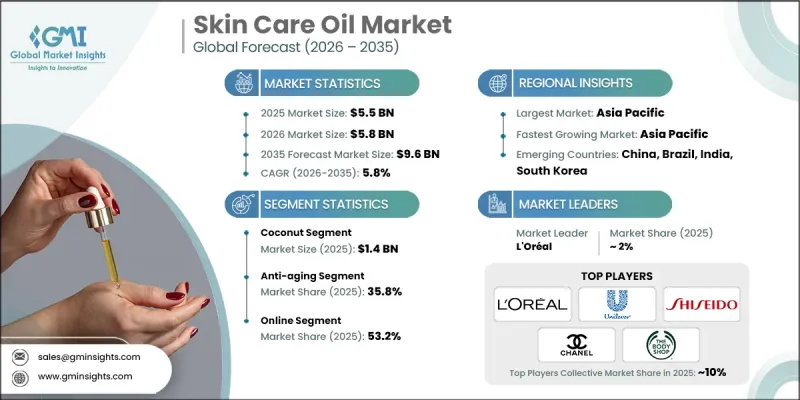
市場成長的驅動力在於消費者對清潔美容和透明個人保健產品日益成長的偏好。隨著消費者對成分安全性和長期肌膚健康的日益關注,他們越來越傾向於選擇天然、無合成成分的配方。護膚油作為日常必需品越來越受歡迎,它們不僅能夠滋養、保濕和強化肌膚屏障,還能融入極簡主義的護膚流程。這些護膚油因其豐富的營養成分、抗氧化成分和調理功效而備受推崇,有助於改善膚質和外觀。數位商務在加速護膚油的普及方面發揮了關鍵作用,它提供了廣泛的產品供應、詳細的成分資訊和個人化的購物體驗。品牌也透過數位宣傳活動和社交平臺加強客戶參與,更有效地傳遞品牌價值並建立信任。這些趨勢共同鞏固了護膚油在全球美容產業快速成長的地位。
| 市場覆蓋範圍 | |
|---|---|
| 開始年份 | 2025 |
| 預測年份 | 2026-2035 |
| 起始金額 | 55億美元 |
| 預測金額 | 96億美元 |
| 複合年成長率 | 5.8% |
預計到2025年,椰子油市場規模將達到14億美元,並在2026年至2035年間以6.3%的複合年成長率成長。該市場憑藉其多功能性和在護膚領域的廣泛應用,保持著主導地位。椰子油配方廣泛應用於保濕產品,並因其適用於多種膚質和產品形態而持續受到青睞。
預計到2025年,抗老產品市佔率將達到35.8%,並在2035年之前以6%的複合年成長率成長。此細分市場的需求成長主要受消費者對預防性護膚和長期肌膚保養日益成長的關注所驅動。消費者正在增加對護膚油類產品的投入,尤其是高級產品系列,這些產品旨在促進肌膚再生、提升肌膚彈性並對抗可見的衰老跡象。
美國護膚油市場預計到2025年將達到9億美元,並在2026年至2035年間以5.4%的複合年成長率成長。消費者對高階、潔淨標示產品的強烈偏好,以及數位技術的廣泛應用,持續推動市場需求。線上平台和永續性的品牌理念在各個年齡層消費者的購買決策中都發揮著核心作用。
目錄
第1章調查方法和範圍
第2章執行摘要
第3章業界考察
- 生態系分析
- 供應商情況
- 利潤率
- 每個階段的附加價值
- 影響價值鏈的因素
- 產業影響因素
- 促進要素
- 對天然和有機產品的需求不斷成長
- 拓展電子商務和直接銷售管道
- 人們對多功能性益處的認知不斷提高
- 挑戰與困難
- 原物料價格波動
- 激烈的市場競爭與仿冒品
- 機會
- 石油混合物和功能配方方面的創新
- 新興市場與男士護理市場
- 促進要素
- 成長潛力分析
- 未來市場趨勢
- 科技與創新趨勢
- 當前技術趨勢
- 新興技術
- 價格趨勢
- 按地區
- 依產品
- 監管環境
- 北美洲
- 美國:消費品安全委員會 (CPSC) 16 CFR 第 1512 部分
- 加拿大:國際標準化組織(ISO)4210
- 歐洲
- 德國:德國標準化協會 (DIN) 歐洲標準 (EN) ISO 4210
- 英國:歐洲標準 (EN) ISO 4210 /英國合格評定 (UKCA)
- 法國:歐洲標準 (EN) ISO 4210
- 亞太地區
- 中國:國家標準(GB)3565
- 印度:印度標準 (IS) 10613
- 日本:日本工業標準(JIS)D 9110
- 拉丁美洲
- 巴西:巴西技術標準協會 (ABNT) 巴西標準 (NBR) ISO 4210
- 墨西哥:國際標準化組織(ISO)4210
- 中東和非洲
- 南非:南非國家標準 (SANS) 311
- 沙烏地阿拉伯:沙烏地阿拉伯標準、計量和品質組織 (SASO) 海灣標準組織 (GSO) ISO 4210
- 北美洲
- 貿易統計(HS編碼-3304)
- 主要進口國
- 主要出口國
- 波特五力分析
- PESTEL 分析
第4章 競爭情勢
- 介紹
- 公司市佔率分析
- 按地區
- 北美洲
- 歐洲
- 亞太地區
- 拉丁美洲
- 中東和非洲
- 按地區
- 企業矩陣分析
- 主要市場公司的競爭分析
- 競爭定位矩陣
- 重大進展
- 併購
- 夥伴關係與合作
- 新產品發布
- 擴張計劃
第5章 依產品類型分類的市場估算與預測,2022-2035年
- 椰子
- 杏仁
- 橄欖
- 檸檬
- 薰衣草
- 茶樹
- 摩洛哥堅果
- 其他(薄荷、胡椒薄荷、乳木果油、柳橙、玫瑰果)
第6章 依功能分類的市場估計與預測,2022-2035年
- 抗衰老
- 保濕營養補充品
- 痤瘡和瑕疵治療
- 其他(洗面乳、刮鬍前用品)
第7章 2022-2035年按價格區間分類的市場估計與預測
- 低價
- 中價位
- 高價
第8章 依最終用戶分類的市場估算與預測,2022-2035年
- 女士
- 男性
- 男女通用的
第9章 按分銷管道分類的市場估算與預測,2022-2035年
- 線上
- 電子商務
- 公司網站
- 離線
- 專業美容店
- 藥局/藥局
- 百貨公司
- 其他(美容院、水療中心等)
第10章 2022-2035年各地區市場估計與預測
- 北美洲
- 美國
- 加拿大
- 歐洲
- 德國
- 英國
- 法國
- 義大利
- 西班牙
- 亞太地區
- 中國
- 印度
- 日本
- 韓國
- 澳洲
- 拉丁美洲
- 巴西
- 墨西哥
- 阿根廷
- 中東和非洲
- 沙烏地阿拉伯
- 阿拉伯聯合大公國
- 南非
第11章:公司簡介
- Amway
- Avon
- Chanel
- Clarins
- Clinique
- 葛氏
- Lancome
- L'Oreal
- Neutrogena
- Nuxe
- Origins
- Shiseido
- The Body Shop.
- Unilever
- Weleda
The Global Skin Care Oil Market was valued at USD 5.5 billion in 2025 and is estimated to grow at a CAGR of 5.8% to reach USD 9.6 billion by 2035.
Market growth is influenced by the rising preference for clean beauty and transparency-focused personal care products. Consumers are increasingly shifting toward formulations perceived as natural and free from synthetic additives, driven by heightened awareness of ingredient safety and long-term skin health. Skin care oils are gaining traction as essential daily-use products because they deliver nourishment, hydration, and barrier support while aligning with minimalist beauty routines. These oils are widely valued for their nutrient density, antioxidant content, and skin-conditioning properties that contribute to improved texture and appearance. Digital commerce has played a critical role in accelerating adoption by offering broader product access, detailed ingredient information, and personalized purchasing experiences. Brands are also strengthening customer engagement through digital campaigns and social platforms, allowing them to communicate brand values and build trust more effectively. These combined dynamics continue to position skin care oils as a fast-growing category within the global beauty industry.
| Market Scope | |
|---|---|
| Start Year | 2025 |
| Forecast Year | 2026-2035 |
| Start Value | $5.5 Billion |
| Forecast Value | $9.6 Billion |
| CAGR | 5.8% |
The coconut oil segment generated USD 1.4 billion in 2025 and is expected to grow at a CAGR of 6.3% from 2026 to 2035. This segment maintains a leading position due to its multifunctional nature and broad acceptance across skin care routines. Coconut-based formulations are widely used for hydration-focused applications and remain appealing due to their compatibility with various skin profiles and product formats.
The anti-aging application segment accounted for 35.8% share in 2025 and is forecast to grow at a CAGR of 6% through 2035. Demand in this segment is supported by increasing focus on preventive skin care and long-term skin maintenance. Consumers are investing in oils formulated to support skin renewal, improve elasticity, and address visible aging concerns, particularly within premium product lines.
United States Skin Care Oil Market reached USD 0.9 billion in 2025 and is projected to grow at a CAGR of 5.4% from 2026 to 2035. Strong consumer inclination toward premium, clean-label products, combined with high digital adoption, continues to drive demand. Online platforms and sustainability-focused branding play a central role in purchasing decisions across age groups.
Major companies operating in the Global Skin Care Oil Market include L'Oreal, Unilever, Shiseido, Chanel, Clarins, Clinique, Weleda, The Body Shop, Kiehl's, Nuxe, Lancome, Amway, Avon, Origins, and Neutrogena. Companies in the skin care oil market strengthen their competitive position through clean-label innovation, premium positioning, and digital-first strategies. Many brands focus on developing traceable, responsibly sourced formulations that align with sustainability expectations. Investment in research supports improved texture, absorption, and multifunctional benefits. Firms expand their presence through e-commerce optimization and targeted social engagement to reach niche consumer segments. Limited-edition launches and personalization options help enhance brand differentiation. Strategic pricing, strong packaging design, and transparent communication around ingredient integrity further reinforce consumer trust and long-term market presence.
Table of Contents
Chapter 1 Methodology & Scope
- 1.1 Market scope & definitions
- 1.2 Research design
- 1.2.1 Research approach
- 1.2.2 Data collection methods
- 1.3 Base estimates and calculations
- 1.3.1 Base year calculation
- 1.3.2 Market estimates & forecasts parameters
- 1.4 Forecast Model
- 1.4.1 Key trends for market estimates
- 1.4.2 Quantified market impact analysis
- 1.4.2.1 Mathematical impact of growth parameters on forecast
- 1.4.3 Scenario analysis framework
- 1.5 Primary research and validation
- 1.5.1 Some of the primary sources (but not limited to)
- 1.6 Data mining sources
- 1.6.1 Paid Sources
- 1.7 Primary research and validation
- 1.7.1 Primary sources
- 1.8 Research Trail & confidence scoring
- 1.8.1 Research trail components
- 1.8.2 Scoring components
- 1.9 Research transparency addendum
- 1.9.1 Source attribution framework
- 1.9.2 Quality assurance metrics
- 1.9.3 Our commitment to trust
- 1.10 Market Definitions
Chapter 2 Executive Summary
- 2.1 Industry 360° synopsis
- 2.2 Key market trends
- 2.2.1 Regional
- 2.2.2 Product type
- 2.2.3 Function
- 2.2.4 Price range
- 2.2.5 End user
- 2.2.6 Distribution channel
- 2.3 CXO perspectives: Strategic imperatives
- 2.3.1 Key decision points for industry executives
- 2.3.2 Critical success factors for market players
- 2.4 Future outlook and strategic recommendations
Chapter 3 Industry Insights
- 3.1 Industry ecosystem analysis
- 3.1.1 Supplier landscape
- 3.1.2 Profit margin
- 3.1.3 Value addition at each stage
- 3.1.4 Factor affecting the value chain
- 3.2 Industry impact forces
- 3.2.1 Growth drivers
- 3.2.1.1 Rising demand for natural & organic products
- 3.2.1.2 Expansion of e-commerce & direct-to-consumer channels
- 3.2.1.3 Growing awareness of multi-functional benefits
- 3.2.2 Pitfalls & Challenges
- 3.2.2.1 Price volatility of raw materials
- 3.2.2.2 Intense market competition & counterfeit products
- 3.2.3 Opportunities
- 3.2.3.1 Innovation in oil blends & functional formulations
- 3.2.3.2 Emerging markets & male grooming segment
- 3.2.1 Growth drivers
- 3.3 Growth potential analysis
- 3.4 Future market trends
- 3.5 Technology and innovation landscape
- 3.5.1 Current technological trends
- 3.5.2 Emerging technologies
- 3.6 Price trends
- 3.6.1 By region
- 3.6.2 By product
- 3.7 Regulatory landscape
- 3.7.1 North America
- 3.7.1.1 US: Consumer Product Safety Commission (CPSC) 16 Code of Federal Regulations (CFR) part 1512
- 3.7.1.2 Canada: International Organization for Standardization (ISO) 4210
- 3.7.2 Europe
- 3.7.2.1 Germany: Deutsches Institut fur Normung (DIN) European Norm (EN) ISO 4210
- 3.7.2.2 UK: European Norm (EN) ISO 4210 / United Kingdom Conformity Assessed (UKCA)
- 3.7.2.3 France: European Norm (EN) ISO 4210
- 3.7.3 Asia Pacific
- 3.7.3.1 China: Guobiao (GB) 3565
- 3.7.3.2 India: Indian Standard (IS) 10613
- 3.7.3.3 Japan: Japanese Industrial Standard (JIS) D 9110
- 3.7.4 Latin America
- 3.7.4.1 Brazil: Associacao Brasileira de Normas Tecnicas (ABNT) Norma Brasileira (NBR) ISO 4210
- 3.7.4.2 Mexico: International Organization for Standardization (ISO) 4210
- 3.7.5 Middle East & Africa
- 3.7.5.1 South Africa: South African National Standard (SANS) 311
- 3.7.5.2 Saudi Arabia: Saudi Standards, Metrology and Quality Organization (SASO) Gulf Standardization Organization (GSO) ISO 4210
- 3.7.1 North America
- 3.8 Trade statistics (HS code- 3304)
- 3.8.1 Major importing countries
- 3.8.2 Major exporting countries
- 3.9 Porter's analysis
- 3.10 PESTEL analysis
Chapter 4 Competitive Landscape, 2025
- 4.1 Introduction
- 4.2 Company market share analysis
- 4.2.1 By Region
- 4.2.1.1 North America
- 4.2.1.2 Europe
- 4.2.1.3 Asia Pacific
- 4.2.1.4 Latin America
- 4.2.1.5 Middle East & Africa
- 4.2.1 By Region
- 4.3 Company matrix analysis
- 4.4 Competitive analysis of major market players
- 4.5 Competitive positioning matrix
- 4.6 Key developments
- 4.6.1 Mergers & acquisitions
- 4.6.2 Partnerships & collaborations
- 4.6.3 New product launches
- 4.6.4 Expansion plans
Chapter 5 Market Estimates & Forecast, By Product Type, 2022 - 2035, (USD Billion) (Million Units)
- 5.1 Key trends
- 5.2 Coconut
- 5.3 Almond
- 5.4 Olive
- 5.5 Lemon
- 5.6 Lavender
- 5.7 Tea Tree
- 5.8 Argan
- 5.9 Others (mint, peppermint, shea butter, orange, rosehip)
Chapter 6 Market Estimates & Forecast, By Function, 2022 - 2035, (USD Billion) (Million Units)
- 6.1 Key trends
- 6.2 Anti-aging
- 6.3 Moisturizing/Nourishing
- 6.4 Acne/Marks Treatment
- 6.5 Others (cleansing, pre-shave)
Chapter 7 Market Estimates & Forecast, By Price Range, 2022 - 2035, (USD Billion) (Million Units)
- 7.1 Key trends
- 7.2 Low
- 7.3 Medium
- 7.4 High
Chapter 8 Market Estimates & Forecast, By End User, 2022 - 2035, (USD Billion) (Million Units)
- 8.1 Key trends
- 8.2 Women
- 8.3 Men
- 8.4 Unisex
Chapter 9 Market Estimates & Forecast, By Distribution Channel, 2022 - 2035, (USD Billion) (Million Units)
- 9.1 Key trends
- 9.2 Online
- 9.2.1 E-commerce
- 9.2.2 Company websites
- 9.3 Offline
- 9.3.1 Specialty beauty stores
- 9.3.2 Pharmacies/drugstores
- 9.3.3 Department stores
- 9.3.4 Others (salons & spas, etc.)
Chapter 10 Market Estimates & Forecast, By Region, 2022 - 2035, (USD Billion) (Million Units)
- 10.1 Key trends
- 10.2 North America
- 10.2.1 U.S.
- 10.2.2 Canada
- 10.3 Europe
- 10.3.1 Germany
- 10.3.2 UK
- 10.3.3 France
- 10.3.4 Italy
- 10.3.5 Spain
- 10.4 Asia Pacific
- 10.4.1 China
- 10.4.2 India
- 10.4.3 Japan
- 10.4.4 South Korea
- 10.4.5 Australia
- 10.5 Latin America
- 10.5.1 Brazil
- 10.5.2 Mexico
- 10.5.3 Argentina
- 10.6 MEA
- 10.6.1 Saudi Arabia
- 10.6.2 UAE
- 10.6.3 South Africa
Chapter 11 Company Profiles
- 11.1 Amway
- 11.2 Avon
- 11.3 Chanel
- 11.4 Clarins
- 11.5 Clinique
- 11.6 Kiehl’s
- 11.7 Lancome
- 11.8 L'Oreal
- 11.9 Neutrogena
- 11.10 Nuxe
- 11.11 Origins
- 11.12 Shiseido
- 11.13 The Body Shop.
- 11.14 Unilever
- 11.15 Weleda

 皮膚健康市場:全球市場按產品類型、分銷管道、應用和最終用戶分類的預測——2026-2032年高級臨床護膚產品市場:2026-2032年全球市場預測(按產品類型、皮膚問題、劑型、價格範圍、分銷管道和最終用戶分類)
 2026-2030年全球視網醇護膚品市場潔面霜市場:依產品形態、膚質、年齡層、性別、價格範圍、應用領域、包裝類型、成分類型和分銷管道分類-全球預測,2026-2032年
 頭髮及身體噴霧市場:按類型、分銷管道和地區分類(2026-2034 年)
 2026 年至 2035 年含維生素 C護膚品的市場機會、成長要素、產業趨勢與預測。
 2026-2030年全球青少年個人護理產品市場
 基於微生物組的護膚療法市場分析及預測(至2035年):按類型、產品、服務、技術、應用、最終用戶、形式、材料類型和安裝類型分類護膚品市場分析及預測(至2035年):類型、產品類型、技術、應用、劑型、材料類型、最終用戶、功能、解決方案護膚市場分析及預測(至2035年):依類型、產品類型、服務、技術、應用、劑型、最終用戶、功能、材料類型及解決方案分類