


 |
市場調查報告書
商品編碼
1936621
伺服驅動器市場機會、成長要素、產業趨勢分析及預測(2026年至2035年)Servo Drives Market Opportunity, Growth Drivers, Industry Trend Analysis, and Forecast 2026 - 2035 |
||||||

全球伺服驅動器市場預計到 2025 年將達到 24 億美元,到 2035 年將達到 35 億美元,年複合成長率為 3.5%。
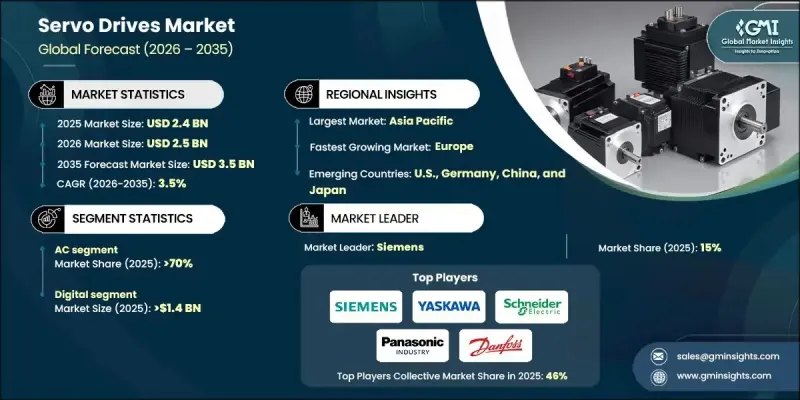
可靠、精準且節能的電機控制解決方案需求不斷成長,推動了市場發展,而工業基礎設施的數位化和升級改造也起到了重要作用。伺服系統的技術進步,包括人工智慧控制和快速回應,正在促進工業運作的自動化。工業現代化投資的增加,以及鼓勵節能系統的管理方案,正在加速相關技術的應用。隨著各行業向軟性生產模式轉型,對具備快速響應、抗干擾能力和高精度的高性能馬達控制解決方案的需求日益成長。現代伺服驅動器採用改良的數位控制演算法、先進的通訊介面和精密的回饋機制,能夠與工業網路無縫整合。這些創新支援即時監控、自適應控制,並與工業4.0和智慧製造舉措相契合,從而塑造了穩健的產業前景。
| 市場覆蓋範圍 | |
|---|---|
| 開始年份 | 2025 |
| 預測年份 | 2026-2035 |
| 起始值 | 24億美元 |
| 預測金額 | 35億美元 |
| 複合年成長率 | 3.5% |
2025年,交流伺服驅動器市場佔有率將達到70%,預計2035年將維持3.5%的複合年成長率。交流變頻器具有卓越的性能,能夠承受高電流突波,並可獨立運行,使其成為重工業和自動化應用的理想選擇。其在複雜運動控制任務中的精準性正推動其在先進製造環境中廣泛應用。
預計到2025年,數位伺服驅動器市場規模將達到14億美元,並在2035年之前以3.8%的複合年成長率成長。數位驅動器能夠精確控制馬達轉速和扭矩,從而降低能耗並提高系統整體效率。不斷上漲的工業能源成本和永續性措施正在推動採用能夠以低功耗實現最佳化效能的數位解決方案。
預計到2025年,美國伺服驅動器市場將佔據65.5%的市場佔有率,並創造2.88億美元的收入。這一成長主要得益於對智慧製造、工業自動化以及老舊生產設施現代化改造的大力投資。包括汽車、電子、航太和包裝在內的各行業正擴大採用伺服驅動器來提高精度、降低能耗並提升營運效率。政府的各項措施和有利於節能和數位化化工業流程的政策也進一步加速了市場應用。
目錄
第1章調查方法和範圍
第2章執行摘要
第3章業界考察
- 生態系分析
- 原物料供應及採購分析
- 影響價值鏈的關鍵因素
- 中斷
- 監管環境
- 產業影響因素
- 促進要素
- 產業潛在風險與挑戰
- 成長潛力分析
- 波特五力分析
- PESTEL 分析
- 伺服驅動器成本結構分析
- 新的機會與趨勢
- 透過物聯網技術實現數位轉型
- 拓展新興市場
- 投資分析及未來展望
第4章 競爭情勢
- 介紹
- 按地區分類的公司市佔率分析
- 北美洲
- 歐洲
- 亞太地區
- 中東和非洲
- 拉丁美洲
- 策略舉措
- 重要夥伴關係與合作
- 重大併購活動
- 產品創新與新產品發布
- 市場擴大策略
- 競爭標竿分析
- 戰略儀錶板
- 創新與科技趨勢
第5章 依驅動系統分類的市場規模及預測(2022-2035年)
- 交換
- 直流
第6章 依類別分類的市場規模及預測(2022-2035年)
- 數位的
- 模擬
第7章 依應用領域分類的市場規模及預測(2022-2035年)
- 石油和天然氣
- 金屬切削/成型
- 物料輸送設備
- 包裝貼標機
- 機器人技術
- 醫療機器人
- 橡膠和塑膠機械
- 倉庫管理
- 自動化
- 惡劣環境應用
- 半導體製造設備
- AGV
- 電子設備
- 其他
第8章 2022-2035年各地區市場規模及預測
- 北美洲
- 美國
- 加拿大
- 墨西哥
- 歐洲
- 德國
- 英國
- 法國
- 義大利
- 西班牙
- 丹麥
- 亞太地區
- 中國
- 日本
- 印度
- 韓國
- 澳洲
- 中東和非洲
- 沙烏地阿拉伯
- 阿拉伯聯合大公國
- 埃及
- 南非
- 拉丁美洲
- 巴西
- 阿根廷
第9章:公司簡介
- ADVANCED Motion Controls
- Applied Motion Products, Inc.
- Beckhoff Automation
- Danfoss
- Delta Electronics
- Elmo Motion Control Ltd.
- Festo India Private Limited
- KEB Automation KG
- Kollmorgen
- Leadshine
- Nidec Motor Corporation
- OMRON Corporation
- Panasonic工業歐洲有限公司
- Parker Hannifin Corp
- Rockwell Automation
- Schneider Electric
- Siemens
- Suzhou Veichi Electric Co., Ltd.
- WEG
- YASKAWA Electric Corporation
The Global Servo Drives Market was valued at USD 2.4 billion in 2025 and is estimated to grow at a CAGR of 3.5% to reach USD 3.5 billion by 2035.
Rising demand for reliable, precise, and energy-efficient motor control solutions is driving market growth, fueled by ongoing digitalization and upgrades in industrial infrastructure. Technological advancements in servo systems, including AI-enabled controls and faster response times, are enhancing automation across industrial operations. Increasing investments in industrial modernization, coupled with supportive regulatory initiatives promoting energy-efficient systems, are accelerating adoption. The need for high-performance motor control solutions with rapid response, disturbance rejection, and precision is growing as industries transition to flexible production models. Modern servo drives now feature improved digital control algorithms, advanced communication interfaces, and sophisticated feedback mechanisms, enabling seamless integration with industrial networks. These innovations support real-time monitoring, adaptive control, and alignment with Industry 4.0 and smart manufacturing initiatives, shaping a robust industry outlook.
| Market Scope | |
|---|---|
| Start Year | 2025 |
| Forecast Year | 2026-2035 |
| Start Value | $2.4 Billion |
| Forecast Value | $3.5 Billion |
| CAGR | 3.5% |
The AC servo drive segment accounted for 70% share in 2025 and is estimated to maintain a CAGR of 3.5% through 2035. AC drives offer superior performance by handling high current surges and operating independently, making them ideal for heavy-duty industrial and automation applications. Their precision in complex motion control tasks drives adoption in advanced production environments.
The digital servo drive segment was valued at USD 1.4 billion in 2025 and is expected to grow at a CAGR of 3.8% by 2035. Digital drives deliver accurate control of motor speed and torque, reduce energy consumption, and enhance overall system efficiency. Rising industrial energy costs and sustainability initiatives are encouraging the adoption of digital solutions for optimized performance with lower power usage.
U.S. Servo Drives Market held a 65.5% share in 2025, generating USD 288 million. The growth is being fueled by robust investments in smart manufacturing, industrial automation, and the modernization of aging production facilities. Industries across automotive, electronics, aerospace, and packaging are increasingly adopting servo drives to improve precision, reduce energy consumption, and enhance operational efficiency. Government initiatives and favorable policies promoting energy-efficient and digitalized industrial processes are further accelerating market adoption.
Leading players in the Global Servo Drives Market include Schneider Electric, Beckhoff Automation, YASKAWA Electric Corporation, Rockwell Automation, Delta Electronics, Panasonic Industry Europe GmbH, Festo India Private Limited, KEB Automation KG, ADVANCED Motion Controls, Nidec Motor Corporation, Leadshine, OMRON Corporation, Suzhou Veichi Electric Co., Ltd., Applied Motion Products, Inc., Parker Hannifin Corp, Kollmorgen, Elmo Motion Control Ltd., Danfoss, WEG, and Siemens. Companies in the servo drives market are strengthening their foothold through multiple strategies. They are investing in research and development to enhance energy efficiency, AI-enabled control, and adaptive motion capabilities. Strategic collaborations with industrial automation providers and system integrators are expanding market reach. Firms are also focusing on modular and scalable drive solutions for flexible manufacturing environments. Establishing localized manufacturing and support centers accelerates delivery and after-sales services.
Table of Contents
Chapter 1 Methodology & Scope
- 1.1 Research design
- 1.1.1 Research approach
- 1.1.2 Data collection methods
- 1.2 Base estimates and calculations
- 1.2.1 Base year calculation
- 1.3 Forecast model
- 1.3.1 Key trends for market estimates
- 1.3.2 Quantified market impact analysis
- 1.3.2.1 Mathematical impact of growth parameters on forecast
- 1.3.3 Scenario analysis framework
- 1.4 Primary research and validation
- 1.4.1 Some of the primary sources (but not limited to)
- 1.5 Data mining sources
- 1.5.1 Paid Sources
- 1.5.1.1 Sources, by region
- 1.5.1 Paid Sources
- 1.6 Research Trail & confidence scoring
- 1.6.1 Research trail components
- 1.6.2 Scoring components
- 1.7 Research transparency addendum
- 1.7.1 Source attribution framework
- 1.7.2 Quality assurance metrics
- 1.7.3 Our commitment to trust
- 1.8 Market definitions
Chapter 2 Executive Summary
- 2.1 Industry synopsis, 2022 - 2035
- 2.2 Business trends
- 2.3 Drive trends
- 2.4 Category trends
- 2.5 Application trends
- 2.6 Regional trends
Chapter 3 Industry Insights
- 3.1 Industry ecosystem analysis
- 3.1.1 Raw material availability & sourcing analysis
- 3.1.2 Key factors affecting the value chain
- 3.1.3 Disruptions
- 3.2 Regulatory landscape
- 3.3 Industry impact forces
- 3.3.1 Growth drivers
- 3.3.2 Industry pitfalls & challenges
- 3.4 Growth potential analysis
- 3.5 Porter's analysis
- 3.5.1 Bargaining power of suppliers
- 3.5.2 Bargaining power of buyers
- 3.5.3 Threat of new entrants
- 3.5.4 Threat of substitutes
- 3.6 PESTEL analysis
- 3.6.1 Political factors
- 3.6.2 Economic factors
- 3.6.3 Social factors
- 3.6.4 Technological factors
- 3.6.5 Legal factors
- 3.6.6 Environmental factors
- 3.7 Cost structure analysis of servo drives
- 3.8 Emerging opportunities & trends
- 3.8.1 Digital transformation with IoT technologies
- 3.8.2 Emerging market penetration
- 3.9 Investment analysis & future outlook
Chapter 4 Competitive Landscape, 2025
- 4.1 Introduction
- 4.2 Company market share analysis, by region, 2025
- 4.2.1 North America
- 4.2.2 Europe
- 4.2.3 Asia Pacific
- 4.2.4 Middle East & Africa
- 4.2.5 Latin America
- 4.3 Strategic initiatives
- 4.3.1 Key partnerships & collaborations
- 4.3.2 Major M&A activities
- 4.3.3 Product innovations & launches
- 4.3.4 Market expansion strategies
- 4.4 Competitive benchmarking
- 4.5 Strategic dashboard
- 4.6 Innovation & technology landscape
Chapter 5 Market Size and Forecast, By Drive, 2022 - 2035, (USD Million and '000 Units)
- 5.1 Key trends
- 5.2 AC
- 5.3 DC
Chapter 6 Market Size and Forecast, By Category, 2022 - 2035, (USD Million and '000 Units)
- 6.1 Key trends
- 6.2 Digital
- 6.3 Analog
Chapter 7 Market Size and Forecast, By Application, 2022 - 2035, (USD Million and '000 Units)
- 7.1 Key trends
- 7.2 Oil & Gas
- 7.3 Metal Cutting & Forming
- 7.4 Material Handling Equipment
- 7.5 Packaging and Labelling Machinery
- 7.6 Robotics
- 7.7 Medical Robotics
- 7.8 Rubber & Plastics Machinery
- 7.9 Warehousing
- 7.10 Automation
- 7.11 Extreme Environment Applications
- 7.12 Semiconductor Machinery
- 7.13 AGV
- 7.14 Electronics
- 7.15 Others
Chapter 8 Market Size and Forecast, By Region, 2022 - 2035, (USD Million and '000 Units)
- 8.1 Key trends
- 8.2 North America
- 8.2.1 U.S.
- 8.2.2 Canada
- 8.2.3 Mexico
- 8.3 Europe
- 8.3.1 Germany
- 8.3.2 UK
- 8.3.3 France
- 8.3.4 Italy
- 8.3.5 Spain
- 8.3.6 Denmark
- 8.4 Asia Pacific
- 8.4.1 China
- 8.4.2 Japan
- 8.4.3 India
- 8.4.4 South Korea
- 8.4.5 Australia
- 8.5 Middle East & Africa
- 8.5.1 Saudi Arabia
- 8.5.2 UAE
- 8.5.3 Egypt
- 8.5.4 South Africa
- 8.6 Latin America
- 8.6.1 Brazil
- 8.6.2 Argentina
Chapter 9 Company Profiles
- 9.1 ADVANCED Motion Controls
- 9.2 Applied Motion Products, Inc.
- 9.3 Beckhoff Automation
- 9.4 Danfoss
- 9.5 Delta Electronics
- 9.6 Elmo Motion Control Ltd.
- 9.7 Festo India Private Limited
- 9.8 KEB Automation KG
- 9.9 Kollmorgen
- 9.10 Leadshine
- 9.11 Nidec Motor Corporation
- 9.12 OMRON Corporation
- 9.13 Panasonic Industry Europe GmbH
- 9.14 Parker Hannifin Corp
- 9.15 Rockwell Automation
- 9.16 Schneider Electric
- 9.17 Siemens
- 9.18 Suzhou Veichi Electric Co., Ltd.
- 9.19 WEG
- 9.20 YASKAWA Electric Corporation


