

 |
市場調查報告書
商品編碼
1936603
生物反應器市場機會、成長要素、產業趨勢分析及2026年至2035年預測Bioreactors Market Opportunity, Growth Drivers, Industry Trend Analysis, and Forecast 2026 - 2035 |
||||||

全球生物反應器市場預計到 2025 年將達到 138 億美元,到 2035 年將達到 389 億美元,年複合成長率為 11.2%。
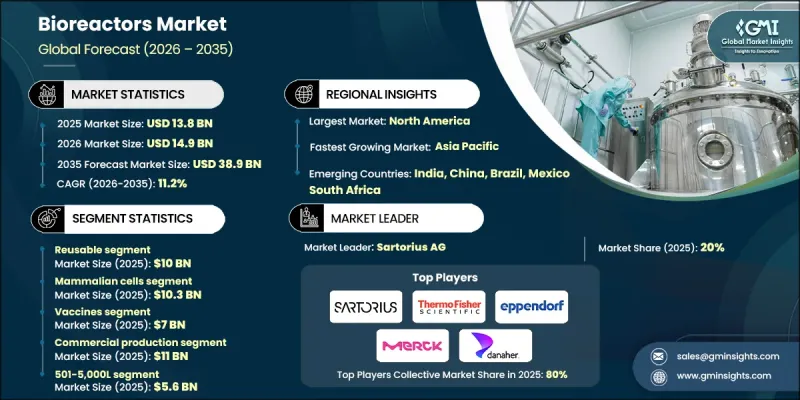
這一成長主要得益於製藥和生物技術行業的擴張、生物反應器系統的技術創新以及對個人化醫療和先進治療方法日益成長的需求。生物反應器在疫苗、單株抗體和細胞療法的生產中發揮核心作用,而慢性病的增加和對創新治療方法的追求推動了這些產品需求的成長。基因工程、再生醫學和生物相似藥的進步,促使企業需要擴充性、高效且符合監管規定的生物反應器系統,以支援大規模生產並維持產品品質。各公司正專注於生物製劑和孤兒藥的研發,這些藥物用於治療罕見疾病,並利用監管激勵措施,投資於一次性系統、自動化平台和其他先進的生物反應器技術。這些因素共同作用,使生物反應器成為現代生物製造不可或缺的一部分。
| 市場覆蓋範圍 | |
|---|---|
| 開始年份 | 2025 |
| 預測年份 | 2026-2035 |
| 起始值 | 138億美元 |
| 預測金額 | 389億美元 |
| 複合年成長率 | 11.2% |
預計到2025年,可重複使用生物反應器市場規模將達到100億美元。由於其成本效益高,可重複使用生物反應器是大規模生產的首選,因為它們可以進行滅菌並重複用於多個生產週期。其耐用性和多功能性使其能夠在各種生產條件下運行,這對於生物製藥生產中高產量、複雜的製程至關重要。這些特性使可重複使用系統成為高效生物製藥生產的基礎,在生物製劑生產中,在不影響品質的前提下管理大量生產至關重要。
預計到2025年,哺乳動物細胞市場規模將達到103億美元。哺乳動物細胞因其能夠模擬人類細胞的行為,確保治療的安全性和有效性,而被廣泛用於生產單株抗體、重組蛋白和疫苗等複雜生物製藥。這些細胞對溫度、pH值、氧氣濃度和營養供應等環境參數高度敏感。生物反應器能夠提供可控的培養條件,從而最佳化細胞生長和生產力,使其成為開發先進治療方法的關鍵設備。
預計到2025年,美國生物反應器市場規模將達47億美元。這一成長主要得益於美國先進的製藥和生物技術產業、生物製藥投資的不斷增加以及個人化醫療的日益普及。生物反應器能夠實現疫苗、單株抗體和基因療法的高品質、大規模生產,從而支持美國產業向先進生物製藥和先進治療方案的轉型。
目錄
第1章調查方法和範圍
第2章執行摘要
第3章業界考察
- 生態系分析
- 產業影響因素
- 促進要素
- 不斷發展的製藥和生物技術產業
- 生物反應器的技術進步
- 人們越來越關注罕見疾病藥物的研發
- 對個人化醫療的需求日益成長
- 產業潛在風險與挑戰
- 低容量一次性生物反應器
- 可萃取物和可浸出物問題
- 市場機遇
- 用於新型醫療應用的精準發酵技術
- 促進要素
- 成長潛力分析
- 監管環境
- 技術進步
- 當前技術趨勢
- 新興技術
- 2024年定價分析
- 未來市場趨勢
- 波特五力分析
- PESTEL 分析
第4章 競爭情勢
- 介紹
- 公司市佔率分析
- 企業矩陣分析
- 主要市場公司的競爭分析
- 競爭定位矩陣
- 重大進展
- 併購
- 合作夥伴關係和合資企業
- 新產品發布
- 擴張計劃
第5章 依產品類型分類的市場估算與預測,2022-2035年
- 一次性(塑膠)
- 可重複使用的
第6章 依電池類型分類的市場估計與預測,2022-2035年
- 哺乳動物細胞
- 細菌細胞
- 酵母菌細胞
- 其他細胞
7. 2022-2035年按分子分類的市場估計與預測
- 單株抗體
- 疫苗
- 重組蛋白
- 幹細胞
- 基因治療
- 其他分子
第8章 按應用領域分類的市場估算與預測,2022-2035年
- 研發階段、非臨床階段及臨床試驗階段
- 商業生產
第9章 按材料分類的市場估算與預測,2022-2035年
- 不銹鋼
- 玻璃
- 一次性的
第10章 依產能分類的市場估計與預測,2022-2035年
- 少於500公升
- 501至5000公升
- 超過5000公升
第11章 依最終用途分類的市場估計與預測,2022-2035年
- 研究與發展研究所
- 生物製藥製造商
- 契約製造組織(CMO)
第12章 2022-2035年各地區市場估算與預測
- 北美洲
- 美國
- 加拿大
- 歐洲
- 德國
- 英國
- 法國
- 西班牙
- 義大利
- 荷蘭
- 亞太地區
- 中國
- 印度
- 日本
- 澳洲
- 韓國
- 拉丁美洲
- 巴西
- 墨西哥
- 阿根廷
- 中東和非洲
- 沙烏地阿拉伯
- 南非
- 阿拉伯聯合大公國
第13章:公司簡介
- Altrad Group
- BaiLun Biotechnology Co., Ltd
- Bbi-biotech
- Cellexus
- CerCell A/S
- Danaher Corporation
- Donaldson Company, Inc
- Eppendorf Group
- Esco Micro Pte. Ltd.
- GEA Group Aktiengesellschaft
- Getinge AB
- Merck KGaA
- PBS Biotech, Inc.
- Sartorius AG
- Thermo Fisher Scientific Inc.
The Global Bioreactors Market was valued at USD 13.8 billion in 2025 and is estimated to grow at a CAGR of 11.2% to reach USD 38.9 billion by 2035.
The growth is fueled by the expansion of the pharmaceutical and biotechnology sectors, technological innovations in bioreactor systems, and increasing demand for personalized and advanced therapies. Bioreactors are central to the manufacturing of vaccines, monoclonal antibodies, and cell-based therapies, which are experiencing high demand due to the rising prevalence of chronic diseases and the pursuit of innovative treatment options. Advancements in genetic engineering, regenerative medicine, and biosimilars are driving the need for scalable, efficient, and compliant bioreactor systems capable of supporting large-scale production while maintaining product quality. Investment in single-use systems, automated platforms, and other advanced bioreactor technologies is intensifying as companies focus on biologics and orphan drugs, which are increasingly developed to address rare diseases under supportive regulatory incentives. These factors collectively make bioreactors indispensable in modern biomanufacturing.
| Market Scope | |
|---|---|
| Start Year | 2025 |
| Forecast Year | 2026-2035 |
| Start Value | $13.8 Billion |
| Forecast Value | $38.9 Billion |
| CAGR | 11.2% |
The reusable bioreactor segment reached USD 10 billion in 2025. Reusable bioreactors are preferred for large-scale production due to their cost-effectiveness, as they can be sterilized and reused across multiple production cycles. Their durability and versatility allow operations under diverse manufacturing conditions, which is critical for high-yield, complex processes in biopharmaceutical production. These features make reusable systems a cornerstone for efficient biologics manufacturing, where managing large batch volumes without compromising quality is essential.
The mammalian cell segment captured USD 10.3 billion in 2025. Mammalian cells are extensively utilized in producing complex biologics, including monoclonal antibodies, recombinant proteins, and vaccines, because they replicate human cellular behavior, ensuring therapeutic safety and efficacy. These cells are highly sensitive to environmental parameters such as temperature, pH, oxygen concentration, and nutrient availability. Bioreactors provide controlled conditions that optimize cell growth and productivity, making them indispensable in the development of advanced therapies.
U.S. Bioreactors Market was valued at USD 4.7 billion in 2025. The expansion is driven by the country's advanced pharmaceutical and biotechnology sectors, increasing investment in biologics, and rising adoption of personalized medicine. Bioreactors facilitate high-quality, large-scale production of vaccines, monoclonal antibodies, and gene therapies, supporting the U.S. industry's shift toward sophisticated biologics and advanced therapeutic solutions.
Leading players in the Global Bioreactors Market include Danaher Corporation, Thermo Fisher Scientific Inc., Sartorius AG, Merck KGaA, Eppendorf Group, GEA Group Aktiengesellschaft, Altrad Group, Cellexus, CerCell A/S, Donaldson Company, Inc., BaiLun Biotechnology Co., Ltd, Bbi-biotech, Esco Micro Pte. Ltd., and PBS Biotech, Inc. Market participants are focusing on strategies such as expanding global production capacity, integrating automation, and developing next-generation single-use and modular bioreactor systems. Companies are investing in R&D to improve bioreactor efficiency, scalability, and compliance with stringent regulatory standards. Strategic partnerships and acquisitions help strengthen regional presence, secure critical raw material supply chains, and diversify product portfolios. Firms are also leveraging digital technologies, AI-driven process control, and real-time monitoring systems to enhance productivity and operational efficiency.
Table of Contents
Chapter 1 Methodology and Scope
- 1.1 Market scope and definition
- 1.2 Research design
- 1.2.1 Research approach
- 1.2.2 Data collection methods
- 1.3 Data mining sources
- 1.3.1 Global
- 1.3.2 Regional/Country
- 1.4 Base estimates and calculations
- 1.4.1 Base year calculation
- 1.4.2 Key trends for market estimation
- 1.5 Primary research and validation
- 1.5.1 Primary sources
- 1.6 Forecast model
- 1.7 Research assumptions and limitations
Chapter 2 Executive Summary
- 2.1 Industry 360° synopsis
- 2.2 Key market trends
- 2.2.1 Regional trends
- 2.2.2 Product type trends
- 2.2.3 Cell trends
- 2.2.4 Molecule trends
- 2.2.5 Usage trends
- 2.2.6 Material trends
- 2.2.7 Size trends
- 2.2.8 End use trends
- 2.3 CXO perspectives: Strategic imperatives
- 2.3.1 Key decision points for industry executives
- 2.3.2 Critical success factors for market players
- 2.4 Future outlook and strategic recommendations
Chapter 3 Industry Insights
- 3.1 Industry ecosystem analysis
- 3.2 Industry impact forces
- 3.2.1 Growth drivers
- 3.2.1.1 Growing pharmaceutical and biotechnology industry
- 3.2.1.2 Technological advancements in bioreactors
- 3.2.1.3 Growing focus on orphan drug development
- 3.2.1.4 Rising demand for personalized medicines
- 3.2.2 Industry pitfalls and challenges
- 3.2.2.1 Low capacity of single-use bioreactors
- 3.2.2.2 Concerns regarding extractables and/or leachables
- 3.2.3 Market opportunities
- 3.2.3.1 Precision fermentation for novel healthcare applications
- 3.2.1 Growth drivers
- 3.3 Growth potential analysis
- 3.4 Regulatory landscape
- 3.4.1 North America
- 3.4.2 Europe
- 3.4.3 Asia Pacific
- 3.4.4 Latin America
- 3.4.5 Middle East and Africa
- 3.5 Technological advancements
- 3.5.1 Current technological trends
- 3.5.2 Emerging technologies
- 3.6 Pricing analysis, 2024
- 3.7 Future market trends
- 3.8 Porter's analysis
- 3.9 PESTEL analysis
Chapter 4 Competitive Landscape, 2024
- 4.1 Introduction
- 4.2 Company market share analysis
- 4.3 Company matrix analysis
- 4.4 Competitive analysis of major market players
- 4.5 Competitive positioning matrix
- 4.6 Key developments
- 4.6.1 Mergers and acquisitions
- 4.6.2 Partnerships and collaborations
- 4.6.3 New product launches
- 4.6.4 Expansion plans
Chapter 5 Market Estimates and Forecast, By Product type, 2022 - 2035 ($ Mn)
- 5.1 Key trends
- 5.2 Single-use (Plastic)
- 5.3 Reusable
Chapter 6 Market Estimates and Forecast, By Cell, 2022 - 2035 ($ Mn)
- 6.1 Key trends
- 6.2 Mammalian cells
- 6.3 Bacterial cells
- 6.4 Yeast cells
- 6.5 Other cells
Chapter 7 Market Estimates and Forecast, By Molecule, 2022 - 2035 ($ Mn)
- 7.1 Key trends
- 7.2 Monoclonal antibodies
- 7.3 Vaccines
- 7.4 Recombinant proteins
- 7.5 Stem cells
- 7.6 Gene therapy
- 7.7 Other molecules
Chapter 8 Market Estimates and Forecast, By Usage, 2022 - 2035 ($ Mn)
- 8.1 Key trends
- 8.2 Developmental, pre-clinical & clinical
- 8.3 Commercial production
Chapter 9 Market Estimates and Forecast, By Materials, 2022 - 2035 ($ Mn)
- 9.1 Key trends
- 9.2 Stainless steel
- 9.3 Glass
- 9.4 Single-use
Chapter 10 Market Estimates and Forecast, By Size, 2022 - 2035 ($ Mn)
- 10.1 Key trends
- 10.2 Less than 500 L
- 10.3 501-5,000 L
- 10.4 More than 5,000 L
Chapter 11 Market Estimates and Forecast, By End Use, 2022 - 2035 ($ Mn)
- 11.1 Key trends
- 11.2 R&D organizations
- 11.3 Biopharma manufacturers
- 11.4 Contract manufacturing organizations (CMOs)
Chapter 12 Market Estimates and Forecast, By Region, 2022 - 2035 ($ Mn)
- 12.1 Key trends
- 12.2 North America
- 12.2.1 U.S.
- 12.2.2 Canada
- 12.3 Europe
- 12.3.1 Germany
- 12.3.2 UK
- 12.3.3 France
- 12.3.4 Spain
- 12.3.5 Italy
- 12.3.6 Netherlands
- 12.4 Asia Pacific
- 12.4.1 China
- 12.4.2 India
- 12.4.3 Japan
- 12.4.4 Australia
- 12.4.5 South Korea
- 12.5 Latin America
- 12.5.1 Brazil
- 12.5.2 Mexico
- 12.5.3 Argentina
- 12.6 Middle East and Africa
- 12.6.1 Saudi Arabia
- 12.6.2 South Africa
- 12.6.3 UAE
Chapter 13 Company Profiles
- 13.1 Altrad Group
- 13.2 BaiLun Biotechnology Co., Ltd
- 13.3 Bbi-biotech
- 13.4 Cellexus
- 13.5 CerCell A/S
- 13.6 Danaher Corporation
- 13.7 Donaldson Company, Inc
- 13.8 Eppendorf Group
- 13.9 Esco Micro Pte. Ltd.
- 13.10 GEA Group Aktiengesellschaft
- 13.11 Getinge AB
- 13.12 Merck KGaA
- 13.13 PBS Biotech, Inc.
- 13.14 Sartorius AG
- 13.15 Thermo Fisher Scientific Inc.

 2026年全球中空纖維生物反應器市場報告2026年全球氣升生物反應器市場報告
 日本生物反應器市場報告:按類型、應用、規模、控制方法和地區分類(2026-2034 年)
 精準發酵生物反應器市場機會、成長促進因素、產業趨勢分析及預測(2025-2034年)
 全球一次性生物反應器市場:市場規模、佔有率和趨勢分析(按產品、類型、細胞類型、分子類型、應用、最終用途、使用階段和地區分類),細分市場預測(2025-2033 年)
 生物反應器市場按類型、組件、操作模式、類別、規模、應用和最終用戶分類-2025-2030 年全球預測
 2025-2029年全球生物反應器市場
 生物反應器食品生產市場分析與至2034年的預測:按類型、產品、服務、技術、組件、應用、流程、最終用戶和安裝方法
 全球氣升生物反應器市場2025 年至 2033 年生物反應器市場規模、佔有率、趨勢及預測(按類型、用途、規模、控制類型和地區)