

 |
市場調查報告書
商品編碼
1936577
織物去污劑市場機會、成長要素、產業趨勢分析及2026年至2035年預測Fabric Stain Remover Market Opportunity, Growth Drivers, Industry Trend Analysis, and Forecast 2026 - 2035 |
||||||

全球織物去污劑市場預計到 2025 年將達到 81 億美元,預計到 2035 年將達到 139 億美元,年複合成長率為 5.6%。
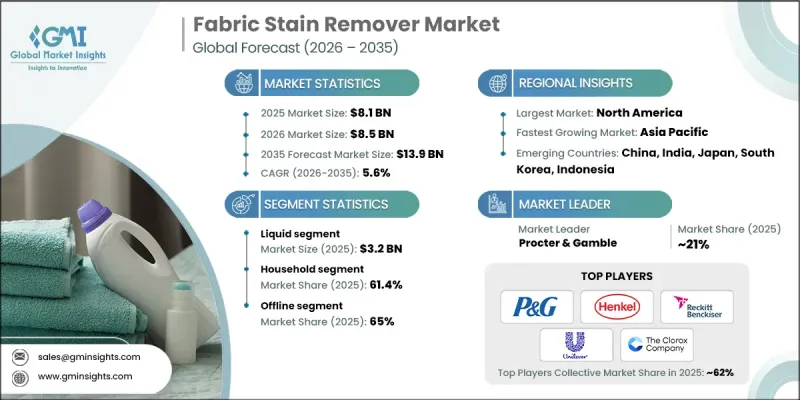
市場擴張的驅動力來自不斷成長的勞動力和日益快節奏的生活。隨著家庭時間壓力增大,消費者積極尋求高效率的衣物照護解決方案。現代消費者在選擇居家產品時更重視便利性和有效性,快速去漬的需求也順應了生活方式的轉變。織物去漬劑提供專業的清潔功效,無需完整的清潔程序即可立即去除污漬。都市區和繁忙的工作日程進一步增強了人們對專業、即時清潔解決方案的依賴。雙薪家庭擴大使用去漬產品,以便在兼顧日常工作的同時,保持專業、整潔的形象。人們對清潔度和儀容儀表的日益成長的期望,進一步推動了市場的持續成長。隨著就業率的提高和日常生活節奏的加快,人們對實用衣物護理解決方案的需求在全球範圍內持續成長。
| 市場覆蓋範圍 | |
|---|---|
| 開始年份 | 2025 |
| 預測年份 | 2026-2035 |
| 起始值 | 81億美元 |
| 預測金額 | 139億美元 |
| 複合年成長率 | 5.6% |
2025年,家庭終端用戶市佔率佔比達61.4%,預計2026年至2035年將以6.2%的複合年成長率成長。由於頻繁的洗衣需求和高衣物消耗量,住宅使用者仍然是主要消費族群。人們對衣物保養和防污意識的提高,促使去污劑在家中廣泛應用。布料種類的日益豐富,也使得人們更加依賴專業清潔產品來保護布料品質。具有競爭力的價格和零售通路的廣泛供應,推動了消費者的定期購買。人們對乾淨整潔衣物的日益關注,也進一步支撐了家庭的長期需求。
預計到2025年,線下分銷管道將佔據65%的市場佔有率,並在2026年至2035年間以3.3%的複合年成長率成長。實體店繼續發揮至關重要的作用,因為消費者優先考慮即時購買和商店選購。成熟的零售網路有助於保持穩定的銷售和強大的品牌知名度。
美國織物去漬劑市場預計到2025年將達到19億美元,到2035年將以4.6%的複合年成長率成長。高家庭普及率和快節奏的生活方式支撐著穩定的市場需求。消費者顯然更傾向於便利的產品形式,以便快速使用。消費者對不同織物護理方法的日益了解也持續推動產品的普及。零售和線上銷售管道的拓展進一步提升了產品在全國的可及性。
目錄
第1章調查方法和範圍
第2章執行摘要
第3章業界考察
- 生態系分析
- 供應商情況
- 利潤率
- 每個階段的附加價值
- 影響價值鏈的因素
- 產業影響因素
- 促進要素
- 不斷成長的勞動力和快節奏的生活方式
- 洗衣機的普及與現代洗衣習慣的傳播
- 旅館、醫療保健和機構洗衣服務業的成長
- 挑戰與困難
- 化學物質安全性和皮膚刺激性問題
- 來自多用途清潔劑和家庭療法的激烈競爭
- 機會
- 對植物來源和環保去污劑的需求不斷成長
- 以噴霧劑、筆和擦拭巾等便利形式進行成長
- 促進要素
- 成長潛力分析
- 未來市場趨勢
- 科技與創新趨勢
- 當前技術趨勢
- 新興技術
- 價格趨勢
- 按地區
- 依產品
- 監管環境
- 標準和合規要求
- 區域法規結構
- 認證標準
- 波特五力分析
- PESTEL 分析
第4章 競爭情勢
- 介紹
- 公司市佔率分析
- 按地區
- 北美洲
- 歐洲
- 亞太地區
- 拉丁美洲
- 中東和非洲
- 按地區
- 企業矩陣分析
- 主要市場公司的競爭分析
- 競爭定位矩陣
- 重大進展
- 併購
- 夥伴關係與合作
- 新產品發布
- 擴張計劃
第5章 依產品類型分類的市場估算與預測,2022-2035年
- 液體
- 粉末
- 酒吧
- 噴
- 發泡體
- 其他
第6章 依最終用戶分類的市場估算與預測,2022-2035年
- 家用
- 商業的
- 工業的
7. 2022-2035年按分銷管道分類的市場估算與預測
- 離線
- 線上
第8章 2022-2035年各地區市場估算與預測
- 北美洲
- 美國
- 加拿大
- 歐洲
- 德國
- 英國
- 法國
- 義大利
- 西班牙
- 亞太地區
- 中國
- 印度
- 日本
- 韓國
- 澳洲
- 拉丁美洲
- 巴西
- 墨西哥
- 阿根廷
- 中東和非洲
- 沙烏地阿拉伯
- 阿拉伯聯合大公國
- 南非
第9章:公司簡介
- ACE Gentle
- Amway
- Attitude
- Biokleen
- Bio-Tex
- Bissell
- Buncha Farmers
- C. Johnson
- Church &Dwight
- Dr Beckmann
- Henkel
- Procter &Gamble
- Reckitt Benckiser
- The Clorox Company
- Unilever
The Global Fabric Stain Remover Market was valued at USD 8.1 billion in 2025 and is estimated to grow at a CAGR of 5.6% to reach USD 13.9 billion by 2035.
Market expansion is influenced by the growing working population and increasingly fast-paced lifestyles. As more households operate on limited time availability, consumers actively seek efficient solutions that simplify garment care. The need for quick stain treatment aligns with changing routines, as modern consumers prioritize convenience and effectiveness in household products. Fabric stain removers offer targeted cleaning benefits that allow users to address stains immediately without completing a full laundry process. Urban living patterns and demanding work schedules continue to reinforce reliance on specialized cleaning solutions designed for instant use. Dual-income households increasingly adopt stain removal products to maintain professional and presentable clothing while managing daily responsibilities. Rising expectations for cleanliness and appearance further support sustained market growth. As employment levels rise and daily routines become more structured around efficiency, demand for practical fabric care solutions continues to increase globally.
| Market Scope | |
|---|---|
| Start Year | 2025 |
| Forecast Year | 2026-2035 |
| Start Value | $8.1 Billion |
| Forecast Value | $13.9 Billion |
| CAGR | 5.6% |
The household end users segment accounted for 61.4% share in 2025 and is projected to grow at a CAGR of 6.2% from 2026 to 2035. Residential consumers remain the leading segment due to recurring laundry needs and frequent clothing usage. Greater awareness of garment maintenance and stain prevention has strengthened routine adoption of stain removers in households. Increased use of varied fabric types has heightened reliance on specialized cleaning products that protect fabric quality. Competitive pricing and widespread retail availability encourage regular purchases. A growing focus on neat and well-maintained clothing further supports long-term household demand.
The offline distribution channels segment held 65% share in 2025 and is expected to grow at a CAGR of 3.3% between 2026 and 2035. Physical retail outlets continue to play a vital role, as consumers value immediate product access and in-store selection. Established retail networks contribute to consistent sales volume and brand visibility.
United States Fabric Stain Remover Market reached USD 1.9 billion in 2025 and is forecast to grow at a CAGR of 4.6% through 2035. Strong household penetration and busy lifestyles support steady demand. Consumers demonstrate a clear preference for easy-to-use formats that enable quick application. Growing awareness of fabric-specific care continues to drive product adoption. Expansion of retail and digital sales channels further enhances nationwide accessibility.
Key companies operating in the Global Fabric Stain Remover Market include Procter & Gamble, Reckitt Benckiser, Unilever, Henkel, The Clorox Company, Church & Dwight, Amway, Dr. Beckmann, Biokleen, Bio-Tex, Bissell, Attitude, Buncha Farmers, ACE Gentle, and C. Johnson. To strengthen their position, companies in the fabric stain remover industry focus on product innovation, brand differentiation, and expanded distribution. Manufacturers invest in research to develop effective formulas that work across multiple fabric types while maintaining fabric integrity. Clean-label and environmentally conscious product lines address evolving consumer preferences. Companies also enhance packaging design for ease of use and portability. Strategic partnerships with retailers and expansion into e-commerce platforms improve market reach. Competitive pricing strategies and promotional campaigns help retain customer loyalty. Continuous marketing efforts centered on fabric care education and performance reliability further support long-term brand strength.
Table of Contents
Chapter 1 Methodology & Scope
- 1.1 Market scope and definition
- 1.2 Research design
- 1.2.1 Research approach
- 1.2.2 Data collection methods
- 1.3 Data mining sources
- 1.3.1 Global
- 1.3.2 Regional/Country
- 1.4 Base estimates and calculations
- 1.4.1 Base year calculation
- 1.4.2 Key trends for market estimation
- 1.5 Primary research and validation
- 1.5.1 Primary sources
- 1.6 Forecast model
- 1.7 Research assumptions and limitations
Chapter 2 Executive Summary
- 2.1 Industry 360° synopsis
- 2.2 Key market trends
- 2.2.1 Regional
- 2.2.2 Burner design
- 2.2.3 Installation
- 2.2.4 Power Range
- 2.2.5 End Use Industry
- 2.3 CXO perspectives: Strategic imperatives
- 2.3.1 Key decision points for industry executives
- 2.3.2 Critical success factors for market players
- 2.4 Future outlook and strategic recommendations
Chapter 3 Industry Insights
- 3.1 Industry ecosystem analysis
- 3.1.1 Supplier landscape
- 3.1.2 Profit margin
- 3.1.3 Value addition at each stage
- 3.1.4 Factor affecting the value chain
- 3.2 Industry impact forces
- 3.2.1 Growth drivers
- 3.2.1.1 Expansion of working populations and fast-paced lifestyles
- 3.2.1.2 Increasing penetration of washing machines and modern laundry practices
- 3.2.1.3 Growth of hospitality, healthcare, and institutional laundry services
- 3.2.2 Pitfalls & Challenges
- 3.2.2.1 Concerns over chemical safety and skin irritation
- 3.2.2.2 Intense competition from multipurpose detergents and home remedies
- 3.2.3 Opportunities
- 3.2.3.1 Rising demand for plant-based and eco-friendly stain removers
- 3.2.3.2 Growth of convenient formats such as sprays, pens, and wipes
- 3.2.1 Growth drivers
- 3.3 Growth potential analysis
- 3.4 Future market trends
- 3.5 Technology and innovation landscape
- 3.5.1 Current technological trends
- 3.5.2 Emerging technologies
- 3.6 Price trends
- 3.6.1 By region
- 3.6.2 By product
- 3.7 Regulatory landscape
- 3.7.1 Standards and compliance requirements
- 3.7.2 Regional regulatory frameworks
- 3.7.3 Certification standards
- 3.8 Porter's analysis
- 3.9 PESTEL analysis
Chapter 4 Competitive Landscape, 2025
- 4.1 Introduction
- 4.2 Company market share analysis
- 4.2.1 By Region
- 4.2.1.1 North America
- 4.2.1.2 Europe
- 4.2.1.3 Asia Pacific
- 4.2.1.4 Latin America
- 4.2.1.5 Middle East & Africa
- 4.2.1 By Region
- 4.3 Company matrix analysis
- 4.4 Competitive analysis of major market players
- 4.5 Competitive positioning matrix
- 4.6 Key developments
- 4.6.1 Mergers & acquisitions
- 4.6.2 Partnerships & collaborations
- 4.6.3 New product launches
- 4.6.4 Expansion plans
Chapter 5 Market Estimates & Forecast, By Product Type, 2022 - 2035, (USD Billion) (Thousand Units)
- 5.1 Key trends
- 5.2 Liquid
- 5.3 Powder
- 5.4 Bar
- 5.5 Spray
- 5.6 Foam
- 5.7 Others
Chapter 6 Market Estimates & Forecast, By End User, 2022 - 2035, (USD Billion) (Thousand Units)
- 6.1 Key trends
- 6.2 Household
- 6.3 Commercial
- 6.4 Industrial
Chapter 7 Market Estimates & Forecast, By Distribution Channel, 2022 - 2035, (USD Billion) (Thousand Units)
- 7.1 Key trends
- 7.2 Offline
- 7.3 Online
Chapter 8 Market Estimates & Forecast, By Region, 2022 - 2035, (USD Billion) (Thousand Units)
- 8.1 Key trends
- 8.2 North America
- 8.2.1 U.S.
- 8.2.2 Canada
- 8.3 Europe
- 8.3.1 Germany
- 8.3.2 UK
- 8.3.3 France
- 8.3.4 Italy
- 8.3.5 Spain
- 8.4 Asia Pacific
- 8.4.1 China
- 8.4.2 India
- 8.4.3 Japan
- 8.4.4 South Korea
- 8.4.5 Australia
- 8.5 Latin America
- 8.5.1 Brazil
- 8.5.2 Mexico
- 8.5.3 Argentina
- 8.6 MEA
- 8.6.1 Saudi Arabia
- 8.6.2 UAE
- 8.6.3 South Africa
Chapter 9 Company Profiles
- 9.1 ACE Gentle
- 9.2 Amway
- 9.3 Attitude
- 9.4 Biokleen
- 9.5 Bio-Tex
- 9.6 Bissell
- 9.7 Buncha Farmers
- 9.8 C. Johnson
- 9.9 Church & Dwight
- 9.10 Dr Beckmann
- 9.11 Henkel
- 9.12 Procter & Gamble
- 9.13 Reckitt Benckiser
- 9.14 The Clorox Company
- 9.15 Unilever

 2026-2030年全球洗衣精市場
 洗衣精珠市場:按產品、配方類型、分銷管道、應用、國家和地區分類-全球產業分析、市場規模、市場佔有率和預測(2026-2033 年)
 非液體清潔劑市場-全球產業規模、佔有率、趨勢、機會與預測:按產品類型、通路、地區和競爭格局分類,2021-2031年洗衣精市場報告:趨勢、預測及競爭分析(至2035年)
 全球超當地語系化洗衣清潔服務市場預測至2034年-按服務類型、服務模式、平台類型、預訂方式、定價模式、應用程式和地區分類的分析環保清潔劑珠市場預測至2034年-全球產品類型、成分類型、包裝類型、應用、認證類型、通路、最終用戶和地區分析
 全球織物去污劑市場規模、佔有率、趨勢和成長分析報告(2026-2034)去污劑市場 - 全球產業規模、佔有率、趨勢、機會及預測(按產品類型、最終用途、分銷管道、地區和競爭格局分類,2021-2031年)抗菌洗衣精市場-全球產業規模、佔有率、趨勢、機會及預測(按類型、應用、銷售管道、地區及競爭格局分類,2021-2031年)洗衣精珠市場 - 全球產業規模、佔有率、趨勢、機會及預測(按產品類型、應用、分銷管道、地區和競爭格局分類,2021-2031年)