


 |
市場調查報告書
商品編碼
1936552
汽車車輪市場機會、成長要素、產業趨勢分析及預測(2026年至2035年)Automotive Wheel Market Opportunity, Growth Drivers, Industry Trend Analysis, and Forecast 2026 - 2035 |
||||||

全球汽車車輪市場預計到 2025 年將達到 408 億美元,到 2035 年將達到 699 億美元,年複合成長率為 5.2%。
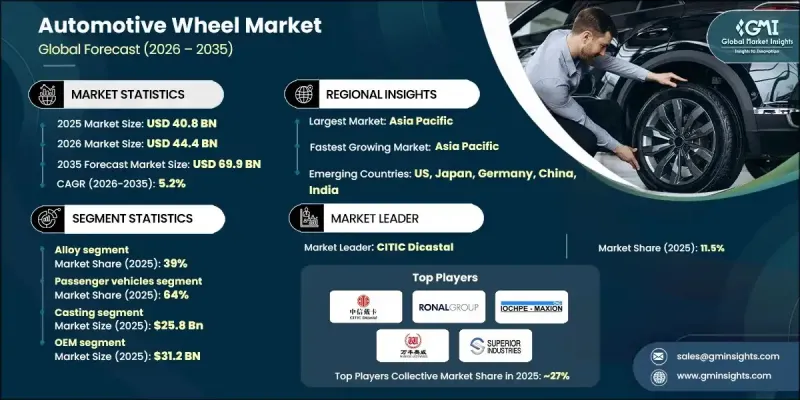
全球汽車產量不斷成長,消費者對高階高性能汽車的需求日益濃厚,以及輪轂設計和製造技術的持續創新,正推動著市場穩步成長。汽車製造商越來越重視效率、耐用性和視覺吸引力,促使不同車型的輪圈規格重塑。在製造商致力於提升車輛動力性能和燃油效率的同時,為了滿足更嚴格的排放氣體和性能標準,輕量化材料的應用也迅速普及。電氣化進一步重新定義了輪轂設計,因為電動車需要能夠承受更高車重並保持空氣動力學效率以延長續航里程的輪轂。這種轉變推動了具有更佳氣流管理和更強結構完整性的先進設計的應用。同時,不斷發展的製造技術和精密工程技術提高了輪轂的一致性、承載能力和整體性能,從而支持了OEM和售後市場管道的長期市場擴張。
| 市場覆蓋範圍 | |
|---|---|
| 開始年份 | 2025 |
| 預測年份 | 2026-2035 |
| 起始值 | 408億美元 |
| 預測金額 | 699億美元 |
| 複合年成長率 | 5.2% |
預計到2025年,合金輪圈市佔率將達到39%,並在2035年之前以4.3%的複合年成長率成長。合金輪圈因其能夠提升車輛的操控性、煞車性和乘坐舒適性,同時顯著降低車身重量而廣泛應用。這些優勢使其成為乘用車的理想選擇,尤其是在中檔和豪華車市場,因為在這些市場中,設計差異化和效率是購車決策的關鍵因素。製造流程的不斷進步,使得合金輪圈的生產成本得以降低,同時也能提升其強度、耐久性和美觀性。
預計到2025年,乘用車市佔率將達到64%,並在2026年至2035年間以4.5%的複合年成長率成長。高產量、對外觀設計日益成長的需求以及不斷提高的性能預期,持續支撐著這個細分市場。 SUV和跨界車的日益普及,推動了對更大尺寸輪圈、更高有效載荷能力和更高級內飾的需求。此外,該領域的電氣化趨勢也迫使製造商開發能夠承受更高扭力、能量回收煞車和增加車輛重量,同時又不影響效率的輪轂。
預計到2025年,美國汽車輪圈市場規模將達到90億美元。 SUV、皮卡和高性能汽車的強勁需求持續推動市場成長,因為這些車型通常需要更大直徑的輪轂和更高價值的材料。國內汽車產量的成長以及實力雄厚的汽車製造商的存在,進一步強化了對先進輪圈解決方案的需求,尤其是在鋁合金輪圈和鍛造輪圈領域。
目錄
第1章調查方法和範圍
第2章執行摘要
第3章業界考察
- 生態系分析
- 供應商情況
- 原物料供應商
- 車輪製造和加工
- OEM
- 售後市場
- 最終用途
- 成本結構
- 利潤率
- 每個過程都增加了價值
- 影響供應鏈的因素
- 顛覆者
- 供應商情況
- 影響因素
- 促進要素
- SUV和高階車型的需求不斷成長
- 售後客製化市場的成長
- 技術進步與製造創新
- 商用及非公路用車輛車隊擴張
- 產業潛在風險與挑戰
- 原物料價格波動
- 高資本投資需求
- 市場機遇
- 新興市場和在地化策略
- 優質化和智慧車輪技術
- 輕質永續材料的發展
- 促進要素
- 成長潛力分析
- 監管環境
- 北美洲
- 企業平均燃油經濟性 (CAFE)
- 美國環保署車輛排放氣體與減重法規
- 美墨加協定汽車原產地規則
- 加州空氣資源委員會 (CARB) 零排放車輛 (ZEV) 和材料合規標準
- 歐洲
- 歐盟汽車和貨車二氧化碳排放性能標準
- 歐洲7號車輛排放氣體法規
- 適合55歲的氣候行動方案
- REACH法規和報廢車輛指令
- 亞太地區
- 中國第六排放氣體法規
- 中國的新能源汽車政策框架
- 印度第六階段排放氣體標準(BS-VI)
- 日本燃油效率標準計畫排名第一
- 拉丁美洲
- PROCONVE排放標準(巴西)
- 阿根廷汽車排放氣體法規與安全標準
- 墨西哥NOM汽車排放氣體標準
- 中東和非洲
- 海灣合作理事會地區的車輛燃油經濟性與排放氣體法規
- 南非汽車生產發展計畫(APDP)
- 國內電動車推廣與產業本土化政策
- 北美洲
- 波特五力分析
- PESTEL 分析
- 科技與創新趨勢
- 當前技術趨勢
- 新興技術
- 定價分析
- 依產品
- 按地區
- 成本細分分析
- 專利分析
- 生產統計
- 生產基地
- 消費基礎
- 出口和進口
- 永續性和環境方面
- 永續實踐
- 減少廢棄物策略
- 生產中的能源效率
- 環保舉措
- 碳足跡考量
- OEM採購和採購策略
- 電動汽車車輪設計和性能要求
- 電動車的負載和扭矩要求
- 空氣動力學輪轂設計與續航里程最佳化
- NVH降低和結構剛度
- 再生煞車對車輪耐久性的影響
- 電動車平台標準化對輪圈尺寸的影響
- 售後市場經濟與客製化趨勢
- 與原廠輪轂相比,價格溢價比較
- 客製化飾面、塗層和美學需求
- 高性能輪圈 vs. 外觀升級
- 製造能力和運轉率分析
- 各區域的裝置容量
- 運轉率(原廠配套與售後市場)
- 現有工廠擴建計劃和新工廠擴建計劃
- 鍛造和旋壓成形能力方面的瓶頸
- 供應鏈風險與韌性
第4章 競爭情勢
- 介紹
- 公司市佔率分析
- 北美洲
- 歐洲
- 亞太地區
- 拉丁美洲
- 中東和非洲
- 主要市場公司的競爭分析
- 競爭定位矩陣
- 戰略展望矩陣
- 重大進展
- 併購
- 夥伴關係與合作
- 新產品發布
- 企業擴張計畫和資金籌措
第5章 按材料分類的市場估算與預測,2022-2035年
- 鋼材
- 合金
- 碳纖維
- 鋁
第6章 依車輛類型分類的市場估計與預測,2022-2035年
- 搭乘用車
- 掀背車
- 轎車
- SUV/跨界車
- 商用車輛
- 輕型商用車(LCV)
- 中型商用車(MCV)
- 重型商用車(HCV)
- 越野車
7. 按製造流程分類的市場估算與預測,2022-2035 年
- 鑄件
- 鍛造
- 旋壓成形
第8章 按輪圈尺寸分類的市場估算與預測,2022-2035年
- 13到15英寸
- 16 至 18 英寸
- 19 至 21 英寸
- 21吋或以上
第9章 依銷售管道分類的市場估計與預測,2022-2035年
- OEM
- 售後市場
第10章 2022-2035年各地區市場估計與預測
- 北美洲
- 美國
- 加拿大
- 歐洲
- 德國
- 英國
- 法國
- 義大利
- 西班牙
- 俄羅斯
- 北歐國家
- 比荷盧經濟聯盟
- 亞太地區
- 中國
- 印度
- 日本
- 澳洲
- 韓國
- 菲律賓
- 印尼
- 新加坡
- 拉丁美洲
- 巴西
- 墨西哥
- 阿根廷
- 智利
- 中東和非洲
- 南非
- 沙烏地阿拉伯
- 阿拉伯聯合大公國
第11章 公司簡介
- Global leaders
- CITIC Dicastal
- Iochpe-Maxion
- RONAL
- Zhejiang Wanfeng Auto Wheel
- Superior Industries International
- Borbet
- Accuride
- Enkei
- RAYS
- Topy Industries
- 本地製造商
- ALCAR
- Mangels Industrial
- Uniwheel
- Lizhong
- Central Motor Wheel
- Jantsa Wheel
- Steel Strips Wheels
- Maxion Janta Wheels
- YHI International
- Kosei Aluminum
- 新興製造商
- Zhongnan Aluminum Wheel
- Handan Hongda Auto Parts
- Samhwa Wheels
- AAM India Wheels
The Global Automotive Wheel Market was valued at USD 40.8 billion in 2025 and is estimated to grow at a CAGR of 5.2% to reach USD 69.9 billion by 2035.
The market is witnessing steady momentum due to rising global vehicle production, growing consumer inclination toward premium and performance-focused vehicles, and continuous innovation in wheel design and manufacturing technologies. Automakers are increasingly emphasizing efficiency, durability, and visual appeal, which is reshaping wheel specifications across vehicle categories. Lightweight materials are gaining strong traction as manufacturers focus on improving vehicle dynamics and fuel efficiency while meeting stricter emission and performance standards. Electrification is further redefining wheel engineering, as electric vehicles demand wheels that can support higher vehicle weights while maintaining aerodynamic efficiency to extend driving range. This shift is encouraging the adoption of advanced designs with improved airflow management and enhanced structural integrity. In parallel, evolving manufacturing techniques and precision engineering enable higher consistency, improved load-bearing capacity, and better overall performance, supporting long-term market expansion across both OEM and aftermarket channels.
| Market Scope | |
|---|---|
| Start Year | 2025 |
| Forecast Year | 2026-2035 |
| Start Value | $40.8 Billion |
| Forecast Value | $69.9 Billion |
| CAGR | 5.2% |
The alloy wheel segment held 39% share in 2025 and is expected to grow at a CAGR of 4.3% through 2035. Alloy wheels are widely adopted due to their ability to significantly reduce vehicle weight while improving handling, braking performance, and ride comfort. These advantages make them highly attractive for passenger vehicles, especially in mid-range and premium categories where design differentiation and efficiency play a critical role in purchasing decisions. Ongoing advancements in manufacturing processes are enabling cost-effective production while delivering enhanced strength, durability, and refined aesthetics.
The passenger vehicles segment accounted for 64% share in 2025 and is projected to grow at a CAGR of 4.5% between 2026 and 2035. High production volumes, increasing demand for visually appealing designs, and rising expectations for performance continue to support this segment. The growing popularity of SUVs and crossovers is driving demand for larger wheel sizes, higher load capacities, and premium finishes. Electrification within this segment is also pushing manufacturers to develop wheels capable of handling higher torque, regenerative braking forces, and increased curb weights without compromising efficiency.
U.S. Automotive Wheel Market reached USD 9 billion in 2025. Strong demand for SUVs, pickup trucks, and performance vehicles continues to support market growth, as these vehicles typically require larger wheel diameters and higher-value materials. Domestic vehicle production and a strong OEM presence further reinforce demand for advanced wheel solutions, particularly in aluminum and forged wheel categories.
Key players in the Global Automotive Wheel Market include CITIC Dicastal, Iochpe-Maxion, Ronal, Enkei, Borbet, Superior Industries International, BBS Autotechnik, Prime Wheel, Topy Industries, Zhejiang Wanfeng Auto Wheel, and Accuride. Companies in the automotive wheel market are strengthening their market position by investing heavily in lightweight material development, advanced manufacturing technologies, and precision engineering. Strategic collaborations with OEMs enable early integration of customized wheel designs into new vehicle platforms, including electric and performance vehicles. Manufacturers are expanding production capacities and regional footprints to improve supply chain resilience and reduce delivery timelines. Increased focus on premium finishes, aerodynamic optimization, and sustainability-driven materials is helping companies differentiate their offerings.
Table of Contents
Chapter 1 Methodology & Scope
- 1.1 Research approach
- 1.2 Quality Commitments
- 1.2.1 GMI AI policy & data integrity commitment
- 1.3 Research Trail & Confidence Scoring
- 1.3.1 Research Trail Components
- 1.3.2 Scoring Components
- 1.4 Data Collection
- 1.4.1 Partial list of primary sources
- 1.5 Data mining sources
- 1.5.1 Paid sources
- 1.6 Base estimates and calculations
- 1.6.1 Base year calculation for any one approach
- 1.7 Forecast model
- 1.8 Research transparency addendum
Chapter 2 Executive Summary
- 2.1 Industry 3600 synopsis, 2022-2035
- 2.2 Key market trends
- 2.2.1 Regional
- 2.2.2 Material
- 2.2.3 Vehicle
- 2.2.4 Manufacturing process
- 2.2.5 Rim size
- 2.2.6 Sales channel
- 2.3 TAM Analysis, 2026-2035
- 2.4 CXO perspectives: Strategic imperatives
- 2.4.1 Key decision points for industry executives
- 2.4.2 Critical success factors for market players
- 2.5 Future outlook and strategic recommendations
Chapter 3 Industry Insights
- 3.1 Industry ecosystem analysis
- 3.1.1 Supplier landscape
- 3.1.1.1 Raw material supplier
- 3.1.1.2 Wheel Manufacturing & Processing
- 3.1.1.3 OEM
- 3.1.1.4 Aftermarket
- 3.1.1.5 End use
- 3.1.2 Cost structure
- 3.1.3 Profit margin
- 3.1.4 Value addition at each stage
- 3.1.5 Factors impacting the supply chain
- 3.1.6 Disruptors
- 3.1.1 Supplier landscape
- 3.2 Impact on forces
- 3.2.1 Growth drivers
- 3.2.1.1 Rising demand for SUVs and premium vehicles
- 3.2.1.2 Growth in aftermarket customization
- 3.2.1.3 Technological advancements and manufacturing innovation
- 3.2.1.4 Expansion of commercial and off-highway vehicle fleets
- 3.2.2 Industry pitfalls & challenges
- 3.2.2.1 Volatility in raw material prices
- 3.2.2.2 High capital investment requirements
- 3.2.3 Market opportunities
- 3.2.3.1 Emerging markets and localization strategies
- 3.2.3.2 Premiumization and smart wheel technologies
- 3.2.3.3 Growth of lightweight and sustainable materials
- 3.2.1 Growth drivers
- 3.3 Growth potential analysis
- 3.4 Regulatory landscape
- 3.4.1 North America
- 3.4.1.1 Corporate Average Fuel Economy (CAFE) Standards
- 3.4.1.2 EPA Vehicle Emissions & Lightweighting Regulations
- 3.4.1.3 USMCA Automotive Rules of Origin
- 3.4.1.4 CARB Zero-Emission Vehicle (ZEV) & Materials Compliance Standards
- 3.4.2 Europe
- 3.4.2.1 EU CO2 Emission Performance Standards for Passenger Cars and Vans
- 3.4.2.2 Euro 7 Vehicle Emission Regulations
- 3.4.2.3 Fit for 55 Climate Package
- 3.4.2.4 REACH & End-of-Life Vehicle (ELV) Directives
- 3.4.3 Asia Pacific
- 3.4.3.1 China VI Emission Standards
- 3.4.3.2 China NEV (New Energy Vehicle) Policy Framework
- 3.4.3.3 Bharat Stage VI (BS-VI) Emission Norms - India
- 3.4.3.4 Japan Top Runner Fuel Efficiency Program
- 3.4.4 Latin America
- 3.4.4.1 PROCONVE Emission Standards (Brazil)
- 3.4.4.2 Argentina Vehicle Emission and Safety Regulations
- 3.4.4.3 Mexico NOM Vehicle Emission Standards
- 3.4.5 Middle East & Africa
- 3.4.5.1 GCC Vehicle Fuel Economy & Emission Standards
- 3.4.5.2 South Africa Automotive Production and Development Programme (APDP)
- 3.4.5.3 National EV Adoption & Industrial Localization Policies
- 3.4.1 North America
- 3.5 Porter's analysis
- 3.6 PESTEL analysis
- 3.7 Technology and innovation landscape
- 3.7.1 Current technological trends
- 3.7.2 Emerging technologies
- 3.8 Pricing analysis
- 3.8.1 By product
- 3.8.2 By region
- 3.9 Cost breakdown analysis
- 3.10 Patent analysis
- 3.11 Production statistics
- 3.11.1 Production hubs
- 3.11.2 Consumption hubs
- 3.11.3 Export and import
- 3.12 Sustainability and environmental aspects
- 3.12.1 Sustainable practices
- 3.12.2 Waste reduction strategies
- 3.12.3 Energy efficiency in production
- 3.12.4 Eco-friendly initiatives
- 3.12.5 Carbon footprint considerations
- 3.13 OEM Sourcing & Procurement Strategy
- 3.14 EV-Specific Wheel Design & Performance Requirements
- 3.14.1 Load-bearing & torque requirements for EVs
- 3.14.2 Aerodynamic wheel designs & range optimization
- 3.14.3 NVH reduction & structural stiffness
- 3.14.4 Regenerative braking impact on wheel durability
- 3.14.5 EV platform standardization effects on rim sizing
- 3.15 Aftermarket Economics & Customization Trends
- 3.15.1 Price premium vs OEM wheels
- 3.15.2 Custom finishes, coatings & aesthetic demand
- 3.15.3 Performance wheels vs cosmetic upgrades
- 3.16 Manufacturing Capacity & Utilization Analysis
- 3.16.1 Installed capacity by region
- 3.16.2 Capacity utilization rates (OEM vs aftermarket)
- 3.16.3 Brownfield vs greenfield expansion plans
- 3.16.4 Bottlenecks in forging & flow-forming capacity
- 3.17 Supply Chain Risk & Resilience
Chapter 4 Competitive Landscape, 2025
- 4.1 Introduction
- 4.2 Company market share analysis
- 4.2.1 North America
- 4.2.2 Europe
- 4.2.3 Asia Pacific
- 4.2.4 LATAM
- 4.2.5 MEA
- 4.3 Competitive analysis of major market players
- 4.4 Competitive positioning matrix
- 4.5 Strategic outlook matrix
- 4.6 Key developments
- 4.6.1 Mergers & acquisitions
- 4.6.2 Partnerships & collaborations
- 4.6.3 New product launches
- 4.6.4 Expansion plans and funding
Chapter 5 Market Estimates & Forecast, By Material, 2022 - 2035 ($Bn, Units)
- 5.1 Key trends
- 5.2 Steel
- 5.3 Alloy
- 5.4 Carbon Fiber
- 5.5 Aluminum
Chapter 6 Market Estimates & Forecast, By Vehicle, 2022 - 2035 ($Bn, Units)
- 6.1 Key trends
- 6.2 Passenger vehicles
- 6.2.1 Hatchback
- 6.2.2 Sedan
- 6.2.3 SUV / Crossover
- 6.3 Commercial vehicles
- 6.3.1 Light commercial vehicles (LCV)
- 6.3.2 Medium commercial vehicles (MCV)
- 6.3.3 Heavy commercial vehicles (HCV)
- 6.4 Off-road vehicles
Chapter 7 Market Estimates & Forecast, By Manufacturing Process, 2022 - 2035 ($Bn, Units)
- 7.1 Key trends
- 7.2 Casting
- 7.3 Forging
- 7.4 Flow forming
Chapter 8 Market Estimates & Forecast, By Rim Size, 2022 - 2035 ($Bn, Units)
- 8.1 Key trends
- 8.2 13-15 inches
- 8.3 16-18 inches
- 8.4 19-21 inches
- 8.5 Above 21 inches
Chapter 9 Market Estimates & Forecast, By Sales Channel, 2022 - 2035 ($Bn, Units)
- 9.1 Key trends
- 9.2 OEM
- 9.3 Aftermarket
Chapter 10 Market Estimates & Forecast, By Region, 2022 - 2035 ($Bn, Units)
- 10.1 Key trends
- 10.2 North America
- 10.2.1 US
- 10.2.2 Canada
- 10.3 Europe
- 10.3.1 Germany
- 10.3.2 UK
- 10.3.3 France
- 10.3.4 Italy
- 10.3.5 Spain
- 10.3.6 Russia
- 10.3.7 Nordics
- 10.3.8 Benelux
- 10.4 Asia Pacific
- 10.4.1 China
- 10.4.2 India
- 10.4.3 Japan
- 10.4.4 Australia
- 10.4.5 South Korea
- 10.4.6 Philippines
- 10.4.7 Indonesia
- 10.4.8 Singapore
- 10.5 Latin America
- 10.5.1 Brazil
- 10.5.2 Mexico
- 10.5.3 Argentina
- 10.5.4 Chile
- 10.6 MEA
- 10.6.1 South Africa
- 10.6.2 Saudi Arabia
- 10.6.3 UAE
Chapter 11 Company Profiles
- 11.1 Global leaders
- 11.1.1 CITIC Dicastal
- 11.1.2 Iochpe-Maxion
- 11.1.3 RONAL
- 11.1.4 Zhejiang Wanfeng Auto Wheel
- 11.1.5 Superior Industries International
- 11.1.6 Borbet
- 11.1.7 Accuride
- 11.1.8 Enkei
- 11.1.9 RAYS
- 11.1.10 Topy Industries
- 11.2 Regional players
- 11.2.1 ALCAR
- 11.2.2 Mangels Industrial
- 11.2.3 Uniwheel
- 11.2.4 Lizhong
- 11.2.5 Central Motor Wheel
- 11.2.6 Jantsa Wheel
- 11.2.7 Steel Strips Wheels
- 11.2.8 Maxion Janta Wheels
- 11.2.9 YHI International
- 11.2.10 Kosei Aluminum
- 11.3 Emerging players
- 11.3.1 Zhongnan Aluminum Wheel
- 11.3.2 Handan Hongda Auto Parts
- 11.3.3 Samhwa Wheels
- 11.3.4 AAM India Wheels

 2026年全球汽車車輪市場報告
 自行車輪市場依材質、輪徑、應用、最終用戶和銷售管道分類,全球預測(2026-2032年)
 汽車輪圈市場規模、佔有率、成長率及全球產業分析:按類型、應用和地區分類,預測2026-2034年全球拖車車輪市場規模、佔有率、趨勢和成長分析報告(2026-2034)全球鎂合金輪圈市場規模、佔有率、趨勢及成長分析報告(2026-2034)
 自行車輪市場按類型、應用和地區分類
 汽車商用車輪圈市場 - 全球產業規模、佔有率、趨勢、機會及預測(按材料類型、銷售管道、地區和競爭格局分類,2021-2031年)汽車輪圈市場 - 全球產業規模、佔有率、趨勢、機會及預測(按車輛類型、材料、銷售管道、地區和競爭格局分類,2021-2031年)汽車輪圈蓋市場 - 全球產業規模、佔有率、趨勢、機會、預測:按材料、車輛類型、銷售管道、地區和競爭對手分類,2021-2031年汽車飛輪市場 - 全球產業規模、佔有率、趨勢、機會及預測(按車輛類型、產品類型、需求類別、技術、材料、地區和競爭格局分類,2021-2031年)