


 |
市場調查報告書
商品編碼
1936519
土壤監測市場機會、成長要素、產業趨勢分析及2026年至2035年預測Soil Monitoring Market Opportunity, Growth Drivers, Industry Trend Analysis, and Forecast 2026 - 2035 |
||||||

2025 年全球土壤監測市場價值為 9.381 億美元,預計到 2035 年將達到 16 億美元,年複合成長率為 5.6%。
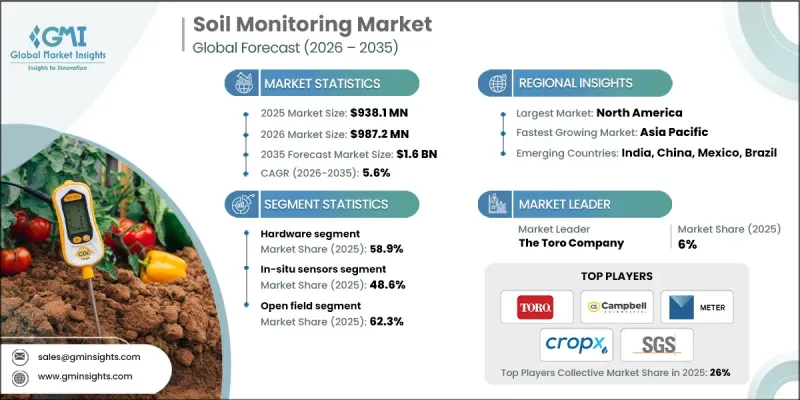
市場成長的驅動力在於人們日益增強的環境保護和永續土地管理意識,以及在氣候變遷壓力不斷加劇的情況下最佳化農業生產力的需求。該行業正在逐步摒棄傳統的土壤檢測方法,這些方法頻率低、依賴人工且依賴實驗室分析。取而代之的是,數位化技術賦能的監測解決方案憑藉其持續的、特異性位置的洞察,正迅速發展。產業內的策略整合正在加速創新,拓展技術組合,並促進全球市場部署。土壤監測解決方案在現代農業中發揮核心作用,它支持數據驅動的決策,從而在提高產量的同時減少對環境的影響。這些系統與糧食安全目標、監管永續性目標以及公共和私人對智慧農業舉措日益成長的投資高度契合。隨著農民和農業相關企業尋求擴充性且高效的作物管理工具,土壤監測作為精密農業的核心組成部分,其重要性在全球範圍內持續提升。
| 市場覆蓋範圍 | |
|---|---|
| 開始年份 | 2025 |
| 預測年份 | 2026-2035 |
| 起始值 | 9.381億美元 |
| 預測金額 | 16億美元 |
| 複合年成長率 | 5.6% |
現代土壤監測系統能夠準確、即時地測量土壤濕度、養分含量和化學成分,從而實現精準施肥。這種方法提高了資源利用效率,降低了投入成本,並減少了可能對周邊生態系統造成負面影響的徑流。北美地區對農業增產的需求不斷成長,加上歐洲和亞太地區對先進農業實踐的政策支持力度不斷加大,進一步提升了這些技術的商業性價值。農民和農藝師越來越傾向於使用自動化系統來取代勞動密集的採樣方法,從而加快決策速度並提高作物產量。
預計到2025年,原位感測器細分市場將佔據48.6%的市場佔有率,並創造4.563億美元的收入。該細分市場預計也將達到最高的複合年成長率,達到6.1%。原位感測器因其能夠直接從土壤剖面獲取連續、高解析度數據而被廣泛採用,有助於實現農場自主作業並最大限度地減少人為干預。它們的廣泛應用反映了整個產業向智慧互聯農業技術的轉型。
2025年,戶外應用領域佔據62.3%的市場佔有率,創造了5.847億美元的收入。預計該領域在2026年至2035年間將以5.8%的複合年成長率成長。戶外監測的主導地位主要得益於全球作物種植規模的龐大以及精密農業技術在大規模農業生產中的日益普及。即時土壤數據能夠顯著提高生產力和效率。
預計到2025年,北美土壤監測市場規模將達到3.085億美元,並在2035年之前以5.6%的複合年成長率成長。該地區正受益於先進的感測技術和整合數據平台,這些技術和平台支援永續土地利用和高產農業。監管機構對環境保護和氣候責任的重視進一步推動了對土壤健康、碳含量和化學影響監測解決方案的需求,從而確保了該地區的穩定成長。
目錄
第1章調查方法和範圍
第2章執行摘要
第3章業界考察
- 生態系分析
- 供應商情況
- 利潤率
- 每個階段的附加價值
- 影響價值鏈的因素
- 產業影響因素
- 促進要素
- 快速的都市化和基礎建設
- 景觀設計和專業樹木護理業務的成長
- 環境永續性和監管重點
- 產業潛在風險與挑戰
- 較高的初始投資和維護成本
- 安全風險及專門訓練的必要性
- 機會
- 電氣化和智慧技術融合
- 設備租賃市場的擴張
- 促進要素
- 成長潛力分析
- 未來市場趨勢
- 科技與創新趨勢
- 當前技術趨勢
- 新興技術
- 價格趨勢
- 按地區
- 依產品類型
- 監管環境
- 標準和合規要求
- 區域法規結構
- 認證標準
- 波特五力分析
- PESTEL 分析
第4章 競爭情勢
- 介紹
- 公司市佔率分析
- 按地區
- 企業矩陣分析
- 主要市場公司的競爭分析
- 競爭定位矩陣
- 重大進展
- 併購
- 夥伴關係與合作
- 新產品發布
- 擴張計劃
第5章 按組件分類的市場估算與預測,2022-2035年
- 硬體
- 軟體
- 服務
第6章 依產品類型分類的市場估算與預測,2022-2035年
- 現場安裝式感應器
- 遙感探測平台
- 攜帶式探頭和測試套件
第7章 按應用領域分類的市場估算與預測,2022-2035年
- 戶外栽培
- 保護性栽培
- 林業
第8章 依最終用戶分類的市場估算與預測,2022-2035年
- 大型商業農場
- 小規模和合作農場
- 研究機構和大學
- 政府和非政府組織
第9章 2022-2035年各地區市場估算與預測
- 北美洲
- 美國
- 加拿大
- 歐洲
- 德國
- 英國
- 法國
- 義大利
- 西班牙
- 亞太地區
- 中國
- 日本
- 印度
- 澳洲
- 韓國
- 拉丁美洲
- 巴西
- 墨西哥
- 阿根廷
- 中東和非洲
- 南非
- 沙烏地阿拉伯
- 阿拉伯聯合大公國
第10章:公司簡介
- Acclima, Inc.
- Arable Labs, Inc.
- Campbell Scientific, Inc.
- CropX Technologies
- Delta-T Devices Ltd
- EarthOptics
- Element Materials Technology
- HydroPoint Data Systems, Inc.
- Irrometer Company, Inc.
- METER Group, Inc.
- SGS SA
- Sentek Technologies
- Soil Scout Oy
- Spectrum Technologies, Inc.
- The Toro Company
The Global Soil Monitoring Market was valued at USD 938.1 million in 2025 and is estimated to grow at a CAGR of 5.6% to reach USD 1.6 billion by 2035.
Market expansion is driven by rising awareness of environmental protection, sustainable land management, and the need to optimize agricultural productivity under increasing climate pressure. The industry is shifting away from conventional soil testing approaches that rely on infrequent, manual, and laboratory-dependent analysis. In their place, digitally enabled monitoring solutions are gaining momentum by delivering continuous and location-specific insights. Strategic consolidation across industry is accelerating innovation, expanding technology portfolios, and improving global market reach. Soil monitoring solutions now play a central role in modern agriculture by supporting data-driven decisions that improve yields while reducing environmental stress. These systems align well with food security objectives, regulatory sustainability goals, and increasing public and private investment in smart agriculture initiatives. As farmers and agribusinesses seek scalable and efficient crop management tools, soil monitoring continues to gain relevance as a core component of precision agriculture worldwide.
| Market Scope | |
|---|---|
| Start Year | 2025 |
| Forecast Year | 2026-2035 |
| Start Value | $938.1 Million |
| Forecast Value | $1.6 Billion |
| CAGR | 5.6% |
Modern soil monitoring systems provide accurate, real-time measurements of moisture levels, nutrient content, and soil chemistry, enabling precise application of water and fertilizers. This approach improves resource efficiency, lowers input costs, and reduces runoff that can harm surrounding ecosystems. The growing demand for higher agricultural output in North America, combined with expanding policy support for advanced farming practices in Europe and the Asia-Pacific region, reinforces the commercial value of these technologies. Farmers and agronomists increasingly favor automated systems that replace labor-intensive sampling methods, supporting faster decision-making and improved crop outcomes.
In 2025, the in-situ sensors segment accounted for a 48.6% share and generated USD 456.3 million. This segment also recorded the highest growth rate with a CAGR of 6.1%. In-situ sensors are widely adopted because they deliver continuous, high-resolution data directly from the soil profile, supporting autonomous farm operations and minimizing human intervention. Their widespread use reflects the broader industry shift toward intelligent, connected agricultural technologies.
The open-field applications segment held a 62.3% share, generating USD 584.7 million in 2025. This segment is expected to grow at a CAGR of 5.8% from 2026 to 2035. The dominance of open-field monitoring is linked to the vast scale of global crop cultivation and the increasing adoption of precision farming practices in large agricultural operations, where real-time soil insights significantly enhance productivity and efficiency.
North America Soil Monitoring Market reached USD 308.5 million in 2025 and is projected to grow at a CAGR of 5.6% through 2035. The region benefits from advanced sensing technologies and integrated data platforms that support sustainable land use and high-yield farming. Regulatory focus on environmental protection and climate accountability further drives demand for solutions that monitor soil health, carbon content, and chemical impact, ensuring steady regional growth.
Key companies active in the Global Soil Monitoring Market include METER Group, Inc., CropX Technologies, Acclima, Inc., SGS SA, Spectrum Technologies, Inc., Campbell Scientific, Inc., Sentek Technologies, Soil Scout Oy, Irrometer Company, Inc., Arable Labs, Inc., EarthOptics, Delta-T Devices Ltd, HydroPoint Data Systems, Inc., Element Materials Technology, and The Toro Company. Companies operating in the soil monitoring market strengthen their market position through technology innovation, data integration, and strategic expansion. Many players focus on developing sensor systems with higher accuracy, longer lifespan, and seamless connectivity with farm management platforms. Investments in analytics software and cloud-based dashboards enhance value by translating raw data into actionable insights. Firms also expand geographically to serve emerging agricultural markets while forming partnerships with agribusinesses and research institutions.
Table of Contents
Chapter 1 Methodology and Scope
- 1.1 Market scope and definition
- 1.2 Research design
- 1.2.1 Research approach
- 1.2.2 Data collection methods
- 1.3 Data mining sources
- 1.3.1 Global
- 1.3.2 Regional/Country
- 1.4 Base estimates and calculations
- 1.4.1 Base year calculation
- 1.4.2 Key trends for market estimation
- 1.5 Primary research and validation
- 1.5.1 Primary sources
- 1.6 Forecast model
- 1.7 Research assumptions and limitations
Chapter 2 Executive Summary
- 2.1 Industry 360° synopsis
- 2.2 Key market trends
- 2.2.1 Regional
- 2.2.2 Component
- 2.2.3 Product Type
- 2.2.4 Application Type
- 2.2.5 End-User
- 2.3 CXO perspectives: Strategic imperatives
- 2.3.1 Key decision points for industry executives
- 2.3.2 Critical success factors for market players
- 2.4 Future outlook and strategic recommendations
Chapter 3 Industry Insights
- 3.1 Industry ecosystem analysis
- 3.1.1 Supplier landscape
- 3.1.2 Profit margin
- 3.1.3 Value addition at each stage
- 3.1.4 Factor affecting the value chain
- 3.2 Industry impact forces
- 3.2.1 Growth drivers
- 3.2.1.1 Rapid Urbanization & Infrastructure Development
- 3.2.1.2 Growth in Landscaping & Professional Tree Care
- 3.2.1.3 Emphasis on Environmental Sustainability & Regulations
- 3.2.2 Industry pitfalls & challenges
- 3.2.2.1 High Initial Investment and Maintenance Costs
- 3.2.2.2 Safety Risks and Need for Specialized Training
- 3.2.3 Opportunities
- 3.2.3.1 Electrification and Smart Technology Integration
- 3.2.3.2 Expansion of the Equipment Rental Market
- 3.2.1 Growth drivers
- 3.3 Growth potential analysis
- 3.4 Future market trends
- 3.5 Technology and innovation landscape
- 3.5.1 Current technological trends
- 3.5.2 Emerging technologies
- 3.6 Price trends
- 3.6.1 By region
- 3.6.2 By Product type
- 3.7 Regulatory landscape
- 3.7.1 Standards and compliance requirements
- 3.7.2 Regional regulatory frameworks
- 3.7.3 Certification standards
- 3.8 Porter's analysis
- 3.9 PESTEL analysis
Chapter 4 Competitive Landscape, 2025
- 4.1 Introduction
- 4.2 Company market share analysis
- 4.2.1 By region
- 4.2.1.1 North America
- 4.2.1.2 Europe
- 4.2.1.3 Asia Pacific
- 4.2.1.4 Latin America
- 4.2.1.5 Middle East and Africa
- 4.2.1 By region
- 4.3 Company matrix analysis
- 4.4 Competitive analysis of major market players
- 4.5 Competitive positioning matrix
- 4.6 Key developments
- 4.6.1 Mergers & acquisitions
- 4.6.2 Partnerships & collaborations
- 4.6.3 New product launches
- 4.6.4 Expansion plans
Chapter 5 Market Estimates and Forecast, By Component, 2022 - 2035 (USD Billion) (Thousand Units)
- 5.1 Key trends
- 5.2 Hardware
- 5.3 Software
- 5.4 Services
Chapter 6 Market Estimates and Forecast, By Product Type, 2022 - 2035 (USD Billion) (Thousand Units)
- 6.1 Key trends
- 6.2 In-situ Sensors
- 6.3 Remote Sensing Platforms
- 6.4 Portable Probes & Test Kits
Chapter 7 Market Estimates and Forecast, By Application Type, 2022 - 2035 (USD Billion) (Thousand Units)
- 7.1 Key trends
- 7.2 Open Field
- 7.3 Protected Cultivation
- 7.4 Forestry
Chapter 8 Market Estimates and Forecast, By End User, 2022 - 2035 (USD Billion) (Thousand Units)
- 8.1 Key trends
- 8.2 Large Commercial Farms
- 8.3 Smallholder & Cooperative Farms
- 8.4 Research Institutes & Universities
- 8.5 Government & NGOs
Chapter 9 Market Estimates and Forecast, By Region, 2022 - 2035 (USD Billion) (Thousand Units)
- 9.1 Key trends
- 9.2 North America
- 9.2.1 U.S.
- 9.2.2 Canada
- 9.3 Europe
- 9.3.1 Germany
- 9.3.2 UK
- 9.3.3 France
- 9.3.4 Italy
- 9.3.5 Spain
- 9.4 Asia Pacific
- 9.4.1 China
- 9.4.2 Japan
- 9.4.3 India
- 9.4.4 Australia
- 9.4.5 South Korea
- 9.5 Latin America
- 9.5.1 Brazil
- 9.5.2 Mexico
- 9.5.3 Argentina
- 9.6 Middle East and Africa
- 9.6.1 South Africa
- 9.6.2 Saudi Arabia
- 9.6.3 UAE
Chapter 10 Company Profiles
- 10.1 Acclima, Inc.
- 10.2 Arable Labs, Inc.
- 10.3 Campbell Scientific, Inc.
- 10.4 CropX Technologies
- 10.5 Delta-T Devices Ltd
- 10.6 EarthOptics
- 10.7 Element Materials Technology
- 10.8 HydroPoint Data Systems, Inc.
- 10.9 Irrometer Company, Inc.
- 10.10 METER Group, Inc.
- 10.11 SGS SA
- 10.12 Sentek Technologies
- 10.13 Soil Scout Oy
- 10.14 Spectrum Technologies, Inc.
- 10.15 The Toro Company

 人工智慧驅動的土壤健康分析市場預測至2034年:按組件、部署模式、技術、應用、最終用戶和地區分類的全球分析
 土壤監測市場-2026-2032年全球市場預測人工智慧土壤健康監測市場預測至2034年—按產品、作物類型、應用、最終用戶和地區分類的全球分析
 土壤監測市場規模、佔有率和趨勢分析報告:按產品、類型、應用和細分市場預測(2026-2033 年)土壤健康監測技術市場預測至2034年—按參數、技術、應用、最終用戶和地區分類的全球分析
 2026年全球土壤監測市場報告土壤探針市場:2026-2032年全球市場預測(依技術、應用、最終用戶、產品、通路和安裝方式分類)土壤碳通量監測器市場:依技術、部署模式、最終用戶、應用和銷售管道,全球預測(2026-2032)
 土壤監測市場分析及預測(至2035年):依類型、產品類型、服務、技術、組件、應用、形式、最終用戶、部署類型及解決方案分類土壤健康監測與分析市場,全球預測至2032年:按組件、技術、部署模式、應用、最終用戶和地區分類