


 |
市場調查報告書
商品編碼
1928954
化學廢熱回收系統市場機會、成長要素、產業趨勢分析及2026年至2035年預測Chemical Waste Heat Recovery Systems Market Opportunity, Growth Drivers, Industry Trend Analysis, and Forecast 2026 - 2035 |
||||||

全球化學廢熱回收系統市場預計到 2025 年將達到 116 億美元,到 2035 年將達到 218 億美元,年複合成長率為 6.6%。
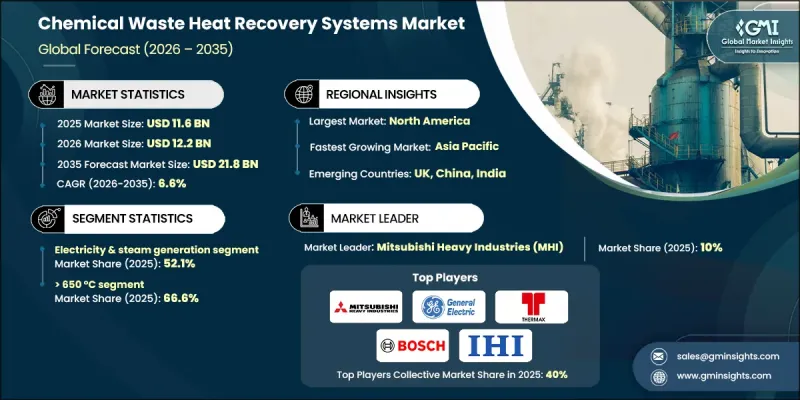
成長的驅動力來自大型化學企業設定的更嚴格的脫碳目標,這些企業日益重視減少燃料蒸氣的產生和製程熱的消耗。廢熱回收正被廣泛採用,成為提高能源效率並減少排放的直接且經濟有效的解決方案。隨著企業將排放目標與營運績效指標掛鉤,這些系統正日益被視為策略性投資,而非可有可無的升級。這種轉變有助於在能源成本波動的情況下穩定營運利潤率。隨著客戶對低碳化工產品的需求日益成長,內部碳計量和產品級排放追蹤的普及進一步加速了這項需求。法規結構也透過要求在核准新產能之前進行詳細的能源評估和剩餘熱能回收,加強了以效率為先的規劃。財政獎勵和支持性政策結構使得這些系統的實施更加便捷,也更容易納入長期資本規劃。
| 市場覆蓋範圍 | |
|---|---|
| 開始年份 | 2025 |
| 預測年份 | 2026-2035 |
| 起始值 | 116億美元 |
| 預測金額 | 218億美元 |
| 複合年成長率 | 6.6% |
預計到 2025 年,電力和蒸氣發電領域將佔 52.1% 的市場佔有率,到 2035 年將以 7.5% 的複合年成長率成長。化學製造商正擴大將回收的熱量轉化為可用能源,以滿足現場電力和蒸氣需求,同時降低排放強度。
預計到 2025 年,運作溫度高於 650°C 的系統將佔市場佔有率的 66.6%,到 2035 年將以 6% 的複合年成長率成長。高溫製程會產生大量可回收的熱量,而回收這種能量正成為能源密集型化學製程中下一代熱效率策略的核心。
2025年,美國化工廢熱回收系統市場價值47億美元,佔全球市場佔有率的82%。區域成長得益於有利的政策機制,這些機制支持效率投資,並加速化學和石化設施採用先進的廢熱回收解決方案。
目錄
第1章調查方法和範圍
第2章執行摘要
第3章業界考察
- 生態系分析
- 監管環境
- 產業影響因素
- 促進要素
- 產業潛在風險與挑戰
- 成長潛力分析
- 波特分析
- 供應商的議價能力
- 買方的議價能力
- 新進入者的威脅
- 替代品的威脅
- PESTEL 分析
- 新的機會與趨勢
- 數位化和物聯網整合
- 拓展新興市場
第4章 競爭情勢
- 介紹
- 公司市佔率分析
- 策略舉措
- 競爭標竿分析
- 戰略儀錶板
- 創新與科技趨勢
第5章 依應用領域分類的市場規模及預測(2022-2035年)
- 預熱
- 電力和蒸氣發電
- 蒸氣朗肯迴圈
- 有機朗肯迴圈
- 卡琳娜循環
- 其他
第6章 依溫度分類的市場規模及預測(2022-2035年)
- 低於 230°C
- 230°C~650°C
- 超過650度C
第7章 2022-2035年各地區市場規模及預測
- 北美洲
- 美國
- 加拿大
- 墨西哥
- 歐洲
- 英國
- 法國
- 德國
- 義大利
- 西班牙
- 亞太地區
- 中國
- 印度
- 日本
- 澳洲
- 韓國
- 中東和非洲
- 沙烏地阿拉伯
- 南非
- 阿拉伯聯合大公國
- 拉丁美洲
- 巴西
- 阿根廷
第8章 公司簡介
- Aura
- BIHL
- Bosch
- Climeon
- Cochran
- Durr Group
- Echogen
- Exergy International
- Forbes Marshall
- General Electric
- IHI Power Systems
- John Wood Group
- Mitsubishi Heavy Industries
- Ormat
- Promec Engineering
- Rentech Boilers
- Siemens Energy
- Sofinter
- Thermax
- Viessmann
The Global Chemical Waste Heat Recovery Systems Market was valued at USD 11.6 billion in 2025 and is estimated to grow at a CAGR of 6.6% to reach USD 21.8 billion by 2035.
Growth is supported by stricter decarbonization targets set by large chemical producers, with increasing focus on reducing fuel-based steam generation and process heat consumption. Waste heat recovery is being adopted as a direct and cost-effective solution to lower emissions while improving energy efficiency. As companies align emissions targets with operational performance metrics, these systems are increasingly viewed as strategic investments rather than optional upgrades. This shift helps stabilize operating margins amid fluctuating energy costs. Broader adoption of internal carbon accounting and product-level emissions tracking is further accelerating demand, as customers increasingly expect lower-carbon chemical outputs. Regulatory frameworks are also reinforcing efficiency-first planning by requiring detailed energy assessments and recovery of excess thermal energy before approving new capacity. Financial incentives and supportive policy structures are making these systems easier to justify and integrate into long-term capital programs.
| Market Scope | |
|---|---|
| Start Year | 2025 |
| Forecast Year | 2026-2035 |
| Start Value | $11.6 Billion |
| Forecast Value | $21.8 Billion |
| CAGR | 6.6% |
The electricity and steam generation segment accounted for 52.1% share in 2025 and is projected to grow at a CAGR of 7.5% through 2035. Chemical producers are increasingly converting recovered heat into usable energy to support on-site power and steam needs while reducing emissions intensity.
The systems operating above 650°C represented 66.6% share in 2025 and are expected to grow at a CAGR of 6% by 2035. High-temperature processes generate substantial recoverable heat, and capturing this energy is becoming central to next-generation thermal efficiency strategies across energy-intensive chemical operations.
U.S. Chemical Waste Heat Recovery Systems Market held 82% share in 2025 and generated USD 4.7 billion. Regional growth is being driven by favorable policy mechanisms that support efficiency investments and accelerate the adoption of advanced heat recovery solutions across chemical and petrochemical facilities.
Key companies active in the Global Chemical Waste Heat Recovery Systems Market include Siemens Energy, Mitsubishi Heavy Industries, General Electric, Bosch, Thermax, Viessmann, John Wood Group, Ormat, Exergy International, Sofinter, Durr Group, IHI Power Systems, Rentech Boilers, Climeon, Forbes Marshall, Aura, BIHL, Cochran, Promec Engineering, and Echogen. Companies operating in the Chemical Waste Heat Recovery Systems Market are strengthening their positions through technology advancement, project integration capabilities, and strategic collaborations. Manufacturers are focusing on developing scalable, high-efficiency solutions that can be deployed across multiple plant configurations. Many players are expanding service offerings to include system design, optimization, and long-term maintenance to improve customer value. Geographic expansion into regions with strong regulatory support is also a key priority.
Table of Contents
Chapter 1 Methodology & Scope
- 1.1 Research approach
- 1.2 Quality commitment
- 1.2.1 GMI AI policy & data integrity commitment
- 1.2.1.1 Source consistency protocol
- 1.2.1 GMI AI policy & data integrity commitment
- 1.3 Research Trail & Confidence Scoring
- 1.3.1 Research Trail Components
- 1.3.2 Scoring Components
- 1.4 Data Collection
- 1.4.1 Partial list of primary sources
- 1.5 Data mining sources
- 1.5.1 Paid sources
- 1.5.1.1 Sources, by region
- 1.5.1 Paid sources
- 1.6 Base estimates and calculations
- 1.6.1 Base year calculation for any one approach
- 1.7 Forecast model
- 1.8 Research transparency addendum
- 1.8.1 Source attribution framework
- 1.8.2 Quality assurance metrics
- 1.8.3 Our commitment to trust
- 1.9 Market definitions
Chapter 2 Executive Summary
- 2.1 Industry synopsis, 2022 - 2035
- 2.1.1 Business trends
- 2.1.2 Application trends
- 2.1.3 Temperature trends
- 2.1.4 Regional trends
Chapter 3 Industry Insights
- 3.1 Industry ecosystem analysis
- 3.2 Regulatory landscape
- 3.3 Industry impact forces
- 3.3.1 Growth drivers
- 3.3.2 Industry pitfalls & challenges
- 3.4 Growth potential analysis
- 3.5 Porter';s analysis
- 3.5.1 Bargaining power of suppliers
- 3.5.2 Bargaining power of buyers
- 3.5.3 Threat of new entrants
- 3.5.4 Threat of substitutes
- 3.6 PESTEL analysis
- 3.6.1 Political factors
- 3.6.2 Economic factors
- 3.6.3 Social factors
- 3.6.4 Technology factors
- 3.6.5 environmental factors
- 3.6.6 Legal factors
- 3.7 Emerging opportunities & trends
- 3.7.1 Digitalization and IoT integration
- 3.7.2 Emerging market penetration
Chapter 4 Competitive landscape, 2025
- 4.1 Introduction
- 4.2 Company market share analysis, 2025
- 4.3 Strategic initiatives
- 4.4 Competitive benchmarking
- 4.5 Strategic dashboard
- 4.6 Innovation & technology landscape
Chapter 5 Market Size and Forecast, By Application, 2022 - 2035 (USD Billion)
- 5.1 Key trends
- 5.2 Pre-heating
- 5.3 Electricity & steam generation
- 5.3.1 Steam rankine cycle
- 5.3.2 Organic rankine cycle
- 5.3.3 Kalina cycle
- 5.4 Other
Chapter 6 Market Size and Forecast, By Temperature, 2022 - 2035 (USD Billion)
- 6.1 Key trends
- 6.2 < 230°C
- 6.3 230°C - 650 °C
- 6.4 > 650 °C
Chapter 7 Market Size and Forecast, By Region, 2022 - 2035 (USD Billion)
- 7.1 Key trends
- 7.2 North America
- 7.2.1 U.S.
- 7.2.2 Canada
- 7.2.3 Mexico
- 7.3 Europe
- 7.3.1 UK
- 7.3.2 France
- 7.3.3 Germany
- 7.3.4 Italy
- 7.3.5 Spain
- 7.4 Asia Pacific
- 7.4.1 China
- 7.4.2 India
- 7.4.3 Japan
- 7.4.4 Australia
- 7.4.5 South Korea
- 7.5 Middle East & Africa
- 7.5.1 Saudi Arabia
- 7.5.2 South Africa
- 7.5.3 UAE
- 7.6 Latin America
- 7.6.1 Brazil
- 7.6.2 Argentina
Chapter 8 Company Profiles
- 8.1 Aura
- 8.2 BIHL
- 8.3 Bosch
- 8.4 Climeon
- 8.5 Cochran
- 8.6 Durr Group
- 8.7 Echogen
- 8.8 Exergy International
- 8.9 Forbes Marshall
- 8.10 General Electric
- 8.11 IHI Power Systems
- 8.12 John Wood Group
- 8.13 Mitsubishi Heavy Industries
- 8.14 Ormat
- 8.15 Promec Engineering
- 8.16 Rentech Boilers
- 8.17 Siemens Energy
- 8.18 Sofinter
- 8.19 Thermax
- 8.20 Viessmann

 廢熱回收市場預測至2034年:按技術、應用、最終用戶和地區分類的全球分析
 全球餘熱回收系統市場規模、佔有率、趨勢及成長分析報告(2026-2034年)
 2026-2030年全球餘熱回收市場
 2026年全球餘熱回收市場報告
 廢熱回收市場規模、佔有率和成長分析:按應用、系統、產品類型、產業、相系統和地區分類-2026-2033年產業預測
 廢熱回收系統市場:按類型、組件、安裝配置、容量和最終用戶分類-2026-2032年全球市場預測
 水泥廢熱回收系統市場規模、佔有率和成長分析:按循環技術、熱源位置、系統元件、產量和地區分類 - 產業預測,2026-2033年
 餘熱回收鍋爐市場規模、佔有率、趨勢和預測:按類型、餘熱溫度、餘熱來源、方向、最終用途行業和地區分類,2026-2034年基於工質、功率範圍、系統配置、應用和終端用戶產業的ORC低溫廢熱發電系統市場全球預測(2026-2032年)日本綠色水泥市場規模、佔有率、趨勢及預測(按類型、原料、應用、最終用戶及地區分類),2026-2034年