


 |
市場調查報告書
商品編碼
1928953
三氯矽烷市場機會、成長要素、產業趨勢分析及預測(2026年至2035年)Trichlorosilane Market Opportunity, Growth Drivers, Industry Trend Analysis, and Forecast 2026 - 2035 |
||||||

全球三氯矽烷市場預計到 2025 年價值 71 億美元,到 2035 年達到 163 億美元,年複合成長率為 8.7%。
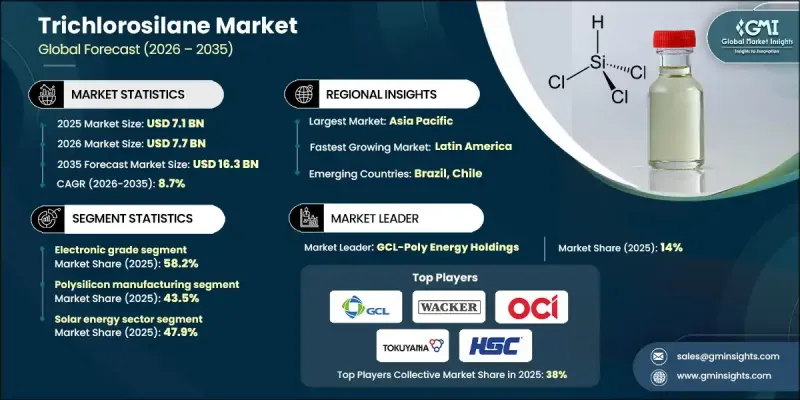
市場擴張的驅動力在於電子、太陽能和綠色氫能技術對高純度矽日益成長的依賴。全球為實現碳中和和清潔能源所做的努力正在加速太陽能的普及,而主要經濟體(尤其是亞太地區)的政府支持政策正在促進本地太陽能製造。半導體產業也是需求的重要貢獻者,其中源自三氯矽烷的超高純度多晶矽對於人工智慧、電動車、5G和物聯網設備等新興技術至關重要。為了滿足不斷成長的需求,各公司正在投資先進的純化製程並擴大產能。此外,環境法規和降低生產成本的需求正在推動向節能製程的轉變,例如流化床反應器(FBR)技術,與傳統製程相比,該技術可降低高達80%的能耗。
| 市場覆蓋範圍 | |
|---|---|
| 開始年份 | 2025 |
| 預測年份 | 2026-2035 |
| 起始值 | 71億美元 |
| 預測金額 | 163億美元 |
| 複合年成長率 | 8.7% |
預計到2025年,電子級TCS市佔率將達到58.2%,並在2035年之前以8.9%的複合年成長率成長。該細分市場的主導地位歸功於其在半導體、光伏電池和光纖等應用領域超高純度多晶矽生產中的關鍵作用。先進電子產品對無缺陷晶圓和晶片生產的需求,推動了對純度為99.9999%及以上TCS的需求。低純度替代品無法滿足高性能半導體應用所需的嚴格純度要求。
預計到2025年,太陽能產業將佔47.9%的市場佔有率,並在2035年之前以8.6%的複合年成長率成長。三氯矽烷是太陽能級多晶矽的關鍵原料,而多晶矽是晶體矽太陽能電池的必需材料。全球為實現脫碳和推廣清潔能源所做的努力,尤其是在那些尋求擴大太陽能發電能力的國家,將繼續推動市場成長。
到 2025 年,北美三氯矽烷市佔率將達到 25.9%。該地區的成長得益於政府旨在重組該國半導體和太陽能製造生態系統的舉措,這些舉措正在推動三氯矽烷的生產和消費增加。
目錄
第1章調查方法和範圍
第2章執行摘要
第3章業界考察
- 生態系分析
- 供應商情況
- 利潤率
- 每個階段的附加價值
- 影響價值鏈的因素
- 中斷
- 產業影響因素
- 促進要素
- 產業潛在風險與挑戰
- 市場機遇
- 成長潛力分析
- 監管環境
- 北美洲
- 歐洲
- 亞太地區
- 拉丁美洲
- 中東和非洲
- 波特分析
- PESTEL 分析
- 價格趨勢
- 按地區
- 按年級
- 未來市場趨勢
- 科技與創新趨勢
- 當前技術趨勢
- 新興技術
- 專利狀態
- 貿易統計(HS編碼)
(註:貿易統計數據僅涵蓋主要國家。)
- 主要進口國
- 主要出口國
- 永續性和環境方面
- 永續努力
- 減少廢棄物策略
- 生產中的能源效率
- 環保舉措
- 考慮到碳足跡
第4章 競爭情勢
- 介紹
- 公司市佔率分析
- 按地區
- 北美洲
- 歐洲
- 亞太地區
- 拉丁美洲
- 中東和非洲
- 按地區
- 企業矩陣分析
- 主要市場公司的競爭分析
- 競爭定位矩陣
- 重大進展
- 併購
- 夥伴關係與合作
- 新產品發布
- 業務拓展計劃
第5章 各等級市場估算與預測,2022-2035年
- 電子級
- 工業級
第6章 按應用領域分類的市場估算與預測,2022-2035年
- 多晶矽製造
- 矽烷氣體生產
- 矽酮中間體
- 太陽能電池
- 光纖
- 塗料和黏合劑
- 實驗室試劑
- 半導體零件
7. 依最終用途分類的市場估計與預測,2022-2035 年
- 太陽能場
- 光電電池製造
- 太陽能板製造
- 半導體和電子學
- 積體電路製造
- 晶圓和晶片製造
- MEMS感測器
- LED和檢測器製造
- 化學處理
- 矽烷和矽酮製造
- 特殊化學中間體
- 電訊
- 光纖電纜及組件
- 玻璃預成型製造
- 汽車與出行
- 用於ADAS和電動車的矽晶片
- 矽基塗層和感測器
- 航太/國防
- 耐熱矽膠部件
- 電子屏蔽部件
- 建築和基礎設施
- 耐候密封劑
- 塗料和黏合劑
- 醫療保健和醫療設備
- 醫用矽膠和植入
- 診斷感測器部件
第8章 2022-2035年各地區市場估算與預測
- 北美洲
- 美國
- 加拿大
- 歐洲
- 德國
- 英國
- 法國
- 西班牙
- 義大利
- 其他歐洲地區
- 亞太地區
- 中國
- 印度
- 日本
- 澳洲
- 韓國
- 亞太其他地區
- 拉丁美洲
- 巴西
- 墨西哥
- 阿根廷
- 其他拉丁美洲地區
- 中東和非洲
- 沙烏地阿拉伯
- 南非
- 阿拉伯聯合大公國
- 其他中東和非洲地區
第9章:公司簡介
- American Elements
- Evonik Industries
- GCL-Poly Energy Holdings
- Gelest
- Haihang Group
- Hemlock Semiconductor Operations
- Hubei Jianghan New Materials
- Iota Corporation
- Linde
- OCI Company Ltd.
- REC Silicon
- Shin-Etsu Chemical
- Siad
- Tokuyama Corporation
- Wacker Chemie
- Others
The Global Trichlorosilane Market was valued at USD 7.1 billion in 2025 and is estimated to grow at a CAGR of 8.7% to reach USD 16.3 billion by 2035.
Market expansion is driven by the increasing reliance on high-purity silicon for electronics, solar energy, and green hydrogen technologies. The global push toward carbon neutrality and clean energy has accelerated solar PV adoption, particularly in Asia-Pacific region, where supportive government policies in major economies have incentivized local solar manufacturing. The semiconductor sector is also contributing significantly to demand, with emerging technologies like artificial intelligence, electric vehicles, 5G, and Internet of Things devices requiring ultra-high-purity polysilicon derived from TCS. Companies are responding with investments in advanced purification processes and expanded production capacities to meet rising demand. Additionally, environmental regulations and the need to lower production costs are prompting a shift toward energy-efficient processes such as Fluidized Bed Reactor (FBR) technology, which reduces energy consumption by up to 80% compared to conventional methods.
| Market Scope | |
|---|---|
| Start Year | 2025 |
| Forecast Year | 2026-2035 |
| Start Value | $7.1 Billion |
| Forecast Value | $16.3 Billion |
| CAGR | 8.7% |
The electronic-grade TCS segment held 58.2% share in 2025 and is expected to grow at a CAGR of 8.9% through 2035. The segment's leadership stems from its critical role in producing ultra-pure polysilicon for semiconductors, solar PV cells, and fiber optics. Demand for 99.9999%+ purity TCS is rising due to the requirement for defect-free wafer and chip production in advanced electronics. Lower-grade alternatives fail to meet the stringent purity needed for high-performance semiconductor applications.
The solar energy sector accounted for 47.9% share in 2025 and is projected to grow at a CAGR of 8.6% through 2035. TCS serves as a primary feedstock for solar-grade polysilicon, essential for crystalline silicon PV cells. Global efforts toward decarbonization and clean energy adoption, particularly in nations aiming to expand solar PV capacity, continue to drive market growth.
North America Trichlorosilane Market held 25.9% in 2025. Growth in the region is supported by government initiatives designed to rebuild domestic semiconductor and solar manufacturing ecosystems, spurring higher production and consumption of TCS.
Leading players in the Global Trichlorosilane Market include American Elements, Evonik Industries, Tokuyama Corporation, OCI Company Ltd., REC Silicon, Wacker Chemie, Shin-Etsu Chemical, Linde, Gelest, GCL-Poly Energy Holdings, Haihang Group, Hemlock Semiconductor Operations, Hubei Jianghan New Materials, Iota Corporation, and Siad. Companies in the Global Trichlorosilane Market are pursuing several strategies to strengthen their foothold. Investments in advanced purification and production technologies enhance product quality and capacity. Strategic partnerships and joint ventures expand market access and secure supply chains for high-purity silicon. Firms are also focusing on sustainability by adopting energy-efficient manufacturing methods to meet environmental regulations. Expanding into emerging regions with high solar and semiconductor growth helps capture new customer bases.
Table of Contents
Chapter 1 Methodology & Scope
- 1.1 Market scope and definition
- 1.2 Research design
- 1.2.1 Research approach
- 1.2.2 Data collection methods
- 1.3 Data mining sources
- 1.3.1 Global
- 1.3.2 Regional/Country
- 1.4 Base estimates and calculations
- 1.4.1 Base year calculation
- 1.4.2 Key trends for market estimation
- 1.5 Primary research and validation
- 1.5.1 Primary sources
- 1.6 Forecast model
- 1.7 Research assumptions and limitations
Chapter 2 Executive Summary
- 2.1 Industry 360° synopsis
- 2.2 Key market trends
- 2.2.1 Regional
- 2.2.2 Grade
- 2.2.3 Application
- 2.2.4 End use
- 2.3 TAM Analysis, 2026-2035
- 2.4 CXO perspectives: Strategic imperatives
- 2.4.1 Executive decision points
- 2.4.2 Critical success factors
- 2.5 Future Outlook and Strategic Recommendations
Chapter 3 Industry Insights
- 3.1 Industry ecosystem analysis
- 3.1.1 Supplier landscape
- 3.1.2 Profit margin
- 3.1.3 Value addition at each stage
- 3.1.4 Factor affecting the value chain
- 3.1.5 Disruptions
- 3.2 Industry impact forces
- 3.2.1 Growth drivers
- 3.2.2 Industry pitfalls and challenges
- 3.2.3 Market opportunities
- 3.3 Growth potential analysis
- 3.4 Regulatory landscape
- 3.4.1 North America
- 3.4.2 Europe
- 3.4.3 Asia Pacific
- 3.4.4 Latin America
- 3.4.5 Middle East & Africa
- 3.5 Porter';s analysis
- 3.6 PESTEL analysis
- 3.7 Price trends
- 3.7.1 By region
- 3.7.2 By grade
- 3.8 Future market trends
- 3.9 Technology and Innovation landscape
- 3.9.1 Current technological trends
- 3.9.2 Emerging technologies
- 3.10 Patent Landscape
- 3.11 Trade statistics (HS code)
( Note: the trade statistics will be provided for key countries only)
- 3.11.1 Major importing countries
- 3.11.2 Major exporting countries
- 3.12 Sustainability and environmental aspects
- 3.12.1 Sustainable practices
- 3.12.2 Waste reduction strategies
- 3.12.3 Energy efficiency in production
- 3.12.4 Eco-friendly initiatives
- 3.13 Carbon footprint consideration
Chapter 4 Competitive Landscape, 2025
- 4.1 Introduction
- 4.2 Company market share analysis
- 4.2.1 By region
- 4.2.1.1 North America
- 4.2.1.2 Europe
- 4.2.1.3 Asia Pacific
- 4.2.1.4 LATAM
- 4.2.1.5 MEA
- 4.2.1 By region
- 4.3 Company matrix analysis
- 4.4 Competitive analysis of major market players
- 4.5 Competitive positioning matrix
- 4.6 Key developments
- 4.6.1 Mergers & acquisitions
- 4.6.2 Partnerships & collaborations
- 4.6.3 New Product Launches
- 4.6.4 Expansion Plans
Chapter 5 Market Estimates and Forecast, By Grade, 2022-2035 (USD Billion) (Kilo Tons)
- 5.1 Key trends
- 5.2 Electronic Grade
- 5.3 Industrial Grade
Chapter 6 Market Estimates and Forecast, By Application, 2022-2035 (USD Billion) (Kilo Tons)
- 6.1 Key trends
- 6.2 Polysilicon Manufacturing
- 6.3 Silane Gas Production
- 6.4 Silicone Intermediate
- 6.5 Photovoltaic Cells
- 6.6 Optical Fibers
- 6.7 Coatings and Adhesives
- 6.8 Laboratory Reagents
- 6.9 Semiconductor Components
Chapter 7 Market Estimates and Forecast, By End Use, 2022-2035 (USD Billion) (Kilo Tons)
- 7.1 Key trends
- 7.2 Solar Energy Sector
- 7.2.1 Photovoltaic cell production
- 7.2.2 Solar panel manufacturing
- 7.3 Semiconductor & Electronics
- 7.3.1 IC manufacturing
- 7.3.2 Wafer and chip fabrication
- 7.3.3 MEMS sensors
- 7.3.4 LED & photodetector fabrication
- 7.4 Chemical Processing
- 7.4.1 Silane and silicone production
- 7.4.2 Specialty chemical intermediates
- 7.5 Telecommunications
- 7.5.1 Optical fiber cables and components
- 7.5.2 Glass preform production
- 7.6 Automotive & Mobility
- 7.6.1 Silicon chips for ADAS and EVs
- 7.6.2 Coatings and sensors using silicon tech
- 7.7 Aerospace & Defense
- 7.7.1 High-temperature resistant silicone parts
- 7.7.2 Electronic shielding components
- 7.8 Construction & Infrastructure
- 7.8.1 Weather-resistant sealants
- 7.8.2 Coatings & adhesives
- 7.9 Healthcare & Medical Devices
- 7.9.1 Medical-grade silicones and implants
- 7.9.2 Diagnostic sensor components
Chapter 8 Market Estimates and Forecast, By Region, 2022-2035 (USD Billion) (Kilo Tons)
- 8.1 Key trends
- 8.2 North America
- 8.2.1 U.S.
- 8.2.2 Canada
- 8.3 Europe
- 8.3.1 Germany
- 8.3.2 UK
- 8.3.3 France
- 8.3.4 Spain
- 8.3.5 Italy
- 8.3.6 Rest of Europe
- 8.4 Asia Pacific
- 8.4.1 China
- 8.4.2 India
- 8.4.3 Japan
- 8.4.4 Australia
- 8.4.5 South Korea
- 8.4.6 Rest of Asia Pacific
- 8.5 Latin America
- 8.5.1 Brazil
- 8.5.2 Mexico
- 8.5.3 Argentina
- 8.5.4 Rest of Latin America
- 8.6 Middle East and Africa
- 8.6.1 Saudi Arabia
- 8.6.2 South Africa
- 8.6.3 UAE
- 8.6.4 Rest of Middle East and Africa
Chapter 9 Company Profiles
- 9.1 American Elements
- 9.2 Evonik Industries
- 9.3 GCL-Poly Energy Holdings
- 9.4 Gelest
- 9.5 Haihang Group
- 9.6 Hemlock Semiconductor Operations
- 9.7 Hubei Jianghan New Materials
- 9.8 Iota Corporation
- 9.9 Linde
- 9.10 OCI Company Ltd.
- 9.11 REC Silicon
- 9.12 Shin-Etsu Chemical
- 9.13 Siad
- 9.14 Tokuyama Corporation
- 9.15 Wacker Chemie
- 9.16 Others

 全球氯矽烷市場規模、佔有率、趨勢和成長分析報告(2026-2034年)全球矽烷市場規模、佔有率、趨勢和成長分析報告(2026-2034年)
 2026年全球矽烷市場報告
 氯矽烷市場機會、成長要素、產業趨勢分析及預測(2026年至2035年)矽烷市場-2026-2031年預測
 電子級六氯二矽烷市場按產品類型、分銷管道、應用和最終用途產業分類,全球預測(2026-2032年)電子級六甲基二矽氮烷市場:依純度、形態、製造方法、應用及銷售管道-2026-2032年全球預測電子級六甲基二矽氮烷(HMDS)市場按形態、純度、晶圓尺寸、配銷通路和應用/最終用途分類-2026-2032年全球預測矽烷市場機會、成長要素、產業趨勢分析及2026年至2035年預測
 三氯矽烷市場規模、佔有率和成長分析(按等級、製造流程、分銷管道、應用、最終用戶和地區分類)—產業預測(2026-2033 年)