

 |
市場調查報告書
商品編碼
1928940
男士護理產品市場機會、成長要素、產業趨勢分析及2026年至2035年預測Men's Grooming Products Market Opportunity, Growth Drivers, Industry Trend Analysis, and Forecast 2026 - 2035 |
||||||

全球男士護理產品市場預計到 2025 年將達到 616 億美元,到 2035 年將達到 1,080 億美元,年複合成長率為 5.8%。
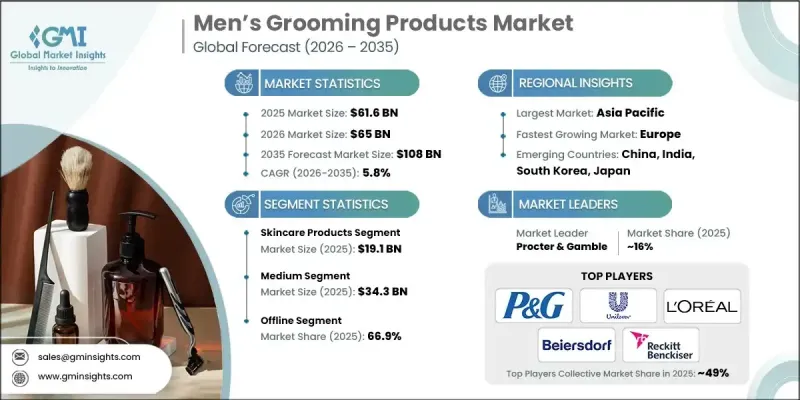
市場成長主要受都市區男性消費者生活方式轉變的驅動,他們越來越重視外表、個人衛生和自我護理。可支配收入的增加使他們能夠消費更多優質的男士護理產品,涵蓋護膚、護髮和剃須等各個方面。人們對規律性照護習慣的日益重視促使他們堅持使用產品,而數位化平台和實體零售通路的不斷拓展也提升了產品的知名度和可及性。品牌傳播和促銷活動塑造了消費者的認知,並鼓勵他們試驗新產品。繁忙的工作生活催生了對便利實用、適合日常使用的產品的需求。持續的創新和頻繁的新品發布吸引了注重外表的消費者的目光。男士沙龍和護理服務提供者的興起進一步促進了產品的普及,專業人士的建議鼓勵消費者在家中持續使用。這些因素共同作用,鞏固了男士護理的長期需求,使其成為全球個人護理行業的核心細分市場之一。
| 市場覆蓋範圍 | |
|---|---|
| 開始年份 | 2025 |
| 預測年份 | 2026-2035 |
| 起始值 | 616億美元 |
| 預測金額 | 1080億美元 |
| 複合年成長率 | 5.8% |
預計到2025年,護膚品市場規模將達到191億美元,2026年至2035年的複合年成長率(CAGR)為6.2%。推動這一市場成長的主要因素是男性消費者日益關注皮膚健康,並開始關注環境污染和老齡化等相關問題。專為男性肌膚設計的配方正在提高產品的使用頻率和接受度。
預計到 2025 年,中價位產品市場規模將達到 343 億美元,到 2035 年將以 5.9% 的複合年成長率成長。該細分市場佔據主導地位,因為它提供與高階產品相同的可靠性能和質量,但價格卻適合日常整裝儀容需求。
中國男士護理產品市場預計到2025年將達到40億美元,2026年至2035年複合年成長率將達到6.4%。快速的都市化、收入水平的提高以及數位文化的強大影響力正在加速全部區域男士護理產品的普及。線上平台和現代零售模式帶來的便利性提升將持續支撐市場的持續成長。
目錄
第1章調查方法和範圍
第2章執行摘要
第3章業界考察
- 生態系分析
- 供應商情況
- 利潤率
- 每個階段的附加價值
- 影響價值鏈的因素
- 產業影響因素
- 促進要素
- 都市化進程和可支配所得水準的提高
- 理髮店擴張,男士美容院數量增加
- 社群媒體、名人效應和生活方式行銷的影響力日益增強
- 挑戰與困難
- 大眾市場和發展中地區的價格敏感性
- 來自成熟的全球和區域品牌的激烈競爭
- 機會
- 消費者對天然、有機和潔淨標示的個人護理產品的需求不斷成長
- 電子商務和直接面對消費者管道的採用率不斷提高
- 促進要素
- 成長潛力分析
- 未來市場趨勢
- 科技與創新趨勢
- 當前技術趨勢
- 新興技術
- 價格趨勢
- 按地區
- 依產品
- 監管環境
- 標準和合規要求
- 區域法規結構
- 認證標準
- 波特分析
- PESTEL 分析
第4章 競爭情勢
- 介紹
- 公司市佔率分析
- 按地區
- 北美洲
- 歐洲
- 亞太地區
- 拉丁美洲
- 中東和非洲
- 按地區
- 企業矩陣分析
- 主要市場公司的競爭分析
- 競爭定位矩陣
- 重大進展
- 併購
- 夥伴關係與合作
- 新產品發布
- 擴張計劃
第5章 依產品類型分類的市場估算與預測,2022-2035年
- 護膚品
- 洗面乳
- 保濕霜
- 口罩
- 其他護膚產品
- 護髮產品
- 洗髮精和護髮素
- 造型產品
- 染髮
- 其他護髮產品
- 刮鬍產品
- 刮鬍前用劑
- 鬍後
- 刮鬍刀和刀片
- 其他產品類型
第6章 依年齡層別分類的市場估計與預測,2022-2035年
- 24歲以下
- 25至45歲
- 45歲或以上
第7章 依價格區間分類的市場估計與預測,2022-2035年
- 低價位
- 中號
- 高價位範圍
第8章 按分銷管道分類的市場估算與預測,2022-2035年
- 線上
- 電子商務網站
- 我們的網站
- 離線
- 超級市場和大賣場
- 專賣店
- 其他零售商
第9章 2022-2035年各地區市場估算與預測
- 北美洲
- 美國
- 加拿大
- 歐洲
- 德國
- 英國
- 法國
- 義大利
- 西班牙
- 亞太地區
- 中國
- 印度
- 日本
- 韓國
- 澳洲
- 拉丁美洲
- 巴西
- 墨西哥
- 阿根廷
- 中東和非洲
- 沙烏地阿拉伯
- 阿拉伯聯合大公國
- 南非
第10章:公司簡介
- Beiersdorf
- Colgate-Palmolive Company
- Conair Corporation
- Coty, Inc.
- DORCO
- Edgewell Personal Care Co.
- Johnson &Johnson
- Kao Corporation
- L'Oreal
- Panasonic
- Philips
- Reckitt Benckiser Group
- Spectrum Brands Holdings
- The Procter &Gamble Company
- Unilever
The Global Men's Grooming Products Market was valued at USD 61.6 billion in 2025 and is estimated to grow at a CAGR of 5.8% to reach USD 108 billion by 2035.
Market momentum is supported by lifestyle shifts among urban male consumers who increasingly prioritize personal appearance, hygiene, and self-care. Rising disposable income levels enable spending on higher-quality grooming solutions across skincare, haircare, and shaving categories. Broader awareness of structured grooming routines is driving consistent product usage, while digital platforms and organized retail continue to improve product visibility and access. Brand communication and promotional activity are shaping consumer perception and encouraging experimentation with new formulations. Busy professional lifestyles are creating demand for convenient, performance-oriented products suited for everyday use. Continuous innovation and frequent product introductions are capturing interest among appearance-conscious consumers. The growing presence of men-focused salons and grooming service providers is further reinforcing product adoption, as professional recommendations encourage continued at-home usage. Together, these factors are strengthening long-term demand and positioning men's grooming as a core segment of the global personal care industry.
| Market Scope | |
|---|---|
| Start Year | 2025 |
| Forecast Year | 2026-2035 |
| Start Value | $61.6 Billion |
| Forecast Value | $108 Billion |
| CAGR | 5.8% |
The skincare products segment generated USD 19.1 billion in 2025 and is forecast to grow at a CAGR of 6.2% from 2026 to 2035. This segment leads the market as male consumers increasingly focus on maintaining skin health and addressing concerns linked to environmental exposure and aging. Purpose-built formulations designed for male skin are improving usage consistency and product acceptance.
The medium-priced category accounted for USD 34.3 billion in 2025 and is expected to grow at a CAGR of 5.9% through 2035. This segment dominates due to its ability to offer dependable performance and quality without premium-level pricing, making it suitable for regular daily grooming needs.
China Men's Grooming Products Market reached USD 4 billion in 2025 and is projected to grow at a CAGR of 6.4% between 2026 and 2035. Rapid urbanization, rising income levels, and strong influence from digital culture are accelerating the adoption of grooming across the region. Improved access through online platforms and modern retail formats continues to support sustained growth.
Major companies active in the Global Men's Grooming Products Market include L'Oreal, The Procter & Gamble Company, Unilever, Beiersdorf, Edgewell Personal Care Co., Philips, Panasonic, Colgate-Palmolive Company, Johnson & Johnson, Coty, Inc., Reckitt Benckiser Group, Spectrum Brands Holdings, Kao Corporation, Conair Corporation, and DORCO. Companies in the Global Men's Grooming Products Market are strengthening their market position through product innovation, brand differentiation, and targeted marketing strategies. Many players are investing in research to develop formulations aligned with evolving skin and hair needs. Expanding digital engagement and direct-to-consumer channels helps brands connect more effectively with younger demographics. Strategic collaborations with grooming professionals and salons increase brand credibility and product trial.
Table of Contents
Chapter 1 Methodology & Scope
- 1.1 Market scope and definition
- 1.2 Research design
- 1.2.1 Research approach
- 1.2.2 Data collection methods
- 1.3 Data mining sources
- 1.3.1 Global
- 1.3.2 Regional/Country
- 1.4 Base estimates and calculations
- 1.4.1 Base year calculation
- 1.4.2 Key trends for market estimation
- 1.5 Primary research and validation
- 1.5.1 Primary sources
- 1.6 Forecast model
- 1.7 Research assumptions and limitations
Chapter 2 Executive Summary
- 2.1 Industry 360° synopsis
- 2.2 Key market trends
- 2.2.1 Regional
- 2.2.2 Product type
- 2.2.3 Age group
- 2.2.4 Price range
- 2.2.5 Distribution channel
- 2.3 CXO perspectives: Strategic imperatives
- 2.3.1 Key decision points for industry executives
- 2.3.2 Critical success factors for market players
- 2.4 Future outlook and strategic recommendations
Chapter 3 Industry Insights
- 3.1 Industry ecosystem analysis
- 3.1.1 Supplier landscape
- 3.1.2 Profit margin
- 3.1.3 Value addition at each stage
- 3.1.4 Factor affecting the value chain
- 3.2 Industry impact forces
- 3.2.1 Growth drivers
- 3.2.1.1 Growth of urbanization and disposable income levels
- 3.2.1.2 Expansion of barber shops and men-focused salons
- 3.2.1.3 Rising influence of social media, celebrities, and lifestyle marketing
- 3.2.2 Pitfalls & Challenges
- 3.2.2.1 Price sensitivity in mass-market and developing regions
- 3.2.2.2 Intense competition from established global and regional brands
- 3.2.3 Opportunities
- 3.2.3.1 Growing demand for natural, organic, and clean-label grooming products
- 3.2.3.2 Rising adoption of e-commerce and direct-to-consumer channels
- 3.2.1 Growth drivers
- 3.3 Growth potential analysis
- 3.4 Future market trends
- 3.5 Technology and innovation landscape
- 3.5.1 Current technological trends
- 3.5.2 Emerging technologies
- 3.6 Price trends
- 3.6.1 By region
- 3.6.2 By product
- 3.7 Regulatory landscape
- 3.7.1 Standards and compliance requirements
- 3.7.2 Regional regulatory frameworks
- 3.7.3 Certification standards
- 3.8 Porter';s analysis
- 3.9 PESTEL analysis
Chapter 4 Competitive Landscape, 2025
- 4.1 Introduction
- 4.2 Company market share analysis
- 4.2.1 By Region
- 4.2.1.1 North America
- 4.2.1.2 Europe
- 4.2.1.3 Asia Pacific
- 4.2.1.4 Latin America
- 4.2.1.5 Middle East & Africa
- 4.2.1 By Region
- 4.3 Company matrix analysis
- 4.4 Competitive analysis of major market players
- 4.5 Competitive positioning matrix
- 4.6 Key developments
- 4.6.1 Mergers & acquisitions
- 4.6.2 Partnerships & collaborations
- 4.6.3 New product launches
- 4.6.4 Expansion plans
Chapter 5 Market Estimates & Forecast, By Product Type, 2022 - 2035, (USD Billion) (Thousand Units)
- 5.1 Key trends
- 5.2 Skincare products
- 5.2.1 Face wash
- 5.2.2 Moisturizers
- 5.2.3 Face mask
- 5.2.4 Other skincare products
- 5.3 Haircare products
- 5.3.1 Shampoo & conditioners
- 5.3.2 Styling products
- 5.3.3 Hair colorants
- 5.3.4 Other haircare products
- 5.4 Shaving products
- 5.4.1 Pre shave
- 5.4.2 Post-shave
- 5.5 Razor & blades
- 5.6 Other product types
Chapter 6 Market Estimates & Forecast, By Age Group, 2022 - 2035, (USD Billion) (Thousand Units)
- 6.1 Key trends
- 6.2 Upto 24 years
- 6.3 25-45 years
- 6.4 Above 45 years
Chapter 7 Market Estimates & Forecast, By Price Range, 2022 - 2035, (USD Billion) (Thousand Units)
- 7.1 Key trends
- 7.2 Low
- 7.3 Medium
- 7.4 High
Chapter 8 Market Estimates & Forecast, By Distribution Channel, 2022 - 2035, (USD Billion) (Thousand Units)
- 8.1 Key trends
- 8.2 Online
- 8.2.1 E-commerce sites
- 8.2.2 Company website
- 8.3 Offline
- 8.3.1 Supermarkets & hypermarkets
- 8.3.2 Specialty stores
- 8.3.3 Other retail stores
Chapter 9 Market Estimates & Forecast, By Region, 2022 - 2035, (USD Billion) (Thousand Units)
- 9.1 Key trends
- 9.2 North America
- 9.2.1 U.S.
- 9.2.2 Canada
- 9.3 Europe
- 9.3.1 Germany
- 9.3.2 UK
- 9.3.3 France
- 9.3.4 Italy
- 9.3.5 Spain
- 9.4 Asia Pacific
- 9.4.1 China
- 9.4.2 India
- 9.4.3 Japan
- 9.4.4 South Korea
- 9.4.5 Australia
- 9.5 Latin America
- 9.5.1 Brazil
- 9.5.2 Mexico
- 9.5.3 Argentina
- 9.6 MEA
- 9.6.1 Saudi Arabia
- 9.6.2 UAE
- 9.6.3 South Africa
Chapter 10 Company Profiles
- 10.1 Beiersdorf
- 10.2 Colgate-Palmolive Company
- 10.3 Conair Corporation
- 10.4 Coty, Inc.
- 10.5 DORCO
- 10.6 Edgewell Personal Care Co.
- 10.7 Johnson & Johnson
- 10.8 Kao Corporation
- 10.9 L’Oreal
- 10.10 Panasonic
- 10.11 Philips
- 10.12 Reckitt Benckiser Group
- 10.13 Spectrum Brands Holdings
- 10.14 The Procter & Gamble Company
- 10.15 Unilever

 全球男士護理產品市場
 男士護理產品市場規模、佔有率、趨勢和預測:按產品、價格範圍、分銷管道和地區分類,2026-2034年
 男士護理產品市場:依產品類型、性別、通路和地區分類
 男士護理產品市場:依產品類型、成分類型及通路分類-2026年至2032年全球預測
 男士護理產品市場-全球產業規模、佔有率、趨勢、機會及預測(按類型、產品類型、通路、地區和競爭格局分類,2021-2031年)日本男士護理產品市場規模、佔有率、趨勢及預測(按產品、價格範圍、分銷管道和地區分類)(2026-2034 年)男性美容產品市場按類型、價格分佈範圍、分銷管道和地區分類
 男性美容產品市場規模、佔有率和成長分析(按產品類型、價格分佈、分銷管道和地區)- 產業預測 2025-2032
 全球男性美容產品市場預測(2025-2030)2024 年至 2031 年男士美容產品市場(依產品、通路及地區劃分)