


 |
市場調查報告書
商品編碼
1928878
膠原腸衣市場機會、成長要素、產業趨勢分析及預測(2026年至2035年)Collagen Casings Market Opportunity, Growth Drivers, Industry Trend Analysis, and Forecast 2026 - 2035 |
||||||

全球膠原腸衣市場預計到 2025 年將達到 15 億美元,到 2035 年將達到 30 億美元,年複合成長率為 6.8%。
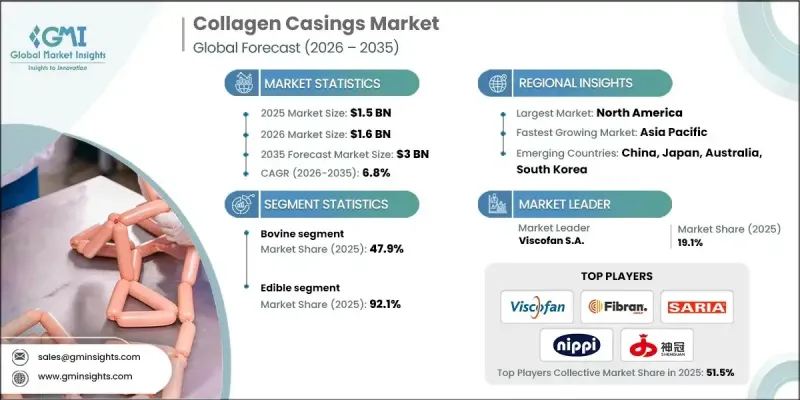
膠原腸衣是一種可食用的高蛋白香腸腸衣,由牛或豬膠原蛋白製成,是傳統動物腸衣的天然永續替代品。膠原蛋白腸衣主要由牛皮製成,因其均勻性、便利性和與高速自動化機械的兼容性而被廣泛應用於香腸生產,顯著提高了肉類加工商的營運效率。全球肉品消費量的持續成長推動了對膠原腸衣的需求,與天然腸衣相比,擴充性且經濟高效的解決方案。根據聯合國糧食及農業組織(糧農組織)預測,2023年全球肉類產量預計將達到約3.64億噸,並有望持續成長,尤其是新興市場。膠原腸衣因其能夠維持直徑一致、承受生產過程中的各種壓力、降低污染風險並符合嚴格的食品安全法規而備受青睞。
| 市場覆蓋範圍 | |
|---|---|
| 開始年份 | 2025 |
| 預測年份 | 2026-2035 |
| 起始值 | 15億美元 |
| 預測金額 | 30億美元 |
| 複合年成長率 | 6.8% |
預計到2025年,牛膠原蛋白市佔率將達到47.9%,並在2035年之前以6.6%的複合年成長率成長。其強度高、穩定性好,且能無縫整合到自動化生產線中,使其成為大型香腸加工商的首選。來自牛肉產業的穩定供應確保了成本效益和可靠的性能。
到2025年,可食用膠原腸衣的市佔率將達到92.1%。無論是生腸衣、熟腸衣或煙燻腸衣,都廣泛應用於香腸的大規模生產製造。它們在食用時仍能與產品保持連接,尺寸均勻,並且與自動化填充系統兼容,因此成為全球各種規模肉類加工企業的首選。
預計到2025年,北美膠原腸衣市場規模將達到4.462億美元,2026年至2035年的複合年成長率(CAGR)為6.6%。消費者對天然、潔淨標示和無過敏原食品的需求不斷成長,推動了膠原腸衣在加工肉品肉製品、蒸餾食品和零食中的應用。為了滿足消費者對健康、透明度和產品品質的期望,各公司越來越注重永續採購和環境友善的生產流程。
目錄
第1章調查方法和範圍
第2章執行摘要
第3章業界考察
- 生態系分析
- 供應商情況
- 利潤率
- 每個階段的附加價值
- 影響價值鏈的因素
- 中斷
- 產業影響因素
- 促進要素
- 全球肉類消費和加工量不斷成長
- 與天然腸衣相比的優勢
- 永續性和循環經濟的發展趨勢
- 產業潛在風險與挑戰
- 原物料價格波動
- 與替代外殼產品的競爭
- 市場機遇
- 有效利用製革廢棄物
- 高級認證市場
- 促進要素
- 成長潛力分析
- 監管環境
- 北美洲
- 歐洲
- 亞太地區
- 拉丁美洲
- 中東和非洲
- 波特分析
- PESTEL 分析
- 價格趨勢
- 按地區
- 按來源
- 未來市場趨勢
- 科技與創新趨勢
- 當前技術趨勢
- 新興技術
- 專利狀態
- 貿易統計(HS編碼)(註:僅提供主要國家的貿易統計)
- 主要進口國
- 主要出口國
- 永續性和環境方面
- 永續實踐
- 減少廢棄物策略
- 生產中的能源效率
- 環保舉措
- 考慮到碳足跡
第4章 競爭情勢
- 介紹
- 公司市佔率分析
- 按地區
- 北美洲
- 歐洲
- 亞太地區
- 拉丁美洲
- 中東和非洲
- 按地區
- 企業矩陣分析
- 主要市場公司的競爭分析
- 競爭定位矩陣
- 重大進展
- 併購
- 夥伴關係與合作
- 新產品發布
- 業務拓展計劃
5. 2022-2035年按來源分類的市場估計與預測
- 牛
- 豬肉
- 家禽
- 漁業
- 綿羊和山羊
第6章 2022-2035年按產品分類的市場估算與預測
- 食用
- 不可食用
第7章 依口徑分類的市場估計與預測,2022-2035年
- 小直徑(14-32毫米)
- 中等直徑(33-50毫米)
- 大直徑(超過50毫米)
第8章 按應用領域分類的市場估算與預測,2022-2035年
- 生香腸
- 熟香腸
- 乾式熟成香腸
- 薰香腸
- 肉類零食
- 其他
第9章 2022-2035年各地區市場估算與預測
- 北美洲
- 美國
- 加拿大
- 歐洲
- 德國
- 英國
- 法國
- 西班牙
- 義大利
- 其他歐洲地區
- 亞太地區
- 中國
- 印度
- 日本
- 澳洲
- 韓國
- 亞太其他地區
- 拉丁美洲
- 巴西
- 墨西哥
- 阿根廷
- 其他拉丁美洲地區
- 中東和非洲
- 沙烏地阿拉伯
- 南非
- 阿拉伯聯合大公國
- 其他中東和非洲地區
第10章:公司簡介
- Belkozin
- FABIOS SA
- Fibran Group
- Foodchem International Corporation
- Nippi Inc.
- PS Seasoning
- SARIA SE &Co. KG
- Shenguan Holdings(Group)Limited
- Viscofan SA
- Viskoteepak
The Global Collagen Casings Market was valued at USD 1.5 billion in 2025 and is estimated to grow at a CAGR of 6.8% to reach USD 3 billion by 2035.
Collagen casings are edible, protein-rich sausage casings made from bovine or porcine collagen, offering a natural and sustainable alternative to traditional casings derived from animal intestines. They are primarily produced from bovine hides and are widely used in sausage manufacturing because they provide uniformity, convenience, and compatibility with high-speed automated machinery, which significantly boosts operational efficiency for meat processors. The steady rise in global meat consumption is fueling demand for collagen casings, as they provide scalable and cost-effective solutions compared to natural alternatives. According to the Food and Agriculture Organization, global meat production reached nearly 364 million metric tons in 2023, with expectations of continuous growth, particularly in emerging markets. Collagen casings are favored because they maintain consistent diameters, withstand production forces, and reduce contamination risks while meeting stringent food safety regulations.
| Market Scope | |
|---|---|
| Start Year | 2025 |
| Forecast Year | 2026-2035 |
| Start Value | $1.5 Billion |
| Forecast Value | $3 Billion |
| CAGR | 6.8% |
The bovine collagen segment held a 47.9% share in 2025 and is expected to grow at a CAGR of 6.6% through 2035. Its strength, stability, and seamless integration into automated production lines make it a preferred choice for major sausage processors. Availability from the beef industry ensures cost-effective sourcing and reliable performance.
The edible collagen casings segment held 92.1% share in 2025. Fresh, cooked, and smoked edible casings are widely used in high-volume sausage production. Their ability to remain on the product during consumption, uniform sizing, and compatibility with automated stuffing systems make them the go-to option for meat processors of all scales worldwide.
North America Collagen Casings Market captured USD 446.2 million in 2025 and is projected grow at a CAGR of 6.6% from 2026 to 2035. Rising consumer demand for natural, clean-label, and allergen-free foods is driving the adoption of collagen casings in processed meat, ready-to-eat meals, and snacks. Companies are increasingly focusing on sustainable sourcing and environmentally friendly manufacturing processes to meet consumer expectations regarding health, transparency, and product quality.
Key players in the Global Collagen Casings Market include FABIOS S.A., Belkozin, Nippi Inc., PS Seasoning, Fibran Group, Viscofan S.A., Shenguan Holdings (Group) Limited, Viskoteepak, Foodchem International Corporation, and SARIA SE & Co. KG. Market participants are strengthening their position by investing in R&D to develop high-performance, consistent, and clean-label casings. Collaborations with meat processors and food manufacturers allow them to customize solutions for automated production lines. Geographic expansion into emerging markets with growing meat consumption enhances market penetration. Companies also focus on sustainable sourcing and eco-friendly manufacturing processes to meet regulatory standards and consumer demand. Offering technical support, training, and innovation in casing design further solidifies brand loyalty and increases competitive advantage.
Table of Contents
Chapter 1 Methodology & Scope
- 1.1 Market scope and definition
- 1.2 Research design
- 1.2.1 Research approach
- 1.2.2 Data collection methods
- 1.3 Data mining sources
- 1.3.1 Global
- 1.3.2 Regional/Country
- 1.4 Base estimates and calculations
- 1.4.1 Base year calculation
- 1.4.2 Key trends for market estimation
- 1.5 Primary research and validation
- 1.5.1 Primary sources
- 1.6 Forecast model
- 1.7 Research assumptions and limitations
Chapter 2 Executive Summary
- 2.1 Industry 360° synopsis
- 2.2 Key market trends
- 2.2.1 Regional
- 2.2.2 Source
- 2.2.3 Product
- 2.2.4 Caliber
- 2.2.5 Application
- 2.3 TAM Analysis, 2026-2035
- 2.4 CXO perspectives: Strategic imperatives
- 2.4.1 Executive decision points
- 2.4.2 Critical success factors
- 2.5 Future Outlook and Strategic Recommendations
Chapter 3 Industry Insights
- 3.1 Industry ecosystem analysis
- 3.1.1 Supplier landscape
- 3.1.2 Profit margin
- 3.1.3 Value addition at each stage
- 3.1.4 Factor affecting the value chain
- 3.1.5 Disruptions
- 3.2 Industry impact forces
- 3.2.1 Growth drivers
- 3.2.1.1 Rising global meat consumption & processing
- 3.2.1.2 Advantages over natural casings
- 3.2.1.3 Sustainability & circular economy trends
- 3.2.2 Industry pitfalls and challenges
- 3.2.2.1 Raw material price volatility
- 3.2.2.2 Competition from alternative casings
- 3.2.3 Market opportunities
- 3.2.3.1 Tannery waste valorization
- 3.2.3.2 Premium certification markets
- 3.2.1 Growth drivers
- 3.3 Growth potential analysis
- 3.4 Regulatory landscape
- 3.4.1 North America
- 3.4.2 Europe
- 3.4.3 Asia Pacific
- 3.4.4 Latin America
- 3.4.5 Middle East & Africa
- 3.5 Porter';s analysis
- 3.6 PESTEL analysis
- 3.7 Price trends
- 3.7.1 By region
- 3.7.2 By source
- 3.8 Future market trends
- 3.9 Technology and innovation landscape
- 3.9.1 Current technological trends
- 3.9.2 Emerging technologies
- 3.10 Patent Landscape
- 3.11 Trade statistics (HS code) ( Note: the trade statistics will be provided for key countries only)
- 3.11.1 Major importing countries
- 3.11.2 Major exporting countries
- 3.12 Sustainability and environmental aspects
- 3.12.1 Sustainable practices
- 3.12.2 Waste reduction strategies
- 3.12.3 Energy efficiency in production
- 3.12.4 Eco-friendly initiatives
- 3.13 Carbon footprint consideration
Chapter 4 Competitive Landscape, 2025
- 4.1 Introduction
- 4.2 Company market share analysis
- 4.2.1 By region
- 4.2.1.1 North America
- 4.2.1.2 Europe
- 4.2.1.3 Asia Pacific
- 4.2.1.4 LATAM
- 4.2.1.5 MEA
- 4.2.1 By region
- 4.3 Company matrix analysis
- 4.4 Competitive analysis of major market players
- 4.5 Competitive positioning matrix
- 4.6 Key developments
- 4.6.1 Mergers & acquisitions
- 4.6.2 Partnerships & collaborations
- 4.6.3 New Product Launches
- 4.6.4 Expansion Plans
Chapter 5 Market Estimates and Forecast, By Source, 2022-2035 (USD Billion) (Million Metres)
- 5.1 Key trends
- 5.2 Bovine
- 5.3 Porcine
- 5.4 Poultry
- 5.5 Marine
- 5.6 Ovine & caprine
Chapter 6 Market Estimates and Forecast, By Product, 2022-2035 (USD Billion) (Million Meters)
- 6.1 Key trends
- 6.2 Edible
- 6.3 Non-edible
Chapter 7 Market Estimates and Forecast, By Caliber, 2022-2035 (USD Billion) (Million Meters)
- 7.1 Key trends
- 7.2 Small diameter (14-32 mm)
- 7.3 Medium diameter (33-50 mm)
- 7.4 Large diameter (>50 mm)
Chapter 8 Market Estimates and Forecast, By Application, 2022-2035 (USD Billion) (Million Meters)
- 8.1 Key trends
- 8.2 Fresh sausages
- 8.3 Cooked sausages
- 8.4 Dry-cured sausages
- 8.5 Smoked sausages
- 8.6 Meat-based snacks
- 8.7 Others
Chapter 9 Market Estimates and Forecast, By Region, 2022-2035 (USD Billion) (Million Meters)
- 9.1 Key trends
- 9.2 North America
- 9.2.1 U.S.
- 9.2.2 Canada
- 9.3 Europe
- 9.3.1 Germany
- 9.3.2 UK
- 9.3.3 France
- 9.3.4 Spain
- 9.3.5 Italy
- 9.3.6 Rest of Europe
- 9.4 Asia Pacific
- 9.4.1 China
- 9.4.2 India
- 9.4.3 Japan
- 9.4.4 Australia
- 9.4.5 South Korea
- 9.4.6 Rest of Asia Pacific
- 9.5 Latin America
- 9.5.1 Brazil
- 9.5.2 Mexico
- 9.5.3 Argentina
- 9.5.4 Rest of Latin America
- 9.6 Middle East and Africa
- 9.6.1 Saudi Arabia
- 9.6.2 South Africa
- 9.6.3 UAE
- 9.6.4 Rest of Middle East and Africa
Chapter 10 Company Profiles
- 10.1 Belkozin
- 10.2 FABIOS S.A.
- 10.3 Fibran Group
- 10.4 Foodchem International Corporation
- 10.5 Nippi Inc.
- 10.6 PS Seasoning
- 10.7 SARIA SE & Co. KG
- 10.8 Shenguan Holdings (Group) Limited
- 10.9 Viscofan S.A.
- 10.10 Viskoteepak


