


 |
市場調查報告書
商品編碼
1913439
工業地坪塗料市場機會、成長要素、產業趨勢分析及預測(2026年至2035年)Industrial Floor Coatings Market Opportunity, Growth Drivers, Industry Trend Analysis, and Forecast 2026 - 2035 |
||||||

全球工業地板塗料市場預計到 2025 年將達到 61 億美元,到 2035 年將達到 123 億美元,年複合成長率為 7.2%。
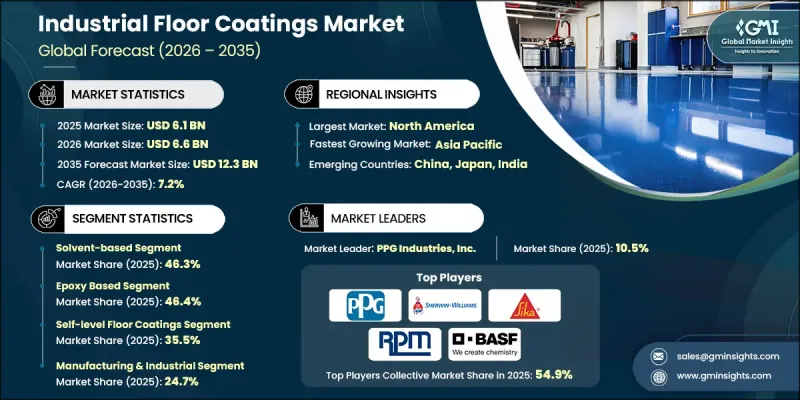
市場成長的驅動力來自各行業對高性能、耐用地板材料日益成長的需求,以及對永續塗料解決方案的轉變。各行業擴大採用水性、低VOC、生物基樹脂塗料,以減少對環境的影響,改善室內空氣質量,並維持耐久性和耐化學性標準。由於其零VOC、優異的耐化學性和在重負荷應用中更長的使用壽命,100%固含量配方,尤其是在環氧樹脂和聚脲系統中,正成為日益流行的趨勢。
| 市場覆蓋範圍 | |
|---|---|
| 開始年份 | 2025 |
| 預測年份 | 2026-2035 |
| 起始值 | 61億美元 |
| 預測金額 | 123億美元 |
| 複合年成長率 | 7.2% |
由於其成本效益和優異的耐化學性,環氧基塗料預計到2025年將佔據46.4%的市場佔有率。同時,整個產業部門都在優先考慮高性能且符合環保要求的解決方案,以滿足營運和監管要求。
預計到2025年,溶劑型塗料將佔據46.3%的市場佔有率,並在2035年之前以6.8%的複合年成長率成長。雖然這類塗料具有優異的附著力和耐久性,但日益嚴格的法規和高揮發性有機化合物(VOC)含量正逐漸促使市場需求轉向更環保的替代品。環氧基塗料仍然是最大的市場佔有率,這反映出它們在重工業生產和倉儲領域的持續應用。同時,聚氨酯基塗料體系在需要柔軟性、抗紫外線和抗熱衝擊性的應用領域,尤其是在戶外和高溫環境下,正日益受到認可。
預計2025年,北美工業地板塗料市場規模將達23億美元。該地區擁有成熟的工業基礎、先進的基礎設施以及嚴格的環境和職業安全法規,這些都是推動市場成長的因素。低VOC和環保塗料的普及,以及老舊工業設施、倉庫和生產車間的維修和現代化改造,持續推動市場擴張。此外,監管機構對衛生、安全和永續性的日益重視,也進一步刺激了該地區對先進塗料解決方案的需求。
目錄
第1章調查方法和範圍
第2章執行摘要
第3章業界考察
- 生態系分析
- 供應商情況
- 利潤率
- 每個階段的附加價值
- 影響價值鏈的因素
- 中斷
- 產業影響因素
- 促進要素
- 製造和倉儲設施的需求不斷成長
- 擴大衛生地板材料在食品和製藥行業的應用
- 產業潛在風險與挑戰
- 先進塗層技術的前期投資和安裝成本較高
- 在極端溫度和重負載應用中的效能限制
- 市場機遇
- 工業設施自動化程度的提高將推動對地板材料的需求。
- 隨著基礎設施現代化,新興經濟體實現成長。
- 促進要素
- 成長潛力分析
- 監管環境
- 北美洲
- 歐洲
- 亞太地區
- 拉丁美洲
- 中東和非洲
- 波特五力分析
- PESTEL 分析
- 價格趨勢
- 按地區
- 依樹脂類型
- 未來市場趨勢
- 科技與創新趨勢
- 當前技術趨勢
- 新興技術
- 專利狀態
- 貿易統計(HS編碼)(註:僅提供主要國家的貿易統計)
- 主要進口國
- 主要出口國
- 永續性和環境方面
- 永續努力
- 減少廢棄物策略
- 生產中的能源效率
- 環保舉措
- 考慮到碳足跡
第4章 競爭情勢
- 介紹
- 公司市佔率分析
- 按地區
- 北美洲
- 歐洲
- 亞太地區
- 拉丁美洲
- 中東和非洲
- 按地區
- 企業矩陣分析
- 主要市場公司的競爭分析
- 競爭定位矩陣
- 重大進展
- 併購
- 夥伴關係與合作
- 新產品發布
- 業務拓展計劃
第5章 依製劑類型分類的市場估算與預測,2022-2035年
- 溶劑型
- 水溶液
- 100%固體
第6章 依樹脂類型分類的市場估算與預測,2022-2035年
- 環氧樹脂基
- 聚氨酯基
- MMA
- 聚天門冬胺酸和聚脲
- 其他
第7章 按技術分類的市場估計與預測,2022-2035年
- 自流平
- 高填充/抹刀流量
- 薄膜
- 廣播/骨材
第8章 依最終用途分類的市場估算與預測,2022-2035年
- 製造業和工業領域
- 一般製造業
- 金屬加工
- 其他
- 倉儲/物流
- 食品/飲料
- 加工廠
- 生產設施
- 其他
- 製藥和生物技術
- 醫療設施
- 醫院
- 研究所
- 汽車製造
- 航太航太
- 電子和半導體
- 商業和零售
- 其他(教育機構和政府/軍事設施)
第9章 2022-2035年各地區市場估算與預測
- 北美洲
- 美國
- 加拿大
- 歐洲
- 德國
- 英國
- 法國
- 西班牙
- 義大利
- 其他歐洲地區
- 亞太地區
- 中國
- 印度
- 日本
- 澳洲
- 韓國
- 亞太其他地區
- 拉丁美洲
- 巴西
- 墨西哥
- 阿根廷
- 其他拉丁美洲地區
- 中東和非洲
- 沙烏地阿拉伯
- 南非
- 阿拉伯聯合大公國
- 其他中東和非洲地區
第10章:公司簡介
- Akzo Nobel NV
- Axalta Coating Systems, LLC
- BASF SE
- Hempel A/S
- Jotun A/S
- MAPEI SpA
- PPG Industries, Inc.
- RPM International Inc.
- Sika AG
- The Sherwin-Williams Company
The Global Industrial Floor Coatings Market was valued at USD 6.1 billion in 2025 and is estimated to grow at a CAGR of 7.2% to reach USD 12.3 billion by 2035.
Market growth is driven by the rising demand for high-performance, durable flooring across industrial sectors and the shift toward sustainable coating solutions. Industries are increasingly adopting water-based, low-VOC, and bio-based resin coatings to reduce environmental impact, improve indoor air quality, and maintain durability and chemical resistance standards. The trend toward 100% solids formulations, especially in epoxy and polyurea systems, is gaining traction due to their zero-VOC benefits, superior chemical resistance, and extended service life in heavy-duty applications.
| Market Scope | |
|---|---|
| Start Year | 2025 |
| Forecast Year | 2026-2035 |
| Start Value | $6.1 Billion |
| Forecast Value | $12.3 Billion |
| CAGR | 7.2% |
The epoxy-based coatings segment accounted for a 46.4% share in 2025 owing to their cost-effectiveness and strong chemical resistance, while the overall industrial sector is prioritizing high-performance, environmentally compliant solutions to meet both operational and regulatory requirements.
The solvent-based coatings captured 46.3% share in 2025 and are anticipated to grow at a CAGR of 6.8% by 2035. While these coatings offer excellent adhesion and durability, demand is gradually shifting toward environmentally friendly alternatives due to stricter regulations and higher VOC content. Epoxy-based coatings remain the largest segment, reflecting their continued use in heavy-production and storage areas, whereas polyurethane-based systems are gaining traction for applications requiring flexibility, UV resistance, and thermal shock tolerance, especially in outdoor or high-temperature environments.
North America Industrial Floor Coatings Market generated USD 2.3 billion in 2025. The region benefits from a well-established industrial base, advanced infrastructure, and strict environmental and worker safety regulations. Adoption of low-VOC, environmentally compliant coatings, coupled with refurbishment and modernization of aging industrial facilities, warehouses, and production plants, continues to support market expansion. Regulatory emphasis on hygiene, safety, and sustainability is further driving demand for advanced coating solutions in the region.
Key players operating in the Global Industrial Floor Coatings Market include Akzo Nobel N.V., Axalta Coating Systems, LLC, BASF SE, Hempel A/S, Jotun A/S, MAPEI S.p.A., PPG Industries, Inc., RPM International Inc., Sika AG, and The Sherwin-Williams Company. Companies in the Global Industrial Floor Coatings Market are adopting multiple strategies to reinforce their market presence and growth. These include developing eco-friendly and low-VOC formulations, enhancing product performance with advanced chemical resistance, and expanding geographic reach to emerging industrial hubs. Firms focus on innovation in water-based, 100% solids, and polyurethane systems to meet diverse industrial needs. Collaborations with construction and industrial service providers improve market access, while refurbishment projects in existing industrial facilities boost adoption.
Table of Contents
Chapter 1 Methodology & Scope
- 1.1 Market scope and definition
- 1.2 Research design
- 1.2.1 Research approach
- 1.2.2 Data collection methods
- 1.3 Data mining sources
- 1.3.1 Global
- 1.3.2 Regional/Country
- 1.4 Base estimates and calculations
- 1.4.1 Base year calculation
- 1.4.2 Key trends for market estimation
- 1.5 Primary research and validation
- 1.5.1 Primary sources
- 1.6 Forecast model
- 1.7 Research assumptions and limitations
Chapter 2 Executive Summary
- 2.1 Industry 3600 synopsis
- 2.2 Key market trends
- 2.2.1 Regional
- 2.2.2 Formulation Type
- 2.2.3 Resin Type
- 2.2.4 Technology
- 2.2.5 End Use
- 2.3 TAM Analysis, 2025-2034
- 2.4 CXO perspectives: Strategic imperatives
- 2.4.1 Executive decision points
- 2.4.2 Critical success factors
- 2.5 Future Outlook and Strategic Recommendations
Chapter 3 Industry Insights
- 3.1 Industry ecosystem analysis
- 3.1.1 Supplier landscape
- 3.1.2 Profit margin
- 3.1.3 Value addition at each stage
- 3.1.4 Factor affecting the value chain
- 3.1.5 Disruptions
- 3.2 Industry impact forces
- 3.2.1 Growth drivers
- 3.2.1.1 Growing demand from manufacturing and warehouse facilities
- 3.2.1.2 Rising adoption of hygienic floors in food and pharma sectors
- 3.2.2 Industry pitfalls and challenges
- 3.2.2.1 High initial investment and installation costs for advanced coatings
- 3.2.2.2 Limited performance in extreme temperatures or heavy-load applications
- 3.2.3 Market opportunities
- 3.2.3.1 Adoption of automation in industrial facilities enhances flooring demand
- 3.2.3.2 Growth in emerging economies with infrastructure modernization
- 3.2.1 Growth drivers
- 3.3 Growth potential analysis
- 3.4 Regulatory landscape
- 3.4.1 North America
- 3.4.2 Europe
- 3.4.3 Asia Pacific
- 3.4.4 Latin America
- 3.4.5 Middle East & Africa
- 3.5 Porter's analysis
- 3.6 PESTEL analysis
- 3.7 Price trends
- 3.7.1 By region
- 3.7.2 By resin type
- 3.8 Future market trends
- 3.9 Technology and Innovation landscape
- 3.9.1 Current technological trends
- 3.9.2 Emerging technologies
- 3.10 Patent Landscape
- 3.11 Trade statistics (HS code) (Note: the trade statistics will be provided for key countries only)
- 3.11.1 Major importing countries
- 3.11.2 Major exporting countries
- 3.12 Sustainability and environmental aspects
- 3.12.1 Sustainable practices
- 3.12.2 Waste reduction strategies
- 3.12.3 Energy efficiency in production
- 3.12.4 Eco-friendly initiatives
- 3.13 Carbon footprint consideration
Chapter 4 Competitive Landscape, 2025
- 4.1 Introduction
- 4.2 Company market share analysis
- 4.2.1 By region
- 4.2.1.1 North America
- 4.2.1.2 Europe
- 4.2.1.3 Asia Pacific
- 4.2.1.4 LATAM
- 4.2.1.5 MEA
- 4.2.1 By region
- 4.3 Company matrix analysis
- 4.4 Competitive analysis of major market players
- 4.5 Competitive positioning matrix
- 4.6 Key developments
- 4.6.1 Mergers & acquisitions
- 4.6.2 Partnerships & collaborations
- 4.6.3 New Product Launches
- 4.6.4 Expansion Plans
Chapter 5 Market Estimates and Forecast, By Formulation type, 2022-2035 (USD Billion) (Kilo Tons)
- 5.1 Key trends
- 5.2 Solvent-Based
- 5.3 Water-Based
- 5.4 100% Solids
Chapter 6 Market Estimates and Forecast, By Resin type, 2022-2035 (USD Billion) (Kilo Tons)
- 6.1 Key trends
- 6.2 Epoxy-Based
- 6.3 Polyurethane-Based
- 6.4 MMA
- 6.5 Polyaspartic & Polyurea
- 6.6 Others
Chapter 7 Market Estimates and Forecast, By Technology, 2022-2035 (USD Billion) (Kilo Tons)
- 7.1 Key trends
- 7.2 Self-Leveling
- 7.3 High-Build/Trowel
- 7.4 Thin-Film
- 7.5 Broadcast/Aggregate
Chapter 8 Market Estimates and Forecast, By End Use, 2022-2035 (USD Billion) (Kilo Tons)
- 8.1 Key trends
- 8.2 Manufacturing & Industrial
- 8.2.1 General Manufacturing
- 8.2.2 Metal Working
- 8.2.3 Others
- 8.3 Warehousing & Logistics
- 8.4 Food & Beverage
- 8.4.1 Processing Plants
- 8.4.2 Production Facilities
- 8.4.3 Others
- 8.5 Pharmaceutical & Biotech
- 8.6 Healthcare Facilities
- 8.6.1 Hospitals
- 8.6.2 Laboratories
- 8.7 Automotive Manufacturing
- 8.8 Aerospace & Aviation
- 8.9 Electronics & Semiconductor
- 8.10 Commercial & Retail
- 8.11 Others (educational institutes and government & military facilities)
Chapter 9 Market Estimates and Forecast, By Region, 2022-2035 (USD Billion) (Kilo Tons)
- 9.1 Key trends
- 9.2 North America
- 9.2.1 U.S.
- 9.2.2 Canada
- 9.3 Europe
- 9.3.1 Germany
- 9.3.2 UK
- 9.3.3 France
- 9.3.4 Spain
- 9.3.5 Italy
- 9.3.6 Rest of Europe
- 9.4 Asia Pacific
- 9.4.1 China
- 9.4.2 India
- 9.4.3 Japan
- 9.4.4 Australia
- 9.4.5 South Korea
- 9.4.6 Rest of Asia Pacific
- 9.5 Latin America
- 9.5.1 Brazil
- 9.5.2 Mexico
- 9.5.3 Argentina
- 9.5.4 Rest of Latin America
- 9.6 Middle East and Africa
- 9.6.1 Saudi Arabia
- 9.6.2 South Africa
- 9.6.3 UAE
- 9.6.4 Rest of Middle East and Africa
Chapter 10 Company Profiles
- 10.1 Akzo Nobel N.V.
- 10.2 Axalta Coating Systems, LLC
- 10.3 BASF SE
- 10.4 Hempel A/S
- 10.5 Jotun A/S
- 10.6 MAPEI S.p.A.
- 10.7 PPG Industries, Inc.
- 10.8 RPM International Inc.
- 10.9 Sika AG
- 10.10 The Sherwin-Williams Company

 美國地板清潔產品市場規模、佔有率和趨勢分析報告:按產品、供應形式、最終用戶、類型、公司規模和細分市場預測(2026-2033 年)
 工業地坪塗料市場:依樹脂類型、應用類型、基材類型及最終用戶分類-2026-2032年全球市場預測
 地板塗料市場報告:按黏合劑類型、塗料成分、地板結構、配方、最終用戶和地區分類(2026-2034 年)地板塗料市場:2026-2032年全球市場預測(依樹脂類型、類別、應用方法及用途分類)地板塗料市場規模、佔有率和趨勢分析報告:按產品、成分、應用、最終用途、地區和細分市場預測(2026-2033 年)
 地板配件市場:依產品類型、材質、最終用戶、通路及地區分類
 全球工業地坪塗料市場規模、佔有率、趨勢及成長分析報告:2026-2034年
 2026年全球工業地板塗料市場報告
 工業地坪塗料市場規模、佔有率及成長分析(按類型、成分、地板材料、應用及地區分類)-2026-2033年產業預測
 地板塗料市場規模、佔有率和成長分析(按黏合劑類型、塗料成分、地板結構、配方、最終用戶和地區分類)—2026-2033年產業預測