


 |
市場調查報告書
商品編碼
1913388
酵素市場:市場機會、成長促進因素、產業趨勢分析及預測(2026-2035)Enzyme Market Opportunity, Growth Drivers, Industry Trend Analysis, and Forecast 2026 - 2035 |
||||||

全球酵素市場預計到 2025 年將達到 152 億美元,到 2035 年將達到 285 億美元,年複合成長率為 6.5%。
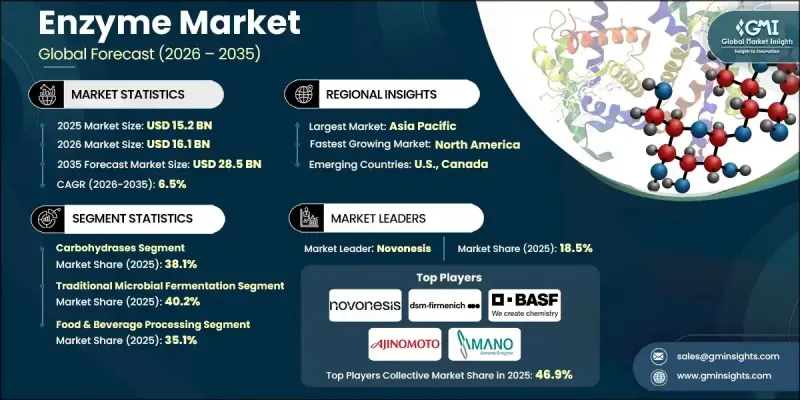
酶的顯著成長得益於其在各個工業領域的廣泛應用。作為天然催化劑,酵素能夠提高化學過程的效率,使生產運作更具永續性、成本效益和環境友善性。酵素的應用涵蓋醫療保健、食品飲料、農業和工業生產等多個領域。在醫療保健領域,酵素可以改善治療和診斷效果;在食品飲料生產領域,酵素可以最佳化加工效率和產品品質;在農業領域,酵素可以提高作物產量和牲畜健康;在工業領域,酵素可以促進環境友善生產,減少化學品用量和能源消耗。全球對綠色技術和永續解決方案的日益關注,持續推動對酵素基應用的需求。
| 市場覆蓋範圍 | |
|---|---|
| 開始年份 | 2025 |
| 預測期 | 2026-2035 |
| 初始市場規模 | 152億美元 |
| 市場規模預測 | 285億美元 |
| 複合年成長率 | 6.5% |
預計到 2025 年,碳水化合物分解酶市佔率將達到 38.1%,到 2035 年將以 6.6% 的複合年成長率成長。這些酶被廣泛用於將複雜的碳水化合物分解成簡單的糖,因此在重視天然和高效工藝的行業中越來越受歡迎。
預計到2025年,傳統微生物發酵市佔率將達到40.2%,並在2026年至2035年間以6.7%的複合年成長率成長。這種生產方法涉及在大規模反應器中培養微生物菌株,仍然是一種成熟且經濟高效的製程。各公司正在最佳化發酵條件並篩選高產菌株,以提高酵素的產量和活性。
北美是酵素製劑的主要區域市場,預計到2025年將佔據28.2%的市場。成長的驅動力包括對天然酵素製劑需求的不斷成長、促進永續發展的嚴格監管標準,以及醫療和工業領域的擴張。旨在減少化學品用量和提高效率的創新持續推動該地區的市場應用。
目錄
第1章:分析方法和範圍
第2章執行摘要
第3章業界考察
- 產業生態系分析
- 供應商情況
- 利潤率
- 每個階段的附加價值
- 影響價值鏈的因素
- 中斷
- 產業影響因素
- 促進要素
- 產業潛在風險與挑戰
- 市場機遇
- 成長潛力分析
- 監管環境
- 北美洲
- 歐洲
- 亞太地區
- 拉丁美洲
- 中東和非洲
- 波特五力分析
- PESTEL 分析
- 價格趨勢
- 按地區
- 依酶類型
- 未來市場趨勢
- 科技與創新趨勢
- 當前技術趨勢
- 新興技術
- 專利狀態
- 貿易統計(HS編碼)(註:僅提供主要國家的貿易統計)
- 主要進口國
- 主要出口國
- 永續性和環境方面
- 永續實踐
- 減少廢棄物策略
- 生產中的能源效率
- 環保舉措
- 考慮到碳足跡
第4章 競爭情勢
- 介紹
- 公司市佔率分析
- 按地區
- 北美洲
- 歐洲
- 亞太地區
- 拉丁美洲
- 中東和非洲
- 按地區
- 企業矩陣分析
- 主要市場公司的競爭分析
- 競爭定位矩陣
- 重大進展
- 併購
- 夥伴關係與合作
- 新產品發布
- 業務拓展計劃
第5章 依酵素類別分類的市場估計與預測(2022-2035 年)
- 碳水化合物分解酶
- 澱粉酶(α、BETA、澱粉葡萄糖化酵素)
- 纖維素酶和半纖維素酶
- 果膠酶和果膠酯酶
- 木聚醣酶和阿拉伯呋喃糖苷酶
- 轉化酶和葡萄糖異構酶
- 蛋白酶
- 鹼性蛋白酶
- 酸性蛋白酶
- 中性蛋白酶
- 特殊蛋白酶
- 脂肪酶和酯酶
- 工業脂肪酶
- 食品級脂肪酶
- 藥用脂肪酶
- 特殊酯酶
- 氧化還原酶
- 過氧化氫酶
- 葡萄糖氧化酵素
- 漆酶
- 過氧化物酶
- 特殊酵素
- 核酸酶(DNase、RNase、鹽活化核酸酶)
- 轉谷氨醯胺酶
- 植酸酶
- 限制性內切酶
- DNA聚合酵素
第6章 依生產技術分類的市場估算與預測(2022-2035 年)
- 傳統微生物發酵
- 深層發酵
- 固體發酵(SSF)
- 補料分批發酵工藝
- 連續發酵系統
- 重組DNA技術
- 大腸桿菌表現系統
- 釀酒酵母的生產
- 畢赤酵母甲基營養系統
- 黑麴菌
- 枯草桿菌(GRAS)
- 先進生物技術平台
- 合成生物學/代謝工程
- 定向進化和蛋白質工程
- 無細胞蛋白質合成
- 哺乳動物細胞表現系統
- 其他
第7章 按應用領域分類的市場估算與預測(2022-2035 年)
- 食品/飲料加工
- 烘焙業(麵包、酥皮點心、無麩質食品)
- 乳製品加工(乳酪、優格、無乳糖產品)
- 飲料生產(啤酒、葡萄酒、果汁澄清)
- 肉類加工和嫩化
- 澱粉加工與高果糖玉米糖漿
- 機能性食品和營養補充劑
- 工業製造
- 清潔劑和清潔產品製造
- 紡織品加工和織物處理
- 紙漿和造紙業應用
- 皮革加工和鞣製
- 生質燃料生產(乙醇、生質柴油)
- 化學合成和精細化學品
- 醫療和藥品
- 治療性酵素替代療法
- 診斷檢測與臨床化學
- 藥物發現與開發工具
- 生物製造和生物加工
- 創傷護理和醫療設備
- 研究與生物技術
- 分子生物學研究工具
- 基因組學和次世代定序
- 蛋白質體學和蛋白質分析
- 細胞培養/組織工程
- 農業生物技術應用
- 動物飼料
- 其他
第8章 各地區市場估算與預測(2022-2035 年)
- 北美洲
- 美國
- 加拿大
- 歐洲
- 德國
- 英國
- 法國
- 西班牙
- 義大利
- 其他歐洲地區
- 亞太地區
- 中國
- 印度
- 日本
- 澳洲
- 韓國
- 亞太其他地區
- 拉丁美洲
- 巴西
- 墨西哥
- 阿根廷
- 其他拉丁美洲地區
- 中東和非洲
- 沙烏地阿拉伯
- 南非
- 阿拉伯聯合大公國
- 其他中東和非洲地區
第9章:公司簡介
- Advanced Enzyme Technologies
- Ajinomoto Co. Inc.
- Amano Enzyme Inc.
- ArcticZymes Technologies ASA
- BASF SE
- Biocatalysts Ltd.
- Codexis Inc.
- Creative Enzymes
- dsm-firmenich
- Dyadic International Inc.
- Enzyme Development Corporation
- Novonesis
- Specialty Enzymes &Probiotics
The Global Enzyme Market was valued at USD 15.2 billion in 2025 and is estimated to grow at a CAGR of 6.5% to reach USD 28.5 billion by 2035.
The market's remarkable growth is fueled by increasing adoption across diverse industries. Enzymes, as natural catalysts, enhance the efficiency of chemical processes, making operations more sustainable, cost-effective, and environmentally friendly. Their applications span healthcare, food and beverages, agriculture, and industrial production. In healthcare, enzymes improve outcomes in therapies and diagnostics. In food and beverage production, they optimize processing efficiency and product quality. In agriculture, enzyme integration enhances both crop yields and livestock well-being. Industrially, enzymes facilitate eco-conscious operations, reducing chemical usage and energy consumption. The rising global focus on green technologies and sustainable solutions continues to drive the demand for enzyme-based applications.
| Market Scope | |
|---|---|
| Start Year | 2025 |
| Forecast Year | 2026-2035 |
| Start Value | $15.2 Billion |
| Forecast Value | $28.5 Billion |
| CAGR | 6.5% |
The carbohydrases segment accounted for 38.1% share in 2025 and is expected to grow at a CAGR of 6.6% through 2035. These enzymes are widely utilized for breaking down complex carbohydrates into simpler sugars, a factor contributing to their growing popularity across industries that prioritize natural and efficient processes.
The traditional microbial fermentation segment held 40.2% share in 2025 and is projected to grow at a CAGR of 6.7% during 2026-2035. This production method, which relies on cultivating microbial strains in large-scale bioreactors, remains a cost-effective and established approach. Companies are increasingly optimizing fermentation conditions and selecting high-yield strains to improve both enzyme output and activity.
North America Enzyme Market held 28.2% share in 2025, making it a leading regional market. The growth is driven by increasing demand for natural enzymes, stringent regulatory standards promoting sustainable practices, and expansion in the healthcare and industrial sectors. Innovations targeting reduced chemical usage and enhanced efficiency continue to support market adoption in this region.
Key players in the Global Enzyme Market include Ajinomoto Co. Inc., Novonesis, BASF SE, Biocatalysts Ltd., Enzyme Development Corporation, Creative Enzymes, Dyadic International Inc., DSM-Firmenich, Advanced Enzyme Technologies, Codexis Inc., Amano Enzyme Inc., ArcticZymes Technologies ASA, and Specialty Enzymes & Probiotics. Leading companies are employing strategies such as advanced research and development to create high-efficiency enzymes, forming strategic partnerships to expand market reach, and focusing on sustainability-driven innovations. They are also optimizing production technologies, diversifying product portfolios, and targeting emerging regional markets to strengthen their market position and maintain a competitive edge.
Table of Contents
Chapter 1 Methodology & Scope
- 1.1 Market scope and definition
- 1.2 Research design
- 1.2.1 Research approach
- 1.2.2 Data collection methods
- 1.3 Data mining sources
- 1.3.1 Global
- 1.3.2 Regional/Country
- 1.4 Base estimates and calculations
- 1.4.1 Base year calculation
- 1.4.2 Key trends for market estimation
- 1.5 Primary research and validation
- 1.5.1 Primary sources
- 1.6 Forecast model
- 1.7 Research assumptions and limitations
Chapter 2 Executive Summary
- 2.1 Industry 360° synopsis
- 2.2 Key market trends
- 2.2.1 Regional
- 2.2.2 Enzyme class
- 2.2.3 Production technology
- 2.2.4 Application
- 2.3 TAM Analysis, 2026-2035
- 2.4 CXO perspectives: Strategic imperatives
- 2.4.1 Executive decision points
- 2.4.2 Critical success factors
- 2.5 Future Outlook and Strategic Recommendations
Chapter 3 Industry Insights
- 3.1 Industry ecosystem analysis
- 3.1.1 Supplier landscape
- 3.1.2 Profit margin
- 3.1.3 Value addition at each stage
- 3.1.4 Factor affecting the value chain
- 3.1.5 Disruptions
- 3.2 Industry impact forces
- 3.2.1 Growth drivers
- 3.2.2 Industry pitfalls and challenges
- 3.2.3 Market opportunities
- 3.3 Growth potential analysis
- 3.4 Regulatory landscape
- 3.4.1 North America
- 3.4.2 Europe
- 3.4.3 Asia Pacific
- 3.4.4 Latin America
- 3.4.5 Middle East & Africa
- 3.5 Porter's analysis
- 3.6 PESTEL analysis
- 3.7 Price trends
- 3.7.1 By region
- 3.7.2 By enzyme class
- 3.8 Future market trends
- 3.9 Technology and Innovation landscape
- 3.9.1 Current technological trends
- 3.9.2 Emerging technologies
- 3.10 Patent Landscape
- 3.11 Trade statistics (HS code) ( Note: the trade statistics will be provided for key countries only)
- 3.11.1 Major importing countries
- 3.11.2 Major exporting countries
- 3.12 Sustainability and environmental aspects
- 3.12.1 Sustainable practices
- 3.12.2 Waste reduction strategies
- 3.12.3 Energy efficiency in production
- 3.12.4 Eco-friendly initiatives
- 3.13 Carbon footprint consideration
Chapter 4 Competitive Landscape, 2025
- 4.1 Introduction
- 4.2 Company market share analysis
- 4.2.1 By region
- 4.2.1.1 North America
- 4.2.1.2 Europe
- 4.2.1.3 Asia Pacific
- 4.2.1.4 LATAM
- 4.2.1.5 MEA
- 4.2.1 By region
- 4.3 Company matrix analysis
- 4.4 Competitive analysis of major market players
- 4.5 Competitive positioning matrix
- 4.6 Key developments
- 4.6.1 Mergers & acquisitions
- 4.6.2 Partnerships & collaborations
- 4.6.3 New Product Launches
- 4.6.4 Expansion Plans
Chapter 5 Market Estimates and Forecast, By Enzyme Class, 2022-2035 (USD Billion) (Kilo Tons)
- 5.1 Key trends
- 5.2 Carbohydrases
- 5.2.1 Amylases (Alpha, Beta, Glucoamylase)
- 5.2.2 Cellulases & hemicellulases
- 5.2.3 Pectinases & pectin esterases
- 5.2.4 Xylanases & arabinofuranosidases
- 5.2.5 Invertases & glucose isomerases
- 5.3 Proteases
- 5.3.1 Alkaline proteases
- 5.3.2 Acid proteases
- 5.3.3 Neutral proteases
- 5.3.4 Specialty proteases
- 5.4 Lipases & Esterases
- 5.4.1 Industrial lipases
- 5.4.2 Food-grade lipases
- 5.4.3 Pharmaceutical lipases
- 5.4.4 Specialty esterases
- 5.5 Oxidoreductases
- 5.5.1 Catalases
- 5.5.2 Glucose oxidases
- 5.5.3 Laccases
- 5.5.4 Peroxidases
- 5.6 Specialized enzymes
- 5.6.1 Nucleases (DNases, RNases, Salt-Active)
- 5.6.2 Transglutaminases
- 5.6.3 Phytases
- 5.6.4 Restriction enzymes
- 5.6.5 DNA polymerases
Chapter 6 Market Estimates and Forecast, By Production Technology, 2022-2035 (USD Billion) (Kilo Tons)
- 6.1 Key trends
- 6.2 Traditional microbial fermentation
- 6.2.1 Submerged liquid fermentation
- 6.2.2 Solid-state fermentation (SSF)
- 6.2.3 Fed-batch fermentation processes
- 6.2.4 Continuous fermentation systems
- 6.3 Recombinant DNA technology
- 6.3.1 Escherichia coli expression systems
- 6.3.2 Saccharomyces cerevisiae production
- 6.3.3 Pichia pastoris Methylotrophic systems
- 6.3.4 Aspergillus niger filamentous fungi
- 6.3.5 Bacillus subtilis GRAS organisms
- 6.4 Advanced biotechnology platforms
- 6.4.1 Synthetic biology & metabolic engineering
- 6.4.2 Directed evolution & protein engineering
- 6.4.3 Cell-free protein synthesis
- 6.4.4 Mammalian cell expression systems
- 6.5 Others
Chapter 7 Market Estimates and Forecast, By Application, 2022-2035 (USD Billion) (Kilo Tons)
- 7.1 Key trends
- 7.2 Food & beverage processing
- 7.2.1 Baking industry (Bread, Pastries, Gluten-Free)
- 7.2.2 Dairy processing (Cheese, Yogurt, Lactose-Free)
- 7.2.3 Beverage production (Beer, Wine, Juice Clarification)
- 7.2.4 Meat processing & tenderization
- 7.2.5 Starch processing & high fructose corn syrup
- 7.2.6 Functional foods & nutraceuticals
- 7.3 Industrial manufacturing
- 7.3.1 Detergent & cleaning product manufacturing
- 7.3.2 Textile processing & fabric treatment
- 7.3.3 Pulp & paper industry applications
- 7.3.4 Leather processing & tanning
- 7.3.5 Biofuel production (Ethanol, Biodiesel)
- 7.3.6 Chemical synthesis & fine chemicals
- 7.4 Healthcare & pharmaceutical
- 7.4.1 Therapeutic enzyme replacement therapies
- 7.4.2 Diagnostic testing & clinical chemistry
- 7.4.3 Drug discovery & development tools
- 7.4.4 Biomanufacturing & bioprocessing
- 7.4.5 Wound care & medical devices
- 7.5 Research & biotechnology
- 7.5.1 Molecular biology research tools
- 7.5.2 Genomics & next-generation sequencing
- 7.5.3 Proteomics & protein analysis
- 7.5.4 Cell culture & tissue engineering
- 7.5.5 Agricultural biotechnology applications
- 7.6 Animal feed
- 7.7 Others
Chapter 8 Market Estimates and Forecast, By Region, 2022-2035 (USD Billion) (Kilo Tons)
- 8.1 Key trends
- 8.2 North America
- 8.2.1 U.S.
- 8.2.2 Canada
- 8.3 Europe
- 8.3.1 Germany
- 8.3.2 UK
- 8.3.3 France
- 8.3.4 Spain
- 8.3.5 Italy
- 8.3.6 Rest of Europe
- 8.4 Asia Pacific
- 8.4.1 China
- 8.4.2 India
- 8.4.3 Japan
- 8.4.4 Australia
- 8.4.5 South Korea
- 8.4.6 Rest of Asia Pacific
- 8.5 Latin America
- 8.5.1 Brazil
- 8.5.2 Mexico
- 8.5.3 Argentina
- 8.5.4 Rest of Latin America
- 8.6 Middle East and Africa
- 8.6.1 Saudi Arabia
- 8.6.2 South Africa
- 8.6.3 UAE
- 8.6.4 Rest of Middle East and Africa
Chapter 9 Company Profiles
- 9.1 Advanced Enzyme Technologies
- 9.2 Ajinomoto Co. Inc.
- 9.3 Amano Enzyme Inc.
- 9.4 ArcticZymes Technologies ASA
- 9.5 BASF SE
- 9.6 Biocatalysts Ltd.
- 9.7 Codexis Inc.
- 9.8 Creative Enzymes
- 9.9 dsm-firmenich
- 9.10 Dyadic International Inc.
- 9.11 Enzyme Development Corporation
- 9.12 Novonesis
- 9.13 Specialty Enzymes & Probiotics

 2026年全球水解酶市場報告2026年全球蛋白質水解酵素市場報告2026年全球酵素市場報告
 抗生素合成酶市場:按酵素類型、抗生素類別、生產技術、製程類型、產品形式和最終用戶分類,全球預測(2026-2032年)藥物合成酶市場(按酵素類型、原料來源、製程類型、產品形式、應用和最終用戶分類)-全球預測(2026-2032年)
 日本酵素市場報告:按類型、原料、反應類型、應用和地區分類,2026-2034年
 酵素市場規模、佔有率和成長分析(按產品類型、原料、反應類型和地區分類)-2026-2033年產業預測
 酵素工程市場:依產品類型、設計方法、原料、改質類型、最終用戶和地區分類
 全球永續酵素市場(2026-2036)
 全球基因改造酶市場:市場規模、佔有率、趨勢分析(按類型、產品和地區分類)、細分市場預測(2025-2033 年)