


 |
市場調查報告書
商品編碼
1913363
機場安檢市場:市場機會、成長促進因素、產業趨勢分析及預測(2026-2035)Airport Security Market Opportunity, Growth Drivers, Industry Trend Analysis, and Forecast 2026 - 2035 |
||||||

全球機場安檢市場預計到 2025 年將達到 199 億美元,到 2035 年將達到 450 億美元,年複合成長率為 8.6%。
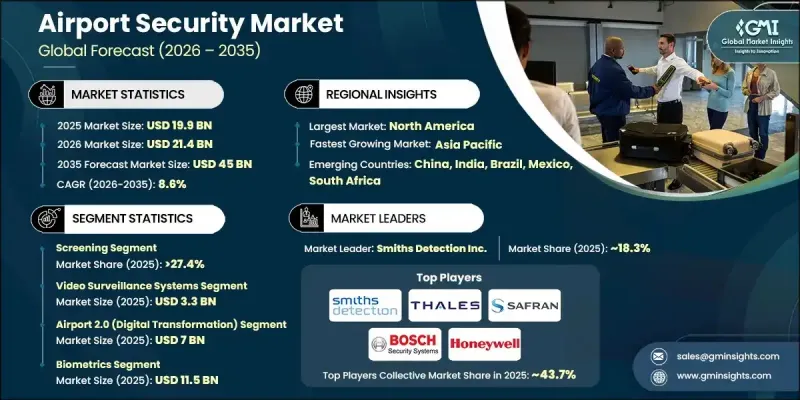
國際和國內航空客運量的成長、安全威脅的加劇以及機場基礎設施現代化的大規模投資,共同推動了這一成長。機場正在部署先進技術,例如人工智慧威脅偵測、生物識別、自動化安檢通道和網路安全解決方案,以確保安全並最佳化旅客流動。疫情後旅遊業的復甦、航空公司網路的擴張以及旅客數量的成長,推動了對下一代系統的需求,例如3D電腦斷層掃描儀、毫米波人體掃描儀、爆炸物痕量檢測器和基於人工智慧的異常檢測系統。各國政府和機場營運商正在部署生物識別系統,例如臉部認證、虹膜掃描和指紋認證,以實現非接觸式、無縫的旅客通關,提高準確性並最大限度地減少人為錯誤。這些解決方案的整合將縮短登機時間,提高營運效率,並提升旅客體驗。
| 市場覆蓋範圍 | |
|---|---|
| 開始年份 | 2025 |
| 預測期 | 2026-2035 |
| 初始市場規模 | 199億美元 |
| 市場規模預測 | 450億美元 |
| 複合年成長率 | 8.6% |
截至2025年,篩檢業務將佔市場佔有率的27.4%。該業務受惠於對旅客和行李進行全面安檢的需求日益成長,而3D X光掃描儀、金屬探測器、毫米波人體掃描儀和自動化行李安檢系統等技術的進步也為此提供了支持。旅客數量的成長、嚴格的監管以及對快速、非接觸式篩檢的需求正在推動這些技術的普及,使該業務成為重要的收入來源。
預計到2035年,網路安全系統市場將以12.4%的複合年成長率成長,達到115億美元。推動市場成長的主要因素是針對機場IT基礎設施、旅客資料和營運系統的網路攻擊日益頻繁且手段愈加複雜。機場對雲端平台、自助報到和網際網路的日益依賴,也催生了對人工智慧驅動的威脅偵測、安全存取管理、網路監控和資料加密的需求。
預計到2025年,北美機場安檢市場佔有率將達到33.5%,這主要得益於高客流量、嚴格的政府監管以及對先進安檢基礎設施的大量投資。人工智慧監控系統、生物識別、自動化行李處理和3D X光掃描等技術的應用日益普及,以提高威脅偵測和營運效率。現代化改造計劃和擴建計畫進一步鞏固了該地區的市場領先地位,其重點在於快速、可靠且非接觸式的安檢解決方案。
目錄
第1章:分析方法和範圍
第2章執行摘要
第3章業界考察
- 生態系分析
- 供應商情況
- 利潤率
- 成本結構
- 每個階段的附加價值
- 影響價值鏈的因素
- 中斷
- 產業影響因素
- 促進要素
- 全球航空運輸量的成長推動了對高效、先進的安全檢查的需求。
- 恐怖主義和犯罪活動的威脅日益加劇,因此需要加強監控和篩檢解決方案。
- 嚴格的政府法規和強制性的航空安全標準正在推動基礎設施升級。
- 3D X光掃描儀、基於人工智慧的威脅偵測和自動化篩檢系統的技術進步
- 機場當局和私人營運商正在加大對整合智慧安防解決方案的投資。
- 產業潛在風險與挑戰
- 先進安防系統的高昂購置和安裝成本限制了其普及應用。
- 將新技術與現有機場基礎設施結合所面臨的挑戰
- 市場機遇
- 採用人工智慧 (AI)、機器學習和基於物聯網的機場安保解決方案
- 新興經濟體機場基礎設施的擴建正在推動對現代安全解決方案的需求。
- 促進要素
- 成長潛力分析
- 監管環境
- 北美洲
- 歐洲
- 亞太地區
- 拉丁美洲
- 中東和非洲
- 波特五力分析
- PESTEL 分析
- 科技與創新趨勢
- 當前技術趨勢
- 新興技術
- 價格趨勢
- 歷史價格分析(2022-2024)
- 價格趨勢背後的因素
- 區域價格波動
- 價格預測(2026-2035)
- 定價策略
- 新興經營模式
- 合規要求
- 永續性措施
- 永續材料評估
- 碳足跡分析
- 採取循環經濟模式
- 永續性認證和標準
- 永續性投資報酬率分析
- 全球消費者心理分析
- 專利分析
第4章 競爭情勢
- 介紹
- 公司市佔率分析
- 按地區
- 北美洲
- 歐洲
- 亞太地區
- 拉丁美洲
- 中東和非洲
- 市場集中度分析
- 按地區
- 主要企業的競爭分析
- 財務績效比較
- 收入
- 利潤率
- 研究與開發
- 產品系列比較
- 產品線的廣度
- 科技
- 創新
- 地理分佈比較
- 全球擴張分析
- 服務網路覆蓋
- 按地區分類的市場滲透率
- 競爭定位矩陣
- 領導者
- 挑戰者
- 追蹤者
- 小眾玩家
- 戰略展望矩陣
- 財務績效比較
- 主要發展(2022-2025)
- 企業合併(M&A)
- 合夥/合資企業
- 技術進步
- 擴張與投資策略
- 永續發展計劃
- 數位轉型計劃
- 新興/Start-Ups競賽的趨勢
第5章 機場安檢市場按安檢系統分類的估算與預測(2022-2035 年)
- 存取控制
- 網路安全
- 邊境安全
- 篩檢
- 監測
- 緊急應變系統
- 其他
第6章 按系統分類的市場估算與預測(2022-2035 年)
- 金屬探測器
- 光纖周界入侵偵測系統
- 反向散射X光系統
- 機上行李檢查系統
- 全身掃描儀
- 化學物質檢測系統
- 爆炸物微量檢測裝置
- 影像監控系統
- 門禁系統
- 網路安全系統
- 其他
第7章 機場安保市場按機場類型分類的估算與預測(2022-2035 年)
- 機場 1.0(傳統模式)
- 機場 2.0(數位轉型)
- 機場3.0(智慧機場)
- 其他
第8章 依技術分類的機場安檢市場估算與預測(2022-2035 年)
- 生物識別
- 臉部認證
- 指紋認證
- 虹膜辨識
- 語音辨識
- 掌紋鑑定
- 步態分析
- 其他生物識別方法
- 非生物識別
- 基於卡片的系統
- 基於PIN碼的系統
- 憑證式的系統
- 射頻識別系統
- QR碼系統
- 行為分析系統
- 其他非生物識別系統
第9章 機場安檢市場按安檢區域分類的估算與預測(2022-2035 年)
- 陸側
- 空側
- 邊境安全
- 空中交通管制
- 貨物裝卸
- 其他
第10章 機場安檢市場區域估價與預測(2022-2035 年)
- 各區域主要趨勢
- 北美洲
- 美國
- 加拿大
- 歐洲
- 英國
- 德國
- 法國
- 義大利
- 西班牙
- 俄羅斯
- 其他歐洲地區
- 亞太地區
- 中國
- 印度
- 日本
- 韓國
- ANZ
- 亞太其他地區
- 拉丁美洲
- 巴西
- 墨西哥
- 其他拉丁美洲地區
- 中東和非洲
- 沙烏地阿拉伯
- 南非
- 阿拉伯聯合大公國
- 其他中東和非洲地區
第11章 公司簡介
- American Science and Engineering Inc
- Axis Communications AB
- Bosch Security Systems
- Cognitec Systems GmbH
- dormakaba Group
- FLIR Systems Inc.
- Genetec Inc.
- Hangzhou Hikvision Digital Technology Co., Ltd.
- Honeywell International Inc.
- Indra Sistemas, SA
- NEC Corporation
- Nuctech Technology Co, Ltd.
- Rapiscan Systems
- Raytheon Technologies
- Safran group
- Siemens AG
- SITA
- Smiths Detection Inc.
- Thales Group
- Unisys Corporation
- Westminster Group Plc.
The Global Airport Security Market was valued at USD 19.9 billion in 2025 and is estimated to grow at a CAGR of 8.6% to reach USD 45 billion by 2035.
The growth is fueled by the rising volume of international and domestic air travel, increasing security threats, and extensive investments in modernizing airport infrastructure. Airports are adopting advanced technologies such as AI-powered threat detection, biometric verification, automated security lanes, and cybersecurity solutions to ensure safety while optimizing passenger flow. The post-pandemic recovery in tourism, expanding airline networks, and higher passenger throughput necessitate next-generation systems, including 3D computed tomography scanners, millimeter-wave body scanners, explosive trace detectors, and AI-based anomaly detection. Governments and airport operators are increasingly implementing biometric systems such as facial recognition, iris scanning, and fingerprint identification to enable touch-free, seamless passenger processing, improving accuracy and minimizing human error. The integration of these solutions supports faster boarding, higher operational efficiency, and enhanced passenger experience.
| Market Scope | |
|---|---|
| Start Year | 2025 |
| Forecast Year | 2026-2035 |
| Start Value | $19.9 Billion |
| Forecast Value | $45 Billion |
| CAGR | 8.6% |
The screening segment held 27.4% share in 2025. This segment benefits from the growing need for thorough passenger and baggage inspection, supported by technologies like 3D X-ray scanners, metal detectors, millimeter-wave body scanners, and automated baggage screening systems. Rising passenger traffic, stringent regulations, and demand for rapid, contactless screening are driving adoption, making this segment a major revenue contributor.
The cybersecurity systems segment is expected to grow at a CAGR of 12.4%, reaching USD 11.5 billion by 2035. The increasing frequency and sophistication of cyberattacks targeting airport IT infrastructure, passenger data, and operational systems are boosting demand. Airports are relying more on cloud-based platforms, automated check-in, and interconnected networks, creating a need for AI-enabled threat detection, secure access management, network monitoring, and data encryption.
North America Airport Security Market accounted for 33.5% share in 2025, driven by high passenger traffic, strict government regulations, and substantial investment in advanced security infrastructure. AI-enabled surveillance, biometric identification, automated baggage handling, and 3D X-ray scanning are increasingly deployed to enhance threat detection and operational efficiency. Modernization projects and expansion initiatives further strengthen the region's market leadership, emphasizing fast, reliable, and contactless security solutions.
Key players operating in the Global Airport Security Market include: American Science and Engineering Inc, Axis Communications AB, Bosch Security Systems, Cognitec Systems GmbH, dormakaba Group, FLIR Systems Inc., Genetec Inc., Hangzhou Hikvision Digital Technology Co, Ltd., Honeywell International Inc., Indra Sistemas S.A., NEC Corporation, Nuctech Technology Co, Ltd., Rapiscan Systems, Raytheon Technologies, Safran Group, Siemens AG, SITA, Smiths Detection Inc., Thales Group, Unisys Corporation, Westminster Group Plc. Companies in the Airport Security Market are employing multiple strategies to strengthen their presence and expand market share. They are investing in R&D to develop AI-based threat detection, biometric solutions, and next-generation scanning systems. Strategic partnerships and collaborations with technology providers and airports enable faster deployment and geographic expansion.
Table of Contents
Chapter 1 Methodology and Scope
- 1.1 Market scope and definition
- 1.2 Research design
- 1.2.1 Research approach
- 1.2.2 Data collection methods
- 1.3 Data mining sources
- 1.3.1 Global
- 1.3.2 Regional/Country
- 1.4 Base estimates and calculations
- 1.4.1 Base year calculation
- 1.4.2 Key trends for market estimation
- 1.5 Primary research and validation
- 1.5.1 Primary sources
- 1.6 Forecast model
- 1.7 Research assumptions and limitations
Chapter 2 Executive Summary
- 2.1 Industry snapshot
- 2.2 Key market trends
- 2.2.1 Security Type trends
- 2.2.2 System trends
- 2.2.3 Airport Model trends
- 2.2.4 Technology trends
- 2.2.5 Security Area trends
- 2.2.6 Regional
- 2.3 TAM Analysis, 2025-2034 (USD Million)
- 2.4 CXO perspectives: Strategic imperatives
- 2.4.1 Executive decision points
- 2.4.2 critical success factors
- 2.5 Future outlook and strategic recommendations
Chapter 3 Industry Insights
- 3.1 Industry ecosystem analysis
- 3.1.1 Supplier Landscape
- 3.1.2 Profit Margin
- 3.1.3 Cost structure
- 3.1.4 Value addition at each stage
- 3.1.5 Factor affecting the value chain
- 3.1.6 Disruptions
- 3.2 Industry impact forces
- 3.2.1 Growth drivers
- 3.2.1.1 Rising global air passenger traffic driving demand for efficient and advanced security screening.
- 3.2.1.2 Increasing threats from terrorism and criminal activities necessitating enhanced surveillance and screening solutions.
- 3.2.1.3 Stringent government regulations and mandatory aviation security standards enforcing infrastructure upgrades.
- 3.2.1.4 Technological advancements in 3D X-ray scanners, AI-based threat detection, and automated screening systems.
- 3.2.1.5 Growing investments by airport authorities and private players in integrated, smart security solutions.
- 3.2.2 Industry pitfalls and challenges
- 3.2.2.1 High capital and installation costs of advanced security systems limiting adoption.
- 3.2.2.2 Challenges in integrating new technologies with legacy airport infrastructure.
- 3.2.3 Market opportunities
- 3.2.4 Adoption of AI, machine learning, and IoT-based airport security solutions.
- 3.2.5 Expansion of airport infrastructure in emerging economies driving demand for modern security solutions.
- 3.2.1 Growth drivers
- 3.3 Growth potential analysis
- 3.4 Regulatory landscape
- 3.4.1 North America
- 3.4.2 Europe
- 3.4.3 Asia Pacific
- 3.4.4 Latin America
- 3.4.5 Middle East & Africa
- 3.5 Porter's analysis
- 3.6 PESTEL analysis
- 3.7 Technology and innovation landscape
- 3.7.1 Current technological trends
- 3.7.2 Emerging technologies
- 3.8 Price trends
- 3.8.1 Historical price analysis (2022-2024)
- 3.8.2 Price trend drivers
- 3.8.3 Regional price variations
- 3.8.4 Price forecast (2026-2035)
- 3.9 Pricing strategies
- 3.10 Emerging business models
- 3.11 Compliance requirements
- 3.12 Sustainability measures
- 3.12.1 Sustainable materials assessment
- 3.12.2 Carbon footprint analysis
- 3.12.3 Circular economy implementation
- 3.12.4 Sustainability certifications and standards
- 3.12.5 Sustainability ROI analysis
- 3.13 Global consumer sentiment analysis
- 3.14 Patent analysis
Chapter 4 Competitive Landscape, 2025
- 4.1 Introduction
- 4.2 Company market share analysis
- 4.2.1 By region
- 4.2.1.1 North America
- 4.2.1.2 Europe
- 4.2.1.3 Asia Pacific
- 4.2.1.4 Latin America
- 4.2.1.5 Middle East & Africa
- 4.2.2 Market Concentration Analysis
- 4.2.1 By region
- 4.3 Competitive benchmarking of key players
- 4.3.1 Financial performance comparison
- 4.3.1.1 Revenue
- 4.3.1.2 Profit margin
- 4.3.1.3 R&D
- 4.3.2 Product portfolio comparison
- 4.3.2.1 Product range breadth
- 4.3.2.2 Technology
- 4.3.2.3 Innovation
- 4.3.3 Geographic presence comparison
- 4.3.3.1 Global footprint analysis
- 4.3.3.2 Service network coverage
- 4.3.3.3 Market penetration by region
- 4.3.4 Competitive positioning matrix
- 4.3.4.1 Leaders
- 4.3.4.2 Challengers
- 4.3.4.3 Followers
- 4.3.4.4 Niche players
- 4.3.5 Strategic outlook matrix
- 4.3.1 Financial performance comparison
- 4.4 Key developments, 2022-2025
- 4.4.1 Mergers and acquisitions
- 4.4.2 Partnerships and collaborations
- 4.4.3 Technological advancements
- 4.4.4 Expansion and investment strategies
- 4.4.5 Sustainability initiatives
- 4.4.6 Digital transformation initiatives
- 4.5 Emerging/ startup competitors landscape
Chapter 5 Airport Security Market Estimates & Forecast, By Security System, 2022 - 2035 (USD Million)
- 5.1 Key trends,
- 5.2 Access Control
- 5.3 Cyber-security
- 5.4 Perimeter Security
- 5.5 Screening
- 5.6 Surveillance
- 5.7 Emergency Response Systems
- 5.8 Others
Chapter 6 Market Estimates and Forecast, By System, 2022 - 2035 (USD Million)
- 6.1 Key trends
- 6.2 Metal Detectors
- 6.3 Fiber Optic Perimeter Intrusion
- 6.4 Backscatter X-Ray Systems
- 6.5 Cabin Baggage Screening Systems
- 6.6 Full-Body Scanners
- 6.7 Chemical Detection Systems
- 6.8 Explosive Trace Detectors
- 6.9 Video Surveillance Systems
- 6.10 Access Control Systems
- 6.11 Cybersecurity Systems
- 6.12 Others
Chapter 7 Airport Security Market Estimates & Forecast, By Airport Model, 2022 - 2035 (USD Million)
- 7.1 Key trends
- 7.2 Airport 1.0 (Traditional model)
- 7.3 Airport 2.0 (Digital transformation)
- 7.4 Airport 3.0 (Smart airport)
- 7.5 Other
Chapter 8 Airport Security Market Estimates & Forecast, By Technology, 2022 - 2035 (USD Million)
- 8.1 Key trends
- 8.2 Biometric
- 8.2.1 Facial Recognition
- 8.2.2 Fingerprint Recognition
- 8.2.3 Iris Recognition
- 8.2.4 Voice Recognition
- 8.2.5 Palm Vein Recognition
- 8.2.6 Gait Analysis
- 8.2.7 Other Biometric Methods
- 8.3 Non-Biometric
- 8.3.1 Card-based Systems
- 8.3.2 PIN-based Systems
- 8.3.3 Token-based Systems
- 8.3.4 RFID Systems
- 8.3.5 QR Code Systems
- 8.3.6 Behavioral Analysis Systems
- 8.3.7 Other Non-Biometric Systems
Chapter 9 Airport Security Market Estimates & Forecast, By Security Area, 2022 - 2035 (USD Million)
- 9.1 Key trends
- 9.2 Landside
- 9.3 Airside
- 9.4 Perimeter
- 9.5 Air Traffic Control
- 9.6 Cargo Handling
- 9.7 Others
Chapter 10 Airport Security Market Estimates & Forecast, By Region, 2022 - 2035 (USD Million)
- 10.1 Key trends, by region
- 10.2 North America
- 10.2.1 U.S.
- 10.2.2 Canada
- 10.3 Europe
- 10.3.1 UK
- 10.3.2 Germany
- 10.3.3 France
- 10.3.4 Italy
- 10.3.5 Spain
- 10.3.6 Russia
- 10.3.7 Rest of Europe
- 10.4 Asia-Pacific
- 10.4.1 China
- 10.4.2 India
- 10.4.3 Japan
- 10.4.4 South Korea
- 10.4.5 ANZ
- 10.4.6 Rest of Asia-Pacific
- 10.5 Latin America
- 10.5.1 Brazil
- 10.5.2 Mexico
- 10.5.3 Rest of Latin America
- 10.6 MEA
- 10.6.1 Saudi Arabia
- 10.6.2 South Africa
- 10.6.3 UAE
- 10.6.4 Rest of MEA
Chapter 11 Company Profiles
- 11.1 American Science and Engineering Inc
- 11.2 Axis Communications AB
- 11.3 Bosch Security Systems
- 11.4 Cognitec Systems GmbH
- 11.5 dormakaba Group
- 11.6 FLIR Systems Inc.
- 11.7 Genetec Inc.
- 11.8 Hangzhou Hikvision Digital Technology Co., Ltd.
- 11.9 Honeywell International Inc.
- 11.10 Indra Sistemas, S.A.
- 11.11 NEC Corporation
- 11.12 Nuctech Technology Co, Ltd.
- 11.13 Rapiscan Systems
- 11.14 Raytheon Technologies
- 11.15 Safran group
- 11.16 Siemens AG
- 11.17 SITA
- 11.18 Smiths Detection Inc.
- 11.19 Thales Group
- 11.20 Unisys Corporation
- 11.21 Westminster Group Plc.

 2026年全球車輛篩檢帳篷市場報告
 機場安防市場:2026-2032年全球市場預測(依解決方案、偵測技術、威脅類型、部署模式、應用程式和最終用戶分類)
 全球機場安檢系統市場規模、佔有率、趨勢和成長分析報告(2026-2034年)
 機場安檢系統市場報告:趨勢、預測與競爭分析(至2035年)
 機場安防市場:依安防類型、安裝位置、系統、機場型號、機場等級及地區分類2026年全球機場安保市場報告機場安檢設備市場:依設備類型、技術、應用、最終用戶和通路分類-2026-2032年全球市場預測2026年全球機場和港口安保市場報告全球篩分設備市場:市場規模、佔有率、成長率、產業分析、依類型、應用和地區劃分的分析以及未來預測(2026-2034)
 機場安檢市場規模、佔有率及成長分析(依安檢類型、地點、服務、機場類型及地區分類)-產業預測,2026-2033年