


 |
市場調查報告書
商品編碼
1913362
電動汽車增程器市場:市場機會、成長促進因素、產業趨勢分析及預測(2026-2035)Electric Vehicle Range Extender Market Opportunity, Growth Drivers, Industry Trend Analysis, and Forecast 2026 - 2035 |
||||||

全球電動車增程器市場預計到 2025 年將達到 14.9 億美元,到 2035 年將達到 35.4 億美元,年複合成長率為 9.2%。
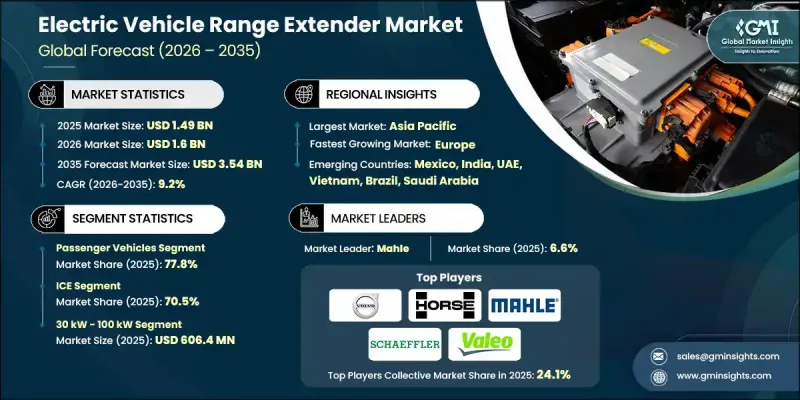
全球向電動出行的加速轉型持續推動市場擴張,電動車銷量的成長直接帶動了對解決續航里程問題的技術的需求。在公共充電網路不發達的地區,增程器的重要性日益凸顯。技術的不斷進步提升了現代增程器器的成本效益和性能,增加了其大規模部署的潛力。這些系統有助於提高車輛效率、減少環境影響並延長續航里程,使電動出行對個人和商業用途更具吸引力。同時,電池領域的創新也帶來了競爭壓力,電池能量密度和快速充電能力的提升降低了對輔助電源系統的依賴。儘管面臨這些挑戰,增程器透過解決長途旅行難題並促進電動車在各種應用場景中的普及,繼續為市場成長提供支援。
| 市場覆蓋範圍 | |
|---|---|
| 開始年份 | 2025 |
| 預測期 | 2026-2035 |
| 初始市場規模 | 14.9億美元 |
| 市場規模預測 | 35.4億美元 |
| 複合年成長率 | 9.2% |
預計到2025年,乘用車市佔率將達到77.8%。消費者越來越重視日常都市區和郊區用車的續航里程,因為減少充電頻率可以提高電動車的便利性和使用者信心。增程器的應用有助於緩解消費者最初的里程焦慮,從而推動電動乘用車在全球範圍內獲得強勁成長。
預計到 2025 年,基於內燃機的解決方案市佔率將達到 70.5%,2026 年至 2035 年的複合年成長率將達到 9.6%。與新興的發電替代方案相比,由於這些系統技術成熟、供應鏈完善且開發和製造成本較低,製造商仍青睞這些系統。
2025年,美國電動車增程器市場價值將達3.097億美元。各州政府對電動車的獎勵、稅收減免和監管支持將繼續推動國內生產和投資,從而增強美國市場的成長。
目錄
第1章:分析方法和範圍
第2章執行摘要
第3章業界考察
- 生態系分析
- 供應商情況
- 利潤率
- 成本結構
- 每個階段的附加價值
- 影響價值鏈的因素
- 中斷
- 產業影響因素
- 促進要素
- 消費者日益成長的里程焦慮
- 電動商用車和車隊車輛的成長
- 新興市場電動車普及率不斷提高
- 農村地區和高速公路沿線缺乏充電基礎設施
- 產業潛在風險與挑戰
- 快速充電基礎設施的快速擴張
- 提高電池能量密度並降低成本
- 市場機遇
- 電動卡車和貨車的增程器
- 現有電動車平台的改造解決方案
- 基礎設施存在缺口的新興市場
- 氫燃料和電子燃料增程器系統
- 促進要素
- 成長潛力分析
- 監管環境
- 北美洲
- 加州空氣資源委員會(CARB)先進清潔汽車II(ACC II)
- 美國環保署溫室氣體(GHG)標準
- IRA(通貨膨脹削減法案)稅額扣抵
- 歐洲
- 歐7標準
- 效用因子(UF)曲線調整
- 歐盟委員會
- 國際清潔交通委員會
- 亞太地區
- 中國的新能源汽車政策
- 印度的FAME-III(草案)
- 雙學分制(CAFC 和 NEV)
- 拉丁美洲
- 巴西搬家計劃
- CONAMA(Conselho Nacional do Meio Ambiente)
- 中東和非洲
- GSO(海灣標準組織)標準
- 阿拉伯聯合大公國(阿拉伯聯合大公國)國家電動車政策
- 沙烏地阿拉伯 SASO 法規
- 北美洲
- 波特五力分析
- PESTEL 分析
- 科技與創新趨勢
- 當前技術趨勢
- 新興技術
- 價格趨勢
- 按地區
- 依產品
- 生產統計
- 生產基地
- 消費基礎
- 出口和進口
- 永續性和環境影響
- 環境影響評估
- 社會影響力和社區服務
- 公司管治與企業社會責任
- 永續金融與投資趨勢
- 對各區域基礎設施發展狀況進行評估
- 充電基礎設施發展狀況:依地區分類
- 增程器系統的燃料供應狀況
- 都市區和城際基礎設施缺口
- 對增程器需求前景的影響
- 成本細分分析
- 引擎/能源產出單元成本
- 發電機及電氣電子設備成本
- 燃油系統和排放氣體控制成本
- 溫度控管和冷卻系統成本
- 製造和組裝成本
- 案例研究
- 未來前景與機遇
第4章 競爭情勢
- 介紹
- 公司市佔率分析
- 北美洲
- 歐洲
- 亞太地區
- 拉丁美洲
- 中東和非洲
- 主要企業的競爭分析
- 競爭定位矩陣
- 戰略展望矩陣
- 重大進展
- 併購
- 夥伴關係與合作
- 新產品發布
- 企業擴張計畫和資金籌措
第5章增程器市場估算與預測(2022-2035)
- 內燃機(ICE)
- 柴油引擎
- 汽油
- 旋轉
- 替代燃料電池
- 天然氣
- 氫
- 生質燃料
第6章 按產量分類的市場估計與預測(2022-2035 年)
- 小於30千瓦
- 30kW~100kW
- 100千瓦或以上
第7章 按組件分類的市場估計和預測(2022-2035 年)
- 電池組
- 電源轉換器
- 電動機
- 發電機
- 其他
第8章 按車輛類型分類的市場估計和預測(2022-2035 年)
- 搭乘用車
- 轎車
- SUV
- 掀背車
- 商用車輛
- 輕型商用車(LCV)
- 中型商用車(MCV)
- 重型商用車(HCV)
- 二輪車/三輪車
第9章 按應用領域分類的市場估算與預測(2022-2035 年)
- 企業/物流車輛
- 共乘/計程車/租車服務
- 個人車
第10章 依銷售管道分類的市場估計與預測(2022-2035 年)
- OEM
- 售後市場
第11章 各地區市場估計與預測(2022-2035 年)
- 北美洲
- 美國
- 加拿大
- 歐洲
- 德國
- 英國
- 法國
- 義大利
- 西班牙
- 俄羅斯
- 北歐國家
- 比荷盧經濟聯盟
- 亞太地區
- 中國
- 印度
- 日本
- 韓國
- 澳洲和紐西蘭
- 新加坡
- 馬來西亞
- 印尼
- 越南
- 泰國
- 拉丁美洲
- 巴西
- 墨西哥
- 阿根廷
- 哥倫比亞
- 中東和非洲
- 南非
- 沙烏地阿拉伯
- 阿拉伯聯合大公國
第12章:公司簡介
- 世界公司
- ZF Group
- Stellantis
- Hyundai Motor
- Volvo
- Mazda Motor
- BYD
- Li Auto
- Huawei
- Leapmotor
- Magna
- MAHLE Powertrain
- Ballard
- 本地公司
- AVL
- FEV Group
- Plug Power
- Scout Motors
- Avatr Technologies
- Deepal
- Bosch Engineering
- XPeng Motors
- 新興企業
- Obrist Powertrain
- Delta Motorsports
- Ceres Power
- Symbio
- EP Tender
The Global Electric Vehicle Range Extender Market was valued at USD 1.49 billion in 2025 and is estimated to grow at a CAGR of 9.2% to reach USD 3.54 billion by 2035.
The accelerating shift toward electric mobility worldwide continues to support market expansion, as rising EV sales directly increase demand for technologies that address driving range concerns. Range extenders are gaining relevance in regions where public charging networks remain underdeveloped. Ongoing technological progress has improved the cost efficiency and performance of modern range extender systems, making them more viable for large-scale adoption. These systems help improve vehicle efficiency, reduce environmental impact, and extend driving distance, which strengthens the appeal of electric mobility for both private and commercial use. At the same time, innovation within the battery sector is creating competitive pressure, as higher battery energy density and faster charging capabilities reduce dependence on auxiliary power systems. Despite these challenges, range extenders continue to support market growth by addressing long-distance travel limitations and enabling wider EV acceptance across diverse use cases.
| Market Scope | |
|---|---|
| Start Year | 2025 |
| Forecast Year | 2026-2035 |
| Start Value | $1.49 Billion |
| Forecast Value | $3.54 Billion |
| CAGR | 9.2% |
The passenger vehicles segment accounted for 77.8% share in 2025. Consumers increasingly prioritize extended driving range for everyday urban and suburban usage, as reduced charging frequency improves convenience and confidence in EV ownership. Range extender integration has helped ease earlier adoption barriers related to range anxiety, allowing electric passenger vehicles to gain stronger global traction.
The internal combustion engine-based solutions segment held 70.5% share in 2025 and is forecast to grow at a CAGR of 9.6% from 2026 to 2035. Manufacturers continue to favor these systems due to their technical maturity, established supply chains, and lower development and manufacturing costs compared to newer power generation alternatives.
U.S. Electric Vehicle Range Extender Market garnered USD 309.7 million in 2025. State-level incentives, tax benefits, and regulatory support for electric vehicles continue to encourage domestic production and investment, strengthening market growth across the country.
Key companies active in the Global Electric Vehicle Range Extender Market include ZF Group, Hyundai Mobis, Mahle, Mazda, AVL, Li Auto, Schaeffler, AB Volvo, Valeo, and Horse Powertrain. Companies operating in the Electric Vehicle Range Extender Market focus on technology optimization, cost reduction, and strategic partnerships to reinforce their market position. Many players invest heavily in research and development to improve efficiency, durability, and system integration. Collaboration with vehicle manufacturers allows suppliers to align product design with evolving EV platforms. Firms also prioritize scalable manufacturing to meet rising demand while maintaining competitive pricing. Geographic expansion remains a key strategy, with companies strengthening regional production and distribution networks. In addition, players emphasize compliance with emission regulations and alignment with government incentive programs.
Table of Contents
Chapter 1 Methodology
- 1.1 Research approach
- 1.2 Quality commitments
- 1.2.1 GMI AI policy & data integrity commitment
- 1.3 Research trail & confidence scoring
- 1.3.1 Research trail components
- 1.3.2 Scoring components
- 1.4 Data collection
- 1.4.1 Partial list of primary sources
- 1.5 Data mining sources
- 1.5.1 Paid sources
- 1.6 Base estimates and calculations
- 1.6.1 Base year calculation
- 1.7 Forecast model
- 1.8 Research transparency addendum
Chapter 2 Executive Summary
- 2.1 Industry 360° synopsis
- 2.2 Key market trends
- 2.2.1 Regional
- 2.2.2 Range extender
- 2.2.3 Power Output
- 2.2.4 Component
- 2.2.5 Vehicle
- 2.2.6 Application
- 2.2.7 Sales Channel
- 2.3 TAM analysis, 2026-2035
- 2.4 CXO perspectives: Strategic imperatives
- 2.4.1 Executive decision points
- 2.4.2 Critical success factors
- 2.5 Future outlook and recommendations
Chapter 3 Industry Insights
- 3.1 Industry ecosystem analysis
- 3.1.1 Supplier landscape
- 3.1.2 Profit margin
- 3.1.3 Cost structure
- 3.1.4 Value addition at each stage
- 3.1.5 Factor affecting the value chain
- 3.1.6 Disruptions
- 3.2 Industry impact forces
- 3.2.1 Growth drivers
- 3.2.1.1 Rising consumer range anxiety
- 3.2.1.2 Growth in electric commercial and fleet vehicles
- 3.2.1.3 Expansion of EV adoption in emerging markets
- 3.2.1.4 Limited charging infrastructure in rural and highway areas
- 3.2.2 Industry pitfalls and challenges
- 3.2.2.1 Rapid expansion of fast-charging infrastructure
- 3.2.2.2 Increasing battery energy density and cost decline
- 3.2.3 Market opportunities
- 3.2.3.1 Range extenders for electric trucks and vans
- 3.2.3.2 Retrofitting solutions for existing EV platforms
- 3.2.3.3 Emerging markets with infrastructure gaps
- 3.2.3.4 Hydrogen and e-fuel-based range extender systems
- 3.2.1 Growth drivers
- 3.3 Growth potential analysis
- 3.4 Regulatory landscape
- 3.4.1 North America
- 3.4.1.1 CARB Advanced Clean Cars II (ACC II)
- 3.4.1.2 EPA Greenhouse Gas (GHG) Standards
- 3.4.1.3 IRA (Inflation Reduction Act) Tax Credits
- 3.4.2 Europe
- 3.4.2.1 Euro 7 Standards
- 3.4.2.2 Utility Factor (UF) Curve Adjustments
- 3.4.2.3 European Commission
- 3.4.2.4 International Council on Clean Transportation
- 3.4.3 Asia Pacific
- 3.4.3.1 China’s New Energy Vehicle Policy
- 3.4.3.2 India’s FAME-III (Draft)
- 3.4.3.3 Dual Credit System (CAFC & NEV)
- 3.4.4 Latin America
- 3.4.4.1 Brazil’s Mover Program
- 3.4.4.2 CONAMA (Conselho Nacional do Meio Ambiente)
- 3.4.5 Middle East & Africa
- 3.4.5.1 GSO (Gulf Standardization Organization) Standards
- 3.4.5.2 UAE National EV Policy
- 3.4.5.3 Saudi SASO Regulations
- 3.4.1 North America
- 3.5 Porter's analysis
- 3.6 PESTEL analysis
- 3.7 Technology and innovation landscape
- 3.7.1 Current technological trends
- 3.7.2 Emerging technologies
- 3.8 Price trends
- 3.8.1 By region
- 3.8.2 By product
- 3.9 Production statistics
- 3.9.1 Production hubs
- 3.9.2 Consumption hubs
- 3.9.3 Export and import
- 3.10 Sustainability and environmental impact
- 3.10.1 Environmental impact assessment
- 3.10.2 Social impact & community benefits
- 3.10.3 Governance & corporate responsibility
- 3.10.4 Sustainable finance & investment trends
- 3.11 Regional infrastructure readiness assessment
- 3.11.1 Charging infrastructure maturity by region
- 3.11.2 Fuel availability for range extender systems
- 3.11.3 Urban versus intercity infrastructure gaps
- 3.11.4 Impact on range extender demand outlook
- 3.12 Cost breakdown analysis
- 3.12.1 Engine or energy generation unit cost
- 3.12.2 Generator and power electronics cost
- 3.12.3 Fuel system and emissions control cost
- 3.12.4 Thermal management and cooling system cost
- 3.12.5 Manufacturing and assembly cost
- 3.13 Case studies
- 3.14 Future outlook & opportunities
Chapter 4 Competitive Landscape, 2025
- 4.1 Introduction
- 4.2 Company market share analysis
- 4.2.1 North America
- 4.2.2 Europe
- 4.2.3 Asia Pacific
- 4.2.4 LATAM
- 4.2.5 MEA
- 4.3 Competitive analysis of major market players
- 4.4 Competitive positioning matrix
- 4.5 Strategic outlook matrix
- 4.6 Key developments
- 4.6.1 Mergers & acquisitions
- 4.6.2 Partnerships & collaborations
- 4.6.3 New product launches
- 4.6.4 Expansion plans and funding
Chapter 5 Market Estimates & Forecast, By Range Extender, 2022 - 2035 ($Mn, Units)
- 5.1 Key trends
- 5.2 ICE
- 5.2.1 Diesel
- 5.2.2 Gasoline
- 5.2.3 Rotary
- 5.3 Alternate fuel cell
- 5.3.1 Natural gas
- 5.3.2 Hydrogen
- 5.3.3 Biofuel
Chapter 6 Market Estimates & Forecast, By Power Output, 2022 - 2035 ($Mn, Units)
- 6.1 Key trends
- 6.2 Less than 30 kW
- 6.3 30 kW - 100 kW
- 6.4 Above 100 kW
Chapter 7 Market Estimates & Forecast, By Component, 2022 - 2035 ($Mn, Units)
- 7.1 Key trends
- 7.2 Battery pack
- 7.3 Power converter
- 7.4 Electric motor
- 7.5 Generator
- 7.6 Others
Chapter 8 Market Estimates & Forecast, By Vehicle, 2022 - 2035 ($Mn, Units)
- 8.1 Key trends
- 8.2 Passenger vehicles
- 8.2.1 Sedan
- 8.2.2 SUV
- 8.2.3 Hatchback
- 8.3 Commercial vehicles
- 8.3.1 LCV
- 8.3.2 MCV
- 8.3.3 HCV
- 8.4 Two-Wheelers & Three-Wheelers
Chapter 9 Market Estimates & Forecast, By Application, 2022 - 2035 ($Mn, Units)
- 9.1 Key trends
- 9.2 Corporate/logistics fleet
- 9.3 Ridesharing/taxi/rental services
- 9.4 Personal vehicles
Chapter 10 Market Estimates & Forecast, By Sales Channel, 2022 - 2035 ($Mn, Units)
- 10.1 Key trends
- 10.2 OEM
- 10.3 Aftermarket
Chapter 11 Market Estimates & Forecast, By Region, 2022 - 2035 ($Mn, Units)
- 11.1 Key trends
- 11.2 North America
- 11.2.1 US
- 11.2.2 Canada
- 11.3 Europe
- 11.3.1 Germany
- 11.3.2 UK
- 11.3.3 France
- 11.3.4 Italy
- 11.3.5 Spain
- 11.3.6 Russia
- 11.3.7 Nordics
- 11.3.8 Benelux
- 11.4 Asia Pacific
- 11.4.1 China
- 11.4.2 India
- 11.4.3 Japan
- 11.4.4 South Korea
- 11.4.5 ANZ
- 11.4.6 Singapore
- 11.4.7 Malaysia
- 11.4.8 Indonesia
- 11.4.9 Vietnam
- 11.4.10 Thailand
- 11.5 Latin America
- 11.5.1 Brazil
- 11.5.2 Mexico
- 11.5.3 Argentina
- 11.5.4 Colombia
- 11.6 MEA
- 11.6.1 South Africa
- 11.6.2 Saudi Arabia
- 11.6.3 UAE
Chapter 12 Company Profiles
- 12.1 Global companies
- 12.1.1 ZF Group
- 12.1.2 Stellantis
- 12.1.3 Hyundai Motor
- 12.1.4 Volvo
- 12.1.5 Mazda Motor
- 12.1.6 BYD
- 12.1.7 Li Auto
- 12.1.8 Huawei
- 12.1.9 Leapmotor
- 12.1.10 Magna
- 12.1.11 MAHLE Powertrain
- 12.1.12 Ballard
- 12.2 Regional companies
- 12.2.1 AVL
- 12.2.2 FEV Group
- 12.2.3 Plug Power
- 12.2.4 Scout Motors
- 12.2.5 Avatr Technologies
- 12.2.6 Deepal
- 12.2.7 Bosch Engineering
- 12.2.8 XPeng Motors
- 12.3 Emerging companies
- 12.3.1 Obrist Powertrain
- 12.3.2 Delta Motorsports
- 12.3.3 Ceres Power
- 12.3.4 Symbio
- 12.3.5 EP Tender

 電動汽車增程器市場報告:按類型、組件、車輛類型和地區分類(2026-2034 年)
 電動汽車增程器:市場佔有率分析、產業趨勢與統計及成長預測(2026-2031 年)
 全球電動車增程器市場
 電動車增程器市場:按增程器類型、燃料類型、功率範圍、車輛類型、應用和銷售管道分類-2026-2032年全球預測
 全球及中國增程器車(REEV)及插電式混合動力汽車(PHEV)市場(2026 年)
 增程型電動車(EREV)市場規模、佔有率和成長分析:按產品類型、推進系統、電池類型、最終用戶和地區分類-2026-2033年產業預測
 增程器電動車市場展望:歐洲、美國、中國,2024-2040年全球電動汽車增程器市場規模、佔有率、趨勢和成長分析報告(2026-2034年)
 電動車增程器市場-全球產業規模、佔有率、趨勢、機會與預測:按類型、組件類型、車輛類型、地區和競爭格局分類,2021-2031年
 增程型電動車市場:依車輛類型、增程器類型、電池容量、應用和地區劃分 - 全球市場分析(2025-2035)