


 |
市場調查報告書
商品編碼
1913317
限滑差速器市場機會、成長要素、產業趨勢分析及預測(2026年至2035年)Limited Slip Differential Market Opportunity, Growth Drivers, Industry Trend Analysis, and Forecast 2026 - 2035 |
||||||

全球限滑差速器市場預計到 2025 年將達到 51 億美元,到 2035 年將達到 142 億美元,年複合成長率為 11.1%。
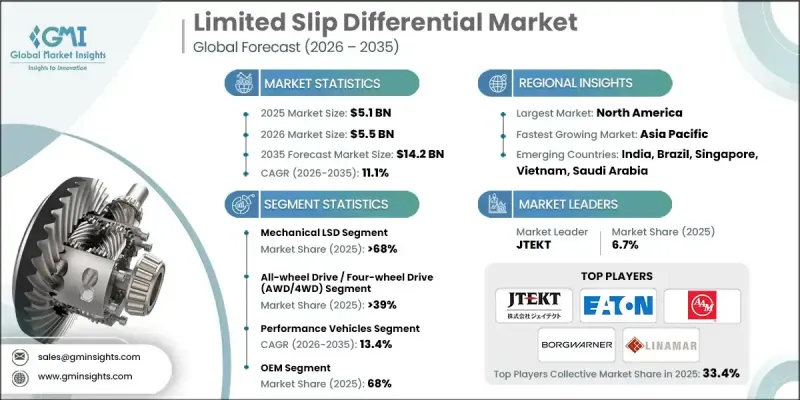
在消費者對車輛穩定性、牽引力控制和操控一致性的日益成長的需求推動下,限滑差速器正逐漸成為傳動系統的核心部件。這些系統擴大與電子穩定控制系統(ESC)配合使用,以提升各類車輛的整體駕駛性能和安全性。此外,消費者對高性能駕駛特性的日益關注也推動了市場需求,這種關注正在影響著除特殊用途之外的更廣泛的消費者偏好。設計工程、材料科學和精密製造技術的不斷進步,使得差速器系統更加緊湊、高效,並具備更高的扭力管理能力。向電氣化動力傳動系統的轉型正在加速電子控制限滑差速器的應用,因為這些系統能夠最佳化扭力分配、提高能量利用率並增強車輛動態性能。同時,全球對實用型車輛的需求不斷成長,也推動了對能夠支援穩定牽引力的先進傳動系統解決方案的需求。這些因素共同推動著全球大眾市場和豪華車市場的持續成長。
| 市場覆蓋範圍 | |
|---|---|
| 開始年份 | 2025 |
| 預測年份 | 2026-2035 |
| 起始值 | 51億美元 |
| 預測金額 | 142億美元 |
| 複合年成長率 | 11.1% |
2025年,機械式限滑差速器市佔率佔比達68%,預計到2035年將達到91億美元。由於其耐用性、成本效益以及無需電子元件即可實現的可靠性能,這些系統持續廣泛應用。內部設計和摩擦材料的不斷改進提高了扭矩傳遞效率並延長了使用壽命,從而推動了多個車型類別和地理市場的強勁需求。
預計2026年至2035年,高性能汽車市場將以13.4%的複合年成長率成長。汽車製造商正日益將電子和機械式限滑差速器結合,以提升車輛的操控性、加速性和動態控制性能。扭矩管理技術的進步正推動其在高階和特殊汽車平臺上的應用,從而增強該細分市場的長期需求。
預計到 2025 年,美國限滑差速器市場規模將達到 7.916 億美元。由於重型汽車平臺的持續生產以及整車製造商不斷專注於提升車輛在各種駕駛條件下的性能、穩定性和牽引力的傳動系統,預計國內需求將保持強勁。
目錄
第1章調查方法
第2章執行摘要
第3章業界考察
- 生態系分析
- 供應商情況
- 利潤率分析
- 成本結構
- 每個階段的附加價值
- 影響價值鏈的因素
- 中斷
- 產業影響因素
- 促進要素
- 對車輛安全性和牽引力的要求日益提高
- SUV和跨界車市場快速成長
- 電動車和混合動力汽車的興起
- 高性能和賽車運動車輛的成長
- 傳動系統和材料技術的進步
- 產業潛在風險與挑戰
- 高昂的系統和整合成本
- 來自替代驅動技術的競爭
- 市場機遇
- 新興市場對全輪驅動技術的採用率不斷提高
- OEM廠商向電子LSD平台的過渡
- 售後性能與越野升級
- 商用和特種車輛應用
- 成長潛力分析
- 監管環境
- 北美洲
- SAE J328 車橋和傳動系統零件性能要求
- 加拿大 - SAE J328 車橋和傳動系統零件性能要求
- 歐洲
- 英國- 聯合國歐洲經濟委員會第13號法規 車輛煞車與穩定系統
- 德國 - ISO 26262 道路車輛電氣和電子系統功能安全
- 法國 - 聯合國歐洲經濟委員會第79號法規 轉向與車輛控制系統
- 義大利 -差速器製造的 ISO 9001 品質管理體系
- 西班牙 - ISO 14001 環境管理系統(差異化生產)
- 亞太地區
- 中國GB/T汽車差速器傳動系統與車橋性能標準
- 日本 - ISO 26262 道路車輛電氣和電子系統功能安全
- 印度-AIS汽車行業標準(車軸和差速器)
- 拉丁美洲
- 巴西-ABNT NBR汽車傳動系統性能標準
- 墨西哥-NOM汽車零件性能和安全標準
- 阿根廷 - 汽車零件 ISO 9001 品質管理體系
- 中東和非洲
- 阿拉伯聯合大公國 - 聯合國歐洲經濟委員會第13號法規 車輛煞車與穩定系統
- 南非 - ISO 26262 道路車輛電氣和電子系統功能安全
- 沙烏地阿拉伯-SASO汽車技術法規(傳動系統)
- 北美洲
- 波特五力分析
- PESTEL 分析
- 技術與創新展望
- 當前技術趨勢
- 新興技術
- 生產統計
- 生產基地
- 消費中心
- 出口和進口
- 成本細分分析
- 開發成本結構
- 研發成本分析
- 行銷和銷售成本
- 專利分析
- 永續性和環境方面
- 永續努力
- 減少廢棄物策略
- 生產中的能源效率
- 環保舉措
- 未來市場展望與機遇
- 競爭基準分析:LSD 與替代技術
- LSD 與開式差速鎖定的效能比較
- 限滑差速器 (LSD) 與電子牽引力控制系統 (ETC) 的比較
- 限滑差速器與扭力向量控制系統的比較
- OEM決策權衡:成本、複雜性和效能
- LSD與車輛動力學控制系統的整合
- 電動車 (EV) 和電力驅動橋相容性分析
- 機械式限滑差速器在電動車架構中的重要性
- 將電子限滑差速器與電驅動橋和電驅動單元整合
- 電動車中限滑差速器與馬達扭力向量控制的比較
- 未來對純電動車、油電混合車和插電式混合動力車的需求預測
第4章 競爭情勢
- 介紹
- 公司市佔率分析
- 北美洲
- 歐洲
- 亞太地區
- 拉丁美洲
- 中東和非洲
- 主要市場公司的競爭分析
- 競爭定位矩陣
- 戰略展望矩陣
- 重大進展
- 併購
- 夥伴關係與合作
- 新產品發布
- 企業擴張計畫和資金籌措
第5章 2022-2035年按產品分類的市場估算與預測
- 機械式LSD
- 電子迷幻藥
- 托森型LSD
第6章 依車輛類型分類的市場估計與預測,2022-2035年
- 搭乘用車
- SUV
- 轎車
- 掀背車
- 商用車輛
- 輕型商用車(LCV)
- MCV
- 重型商用車(HCV)
第7章 按驅動類型分類的市場估算與預測,2022-2035年
- 前輪驅動(FWD)
- 後輪驅動(RWD)
- 全輪驅動/四輪驅動(AWD/4WD)
第8章 按應用領域分類的市場估算與預測,2022-2035年
- 高性能車輛
- 越野車
- 搭乘用車
- 其他
第9章 依銷售管道分類的市場估計與預測,2022-2035年
- OEM
- 售後市場
第10章 2022-2035年各地區市場估計與預測
- 北美洲
- 美國
- 加拿大
- 歐洲
- 德國
- 英國
- 法國
- 義大利
- 西班牙
- 俄羅斯
- 北歐國家
- 葡萄牙
- 克羅埃西亞
- 比荷盧經濟聯盟
- 亞太地區
- 中國
- 印度
- 日本
- 澳洲
- 韓國
- 新加坡
- 泰國
- 印尼
- 越南
- 拉丁美洲
- 巴西
- 墨西哥
- 阿根廷
- 哥倫比亞
- 中東和非洲
- 南非
- 沙烏地阿拉伯
- 阿拉伯聯合大公國
- 土耳其
第11章 公司簡介
- 世界玩家
- Aisin Seiki
- American Axle &Manufacturing
- BorgWarner
- Dana
- Eaton
- GKN Automotive
- JTEKT
- Linamar
- Schaeffler
- ZF Friedrichshafen
- 本地製造商
- Auburn Gear
- Drexler Automotive
- Kaaz
- OS Giken
- RT Quaife Engineering
- Truetrac Limited Slip
- Yukon Gear &Axle
- ARB
- Torsen
- Emerging/Disruptor Players
- Carrosser
- CUSCO Japan
- Powertrax
- Wavetrac Differentials
- OS Giken Motorsport Division
- Xtrac
- MFactory
- Motive Gear
The Global Limited Slip Differential Market was valued at USD 5.1 billion in 2025 and is estimated to grow at a CAGR of 11.1% to reach USD 14.2 billion by 2035.
Rising expectations for vehicle stability, traction management, and consistent handling performance are positioning limited slip differentials as a core drivetrain component. These systems are increasingly used alongside electronic stability solutions to improve overall drivability and safety across a wide range of vehicle categories. Demand is also supported by growing interest in performance-oriented driving characteristics, which has influenced broader consumer preferences beyond specialized applications. Ongoing advancements in design engineering, materials science, and precision manufacturing are enabling more compact and efficient differential systems with higher torque management capability. The growing shift toward electrified powertrains is accelerating the adoption of electronically controlled limited slip differentials, as these systems support optimized torque delivery, improved energy utilization, and enhanced vehicle dynamics. In parallel, rising global demand for utility-focused vehicles is strengthening the need for advanced driveline solutions that support traction consistency and stability. These combined factors continue to drive sustained growth across both mainstream and premium automotive segments worldwide.
| Market Scope | |
|---|---|
| Start Year | 2025 |
| Forecast Year | 2026-2035 |
| Start Value | $5.1 Billion |
| Forecast Value | $14.2 Billion |
| CAGR | 11.1% |
In 2025, the mechanical limited slip differentials segment accounted for 68% share and is projected to reach USD 9.1 billion by 2035. These systems remain widely adopted due to their durability, cost efficiency, and reliable performance without reliance on electronic components. Continuous improvements in internal design and friction materials are enhancing torque transfer efficiency and extending service life, ensuring strong demand across multiple vehicle categories and regional markets.
The performance vehicle segment is expected to grow at a CAGR of 13.4% during 2026-2035. Automakers are increasingly integrating both electronic and mechanical limited slip differentials to support enhanced handling, acceleration, and dynamic control. Advances in torque management technologies are expanding adoption across high-value and specialized vehicle platforms, reinforcing long-term demand within this segment.
US Limited Slip Differential Market reached USD 791.6 million in 2025. Strong domestic demand is driven by sustained production of larger vehicle platforms and continued OEM focus on driveline systems that enhance capability, stability, and traction across diverse operating conditions.
Key companies active in the Global Limited Slip Differential Market include ZF Friedrichshafen, Dana, BorgWarner, Eaton, GKN Automotive, Aisin Seiki, JTEKT, American Axle & Manufacturing, Linamar, and Auburn Gear. Companies operating in the Global Limited Slip Differential Market are reinforcing their competitive position through continuous product innovation and investment in advanced driveline technologies. Manufacturers are focusing on lightweight materials, compact designs, and improved torque management to meet evolving OEM requirements. Strategic collaborations with vehicle manufacturers are enabling early integration of next-generation differential systems into new platforms. Many players are expanding electronic and hybrid LSD offerings to align with the growing electrification trend. Global footprint expansion through localized manufacturing and supply chain optimization is improving responsiveness to regional demand.
Table of Contents
Chapter 1 Methodology
- 1.1 Research approach
- 1.2 Quality commitments
- 1.2.1 GMI AI policy & data integrity commitment
- 1.3 Research trail & confidence scoring
- 1.3.1 Research trail components
- 1.3.2 Scoring components
- 1.4 Data collection
- 1.4.1 Partial list of primary sources
- 1.5 Data mining sources
- 1.5.1 Paid sources
- 1.6 Base estimates and calculations
- 1.6.1 Base year calculation
- 1.7 Forecast
- 1.8 Research transparency addendum
Chapter 2 Executive Summary
- 2.1 Industry 360° synopsis, 2022 - 2035
- 2.2 Key market trends
- 2.2.1 Regional
- 2.2.2 Product
- 2.2.3 Drive
- 2.2.4 Vehicle
- 2.2.5 Application
- 2.2.6 Sales channel
- 2.3 TAM Analysis, 2026-2035
- 2.4 CXO perspectives: Strategic imperatives
- 2.4.1 Executive decision points
- 2.4.2 Critical success factors
- 2.5 Future outlook & strategic recommendations
Chapter 3 Industry Insights
- 3.1 Industry ecosystem analysis
- 3.1.1 Supplier landscape
- 3.1.2 Profit margin analysis
- 3.1.3 Cost structure
- 3.1.4 Value addition at each stage
- 3.1.5 Factor affecting the value chain
- 3.1.6 Disruptions
- 3.2 Industry impact forces
- 3.2.1.1 Growth drivers
- 3.2.1.2 Rising demand for vehicle safety and traction
- 3.2.1.3 Rapid growth of SUV and crossover segments
- 3.2.1.4 Expansion of electric and hybrid vehicles
- 3.2.1.5 Growth of performance and motorsports vehicles
- 3.2.1.6 Advancements in driveline and materials technology
- 3.2.2 Industry pitfalls and challenges
- 3.2.2.1 High system and integration costs
- 3.2.2.2 Competition from alternative traction technologies
- 3.2.3 Market opportunities
- 3.2.3.1 Rising AWD adoption in emerging markets
- 3.2.3.2 OEM shift toward electronic LSD platforms
- 3.2.3.3 Aftermarket performance and off-road upgrades
- 3.2.3.4 Commercial and specialty vehicle applications
- 3.3 Growth potential analysis
- 3.4 Regulatory landscape
- 3.4.1 North America
- 3.4.1.1 United States - SAE J328 Axle and Driveline Component Performance Requirements
- 3.4.1.2 Canada - SAE J328 Axle and Driveline Component Performance Requirements
- 3.4.2 Europe
- 3.4.2.1 United Kingdom - UNECE Regulation No. 13 Vehicle Braking and Stability Systems
- 3.4.2.2 Germany - ISO 26262 Functional Safety of Electrical and Electronic Systems in Road Vehicles
- 3.4.2.3 France - UNECE Regulation No. 79 Steering and Vehicle Control Systems
- 3.4.2.4 Italy - ISO 9001 Quality Management Systems for Differential Manufacturing
- 3.4.2.5 Spain - ISO 14001 Environmental Management Systems for Differential Production
- 3.4.3 Asia Pacific
- 3.4.3.1 China - GB/T Driveline and Axle Performance Standards for Automotive Differentials
- 3.4.3.2 Japan - ISO 26262 Functional Safety of Electrical and Electronic Systems in Road Vehicles
- 3.4.3.3 India - AIS Automotive Industry Standards for Axles and Differentials
- 3.4.4 Latin America
- 3.4.4.1 Brazil - ABNT NBR Automotive Driveline Performance Standards
- 3.4.4.2 Mexico - NOM Automotive Component Performance and Safety Standards
- 3.4.4.3 Argentina - ISO 9001 Quality Management Systems for Automotive Components
- 3.4.5 Middle East & Africa
- 3.4.5.1 United Arab Emirates - UNECE Regulation No. 13 Vehicle Braking and Stability Systems
- 3.4.5.2 South Africa - ISO 26262 Functional Safety of Electrical and Electronic Systems in Road Vehicles
- 3.4.5.3 Saudi Arabia - SASO Automotive Technical Regulations for Driveline Systems
- 3.4.1 North America
- 3.5 Porter's analysis
- 3.6 PESTEL analysis
- 3.7 Technology and innovation landscape
- 3.7.1 Current technological trends
- 3.7.2 Emerging technologies
- 3.8 Production statistics
- 3.8.1 Production hubs
- 3.8.2 Consumption hubs
- 3.8.3 Export and import
- 3.9 Cost breakdown analysis
- 3.9.1 Development cost structure
- 3.9.2 R&D cost analysis
- 3.9.3 Marketing & sales costs
- 3.10 Patent analysis
- 3.11 Sustainability and environmental aspects
- 3.11.1 Sustainable practices
- 3.11.2 Waste reduction strategies
- 3.11.3 Energy efficiency in production
- 3.11.4 Eco-friendly Initiatives
- 3.12 Future market outlook & opportunities
- 3.13 Competitive technology benchmarking: LSD vs alternatives
- 3.13.1 LSD vs open differential performance comparison
- 3.13.2 LSD vs electronic traction control systems (ETC)
- 3.13.3 LSD vs torque vectoring systems
- 3.13.4 OEM decision trade-offs: cost, complexity, performance
- 3.14 LSD integration with vehicle dynamics systems
- 3.15 Electric Vehicle & e-Axle Compatibility Analysis
- 3.15.1 Mechanical LSD relevance in EV architectures
- 3.15.2 e-LSD integration with e-axles and electric drive units
- 3.15.3 LSD vs motor-based torque vectoring in EVs
- 3.15.4 Future demand outlook across BEV, HEV, PHEV
Chapter 4 Competitive Landscape, 2025
- 4.1 Introduction
- 4.2 Company market share analysis
- 4.2.1 North America
- 4.2.2 Europe
- 4.2.3 Asia Pacific
- 4.2.4 LATAM
- 4.2.5 MEA
- 4.3 Competitive analysis of major market players
- 4.4 Competitive positioning matrix
- 4.5 Strategic outlook matrix
- 4.6 Key developments
- 4.6.1 Mergers & acquisitions
- 4.6.2 Partnerships & collaborations
- 4.6.3 New Product Launches
- 4.6.4 Expansion Plans and funding
Chapter 5 Market Estimates & Forecast, By Product, 2022 - 2035 ($Bn, units)
- 5.1 Key trends
- 5.2 Mechanical LSD
- 5.3 Electronic LSD
- 5.4 Torsen LSD
Chapter 6 Market Estimates & Forecast, By Vehicle, 2022 - 2035 ($Bn, units)
- 6.1 Key trends
- 6.2 Passenger vehicle
- 6.2.1 SUV
- 6.2.2 Sedan
- 6.2.3 Hatchback
- 6.3 Commercial vehicle
- 6.3.1 LCV
- 6.3.2 MCV
- 6.3.3 HCV
Chapter 7 Market Estimates & Forecast, By Drive, 2022 - 2035 ($Bn, units)
- 7.1 Key trends
- 7.2 Front-Wheel Drive (FWD)
- 7.3 Rear-Wheel Drive (RWD)
- 7.4 All-Wheel Drive / Four-Wheel Drive (AWD/4WD)
Chapter 8 Market Estimates & Forecast, By Application, 2022 - 2035 ($Bn, units)
- 8.1 Key trends
- 8.2 Performance vehicles
- 8.3 Off-road vehicles
- 8.4 Passenger vehicles
- 8.5 Others
Chapter 9 Market Estimates & Forecast, By Sales Channel, 2022 - 2035 ($Bn, units)
- 9.1 Key trends
- 9.2 OEM
- 9.3 Aftermarket
Chapter 10 Market Estimates & Forecast, By Region, 2022 - 2035 ($Bn, units)
- 10.1 Key trends
- 10.2 North America
- 10.2.1 US
- 10.2.2 Canada
- 10.3 Europe
- 10.3.1 Germany
- 10.3.2 UK
- 10.3.3 France
- 10.3.4 Italy
- 10.3.5 Spain
- 10.3.6 Russia
- 10.3.7 Nordics
- 10.3.8 Portugal
- 10.3.9 Croatia
- 10.3.10 Benelux
- 10.4 Asia Pacific
- 10.4.1 China
- 10.4.2 India
- 10.4.3 Japan
- 10.4.4 Australia
- 10.4.5 South Korea
- 10.4.6 Singapore
- 10.4.7 Thailand
- 10.4.8 Indonesia
- 10.4.9 Vietnam
- 10.5 Latin America
- 10.5.1 Brazil
- 10.5.2 Mexico
- 10.5.3 Argentina
- 10.5.4 Colombia
- 10.6 MEA
- 10.6.1 South Africa
- 10.6.2 Saudi Arabia
- 10.6.3 UAE
- 10.6.4 Turkey
Chapter 11 Company Profiles
- 11.1 Global Players
- 11.1.1 Aisin Seiki
- 11.1.2 American Axle & Manufacturing
- 11.1.3 BorgWarner
- 11.1.4 Dana
- 11.1.5 Eaton
- 11.1.6 GKN Automotive
- 11.1.7 JTEKT
- 11.1.8 Linamar
- 11.1.9 Schaeffler
- 11.1.10 ZF Friedrichshafen
- 11.2 Regional Players
- 11.2.1 Auburn Gear
- 11.2.2 Drexler Automotive
- 11.2.3 Kaaz
- 11.2.4 OS Giken
- 11.2.5 RT Quaife Engineering
- 11.2.6 Truetrac Limited Slip
- 11.2.7 Yukon Gear & Axle
- 11.2.8 ARB
- 11.2.9 Torsen
- 11.3 Emerging / Disruptor Players
- 11.3.1 Carrosser
- 11.3.2 CUSCO Japan
- 11.3.3 Powertrax
- 11.3.4 Wavetrac Differentials
- 11.3.5 OS Giken Motorsport Division
- 11.3.6 Xtrac
- 11.3.7 MFactory
- 11.3.8 Motive Gear

 2026年全球電子限滑差速器市場報告2026年全球汽車齒輪市場報告
 齒輪、驅動裝置和變速箱市場:按產品類型、額定功率、功率轉速、最終用途行業和配銷通路分類的全球預測 - 2026 年至 2032 年齒輪傳動攪拌機市場(按攪拌機配置、額定功率、容量、速度、應用、最終用戶產業和分銷管道分類),全球預測,2026-2032年2026年全球變速箱、工業高速驅動器和齒輪市場報告
 卡車拖車起落架市場 - 全球產業規模、佔有率、趨勢、機會、預測:按類型、起重能力、銷售管道、地區和競爭格局分類,2021-2031年
 限滑差速器市場預測至2032年:按類型、車輛類型、推進系統、傳動系統、銷售管道、應用和地區分類的全球分析
 汽車齒輪市場規模、佔有率和成長分析(按產品類型、材質、車輛類型、應用和地區分類)-2026-2033年產業預測卡車起落架市場預測(至 2032 年):按類型、營運、負載能力、銷售管道、最終用戶和地區進行的全球分析
 全球限滑差速器市場