

 |
市場調查報告書
商品編碼
1913306
管理系統認證市場機會、成長要素、產業趨勢分析及預測(2026-2035年)Management System Certification Market Opportunity, Growth Drivers, Industry Trend Analysis, and Forecast 2026 - 2035 |
||||||

全球管理系統認證市場預計到 2025 年將達到 276 億美元,到 2035 年將達到 608 億美元,年複合成長率為 8.6%。
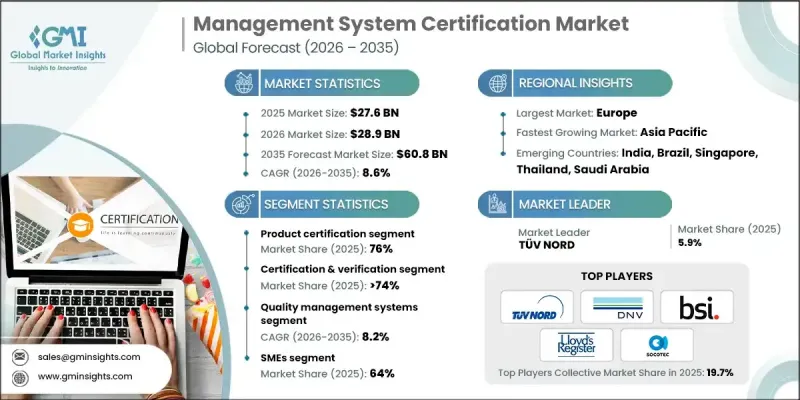
這一成長的驅動力來自日益成長的監管壓力、對品質和永續性的日益重視以及全球合規性的需求。企業尋求認證不僅是為了滿足監管要求,更是為了提升信譽、管理風險並在國際貿易中獲得競爭優勢。受監管產業的企業越來越要求供應商提供經認證的管理體系,以確保品質、安全性和可靠性。認證能夠增強市場進入、降低營運和法律風險、保障職場安全、保護資料並維護客戶信任。快速的數位轉型和日益嚴峻的網路威脅也在推動資訊安全和網路安全認證的需求。諸如基於區塊鏈的認證平台等創新技術簡化了認證數據的管理、檢驗和確認流程,從而實現了全球供應鏈的即時合規性保障。
| 市場覆蓋範圍 | |
|---|---|
| 開始年份 | 2025 |
| 預測年份 | 2026-2035 |
| 起始值 | 276億美元 |
| 預測金額 | 608億美元 |
| 複合年成長率 | 8.6% |
產品認證領域佔了76%的市場佔有率,預計2026年至2035年將以8.3%的複合年成長率成長。產品認證與永續性、可追溯性、績效基準和數位化合規工具的結合日益緊密,幫助企業實現產品差異化,並在滿足監管要求之外展現可衡量的價值。在出口導向和監管嚴格的市場中,對產品認證的需求特別強勁,因為這些市場需要透明度、安全保障和生命週期影響檢驗。
到2025年,認證和檢驗領域將佔市場規模(約205億美元)的74%。第三方認證和檢驗服務對於希望滿足監管要求、提高供應鏈可靠性並建立客戶信任的企業仍然至關重要。包括遠端和混合方法在內的技術賦能型審核,在保持合規性嚴謹性的同時,提高了檢驗服務的效率、擴充性和一致性。
預計2025年,美國管理體系認證市場規模將達92億美元。法律規範加大、網路安全風險日益增加以及ESG合規壓力是推動市場成長的主要因素。醫療保健、國防、科技和關鍵基礎設施等產業對第三方檢驗和合規保證的需求日益成長,因此這些產業對認證的需求也顯著增加。為了應對聯邦法規、資料隱私法以及企業、國防和雲端營運中不斷成長的網路威脅,資訊安全和網路安全認證正被各組織機構迅速採用。
目錄
第1章調查方法
第2章執行摘要
第3章業界考察
- 生態系分析
- 供應商情況
- 利潤率分析
- 成本結構
- 每個階段的附加價值
- 影響價值鏈的因素
- 中斷
- 產業影響因素
- 促進要素
- 監理合規要求
- 供應鏈資質認證壓力
- 網路安全和資料保護風險日益加劇
- 專注於營運效率和風險管理
- 人們越來越關注ESG和永續性。
- 產業潛在風險與挑戰
- 高昂的認證和審核成本
- 身份驗證過程的複雜性
- 市場機遇
- 為中小企業拓展身份驗證解決方案
- 綜合管理體系認證的發展
- 新興經濟體需求不斷成長
- 審核和遠端審核模式
- 成長潛力分析
- 監管環境
- 北美洲
- 美國- ISO 9001 品質管理體系
- 加拿大 - ISO 45001 職業健康與安全
- 歐洲
- 英國- ISO/IEC 27001資訊安全管理
- 德國 - ISO 50001 能源管理體系
- 法國 - ISO 45001 職業健康與安全
- 義大利 - ISO 14001 環境管理體系
- 西班牙 - ISO 22000 食品安全管理體系
- 亞太地區
- 中國-ISO/IEC 27001資訊安全管理體系
- 日本 - ISO 14001 環境管理體系
- 印度 - ISO 45001 職業健康與安全
- 拉丁美洲
- 巴西 - ISO 14001 環境管理體系
- 墨西哥 - ISO 45001 職業健康與安全
- 阿根廷 - ISO 14001 環境管理體系
- 中東和非洲
- 阿拉伯聯合大公國-ISO 14001環境管理體系
- 南非 - ISO 45001 職業健康與安全
- 沙烏地阿拉伯 - ISO 14001 環境管理體系
- 北美洲
- 波特五力分析
- PESTEL 分析
- 科技與創新趨勢
- 當前技術趨勢
- 新興技術
- 成本細分分析
- 開發成本結構
- 研發成本分析
- 行銷和銷售成本
- 專利分析
- 永續性和環境方面
- 永續實踐
- 減少廢棄物策略
- 生產中的能源效率
- 環保舉措
- 未來市場展望與機遇
- 認證和管治生態系統
- 認證機構(IAF、ANAB、UKAS、DAkkS、NABCB)的作用
- ISO、認可機構和認證機構之間的關係
- 認證政策對市場進入與定價的影響
- 買方決策和認證選擇標準
- 價格與品牌可靠性之間的權衡
- 認證認可的重要性
- 各行業的認證偏好
- 切換行為並使用多個憑證授權單位
- 認證生命週期和收入模式的發展趨勢
- 審核能力、素質與勞動力動態
第4章 競爭情勢
- 介紹
- 公司市佔率分析
- 北美洲
- 歐洲
- 亞太地區
- 拉丁美洲
- 中東和非洲
- 主要市場公司的競爭分析
- 競爭定位矩陣
- 戰略展望矩陣
- 重大進展
- 併購
- 夥伴關係與合作
- 新產品發布
- 企業擴張計畫和資金籌措
第5章 依認證類型分類的市場估算與預測,2022-2035年
- 產品認證
- 系統認證
第6章 依服務分類的市場估計與預測,2022-2035年
- 身份驗證和檢驗
- 培訓及業務保障
第7章 依公司規模分類的市場估計與預測,2022-2035年
- 小型企業
- 主要企業
第8章 按應用領域分類的市場估算與預測,2022-2035年
- 品質管理體系
- 職業安全與健康
- 網路安全
- 資訊安全
- 食品安全
- 環境管理
- 其他
第9章 2022-2035年各產業市場估算與預測
- 航太/國防
- 汽車/運輸設備
- 建設業
- 消費品和零售
- 能源與公共產業
- 醫學與生命科學
- 資訊科技與通訊
- 製造業
- 其他
第10章 2022-2035年各地區市場估計與預測
- 北美洲
- 美國
- 加拿大
- 歐洲
- 德國
- 英國
- 法國
- 義大利
- 西班牙
- 俄羅斯
- 北歐國家
- 葡萄牙
- 克羅埃西亞
- 比荷盧經濟聯盟
- 亞太地區
- 中國
- 印度
- 日本
- 澳洲
- 韓國
- 新加坡
- 泰國
- 印尼
- 越南
- 拉丁美洲
- 巴西
- 墨西哥
- 阿根廷
- 哥倫比亞
- 中東和非洲
- 南非
- 沙烏地阿拉伯
- 阿拉伯聯合大公國
- 土耳其
第11章 公司簡介
- 世界玩家
- TUV NORD
- DNV
- The British Standards Institution BSI
- Lloyd's Register Group Services
- RINA
- ASTM
- SGS
- Bureau Veritas
- Intertek
- TUV Rheinland
- DEKRA
- UL
- Applus+
- 區域玩家
- Holding Socotec
- DQS
- IMQ
- IRCLASS
- SIS Certifications
- LL-C Certification
- GCL International
- Aurion International
- AL BORJ Facility Management
- Emerging/Disruptor Players
- Drata
- Vanta
- Bluestar Management Systems
- Finecert
The Global Management System Certification Market was valued at USD 27.6 billion in 2025 and is estimated to grow at a CAGR of 8.6% to reach USD 60.8 billion by 2035.
Growth is fueled by rising regulatory pressures, increasing focus on quality, sustainability, and the need for global compliance. Companies pursue certification not only to meet regulatory mandates but also to enhance credibility, manage risk, and gain a competitive edge in international trade. Organizations operating in regulated industries increasingly require certified management systems from suppliers to assure quality, safety, and reliability. Certification strengthens market access, reduces operational and legal risks, ensures workplace safety, protects data, and maintains customer trust. Rapid digital transformation and rising cyber threats are also driving demand for information security and cybersecurity certifications. Innovations such as blockchain-enabled certification platforms are streamlining the management, verification, and validation of certification data, enabling real-time compliance assurance across global supply chains.
| Market Scope | |
|---|---|
| Start Year | 2025 |
| Forecast Year | 2026-2035 |
| Start Value | $27.6 Billion |
| Forecast Value | $60.8 Billion |
| CAGR | 8.6% |
The product certification segment held a 76% share and is expected to grow at a CAGR of 8.3% from 2026 to 2035. Product certifications are increasingly aligned with sustainability, traceability, performance benchmarks, and digital compliance tools, helping organizations differentiate their offerings while demonstrating measurable value beyond regulatory requirements. Demand is particularly strong in export-oriented and regulated markets that require transparency, safety assurances, and lifecycle impact validation.
The certification & verification segment accounted for 74% share in 2025, valued at around USD 20.5 billion. Third-party certification and verification services remain critical for companies seeking to satisfy regulatory requirements, enhance supply chain credibility, and build customer confidence. Technology-enabled audits, including remote and hybrid approaches, are enhancing the efficiency, scalability, and consistency of verification services while maintaining compliance rigor.
U.S. Management System Certification Market was valued at USD 9.2 billion in 2025. Growth is driven by regulatory oversight, increasing cybersecurity risks, and ESG compliance pressures. Adoption is strong in healthcare, defense, technology, and critical infrastructure sectors, where third-party validation and compliance assurance are essential. Information security and cybersecurity certifications are experiencing rapid uptake as organizations respond to federal regulations, data privacy laws, and escalating cyber threats across enterprise, defense, and cloud-based operations.
Key players in the Global Management System Certification Market include DNV, TUV NORD, Lloyd's Register Group Services, The British Standards Institution, Holding Socotec, DQS, RINA, Drata, and SIS Certifications. Companies in the Management System Certification Market are leveraging multiple strategies to expand their market presence. They are investing in technology-driven audit solutions, including remote and hybrid verification platforms, to increase efficiency and scalability. Expanding service portfolios to include cybersecurity, ESG, and sustainability certifications helps cater to evolving regulatory and corporate governance needs. Strategic partnerships with industry associations, technology providers, and multinational enterprises strengthen client acquisition and retention. Firms are enhancing digital platforms for real-time certificate management, data analytics, and compliance reporting.
Table of Contents
Chapter 1 Methodology
- 1.1 Market scope and definition
- 1.2 Research design
- 1.2.1 Research approach
- 1.2.2 Data collection methods
- 1.3 Data mining sources
- 1.3.1 Global
- 1.3.2 Regional/Country
- 1.4 Base estimates and calculations
- 1.4.1 Base year calculation
- 1.4.2 Key trends for market estimation
- 1.5 Primary research and validation
- 1.5.1 Primary sources
- 1.6 Forecast
- 1.7 Research assumptions and limitations
Chapter 2 Executive Summary
- 2.1 Industry 360° synopsis, 2022 - 2035
- 2.2 Key market trends
- 2.2.1 Regional
- 2.2.2 Certification
- 2.2.3 Service
- 2.2.4 Organization size
- 2.2.5 Application
- 2.2.6 Industry vertical
- 2.3 TAM Analysis, 2026-2035
- 2.4 CXO perspectives: Strategic imperatives
- 2.4.1 Executive decision points
- 2.4.2 Critical success factors
- 2.5 Future outlook & strategic recommendations
Chapter 3 Industry Insights
- 3.1 Industry ecosystem analysis
- 3.1.1 Supplier landscape
- 3.1.2 Profit margin analysis
- 3.1.3 Cost structure
- 3.1.4 Value addition at each stage
- 3.1.5 Factor affecting the value chain
- 3.1.6 Disruptions
- 3.2 Industry impact forces
- 3.2.1.1 Growth drivers
- 3.2.1.2 Regulatory compliance requirements
- 3.2.1.3 Supply chain qualification pressure
- 3.2.1.4 Rising cybersecurity and data protection risks
- 3.2.1.5 Focus on operational efficiency and risk management
- 3.2.1.6 Growing emphasis on ESG and sustainability
- 3.2.2 Industry pitfalls and challenges
- 3.2.2.1 High certification and audit costs
- 3.2.2.2 Complexity of certification processes
- 3.2.3 Market opportunities
- 3.2.3.1 Expansion of SME-focused certification solutions
- 3.2.3.2 Growth of integrated management system certifications
- 3.2.3.3 Rising demand in emerging economies
- 3.2.3.4 Digital and remote auditing models
- 3.3 Growth potential analysis
- 3.4 Regulatory landscape
- 3.4.1 North America
- 3.4.1.1 U.S. - ISO 9001 Quality Management Systems
- 3.4.1.2 Canada - ISO 45001 Occupational Health and Safety
- 3.4.2 Europe
- 3.4.2.1 UK - ISO/IEC 27001 Information Security Management
- 3.4.2.2 Germany - ISO 50001 Energy Management Systems
- 3.4.2.3 France - ISO 45001 Occupational Health and Safety
- 3.4.2.4 Italy - ISO 14001 Environmental Management Systems
- 3.4.2.5 Spain - ISO 22000 Food Safety Management Systems
- 3.4.3 Asia Pacific
- 3.4.3.1 China - ISO/IEC 27001 Information Security Management
- 3.4.3.2 Japan - ISO 14001 Environmental Management Systems
- 3.4.3.3 India - ISO 45001 Occupational Health and Safety
- 3.4.4 Latin America
- 3.4.4.1 Brazil - ISO 14001 Environmental Management Systems
- 3.4.4.2 Mexico - ISO 45001 Occupational Health and Safety
- 3.4.4.3 Argentina - ISO 14001 Environmental Management Systems
- 3.4.5 Middle East & Africa
- 3.4.5.1 UAE - ISO 14001 Environmental Management Systems
- 3.4.5.2 South Africa - ISO 45001 Occupational Health and Safety
- 3.4.5.3 Saudi Arabia - ISO 14001 Environmental Management Systems
- 3.4.1 North America
- 3.5 Porter's analysis
- 3.6 PESTEL analysis
- 3.7 Technology and innovation landscape
- 3.7.1 Current technological trends
- 3.7.2 Emerging technologies
- 3.8 Cost breakdown analysis
- 3.8.1 Development cost structure
- 3.8.2 R&D cost analysis
- 3.8.3 Marketing & sales costs
- 3.9 Patent analysis
- 3.10 Sustainability and environmental aspects
- 3.10.1 Sustainable practices
- 3.10.2 Waste reduction strategies
- 3.10.3 Energy efficiency in production
- 3.10.4 Eco-friendly Initiatives
- 3.11 Future market outlook & opportunities
- 3.12 Accreditation & governance ecosystem
- 3.12.1 Role of accreditation bodies (IAF, ANAB, UKAS, DAkkS, NABCB)
- 3.12.2 Relationship between ISO, accreditation bodies & certification bodies
- 3.12.3 Impact of accreditation policies on market access and pricing
- 3.13 Buyer decision-making & certification selection criteria
- 3.13.1 Price vs brand credibility trade-offs
- 3.13.2 Importance of accreditation recognition
- 3.13.3 Industry-specific certification preferences
- 3.13.4 Switching behavior and multi-certifier usage
- 3.14 Certification lifecycle & revenue model dynamics
- 3.15 Auditor capacity, competency & workforce dynamics
Chapter 4 Competitive Landscape, 2025
- 4.1 Introduction
- 4.2 Company market share analysis
- 4.2.1 North America
- 4.2.2 Europe
- 4.2.3 Asia Pacific
- 4.2.4 LATAM
- 4.2.5 MEA
- 4.3 Competitive analysis of major market players
- 4.4 Competitive positioning matrix
- 4.5 Strategic outlook matrix
- 4.6 Key developments
- 4.6.1 Mergers & acquisitions
- 4.6.2 Partnerships & collaborations
- 4.6.3 New Product Launches
- 4.6.4 Expansion Plans and funding
Chapter 5 Market Estimates & Forecast, By Certification, 2022 - 2035 ($Bn)
- 5.1 Key trends
- 5.2 Product certification
- 5.3 System certification
Chapter 6 Market Estimates & Forecast, By Service, 2022 - 2035 ($Bn)
- 6.1 Key trends
- 6.2 Certification & Verification
- 6.3 Training & Business Assurance
Chapter 7 Market Estimates & Forecast, By Organization size, 2022 - 2035 ($Bn)
- 7.1 Key trends
- 7.2 SMEs
- 7.3 Large Enterprises
Chapter 8 Market Estimates & Forecast, By Application, 2022 - 2035 ($Bn)
- 8.1 Key trends
- 8.2 Quality Management Systems
- 8.3 Occupational Health and Safety
- 8.4 Cyber Security
- 8.5 Information Security
- 8.6 Food Safety
- 8.7 Environmental Management
- 8.8 Others
Chapter 9 Market Estimates & Forecast, By Industry vertical, 2022 - 2035 ($Bn)
- 9.1 Key trends
- 9.2 Aerospace & Defense
- 9.3 Automotive & Transportation
- 9.4 Construction
- 9.5 Consumer Goods & Retail
- 9.6 Energy & Utilities
- 9.7 Healthcare & Life Sciences
- 9.8 Information Technology & Telecommunication
- 9.9 Manufacturing
- 9.10 Others
Chapter 10 Market Estimates & Forecast, By Region, 2022 - 2035 ($Bn)
- 10.1 Key trends
- 10.2 North America
- 10.2.1 US
- 10.2.2 Canada
- 10.3 Europe
- 10.3.1 Germany
- 10.3.2 UK
- 10.3.3 France
- 10.3.4 Italy
- 10.3.5 Spain
- 10.3.6 Russia
- 10.3.7 Nordics
- 10.3.8 Portugal
- 10.3.9 Croatia
- 10.3.10 Benelux
- 10.4 Asia Pacific
- 10.4.1 China
- 10.4.2 India
- 10.4.3 Japan
- 10.4.4 Australia
- 10.4.5 South Korea
- 10.4.6 Singapore
- 10.4.7 Thailand
- 10.4.8 Indonesia
- 10.4.9 Vietnam
- 10.5 Latin America
- 10.5.1 Brazil
- 10.5.2 Mexico
- 10.5.3 Argentina
- 10.5.4 Colombia
- 10.6 MEA
- 10.6.1 South Africa
- 10.6.2 Saudi Arabia
- 10.6.3 UAE
- 10.6.4 Turkey
Chapter 11 Company Profiles
- 11.1 Global Players
- 11.1.1 TUV NORD
- 11.1.2 DNV
- 11.1.3 The British Standards Institution BSI
- 11.1.4 Lloyd's Register Group Services
- 11.1.5 RINA
- 11.1.6 ASTM
- 11.1.7 SGS
- 11.1.8 Bureau Veritas
- 11.1.9 Intertek
- 11.1.10 TUV Rheinland
- 11.1.11 DEKRA
- 11.1.12 UL
- 11.1.13 Applus+
- 11.2 Regional Players
- 11.2.1 Holding Socotec
- 11.2.2 DQS
- 11.2.3 IMQ
- 11.2.4 IRCLASS
- 11.2.5 SIS Certifications
- 11.2.6 LL-C Certification
- 11.2.7 GCL International
- 11.2.8 Aurion International
- 11.2.9 AL BORJ Facility Management
- 11.3 Emerging / Disruptor Players
- 11.3.1 Drata
- 11.3.2 Vanta
- 11.3.3 Bluestar Management Systems
- 11.3.4 Finecert

 管理體系認證市場-2026-2032年全球市場預測
 管理系統認證市場規模、佔有率和成長分析:依認證類型、服務類型、企業規模、最終用戶產業、認證機構類型、部署方式和地區分類-2026-2033年產業預測
 管理系統認證市場規模、佔有率和趨勢分析報告:按認證類型、行業、公司規模、地區和細分市場預測(2026-2033 年)
 管理系統認證市場分析及預測(至2035年):類型、產品類型、技術、組件、應用、流程、部署模式、最終用戶、解決方案
 2026年全球管理體系認證市場報告
 管理系統認證市場規模、佔有率、成長及全球產業分析:按類型、應用和地區分類,並預測至2026-2034年
 全球管理體系認證市場
 全球管理系統認證市場:品管、環境管理、職業健康與安全、資訊安全、IT與通訊、消費品與零售、醫療保健與生命科學-預測至2030年