


 |
市場調查報告書
商品編碼
1892885
農機市場機會、成長促進因素、產業趨勢分析及預測(2026-2035年)Farm Equipment Market Opportunity, Growth Drivers, Industry Trend Analysis, and Forecast 2026 - 2035 |
||||||

2025年全球農業設備市場價值為1,869億美元,預計到2035年將以6.5%的複合年成長率成長至3,509億美元。
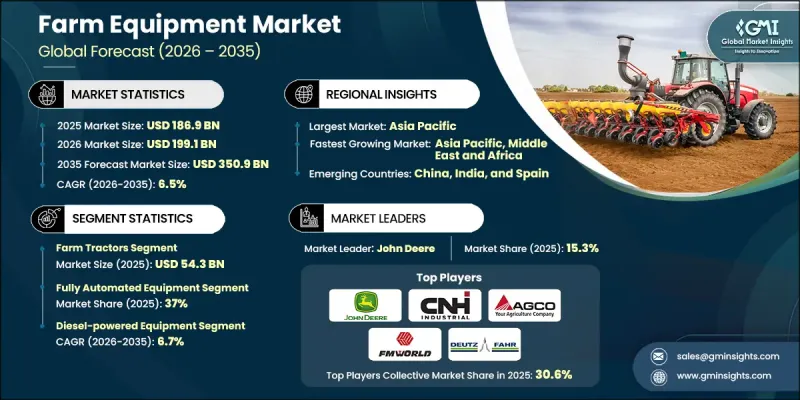
這一穩步成長勢頭反映了現代農業的快速發展,而現代農業的變革正受到機械化、不斷成長的糧食需求和技術突破的推動。市場涵蓋了種類繁多的工具和機械,旨在提高農業生產力,減少對勞動力的依賴,並簡化作物種植、畜牧管理和園藝等各個環節的作業流程。設備種類繁多,從傳統的曳引機和聯合收割機到由感測器、人工智慧和導航技術驅動的新一代自動化系統,應有盡有。精準農業解決方案,包括配備GPS的機械、先進的感測器和無人機,正在透過提高投入利用率和支援數據驅動決策,重塑田間管理模式。這些技術支援變數施肥、即時監測和最佳化資源配置,幫助農民在提高產量的同時,降低15-20%的投入成本。發展中地區對永續農業的日益重視和機械化程度的不斷提高,持續推動農業產業的擴張。
| 市場範圍 | |
|---|---|
| 起始年份 | 2025 |
| 預測年份 | 2026-2035 |
| 起始值 | 1869億美元 |
| 預測值 | 3509億美元 |
| 複合年成長率 | 6.5% |
2024年,農用曳引機市場規模達543億美元,預計2025年至2034年間將以5.3%的複合年成長率成長。小型和多用途曳引機的需求仍然強勁,尤其是在中小農場。旨在促進農業現代化的財政激勵和補貼政策進一步提高了此類曳引機的普及率。
預計到2035年,柴油動力設備市場將以6.7%的複合年成長率成長。柴油機械因其耐用性、在高負荷下仍能保持穩定運行以及廣泛的可用性而繼續受到青睞。然而,不斷上漲的燃油價格和日益嚴格的排放法規正促使製造商提高效率並開發更清潔的替代方案。
美國農機市場佔80%的市場佔有率,預計2025年市場規模將達206億美元。美國市場受益於技術的快速發展、精準農業的廣泛應用以及對能夠勝任各種農場作業的高性能機械日益成長的需求。人們對減少收穫後損失和提高作業效率的意識不斷增強,推動了收割機械市場的成長;同時,對永續水資源管理的日益重視也促進了對先進灌溉系統的需求。
目錄
第1章:方法論與範圍
第2章:執行概要
第3章:行業洞察
- 產業生態系分析
- 供應商格局
- 利潤率
- 每個階段的價值增加
- 影響價值鏈的因素
- 產業影響因素
- 成長促進因素
- 產業陷阱與挑戰
- 機會
- 成長潛力分析
- 未來市場趨勢
- 技術與創新格局
- 當前技術趨勢
- 新興技術
- 價格趨勢
- 按地區
- 依設備類型
- 監管環境
- 標準和合規要求
- 區域監理框架
- 認證標準
- 貿易統計
- 主要進口國
- 主要出口國
- 波特的分析
- PESTEL 分析
第4章:競爭格局
- 介紹
- 公司市佔率分析
- 按地區
- 公司矩陣分析
- 主要市場參與者的競爭分析
- 競爭定位矩陣
- 關鍵進展
- 併購
- 合作夥伴關係與合作
- 新產品發布
- 擴張計劃
第5章:市場估算與預測:依設備類型分類,2022-2035年
- 農用曳引機
- 四輪驅動(4WD)曳引機
- 行栽曳引機
- 多用途曳引機
- 小型多用途曳引機
- 收割機械
- 聯合收割機
- 割草機/割曬機
- 飼料收割機
- 乾草收割機械
- 割草機
- 翻曬乾草的人
- 種植和施肥
- 耕作
- 其他(灌溉設備等)
第6章:市場估算與預測:依營運模式分類,2022-2035年
- 手動設備
- 半自動化設備
- 全自動設備
第7章:市場估算與預測:依電源類型分類,2022-2035年
- 柴油動力設備
- 電動和混合動力設備
- 替代燃料
第8章:市場估算與預測:依應用領域分類,2022-2035年
- 作物生產應用
- 耕作與土壤健康管理
- 種植和播種作業
- 作物保護
- 收割和脫粒
- 精準農業
- GPS引導的自動駕駛
- 可變利率技術
- 產量監測與測繪
- 分區控制系統
- 保護與永續性
- 保護性耕作方式
- 精準灌溉
- 有針對性的農藥施用
- 畜牧業
- 乳牛養殖
- 牛/豬飼養場
第9章:市場估算與預測:依最終用途分類,2022-2035年
- 商業營運
- 中小農戶
第10章:市場估價與預測:依配銷通路分類,2022-2035年
- 直銷
- 間接銷售
第11章:市場估計與預測:按地區分類,2022-2035年
- 北美洲
- 美國
- 加拿大
- 歐洲
- 德國
- 英國
- 法國
- 西班牙
- 義大利
- 荷蘭
- 亞太地區
- 中國
- 日本
- 印度
- 澳洲
- 韓國
- 拉丁美洲
- 巴西
- 墨西哥
- 阿根廷
- MEA
- 南非
- 沙烏地阿拉伯
- 阿拉伯聯合大公國
第12章:公司簡介
- AGCO Corporation
- Bomet
- CLAAS
- CNH Industrial
- Deutz-Fahr
- FMWORLD Agricultural Machinery
- JCB
- John Deere
- Kubota Corporation
- KUHN
- Mahindra & Mahindra
- SDF Group
- Vermeer Corporation
- Yanmar
The Global Farm Equipment Market was valued at USD 186.9 billion in 2025 and is estimated to grow at a CAGR of 6.5% to reach USD 350.9 billion by 2035.
This steady momentum reflects the rapid evolution of modern agriculture, which is being shaped by mechanization, rising food demand, and technological breakthroughs. The market spans a broad spectrum of tools and machinery engineered to increase farm productivity, reduce reliance on labor, and streamline operations across crop cultivation, livestock management, and horticulture. Equipment ranges from traditional tractors and combine harvesters to next-generation automated systems powered by sensors, artificial intelligence, and guided navigation. Precision farming solutions, including GPS-enabled machinery, advanced sensors, and drones, are reshaping field management by improving input utilization and enabling data-driven decisions. These technologies support variable-rate applications, real-time monitoring, and optimized resource allocation, helping farmers improve yields while reducing input costs by 15-20%. Growing emphasis on sustainable farming and increased mechanization across developing regions continues to reinforce industry expansion.
| Market Scope | |
|---|---|
| Start Year | 2025 |
| Forecast Year | 2026-2035 |
| Start Value | $186.9 Billion |
| Forecast Value | $350.9 Billion |
| CAGR | 6.5% |
The farm tractors segment generated USD 54.3 billion in 2024 and is projected to grow at a CAGR of 5.3% during 2025-2034. Demand for compact and utility tractors remains strong, particularly among small and medium-sized farms. Financial incentives and subsidies designed to promote agricultural modernization are further elevating adoption rates in this category.
The diesel-powered equipment segment is anticipated to grow at a CAGR of 6.7% through 2035. Diesel machinery continues to be preferred for its durability, resilience under heavy workloads, and widespread availability. However, rising fuel prices and stricter emissions regulations are prompting manufacturers to enhance efficiency and develop cleaner alternatives.
United States Farm Equipment Market held an 80% share and generated USD 20.6 billion in 2025. The U.S. market benefits from rapid advancements in technology, strong uptake of precision agriculture, and increasing demand for high-performance machinery capable of handling diverse farm operations. Enhanced awareness regarding reducing post-harvest losses and improving operational speed is supporting growth in harvesting machinery, while heightened attention on sustainable water management is boosting demand for advanced irrigation systems.
Key players in the Global Farm Equipment Market include John Deere, SDF Group, CLAAS, AGCO Corporation, Yanmar, KUHN, CNH Industrial, Mahindra & Mahindra, Deutz-Fahr, JCB, Vermeer Corporation, Kubota Corporation, Bomet, and FMWORLD Agricultural Machinery. Companies competing in the Farm Equipment Market are adopting multiple strategies to strengthen their market position. Leading manufacturers are heavily investing in precision farming solutions, automation, and smart machinery to improve productivity and sustainability. Expanding product lines across various horsepower segments and machinery categories allows brands to serve diverse farm sizes and operational needs. Collaborations with technology partners, digital platform development, and integration of telematics enhance equipment monitoring and performance analytics for customers. Companies are also focusing on regional expansion through distribution networks, localized manufacturing, and after-sales service programs.
Table of Contents
Chapter 1 Methodology and scope
- 1.1 Market scope and definition
- 1.2 Research design
- 1.2.1 Research approach
- 1.2.2 Data collection methods
- 1.3 Data mining sources
- 1.3.1 Global
- 1.3.2 Regional/country
- 1.4 Base estimates and calculations
- 1.4.1 Base year calculation
- 1.4.2 Key trends for market estimation
- 1.5 Primary research and validation
- 1.5.1 Primary sources
- 1.6 Forecast model
- 1.7 Research assumptions and limitations
Chapter 2 Executive summary
- 2.1 Industry 3600 synopsis
- 2.2 Key market trends
- 2.2.1 Regional
- 2.2.2 Equipment type
- 2.2.3 Mode of operation
- 2.2.4 Power source
- 2.2.5 Application
- 2.2.6 End use
- 2.2.7 Distribution channel
- 2.3 CXO perspectives: strategic imperatives
- 2.3.1 Key decision points for industry executives
- 2.3.2 Critical success factors for market players
- 2.4 Future outlook and strategic recommendations
Chapter 3 Industry insights
- 3.1 Industry ecosystem analysis
- 3.1.1 Supplier landscape
- 3.1.2 Profit margin
- 3.1.3 Value addition at each stage
- 3.1.4 Factor affecting the value chain
- 3.2 Industry impact forces
- 3.2.1 Growth drivers
- 3.2.2 Industry pitfalls & challenges
- 3.2.3 Opportunities
- 3.3 Growth potential analysis
- 3.4 Future market trends
- 3.5 Technology and innovation landscape
- 3.5.1 Current technological trends
- 3.5.2 Emerging technologies
- 3.6 Price trends
- 3.6.1 By region
- 3.6.2 By equipment type
- 3.7 Regulatory landscape
- 3.7.1 Standards and compliance requirements
- 3.7.2 Regional regulatory frameworks
- 3.7.3 Certification standards
- 3.8 Trade statistics
- 3.8.1 Major importing countries
- 3.8.2 Major exporting countries
- 3.9 Porter's analysis
- 3.10 PESTEL analysis
Chapter 4 Competitive landscape, 2024
- 4.1 Introduction
- 4.2 Company market share analysis
- 4.2.1 By region
- 4.2.1.1 North America
- 4.2.1.2 Europe
- 4.2.1.3 Asia Pacific
- 4.2.1.4 Latin America
- 4.2.1.5 MEA
- 4.2.1 By region
- 4.3 Company matrix analysis
- 4.4 Competitive analysis of major market players
- 4.5 Competitive positioning matrix
- 4.6 Key developments
- 4.6.1 Mergers & acquisitions
- 4.6.2 Partnerships & collaborations
- 4.6.3 New product launches
- 4.6.4 Expansion plans
Chapter 5 Market Estimates & Forecast, By Equipment Type, 2022 - 2035 ($Billion, Thousand Units)
- 5.1 Key trends
- 5.2 Farm tractors
- 5.2.1 4-wheel drive (4wd) tractors
- 5.2.2 Row crop tractors
- 5.2.3 Utility tractors
- 5.2.4 Compact utility tractors
- 5.3 Harvesting machinery
- 5.3.1 Combine harvester
- 5.3.2 Mower/swather
- 5.3.3 Forage harvester
- 5.4 Haying machinery
- 5.4.1 Hay mowers
- 5.4.2 Hay tedders
- 5.5 Planting & fertilizing
- 5.6 Plowing & cultivation
- 5.7 Others (Irrigation equipment etc.)
Chapter 6 Market Estimates & Forecast, By Mode of Operation, 2022 - 2035 ($Billion, Thousand Units)
- 6.1 Key trends
- 6.2 Manual equipment
- 6.3 Semi-automated equipment
- 6.4 Fully automated equipment
Chapter 7 Market Estimates & Forecast, By Power Source, 2022 - 2035 ($Billion, Thousand Units)
- 7.1 Key trends
- 7.2 Diesel-powered equipment
- 7.3 Electric & hybrid equipment
- 7.4 Alternative fuels
Chapter 8 Market Estimates & Forecast, By Application, 2022 - 2035 ($Billion, Thousand Units)
- 8.1 Key trends
- 8.2 Crop production applications
- 8.2.1 Tillage & soil health management
- 8.2.2 Planting & seeding operations
- 8.2.3 Crop protection
- 8.2.4 Harvesting & threshing
- 8.3 Precision agriculture
- 8.3.1 GPS-guided auto-steering
- 8.3.2 Variable rate technology
- 8.3.3 Yield monitoring & mapping
- 8.3.4 Section control systems
- 8.4 Conservation & sustainability
- 8.4.1 Conservation tillage practices
- 8.4.2 Precision irrigation
- 8.4.3 Targeted pesticide application
- 8.5 Livestock operations
- 8.5.1 Dairy farming
- 8.5.2 Cattle/hog feeding operations
Chapter 9 Market Estimates & Forecast, By End Use, 2022 - 2035 ($Billion, Thousand Units)
- 9.1 Key trends
- 9.2 Commercial operations
- 9.3 Small & medium farmers
Chapter 10 Market Estimates & Forecast, By Distribution Channel, 2022 - 2035 ($Billion, Thousand Units)
- 10.1 Key trends
- 10.2 Direct sales
- 10.3 Indirect sales
Chapter 11 Market Estimates & Forecast, By Region, 2022 - 2035 ($Billion, Thousand Units)
- 11.1 Key trends
- 11.2 North America
- 11.2.1 U.S.
- 11.2.2 Canada
- 11.3 Europe
- 11.3.1 Germany
- 11.3.2 UK
- 11.3.3 France
- 11.3.4 Spain
- 11.3.5 Italy
- 11.3.6 Netherlands
- 11.4 Asia Pacific
- 11.4.1 China
- 11.4.2 Japan
- 11.4.3 India
- 11.4.4 Australia
- 11.4.5 South Korea
- 11.5 Latin America
- 11.5.1 Brazil
- 11.5.2 Mexico
- 11.5.3 Argentina
- 11.6 MEA
- 11.6.1 South Africa
- 11.6.2 Saudi Arabia
- 11.6.3 UAE
Chapter 12 Company Profiles
- 12.1 AGCO Corporation
- 12.2 Bomet
- 12.3 CLAAS
- 12.4 CNH Industrial
- 12.5 Deutz-Fahr
- 12.6 FMWORLD Agricultural Machinery
- 12.7 JCB
- 12.8 John Deere
- 12.9 Kubota Corporation
- 12.10 KUHN
- 12.11 Mahindra & Mahindra
- 12.12 SDF Group
- 12.13 Vermeer Corporation
- 12.14 Yanmar

 穀物螺旋輸送機市場:按類型、動力來源、容量、應用、最終用戶和分銷管道分類-2026-2032年全球預測紅外線瀝青加熱器市場:按產品類型、電源、移動性、應用、最終用戶、分銷管道分類,全球預測(2026-2032年)堆高機升降臂市場:按類型、容量、應用和最終用戶分類,全球預測,2026-2032年挖土機底盤零件市場:按產品類型、應用、分銷管道和最終用途分類,全球預測,2026-2032年重型設備底盤零件市場:按零件類型、設備類型、銷售管道、最終用途產業和材料分類,全球預測,2026-2032年
 農業機械市場規模、佔有率和成長分析(按動力、傳動系統、功能、推進、設備類型和地區分類)-2026-2033年產業預測
 2026-2030年全球農業機械市場
 美國農業機械:市場佔有率分析、產業趨勢與統計、成長預測(2026-2031)越南農業機械:市場佔有率分析、產業趨勢與統計、成長預測(2026-2031)
 全球農業乾燥機市場規模、佔有率、趨勢和成長分析報告(2026-2034年)