


 |
市場調查報告書
商品編碼
1892851
自主農業車輛市場機會、成長促進因素、產業趨勢分析及預測(2025-2034年)Autonomous Agricultural Vehicle Market Opportunity, Growth Drivers, Industry Trend Analysis, and Forecast 2025 - 2034 |
||||||

2024 年全球自主農業車輛市場價值為 67 億美元,預計到 2034 年將以 13.4% 的複合年成長率成長至 237 億美元。
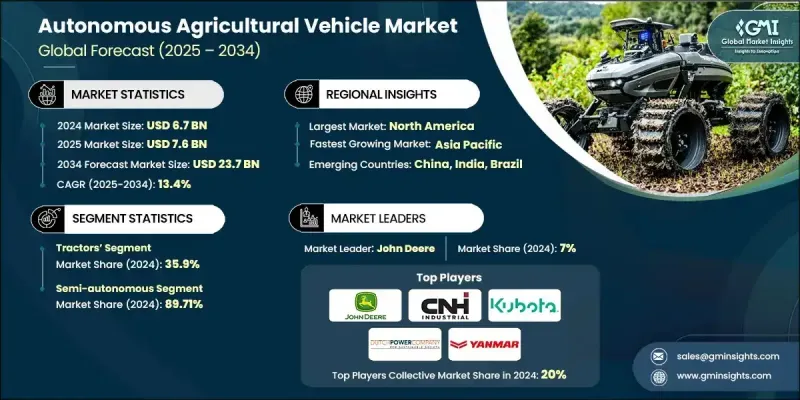
隨著農場不斷尋求提高生產力並減少對勞動力的依賴,市場正在擴張。自動化和智慧技術在農業生產中的應用,推動了對自動駕駛曳引機、收割機和輔助播種、作物監測和收割的專用機器人的需求。不斷上漲的勞動成本和最大化作物產量的需求,促使農民採用這些自動化系統。此外,全球人口的成長和日益成長的糧食需求,也推動了對更有效率耕作方式的需求。電動和混合動力農業機械的創新、先進的感測器融合技術以及與農場管理軟體的無縫連接,正在提升車輛的效率、精準度和可靠性。這些技術進步使自動駕駛農業車輛成為現代農業不可或缺的工具。
| 市場範圍 | |
|---|---|
| 起始年份 | 2024 |
| 預測年份 | 2025-2034 |
| 起始值 | 67億美元 |
| 預測值 | 237億美元 |
| 複合年成長率 | 13.4% |
2024年,曳引機市佔率達35.9%。曳引機仍是現代農業的支柱,承擔耕地、播種、中耕、收割和運輸農產品等任務。其多功能性使其成為自主作業的理想選擇,因為一台機器即可完成多種田間作業。
到2024年,半自動農業機械市佔率將達到89.71%。半自動解決方案,包括GPS導航、自動分段噴灑和基本農具管理等,旨在增強而非完全取代人工操作能力。這種廣泛的應用凸顯了農業輔助自動化技術的成熟度和市場需求。
北美自動駕駛農業車輛市場預計在2024年佔據44.1%的市場佔有率,是成長最快的地區。該地區的農民是先進技術的早期採用者,而大型農場的普遍存在降低了自動駕駛車輛的單位投資成本,使他們能夠受益於規模經濟。
目錄
第1章:方法論與範圍
第2章:執行概要
第3章:行業洞察
- 產業生態系分析
- 供應商格局
- 利潤率
- 每個階段的價值增加
- 影響價值鏈的因素
- 產業影響因素
- 成長促進因素
- 勞動力嚴重短缺
- 技術越來越便宜、越來越好
- 全球推動精準農業
- 產業陷阱與挑戰
- 更嚴格的政府法規(安全與效率)
- 從“自主”轉向“人工智慧增強”
- 機會
- 模組化小型機器人艦隊
- 資料即服務 (DaaS) 整合
- 成長促進因素
- 成長潛力分析
- 未來市場趨勢
- 技術與創新格局
- 當前技術趨勢
- 新興技術
- 價格趨勢
- 按地區
- 按類型
- 監管環境
- 標準和合規要求
- 區域監理框架
- 認證標準
- 波特的分析
- PESTEL 分析
第4章:競爭格局
- 介紹
- 公司市佔率分析
- 按地區
- 公司矩陣分析
- 主要市場參與者的競爭分析
- 競爭定位矩陣
- 關鍵進展
- 併購
- 合作夥伴關係與合作
- 新產品發布
- 擴張計劃
第5章:市場估算與預測:依產品分類,2021-2034年
- 聯結機
- 低於 20 匹馬力
- 21-45馬力
- 46-60馬力
- 61-75馬力
- 75馬力以上
- 收割機
- 自走式聯合收割機
- 傳統聯合收割機
- 旋轉式聯合收割機
- 控制聯合收割機
- 自走式聯合收割機
- 播種機
- 廣播種子
- 播種機
- 氣動播種機
- 精密播種機
- 其他(指播等)
- 噴霧器
- 手持噴霧器
- 背包式噴霧器
- 無氣噴塗機
- 壓縮噴霧器
- 噴霧器
第6章:市場估算與預測,自動化,2021-2034年
- 完全自主
- 半自主
第7章:市場估計與預測:依應用領域分類,2021-2034年
- 培養
- 耕作
- 施肥
- 收割
- 種植
- 其他
第8章:市場估算與預測:依地區分類,2021-2034年
- 北美洲
- 美國
- 加拿大
- 歐洲
- 德國
- 英國
- 法國
- 義大利
- 西班牙
- 亞太地區
- 中國
- 日本
- 印度
- 澳洲
- 韓國
- 拉丁美洲
- 巴西
- 墨西哥
- 阿根廷
- 中東和非洲
- 南非
- 沙烏地阿拉伯
- 阿拉伯聯合大公國
第9章:公司簡介
- ABB
- Assa Abloy
- Berger Stromversorgungen
- Camtec Power Supplies
- Delta Electronics
- Emerson
- Gebruder Frei
- Mean Well
- Murata Manufacturing
- Murrelektronik
- Schneider Electric
- Siemens
- TDK Corporation
- Weidmueller Interface
- XP Power
The Global Autonomous Agricultural Vehicle Market was valued at USD 6.7 billion in 2024 and is estimated to grow at a CAGR of 13.4% to reach USD 23.7 billion by 2034.
The market is expanding as farms increasingly seek to boost productivity while reducing reliance on labor. The integration of automation and smart technologies across agricultural operations is driving demand for self-driving tractors, harvesters, and specialized robots that assist in planting, monitoring crops, and harvesting. Rising labor costs and the need to maximize crop yields are pushing farmers to adopt these autonomous systems. Additionally, the growing global population and increasing demand for food are fueling the need for more efficient farming practices. Innovations in electric and hybrid agricultural machinery, advanced sensor fusion, and seamless connectivity with farm management software are enhancing vehicle efficiency, precision, and reliability. These technological improvements are positioning autonomous agricultural vehicles as indispensable tools in modern agriculture.
| Market Scope | |
|---|---|
| Start Year | 2024 |
| Forecast Year | 2025-2034 |
| Start Value | $6.7 Billion |
| Forecast Value | $23.7 Billion |
| CAGR | 13.4% |
In 2024, the tractors segment held a 35.9% share. Tractors remain the backbone of modern farming, performing tasks such as plowing, planting, cultivating, harvesting, and transporting produce. Their versatility makes them ideal candidates for autonomous operations, as a single machine can carry out multiple field activities.
The semi-autonomous segment held a 89.71% share in 2024. Semi-autonomous solutions, including GPS-guided steering, auto-section sprayer control, and basic implement management, enhance human operator capabilities rather than fully replacing them. This widespread adoption highlights the current maturity and preference for assisted automation in agriculture.
North America Autonomous Agricultural Vehicle Market accounted for 44.1% share in 2024 and is the fastest-growing region. Farmers in this region are early adopters of advanced technologies, and the prevalence of large-scale farms reduces the per-unit investment cost for autonomous vehicles, allowing them to benefit from economies of scale.
Major players operating in the Autonomous Agricultural Vehicle Market include AGCO, John Deere, CNH Industrial, Kubota Corporation, Dutch Power Company, Yanmar Co. Ltd, Zimeno Inc., AutoNxt Automation, Argo Tractors, Monarch Tractors, Case IH, and New Holland. Companies in the Autonomous Agricultural Vehicle Market focus on continuous innovation in robotics, electrification, and sensor integration to enhance vehicle efficiency and performance. Firms invest heavily in research and development to develop versatile machines capable of multiple tasks and operating in diverse agricultural conditions. Strategic partnerships with technology providers, software developers, and farm management platforms help companies integrate precision farming solutions. Expanding global distribution networks and after-sales service infrastructure ensures market reach and customer support. Companies also offer training programs and demonstration initiatives to educate farmers on autonomous technology benefits. Customizing vehicles for regional crops, terrains, and farm sizes strengthens market penetration.
Table of Contents
Chapter 1 Methodology and Scope
- 1.1 Market scope and definition
- 1.2 Research design
- 1.2.1 Research approach
- 1.2.2 Data collection methods
- 1.3 Data mining sources
- 1.3.1 Global
- 1.3.2 Regional/Country
- 1.4 Base estimates and calculations
- 1.4.1 Base year calculation
- 1.4.2 Key trends for market estimation
- 1.5 Primary research and validation
- 1.5.1 Primary sources
- 1.6 Forecast model
- 1.7 Research assumptions and limitations
Chapter 2 Executive Summary
- 2.1 Industry 360° synopsis
- 2.2 Key market trends
- 2.2.1 Regional
- 2.2.2 Product
- 2.2.3 Automation
- 2.2.4 Application
- 2.3 CXO perspectives: Strategic imperatives
- 2.3.1 Key decision points for industry executives
- 2.3.2 Critical success factors for market players
- 2.4 Future outlook and strategic recommendations
Chapter 3 Industry Insights
- 3.1 Industry ecosystem analysis
- 3.1.1 Supplier landscape
- 3.1.2 Profit margin
- 3.1.3 Value addition at each stage
- 3.1.4 Factor affecting the value chain
- 3.2 Industry impact forces
- 3.2.1 Growth drivers
- 3.2.1.1 Big Labor Shortages
- 3.2.1.2 Tech Getting Cheaper & Better
- 3.2.1.3 Global Push for Precision Farming
- 3.2.2 Industry pitfalls & challenges
- 3.2.2.1 Stricter Government Regulations (Safety & Efficiency)
- 3.2.2.2 Shift from "Autonomous" to "AI-Enhanced"
- 3.2.3 Opportunities
- 3.2.3.1 Modular, Small Robot Fleets
- 3.2.3.2 Data-as-a-Service (DaaS) Integration
- 3.2.1 Growth drivers
- 3.3 Growth potential analysis
- 3.4 Future market trends
- 3.5 Technology and innovation landscape
- 3.5.1 Current technological trends
- 3.5.2 Emerging technologies
- 3.6 Price trends
- 3.6.1 By region
- 3.6.2 By type
- 3.7 Regulatory landscape
- 3.7.1 Standards and compliance requirements
- 3.7.2 Regional regulatory frameworks
- 3.7.3 Certification standards
- 3.8 Porter's analysis
- 3.9 PESTEL analysis
Chapter 4 Competitive Landscape, 2024
- 4.1 Introduction
- 4.2 Company market share analysis
- 4.2.1 By region
- 4.2.1.1 North America
- 4.2.1.2 Europe
- 4.2.1.3 Asia Pacific
- 4.2.1.4 Latin America
- 4.2.1.5 Middle East and Africa
- 4.2.1 By region
- 4.3 Company matrix analysis
- 4.4 Competitive analysis of major market players
- 4.5 Competitive positioning matrix
- 4.6 Key developments
- 4.6.1 Mergers & acquisitions
- 4.6.2 Partnerships & collaborations
- 4.6.3 New product launches
- 4.6.4 Expansion plans
Chapter 5 Market Estimates and Forecast, By Product, 2021 - 2034 (USD Billion) (Thousand Units)
- 5.1 Key trends
- 5.2 Tractor
- 5.2.1 Below 20 HP
- 5.2.2 21-45 HP
- 5.2.3 46-60 HP
- 5.2.4 61-75 HP
- 5.2.5 Above 75 HP
- 5.3 Harvester
- 5.3.1 Self-propelled Combine Harvesters
- 5.3.1.1 Conventional combines
- 5.3.1.2 Rotary combines
- 5.3.2 Control Combine Harvester
- 5.3.1 Self-propelled Combine Harvesters
- 5.4 Seeders
- 5.4.1 Broadcast seeder
- 5.4.2 Drop seeder
- 5.4.3 Pneumatic seeder
- 5.4.4 Precision seeder
- 5.4.5 Others (Finger seeder, etc.)
- 5.5 Sprayers
- 5.5.1 Handheld sprayers
- 5.5.2 Backpack sprayers
- 5.5.3 Airless sprayers
- 5.5.4 Compression sprayers
- 5.5.5 Mist sprayers
Chapter 6 Market Estimates and Forecast, Automation, 2021 - 2034 (USD Billion) (Thousand Units)
- 6.1 Key trends
- 6.2 Fully autonomous
- 6.3 Semi-autonomous
Chapter 7 Market Estimates and Forecast, By Application, 2021 - 2034 (USD Billion) (Thousand Units)
- 7.1 Key trends
- 7.2 Cultivating
- 7.3 Plowing
- 7.4 Fertilizing
- 7.5 Harvesting
- 7.6 Planting
- 7.7 Others
Chapter 8 Market Estimates and Forecast, By Region, 2021 - 2034 (USD Billion) (Thousand Units)
- 8.1 Key trends
- 8.2 North America
- 8.2.1 U.S.
- 8.2.2 Canada
- 8.3 Europe
- 8.3.1 Germany
- 8.3.2 UK
- 8.3.3 France
- 8.3.4 Italy
- 8.3.5 Spain
- 8.4 Asia Pacific
- 8.4.1 China
- 8.4.2 Japan
- 8.4.3 India
- 8.4.4 Australia
- 8.4.5 South Korea
- 8.5 Latin America
- 8.5.1 Brazil
- 8.5.2 Mexico
- 8.5.3 Argentina
- 8.6 Middle East and Africa
- 8.6.1 South Africa
- 8.6.2 Saudi Arabia
- 8.6.3 UAE
Chapter 9 Company Profiles
- 9.1 ABB
- 9.2 Assa Abloy
- 9.3 Berger Stromversorgungen
- 9.4 Camtec Power Supplies
- 9.5 Delta Electronics
- 9.6 Emerson
- 9.7 Gebruder Frei
- 9.8 Mean Well
- 9.9 Murata Manufacturing
- 9.10 Murrelektronik
- 9.11 Schneider Electric
- 9.12 Siemens
- 9.13 TDK Corporation
- 9.14 Weidmueller Interface
- 9.15 XP Power

 除草機器人市場:按組件、類型、運作方式、銷售管道、應用和最終用途分類-2026-2032年全球市場預測農作物殘渣處理機械市場:按類型、機械化程度、動力來源、應用、最終用途和分銷管道分類-2026-2032年全球市場預測
 2026年全球自主作物殘茬管理機器人市場報告農業橡膠履帶市場:2026-2032年全球市場預測(依應用程式、銷售管道、履頻寬度、橡膠配方類型、履帶長度及最終用戶類型分類)
 自主農業車輛市場:策略性洞察與預測(2026-2031年)溶離設備市場:2026-2032年全球市場預測(依設備類型、自動化程度、技術、應用、最終用戶及銷售管道)農業和施工機械市場:按產品類型、功率範圍、引擎類型、應用、最終用戶和分銷管道分類——2026-2032年全球預測穀物螺旋輸送機市場:按類型、動力來源、容量、應用、最終用戶和分銷管道分類-2026-2032年全球預測紅外線瀝青加熱器市場:按產品類型、電源、移動性、應用、最終用戶、分銷管道分類,全球預測(2026-2032年)
 農業設備市場規模、佔有率、趨勢和預測:按設備類型、應用、銷售管道和地區分類,2026-2034年