


 |
市場調查報告書
商品編碼
1892873
單株抗體市場機會、成長促進因素、產業趨勢分析及預測(2026-2035年)Monoclonal Antibodies Market Opportunity, Growth Drivers, Industry Trend Analysis, and Forecast 2026 - 2035 |
||||||

2025年全球單株抗體市場價值為2,859億美元,預計到2035年將以12.7%的複合年成長率成長至9,361億美元。
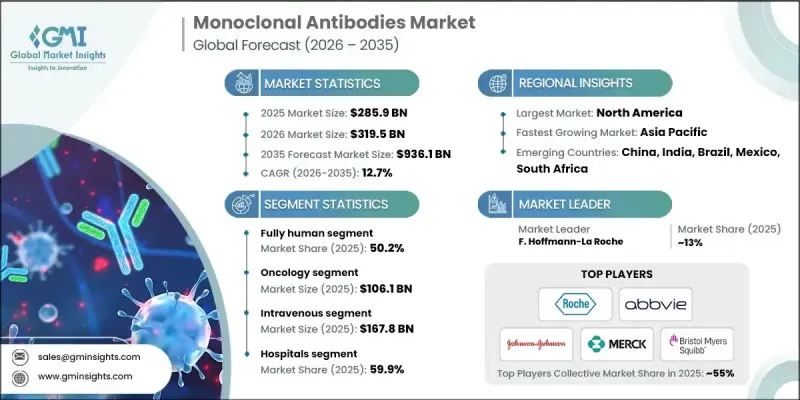
由於全球慢性病、自體免疫疾病和癌症相關疾病的盛行率不斷上升,市場正經歷強勁成長。單株抗體是實驗室合成的分子,旨在模擬免疫系統識別和對抗有害病原體(包括癌細胞和病毒)的能力。它們針對特定抗原,與傳統療法相比,可提供高度精準的治療,並減少脫靶效應。這些生物製劑正日益廣泛地應用於腫瘤學、免疫學、傳染病和其他治療領域。市場成長的驅動力來自於精準醫療的日益普及、治療效果的改善以及標靶療法的開發。領先企業之間的策略合作、夥伴關係和收購正在重塑競爭格局,強化供應鏈,並支持全球擴張,尤其是在新興市場,同時滿足已開發地區和發展中地區不斷成長的需求。
| 市場範圍 | |
|---|---|
| 起始年份 | 2025 |
| 預測年份 | 2026-2035 |
| 起始值 | 2859億美元 |
| 預測值 | 9361億美元 |
| 複合年成長率 | 12.7% |
預計到2025年,全人源單株抗體市佔率將達到50.2%,並有望以12.8%的複合年成長率成長。全人源單株抗體因其安全性高、免疫原性低和治療效果好而備受青睞。它們與天然人類免疫球蛋白結構高度相似,可降低抗藥性抗體反應,並確保長期治療的持續療效。主要全人源療法的臨床成功進一步鞏固了該領域的領先地位。
預計到2025年,腫瘤治療領域市場規模將達到1,061億美元,年複合成長率(CAGR)為12.5%。全球癌症發生率的上升以及標靶治療的普及是推動該領域成長的主要因素。單株抗體因其能夠選擇性靶向腫瘤相關抗原、最大限度降低脫靶毒性並改善患者生存預後,而被廣泛應用於腫瘤治療。抗體藥物偶聯物、雙特異性抗體和免疫檢查點抑制劑的創新進一步鞏固了單株抗體在精準腫瘤治療中的作用。
北美單株抗體市場預計到2025年將佔據41.5%的市場佔有率,這主要得益於先進的醫療基礎設施、慢性病和傳染病的高發生率以及眾多領先生物製藥公司的存在。此外,下一代抗體技術的早期應用、個人化療法的廣泛使用、強勁的研發投入、有利的醫保政策、生物類似藥滲透率的不斷提高以及傳染病診斷率的提升,都對強勁的市場需求起到了推動作用。
目錄
第1章:方法論與範圍
第2章:執行概要
第3章:行業洞察
- 產業生態系分析
- 產業影響因素
- 成長促進因素
- 全球慢性病和傳染病之病率不斷上升
- 不斷成長的研發活動
- 已開發市場的高接受度與加速核准
- 生物製劑市場蓬勃發展,單株抗體的應用日益廣泛
- 產業陷阱與挑戰
- 單株抗體療法成本高
- 嚴格的監管框架和合規要求
- 市場機遇
- 下一代抗體技術的出現
- 拓展至醫療基礎建設更完善的新興市場
- 成長促進因素
- 成長潛力分析
- 技術格局
- 當前技術趨勢
- 新興技術
- 監管環境
- 北美洲
- 歐洲
- 亞太地區
- 未來市場趨勢
- 管道分析
- 波特的分析
- PESTEL 分析
第4章:競爭格局
- 介紹
- 公司市佔率分析
- 公司矩陣分析
- 主要市場參與者的競爭分析
- 競爭定位矩陣
- 關鍵進展
- 併購
- 夥伴關係與合作
- 新產品發布
- 擴張計劃
第5章:市場估算與預測:依來源類型分類,2022-2035年
- 嵌合體
- 小鼠
- 完全人類
- 人性化
第6章:市場估算與預測:依應用領域分類,2022-2035年
- 腫瘤學
- 自體免疫疾病
- 傳染病
- 神經系統疾病
- 其他應用
第7章:市場估計與預測:依給藥途徑分類,2022-2035年
- 靜脈
- 皮下
- 肌肉內注射
第8章:市場估算與預測:依最終用途分類,2022-2035年
- 醫院
- 專科中心
- 其他最終用途
第9章:市場估計與預測:依地區分類,2022-2035年
- 北美洲
- 美國
- 加拿大
- 歐洲
- 德國
- 英國
- 法國
- 西班牙
- 義大利
- 荷蘭
- 亞太地區
- 中國
- 印度
- 日本
- 澳洲
- 韓國
- 拉丁美洲
- 巴西
- 墨西哥
- 阿根廷
- 中東和非洲
- 南非
- 沙烏地阿拉伯
- 阿拉伯聯合大公國
第10章:公司簡介
- AbbVie
- Amgen
- Arcus Biosciences
- AstraZeneca
- BioArctic
- Bristol Myers Squibb
- Eli Lilly and Company
- F. Hoffmann-La Roche
- GlaxoSmithKline
- Johnson & Johnson
- Merck & Co.
- Novartis AG
- Regeneron Pharmaceuticals
- Sanofi
- Takeda Pharmaceutical Company
- UCB Pharma
The Global Monoclonal Antibodies Market was valued at USD 285.9 billion in 2025 and is estimated to grow at a CAGR of 12.7% to reach USD 936.1 billion by 2035.
The market is witnessing strong growth due to the rising prevalence of chronic, autoimmune, and cancer-related diseases worldwide. Monoclonal antibodies are lab-engineered molecules designed to mimic the immune system's ability to recognize and combat harmful pathogens, including cancer cells and viruses. They target specific antigens, providing highly precise treatments with reduced off-target effects compared to conventional therapies. These biologics are increasingly applied in oncology, immunology, infectious diseases, and other therapeutic areas. The market is driven by the growing adoption of precision medicine, improved treatment outcomes, and the development of targeted therapies. Strategic collaborations, partnerships, and acquisitions among leading players are reshaping the competitive landscape, strengthening supply chains, and supporting global expansion, particularly in emerging markets, while addressing rising demand in both developed and developing regions.
| Market Scope | |
|---|---|
| Start Year | 2025 |
| Forecast Year | 2026-2035 |
| Start Value | $285.9 Billion |
| Forecast Value | $936.1 Billion |
| CAGR | 12.7% |
The fully human segment held a 50.2% share in 2025 and is expected to grow at a CAGR of 12.8%. Fully human monoclonal antibodies are preferred due to their safety, minimal immunogenicity, and high therapeutic efficacy. They closely resemble natural human immunoglobulins, reducing anti-drug antibody responses and enabling sustained effectiveness in long-term therapies. The clinical success of major fully human therapies has further reinforced the dominance of this segment.
The oncology segment generated USD 106.1 billion in 2025, growing at a CAGR of 12.5%. The increasing global incidence of cancer and the adoption of targeted therapies drive growth in this segment. Monoclonal antibodies are widely used in oncology because they selectively target tumor-associated antigens, minimize off-target toxicity, and improve survival outcomes. Innovations in antibody-drug conjugates, bispecific antibodies, and checkpoint inhibitors have further strengthened their role in precision oncology.
North America Monoclonal Antibodies Market held a 41.5% share in 2025, driven by advanced healthcare infrastructure, high prevalence of chronic and infectious diseases, and the presence of leading biopharmaceutical companies. Early adoption of next-generation antibody technologies, extensive use of personalized therapies, strong research investments, favorable reimbursement policies, increasing biosimilar penetration, and higher diagnostic rates for infectious diseases contribute to robust market demand.
Key companies active in the Global Monoclonal Antibodies Market include Johnson & Johnson, Takeda Pharmaceutical, Amgen, AbbVie, BioArctic, Eli Lilly and Company, AstraZeneca, Regeneron Pharmaceuticals, Novartis AG, F. Hoffmann-La Roche, GlaxoSmithKline, Arcus Biosciences, Bristol Myers Squibb, UCB Pharma, and Sanofi. Companies in the Global Monoclonal Antibodies Market are strengthening their market presence through several strategies. They are heavily investing in research and development to discover next-generation antibodies with enhanced efficacy and safety profiles. Strategic partnerships and collaborations with biotech firms and research institutions are expanding their global footprint. Companies are also focusing on geographic expansion, particularly into emerging markets, to capture rising demand. Additionally, mergers and acquisitions are used to enhance product portfolios and accelerate market penetration. Adoption of digital platforms for clinical trial management, patient engagement, and supply chain optimization is also being leveraged to improve operational efficiency and market reach.
Table of Contents
Chapter 1 Methodology and Scope
- 1.1 Market scope and definition
- 1.2 Research design
- 1.2.1 Research approach
- 1.2.2 Data collection methods
- 1.3 Data mining sources
- 1.3.1 Global
- 1.3.2 Regional/Country
- 1.4 Base estimates and calculations
- 1.4.1 Base year calculation
- 1.4.2 Key trends for market estimation
- 1.5 Primary research and validation
- 1.5.1 Primary sources
- 1.6 Forecast model
- 1.7 Research assumptions and limitations
Chapter 2 Executive Summary
- 2.1 Industry 3600 synopsis
- 2.2 Key market trends
- 2.2.1 Regional trends
- 2.2.2 Source type trends
- 2.2.3 Application trends
- 2.2.4 Route of administration trends
- 2.2.5 End use trends
- 2.3 CXO perspectives: Strategic imperatives
- 2.3.1 Key decision points for industry executives
- 2.3.2 Critical success factors for market players
- 2.4 Future outlook and strategic recommendations
Chapter 3 Industry Insights
- 3.1 Industry ecosystem analysis
- 3.2 Industry impact forces
- 3.2.1 Growth drivers
- 3.2.1.1 Increasing prevalence of chronic and infectious diseases worldwide
- 3.2.1.2 Growing research and development activities
- 3.2.1.3 High adoption and accelerated approvals in developed markets
- 3.2.1.4 The booming biologics market and rising applications of monoclonal antibodies
- 3.2.2 Industry pitfalls and challenges
- 3.2.2.1 High cost of monoclonal antibody therapeutics
- 3.2.2.2 Stringent regulatory framework and compliance requirements
- 3.2.3 Market opportunities
- 3.2.3.1 Emergence of next-generation antibody technologies
- 3.2.3.2 Expansion into emerging markets with improved healthcare infrastructure
- 3.2.1 Growth drivers
- 3.3 Growth potential analysis
- 3.4 Technology landscape
- 3.4.1 Current technological trends
- 3.4.2 Emerging technologies
- 3.5 Regulatory landscape
- 3.5.1 North America
- 3.5.2 Europe
- 3.5.3 Asia Pacific
- 3.6 Future market trends
- 3.7 Pipeline analysis
- 3.8 Porter's analysis
- 3.9 PESTEL analysis
Chapter 4 Competitive Landscape, 2025
- 4.1 Introduction
- 4.2 Company market share analysis
- 4.3 Company matrix analysis
- 4.4 Competitive analysis of major market players
- 4.5 Competitive positioning matrix
- 4.6 Key developments
- 4.6.1 Merger and acquisition
- 4.6.2 Partnership and collaboration
- 4.6.3 New product launches
- 4.6.4 Expansion plans
Chapter 5 Market Estimates and Forecast, By Source Type, 2022 - 2035 ($ Mn)
- 5.1 Key trends
- 5.2 Chimeric
- 5.3 Murine
- 5.4 Fully human
- 5.5 Humanized
Chapter 6 Market Estimates and Forecast, By Application, 2022 - 2035 ($ Mn)
- 6.1 Key trends
- 6.2 Oncology
- 6.3 Autoimmune diseases
- 6.4 Infectious diseases
- 6.5 Neurological diseases
- 6.6 Other applications
Chapter 7 Market Estimates and Forecast, By Route of Administration, 2022 - 2035 ($ Mn)
- 7.1 Key trends
- 7.2 Intravenous
- 7.3 Subcutaneous
- 7.4 Intramuscular
Chapter 8 Market Estimates and Forecast, By End Use, 2022 - 2035 ($ Mn)
- 8.1 Key trends
- 8.2 Hospitals
- 8.3 Specialty centers
- 8.4 Other end use
Chapter 9 Market Estimates and Forecast, By Region, 2022 - 2035 ($ Mn)
- 9.1 Key trends
- 9.2 North America
- 9.2.1 U.S.
- 9.2.2 Canada
- 9.3 Europe
- 9.3.1 Germany
- 9.3.2 UK
- 9.3.3 France
- 9.3.4 Spain
- 9.3.5 Italy
- 9.3.6 Netherlands
- 9.4 Asia Pacific
- 9.4.1 China
- 9.4.2 India
- 9.4.3 Japan
- 9.4.4 Australia
- 9.4.5 South Korea
- 9.5 Latin America
- 9.5.1 Brazil
- 9.5.2 Mexico
- 9.5.3 Argentina
- 9.6 Middle East and Africa
- 9.6.1 South Africa
- 9.6.2 Saudi Arabia
- 9.6.3 UAE
Chapter 10 Company Profiles
- 10.1 AbbVie
- 10.2 Amgen
- 10.3 Arcus Biosciences
- 10.4 AstraZeneca
- 10.5 BioArctic
- 10.6 Bristol Myers Squibb
- 10.7 Eli Lilly and Company
- 10.8 F. Hoffmann-La Roche
- 10.9 GlaxoSmithKline
- 10.10 Johnson & Johnson
- 10.11 Merck & Co.
- 10.12 Novartis AG
- 10.13 Regeneron Pharmaceuticals
- 10.14 Sanofi
- 10.15 Takeda Pharmaceutical Company
- 10.16 UCB Pharma

 抗A4B7整合素單株抗體市場:2026-2032年全球預測(依適應症、給藥途徑、治療線、病患年齡層及劑型分類)
 單株抗體療法市場分析及預測(至2035年):依類型、產品類型、技術、應用、最終使用者、功能、流程、實施類型及發展階段分類
 腫瘤學中的單株抗體:全球市場
 單株抗體療法市場-全球產業規模、佔有率、趨勢、機會及預測(按產品類型、應用、生產來源、最終用戶、地區和競爭格局分類,2021-2031年)CD20單株抗體市場依產品、適應症、作用機制類型、給藥途徑及最終用戶分類,全球預測,2026-2032年抗BETA澱粉樣蛋白單株抗體市場:依產品類型、適應症、作用機制、最終用戶和通路分類,全球預測(2026-2032年)雷珠單抗市場按適應症、劑量強度、給藥途徑、治療線、最終用戶和分銷管道分類-2026-2032年全球預測
 單株抗體市場規模、佔有率和成長分析(按來源、適應症、生產類型、應用、給藥途徑、最終用途和地區分類)-2026-2033年產業預測
 單株抗體療法市場規模、佔有率和成長分析(按生產方法、來源、治療方法、給藥方法、最終用戶和地區分類)—2026-2033年產業預測
 單株抗體合作與授權協議:2019-2025