


 |
市場調查報告書
商品編碼
1892838
高速鼓風機市場機會、成長促進因素、產業趨勢分析及預測(2026-2035年)High-Speed Blowers Market Opportunity, Growth Drivers, Industry Trend Analysis, and Forecast 2026 - 2035 |
||||||

2025 年全球高速鼓風機市場價值為 9.727 億美元,預計到 2035 年將以 3.7% 的複合年成長率成長至 14.2 億美元。
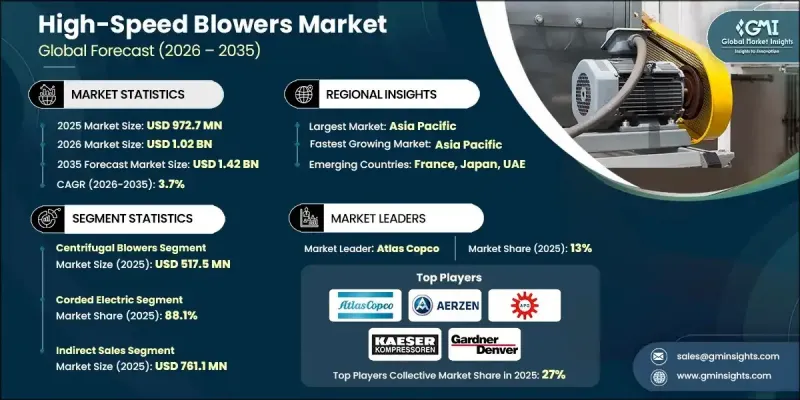
這一成長是由各行業對高效、可靠、高性能氣流解決方案日益成長的需求所驅動的。高速鼓風機已成為工業運作不可或缺的一部分,使企業能夠保持穩定的氣流、降低能耗並在嚴苛環境下高效運作。石油和天然氣產業高度依賴這些鼓風機來壓縮氣體、提煉石油和高效輸送產品。不斷成長的能耗和對運作可靠性的需求正促使各行業採用現代高速鼓風機技術。更嚴格的環境法規和永續發展目標促使企業用節能型鼓風機取代傳統系統,這些鼓風機在降低碳排放的同時,也能維持高性能。此外,智慧監控系統和預測性維護工具的整合使操作人員能夠最大限度地減少停機時間、延長設備壽命並最佳化整體擁有成本,從而進一步推動了高速鼓風機在工業應用中的普及。
| 市場範圍 | |
|---|---|
| 起始年份 | 2025 |
| 預測年份 | 2026-2035 |
| 起始值 | 9.727億美元 |
| 預測值 | 14.2億美元 |
| 複合年成長率 | 3.7% |
2025年,離心式鼓風機市場規模預計將達5.175億美元。這類鼓風機利用離心力高效輸送空氣或氣體,空氣從中央葉輪進入,經由擴散器排出,擴散器將動能轉換為高壓氣流。離心式鼓風機以其耐用性、能源效率和可靠性而著稱,廣泛應用於工業製造、暖通空調系統以及需要中高壓穩定氣流的物料搬運等領域。
至2025年,有線電動鼓風機市佔率將達到88.1%。有線電動鼓風機透過電源插座持續供電,因此在工業和商業環境中具有很高的可靠性。與電池或燃油動力鼓風機不同,有線鼓風機可確保不間斷運行,降低維護複雜性,並消除充電或加油的顧慮,使其成為經濟高效且可靠的解決方案。
美國高速鼓風機市場佔78.7%的市場佔有率,預計到2025年市場規模將達到2.019億美元。市場成長主要得益於節能和永續營運方式的普及。由於監管要求和對高效曝氣的需求,廢水處理行業仍然是高速鼓風機的主要用戶。然而,隨著企業為滿足環保和效率標準而進行營運現代化改造,高速鼓風機在化工、石油天然氣和發電等行業的應用也日益廣泛。
目錄
第1章:方法論與範圍
第2章:執行概要
第3章:行業洞察
- 產業生態系分析
- 供應商格局
- 利潤率
- 每個階段的價值增加
- 影響價值鏈的因素
- 產業影響因素
- 成長促進因素
- 石油和天然氣產業的成長
- 工業化和基礎設施擴張
- 能源效率和營運節省
- 對無油認證鼓風機的需求不斷成長
- 產業陷阱與挑戰
- 高初始投資
- 熟練勞動力需求
- 機會
- 廢水處理應用
- 採用智慧和物聯網整合式鼓風機
- 成長促進因素
- 成長潛力分析
- 未來市場趨勢
- 技術與創新格局
- 當前技術趨勢
- 新興技術
- 價格趨勢
- 按地區
- 按類型
- 監管環境
- 標準和合規要求
- 區域監理框架
- 認證標準
- 波特的分析
- PESTEL 分析
第4章:競爭格局
- 介紹
- 公司市佔率分析
- 按地區
- 公司矩陣分析
- 主要市場參與者的競爭分析
- 競爭定位矩陣
- 關鍵進展
- 併購
- 合作夥伴關係與合作
- 新產品發布
- 擴張計劃
第5章:市場估算與預測:依類型分類,2022-2035年
- 離心式鼓風機
- 軸流式鼓風機
- 橫流式鼓風機
- 其他類型(螺旋式鼓風機、羅茨式鼓風機等)
第6章:市場估算與預測:依電源類型分類,2022-2035年
- 有線電
- 電池供電
第7章:市場估計與預測:依技術分類,2022-2035年
- 磁軸承
- 翼型軸承
第8章:市場估算與預測:依應用領域分類,2022-2035年
- 廢水處理
- 石油和天然氣
- 化學
- 海洋
- 食品和飲料
- 其他(紙漿和造紙、食品和飲料等)
第9章:市場估算與預測:依配銷通路分類,2022-2035年
- 直銷
- 間接銷售
第10章:市場估計與預測:依地區分類,2022-2035年
- 北美洲
- 美國
- 加拿大
- 歐洲
- 德國
- 英國
- 法國
- 義大利
- 西班牙
- 亞太地區
- 中國
- 日本
- 印度
- 澳洲
- 韓國
- 拉丁美洲
- 巴西
- 墨西哥
- 阿根廷
- 中東和非洲
- 南非
- 沙烏地阿拉伯
- 阿拉伯聯合大公國
第11章:公司簡介
- Aerzen Turbo
- APG Neuros
- Atlas Copco AB
- Busch Vacuum Solutions
- Continental Industrie
- Esurging (Tianjin) Technology
- Gardner Denver
- Hoffman & Lamson
- Kaeser Kompressoren SE
- Nanjing Magnetic Valley Technology
- Pfeiffer Vacuum
- Spencer Turbine Company
- Sulzer
- Tuthill
- Xylem
The Global High-Speed Blowers Market was valued at USD 972.7 million in 2025 and is estimated to grow at a CAGR of 3.7% to reach USD 1.42 billion by 2035.
This growth is driven by the increasing demand for efficient, reliable, and high-performance airflow solutions across industries. High-speed blowers have become integral to industrial operations, allowing companies to maintain stable airflow, reduce energy consumption, and operate effectively in demanding environments. The oil and gas sector heavily relies on these blowers for compressing gas, refining petroleum, and transporting products efficiently. Rising energy consumption and the need for operational reliability are motivating industries to adopt modern high-speed blower technologies. Stricter environmental regulations and sustainability targets are prompting companies to replace traditional systems with energy-efficient blowers that lower carbon emissions while maintaining high performance. Furthermore, the integration of smart monitoring systems and predictive maintenance tools allows operators to minimize downtime, extend equipment life, and optimize total cost of ownership, driving further adoption in industrial applications.
| Market Scope | |
|---|---|
| Start Year | 2025 |
| Forecast Year | 2026-2035 |
| Start Value | $972.7 Million |
| Forecast Value | $1.42 Billion |
| CAGR | 3.7% |
The centrifugal blowers segment generated USD 517.5 million in 2025. These blowers utilize centrifugal force to transfer air or gas efficiently, with air entering through a central impeller and exiting via diffusers that convert kinetic energy into high-pressure airflow. Renowned for their durability, energy efficiency, and reliability, centrifugal blowers are widely used in industrial manufacturing, HVAC systems, and material handling processes where consistent airflow at moderate to high pressures is required.
The corded electric segment held 88.1% share in 2025. Corded electric blowers provide a continuous power supply from electrical outlets, making them highly reliable in industrial and commercial environments. Unlike battery or fuel-powered alternatives, corded units ensure uninterrupted operation, reduce maintenance complexity, and eliminate concerns about recharge or refueling cycles, making them cost-effective and dependable solutions.
U.S. High-Speed Blowers Market held a 78.7% share, generating USD 201.9 million in 2025. Growth is driven by the adoption of energy-efficient and sustainable operational methods. The wastewater treatment industry remains a major user due to regulatory requirements and the need for efficient aeration. However, high-speed blowers are increasingly adopted across chemical processing, oil and gas, and power generation industries as companies modernize operations to meet environmental and efficiency standards.
Key players in the Global High-Speed Blowers Market include Kaeser Kompressoren SE, Hoffman & Lamson, Spencer Turbine Company, Tuthill, Xylem, APG Neuros, Aerzen Turbo, Atlas Copco AB, Howden North America, Continental Industrie, KTurbo, Sulzer, Nanjing Magnetic Valley Technology, Esurging (Tianjin) Technology, and Gardner Denver. Market leaders focus on strengthening their position through strategic initiatives such as continuous R&D to enhance blower efficiency, reliability, and energy performance. Companies integrate IoT-enabled monitoring systems and predictive maintenance solutions to reduce downtime and operational costs. Expansion of product portfolios, including centrifugal and high-capacity units, allows them to cater to diverse industrial applications. Collaborations with industrial players and service partnerships enhance customer reach, while investments in sustainable and environmentally compliant solutions improve competitiveness.
Table of Contents
Chapter 1 Methodology and Scope
- 1.1 Market scope and definition
- 1.2 Research design
- 1.2.1 Research approach
- 1.2.2 Data collection methods
- 1.3 Data mining sources
- 1.3.1 Global
- 1.3.2 Regional/Country
- 1.4 Base estimates and calculations
- 1.4.1 Base year calculation
- 1.4.2 Key trends for market estimation
- 1.5 Primary research and validation
- 1.5.1 Primary sources
- 1.6 Forecast model
- 1.7 Research assumptions and limitations
Chapter 2 Executive Summary
- 2.1 Industry 3600 synopsis
- 2.2 Key market trends
- 2.2.1 Regional
- 2.2.2 Type
- 2.2.3 Power source
- 2.2.4 Technology
- 2.2.5 Application
- 2.2.6 Distribution channel
- 2.3 CXO perspectives: Strategic imperatives
- 2.3.1 Key decision points for industry executives
- 2.3.2 Critical success factors for market players
- 2.4 Future outlook and strategic recommendations
Chapter 3 Industry Insights
- 3.1 Industry ecosystem analysis
- 3.1.1 Supplier landscape
- 3.1.2 Profit margin
- 3.1.3 Value addition at each stage
- 3.1.4 Factor affecting the value chain
- 3.2 Industry impact forces
- 3.2.1 Growth drivers
- 3.2.1.1 Growth of the oil & gas industry
- 3.2.1.2 Industrialization & infrastructure expansion
- 3.2.1.3 Energy efficiency & operational savings
- 3.2.1.4 Increasing demand for oil free and certified blowers
- 3.2.2 Industry pitfalls & challenges
- 3.2.2.1 High initial investment
- 3.2.2.2 Skilled workforce needs
- 3.2.3 Opportunities
- 3.2.3.1 Wastewater treatment applications
- 3.2.3.2 Adoption of smart & IoT-integrated blowers
- 3.2.1 Growth drivers
- 3.3 Growth potential analysis
- 3.4 Future market trends
- 3.5 Technology and innovation landscape
- 3.5.1 Current technological trends
- 3.5.2 Emerging technologies
- 3.6 Price trends
- 3.6.1 By Region
- 3.6.2 By Type
- 3.7 Regulatory landscape
- 3.7.1 Standards and compliance requirements
- 3.7.2 Regional regulatory frameworks
- 3.7.3 Certification standards
- 3.8 Porter's analysis
- 3.9 PESTEL analysis
Chapter 4 Competitive Landscape, 2025
- 4.1 Introduction
- 4.2 Company market share analysis
- 4.2.1 By region
- 4.2.1.1 North America
- 4.2.1.2 Europe
- 4.2.1.3 Asia Pacific
- 4.2.1.4 Latin America
- 4.2.1.5 Middle East and Africa
- 4.2.1 By region
- 4.3 Company matrix analysis
- 4.4 Competitive analysis of major market players
- 4.5 Competitive positioning matrix
- 4.6 Key developments
- 4.6.1 Mergers & acquisitions
- 4.6.2 Partnerships & collaborations
- 4.6.3 New product launches
- 4.6.4 Expansion plans
Chapter 5 Market Estimates and Forecast, By Type, 2022 - 2035 (USD Million) (Thousand Units)
- 5.1 Key trends
- 5.2 Centrifugal blowers
- 5.3 Axial blowers
- 5.4 Cross-flow blowers
- 5.5 Others (screw blower, roots blower, etc.)
Chapter 6 Market Estimates and Forecast, By Power Source, 2022 - 2035 (USD Million) (Thousand Units)
- 6.1 Key trends
- 6.2 Corded electric
- 6.3 Battery powered
Chapter 7 Market Estimates and Forecast, By Technology, 2022 - 2035 (USD Million) (Thousand Units)
- 7.1 Key trends
- 7.2 Magnetic bearings
- 7.3 Airfoil bearings
Chapter 8 Market Estimates and Forecast, By Application, 2022 - 2035 (USD Million) (Thousand Units)
- 8.1 Key trends
- 8.2 Wastewater treatment
- 8.3 Oil & gas
- 8.4 Chemical
- 8.5 Marine
- 8.6 Food & beverages
- 8.7 Others (pulp and paper, food and beverage, etc.)
Chapter 9 Market Estimates and Forecast, By Distribution Channel, 2022 - 2035 (USD Million) (Thousand Units)
- 9.1 Key trends
- 9.2 Direct sales
- 9.3 Indirect sales
Chapter 10 Market Estimates and Forecast, By Region, 2022 - 2035 (USD Million) (Thousand Units)
- 10.1 Key trends
- 10.2 North America
- 10.2.1 U.S.
- 10.2.2 Canada
- 10.3 Europe
- 10.3.1 Germany
- 10.3.2 UK
- 10.3.3 France
- 10.3.4 Italy
- 10.3.5 Spain
- 10.4 Asia Pacific
- 10.4.1 China
- 10.4.2 Japan
- 10.4.3 India
- 10.4.4 Australia
- 10.4.5 South Korea
- 10.5 Latin America
- 10.5.1 Brazil
- 10.5.2 Mexico
- 10.5.3 Argentina
- 10.6 Middle East and Africa
- 10.6.1 South Africa
- 10.6.2 Saudi Arabia
- 10.6.3 UAE
Chapter 11 Company Profiles
- 11.1 Aerzen Turbo
- 11.2 APG Neuros
- 11.3 Atlas Copco AB
- 11.4 Busch Vacuum Solutions
- 11.5 Continental Industrie
- 11.6 Esurging (Tianjin) Technology
- 11.7 Gardner Denver
- 11.8 Hoffman & Lamson
- 11.9 Kaeser Kompressoren SE
- 11.10 Nanjing Magnetic Valley Technology
- 11.11 Pfeiffer Vacuum
- 11.12 Spencer Turbine Company
- 11.13 Sulzer
- 11.14 Tuthill
- 11.15 Xylem


