


 |
市場調查報告書
商品編碼
1892829
復健護理市場機會、成長促進因素、產業趨勢分析及預測(2026-2035年)Post-acute Care Market Opportunity, Growth Drivers, Industry Trend Analysis, and Forecast 2026 - 2035 |
||||||

2025 年全球復健護理市場價值 1.2 兆美元,預計到 2035 年將以 7.2% 的複合年成長率成長至 2.4 兆美元。
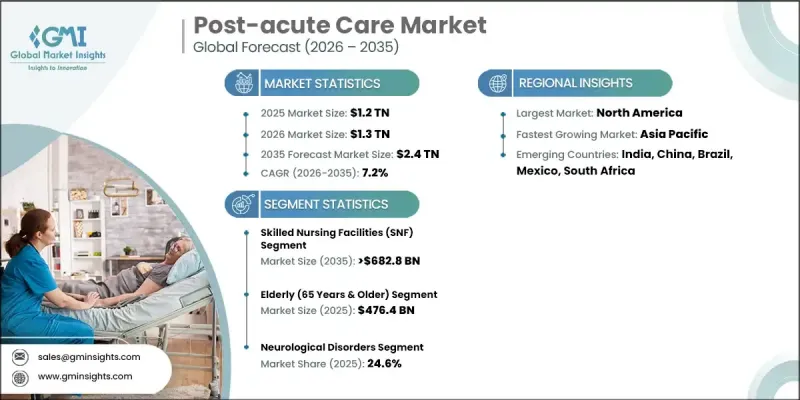
居家和社區復健服務的日益普及、復健技術的不斷創新以及慢性病和老年相關疾病盛行率的不斷上升,共同推動了復健市場的成長。全球人口結構的變化也促進了需求的持續成長,2022年,65歲以上人口占全球總人口的10%。這些因素增加了患者出院後長期復健護理的需求,推動了家庭醫療保健服務、專業護理機構和住院復健機構的使用。此外,醫療保健系統尋求經濟高效的復健途徑,以改善治療效果並減少再入院率,也進一步支撐了市場的發展。隨著患者期望的不斷變化,復健後護理機構正成為更廣泛的醫療保健服務體系中不可或缺的一部分,為不同患者群體提供長期復健、行動能力改善和慢性病管理方面的支持。
| 市場範圍 | |
|---|---|
| 起始年份 | 2025 |
| 預測年份 | 2026-2035 |
| 起始值 | 1.2兆美元 |
| 預測值 | 2.4兆美元 |
| 複合年成長率 | 7.2% |
數位健康解決方案的採用正在改變復健後護理的模式。遠距復健平台、穿戴式監測設備、人工智慧支援的復健分析以及自動化治療系統等技術,能夠實現對患者的持續監測和個人化治療方案的發展。這些進步有助於更早進行干預,並提高復原效率。由於成本優勢和更高的患者滿意度,居家和社區護理模式越來越受歡迎,這促使醫療機構擴大居家治療、遠端監測和專業護理課程的覆蓋範圍。這種轉變正逐步將復健後照護重新定位為更分散化、以病人為中心的照護模式。
預計到2025年,專業護理機構將佔市場佔有率的31.5%。這些機構的需求主要源於患者出院後需要持續的臨床監管、結構化的復健服務以及全面的復健支持。縮短住院時間的壓力持續推高了轉診至專業護理機構的患者數量。
2025年,65歲及以上人口創造了4,764億美元的經濟產值,預計到2035年將以7.1%的複合年成長率成長。壽命延長以及行動不便和慢性病的盛行率上升,推動了對復健、監測和長期恢復服務的持續需求。
2025年美國復健護理市場規模達4,906億美元,2026年至2035年將以6.4%的複合年成長率成長。向基於價值的照護模式的轉變,不斷加強復健護理機構在改善治療效果和確保醫療保健系統內護理連續性方面的作用。
目錄
第1章:方法論與範圍
第2章:執行概要
第3章:行業洞察
- 產業生態系分析
- 產業影響因素
- 成長促進因素
- 慢性病和合併症盛行率上升
- 轉向以價值為導向的醫療模式,以及降低醫院再入院率的壓力
- 患者越來越傾向於選擇居家和社區護理
- 遠距醫療和遠距患者監測技術的進步
- 產業陷阱與挑戰
- 報銷的不確定性與政策/監管變化
- 不同醫療機構和服務提供者之間的照護協調存在碎片化問題。
- 來自專業護理機構和門診中心的競爭
- 市場機遇
- 遠距醫療和遠距監測服務的擴展
- 居家醫院和家庭急性照護計畫的成長
- 成長促進因素
- 成長潛力分析
- 監管環境
- 北美洲
- 歐洲
- 亞太地區
- 技術格局
- 當前技術趨勢
- 新興技術
- 報銷方案
- 消費者洞察
- 未來市場趨勢
- 概述及優勢
- 復健護理中的價值導向護理模式
- 復健護理-投資展望
- 創業場景
- 波特的分析
- PESTEL 分析
- 差距分析
第4章:競爭格局
- 介紹
- 公司矩陣分析
- 競爭定位矩陣
- 主要市場參與者的競爭分析
- 關鍵進展
- 併購
- 合作夥伴關係與合作
- 新服務上線
- 擴張計劃
第5章:市場估算與預測:依服務類型分類,2022-2035年
- 專業護理機構(SNF)
- 家庭健康機構(HHA)
- 長期照護醫院(LTCH)
- 安寧療護
- 住院復健機構(IRF)
- 其他服務
第6章:市場估計與預測:依年齡層別分類,2022-2035年
- 老年人(65歲以上)
- 成人(45-64歲)
- 其他年齡層
第7章:市場估計與預測:依條件分類,2022-2035年
- 神經系統疾病
- 腦損傷
- 截肢
- 脊髓損傷
- 傷口管理
- 其他條件
第8章:市場估算與預測:依地區分類,2022-2035年
- 北美洲
- 美國
- 加拿大
- 歐洲
- 德國
- 英國
- 法國
- 西班牙
- 義大利
- 荷蘭
- 亞太地區
- 中國
- 日本
- 印度
- 澳洲
- 韓國
- 拉丁美洲
- 巴西
- 墨西哥
- 阿根廷
- 中東和非洲
- 南非
- 沙烏地阿拉伯
- 阿拉伯聯合大公國
第9章:公司簡介
- Alden Network
- Amedisys
- Athena Health Care Systems
- Bella Vista Health Center
- Benchmark Senior Living
- Brookdale Senior Living
- CareCentrix
- Covenant Care
- Encompass Health
- Evernorth Health
- Genesis Healthcare
- Select Medical
- SYMPHONY CARE NETWORK
- Vineyard Post Acute
- VITAS Healthcare
The Global Post-acute Care Market was valued at USD 1.2 trillion in 2025 and estimated to grow at a CAGR of 7.2% to reach USD 2.4 trillion by 2035.
The growth is supported by the rising preference for home-based and community-centered recovery services, continued innovation in rehabilitation technologies, and the growing prevalence of chronic and age-related health conditions. Global demographic shifts are also contributing to sustained demand, as the share of individuals aged 65 years and older reached 10% of the global population in 2022. These factors are increasing the need for extended recovery care following hospital discharge, driving utilization of home healthcare services, skilled nursing facilities, and inpatient rehabilitation settings. The market is further supported by healthcare systems seeking cost-effective recovery pathways that improve outcomes while reducing hospital readmissions. As patient expectations evolve, post-acute care providers are becoming an essential component of the broader care continuum, supporting long-term recovery, mobility improvement, and chronic condition management across diverse patient populations.
| Market Scope | |
|---|---|
| Start Year | 2025 |
| Forecast Year | 2026-2035 |
| Start Value | $1.2 Trillion |
| Forecast Value | $2.4 Trillion |
| CAGR | 7.2% |
The adoption of digital health solutions is transforming post-acute care delivery. Technologies such as remote rehabilitation platforms, wearable monitoring devices, AI-supported recovery analytics, and automated therapy systems enable continuous patient oversight and personalized treatment planning. These advancements support earlier intervention and improved recovery efficiency. Home- and community-based care models are increasingly favored due to cost advantages and higher patient satisfaction, encouraging providers to expand in-home therapy, remote monitoring, and skilled nursing programs. This shift is gradually repositioning post-acute care toward a more decentralized, patient-centered delivery model.
The skilled nursing facilities segment accounted for a 31.5% share in 2025. Demand for these facilities is driven by the need for continuous clinical supervision, structured rehabilitation services, and comprehensive recovery support following hospital stays. Pressure to reduce inpatient length of stay continues to strengthen referral volumes to skilled nursing providers.
The population aged 65 years and older generated USD 476.4 billion in 2025 and is expected to grow at a CAGR of 7.1% through 2035. Increasing longevity and higher rates of mobility limitations and chronic conditions are driving sustained demand for rehabilitation, monitoring, and long-term recovery services.
U.S. Post-acute Care Market generated USD 490.6 billion in 2025 and will grow at a CAGR of 6.4% from 2026 to 2035. The shift toward value-based care models continues to strengthen the role of post-acute providers in improving outcomes and ensuring care continuity across healthcare systems.
Key companies operating in the Global Post-acute Care Market include Encompass Health, Brookdale Senior Living, Amedisys, Genesis Healthcare, Select Medical, CareCentrix, Evernorth Health, Benchmark Senior Living, Athena Health Care Systems, Covenant Care, Alden Network, VITAS Healthcare, Vineyard Post Acute, Bella Vista Health Center, and SYMPHONY CARE NETWORK. Companies in the Post-acute Care Market adopt multiple strategies to reinforce their market position and expand service reach. Providers invest in home-based care models and remote monitoring technologies to align with patient preferences and cost-efficiency goals. Strategic expansion through partnerships and acquisitions helps broaden geographic coverage and service portfolios. Emphasis on clinical quality, outcomes measurement, and value-based care alignment strengthens relationships with hospitals and payers. Workforce development initiatives support skilled staffing across nursing and rehabilitation services.
Table of Contents
Chapter 1 Methodology and Scope
- 1.1 Market scope and definitions
- 1.2 Research design
- 1.2.1 Research approach
- 1.2.2 Data collection methods
- 1.3 Data mining sources
- 1.3.1 Global
- 1.3.2 Regional/country
- 1.4 Base estimates and calculations
- 1.4.1 Base year calculation
- 1.4.2 Key trends for market estimation
- 1.5 Primary research and validation
- 1.5.1 Primary sources
- 1.6 Forecast model
- 1.7 Research assumptions and limitations
Chapter 2 Executive Summary
- 2.1 Industry 3600 synopsis
- 2.2 Key market trends
- 2.2.1 Regional trends
- 2.2.2 Service trends
- 2.2.3 Age group trends
- 2.2.4 Condition trends
- 2.3 CXO perspectives: Strategic imperatives
- 2.3.1 Key decision points for industry executives
- 2.3.2 Critical success factors for market players
- 2.4 Future outlook and strategic recommendations
Chapter 3 Industry Insights
- 3.1 Industry ecosystem analysis
- 3.2 Industry impact forces
- 3.2.1 Growth drivers
- 3.2.1.1 Rising prevalence of chronic diseases and comorbidities
- 3.2.1.2 Shift to value-based care and pressure to reduce hospital readmissions
- 3.2.1.3 Increasing patient preference for home- and community-based care
- 3.2.1.4 Advances in telehealth and remote patient monitoring
- 3.2.2 Industry pitfalls and challenges
- 3.2.2.1 Reimbursement uncertainty and policy/regulatory changes
- 3.2.2.2 Fragmented care coordination across providers and settings
- 3.2.2.3 Competition from skilled nursing facilities and outpatient centers
- 3.2.3 Market opportunities
- 3.2.3.1 Expansion of telehealth and remote monitoring services
- 3.2.3.2 Growth of hospital-at-home and home-based acute care programs
- 3.2.1 Growth drivers
- 3.3 Growth potential analysis
- 3.4 Regulatory landscape
- 3.4.1 North America
- 3.4.2 Europe
- 3.4.3 Asia Pacific
- 3.5 Technology landscape
- 3.5.1 Current technological trends
- 3.5.2 Emerging technologies
- 3.6 Reimbursement scenario
- 3.7 Consumer insights
- 3.8 Future market trends
- 3.9 Overview and benefits
- 3.10 Value-based care model in post-acute care
- 3.11 Post-acute care - Investment outlook
- 3.12 Start-up scenario
- 3.13 Porter's analysis
- 3.14 PESTEL analysis
- 3.15 Gap analysis
Chapter 4 Competitive Landscape, 2025
- 4.1 Introduction
- 4.2 Company matrix analysis
- 4.3 Competitive positioning matrix
- 4.4 Competitive analysis of major market players
- 4.5 Key developments
- 4.5.1 Mergers & acquisitions
- 4.5.2 Partnerships & collaborations
- 4.5.3 New service launches
- 4.5.4 Expansion plans
Chapter 5 Market Estimates and Forecast, By Service, 2022 - 2035 ($ Mn)
- 5.1 Key trends
- 5.2 Skilled nursing facilities (SNF)
- 5.3 Home health agencies (HHA)
- 5.4 Long-term care hospitals (LTCHs)
- 5.5 Hospice care
- 5.6 Inpatient rehabilitation facilities (IRF)
- 5.7 Other services
Chapter 6 Market Estimates and Forecast, By Age Group, 2022 - 2035 ($ Mn)
- 6.1 Key trends
- 6.2 Elderly (65 years & older)
- 6.3 Adult (45-64 years)
- 6.4 Other age groups
Chapter 7 Market Estimates and Forecast, By Condition, 2022 - 2035 ($ Mn)
- 7.1 Key trends
- 7.2 Neurological disorders
- 7.3 Brain injury
- 7.4 Amputations
- 7.5 Spinal cord injury
- 7.6 Wound management
- 7.7 Other conditions
Chapter 8 Market Estimates and Forecast, By Region, 2022 - 2035 ($ Mn)
- 8.1 Key trends
- 8.2 North America
- 8.2.1 U.S.
- 8.2.2 Canada
- 8.3 Europe
- 8.3.1 Germany
- 8.3.2 UK
- 8.3.3 France
- 8.3.4 Spain
- 8.3.5 Italy
- 8.3.6 Netherlands
- 8.4 Asia Pacific
- 8.4.1 China
- 8.4.2 Japan
- 8.4.3 India
- 8.4.4 Australia
- 8.4.5 South Korea
- 8.5 Latin America
- 8.5.1 Brazil
- 8.5.2 Mexico
- 8.5.3 Argentina
- 8.6 Middle East and Africa
- 8.6.1 South Africa
- 8.6.2 Saudi Arabia
- 8.6.3 UAE
Chapter 9 Company Profiles
- 9.1 Alden Network
- 9.2 Amedisys
- 9.3 Athena Health Care Systems
- 9.4 Bella Vista Health Center
- 9.5 Benchmark Senior Living
- 9.6 Brookdale Senior Living
- 9.7 CareCentrix
- 9.8 Covenant Care
- 9.9 Encompass Health
- 9.10 Evernorth Health
- 9.11 Genesis Healthcare
- 9.12 Select Medical
- 9.13 SYMPHONY CARE NETWORK
- 9.14 Vineyard Post Acute
- 9.15 VITAS Healthcare

 骨盆底復健設備市場:依設備類型、技術、應用、最終用戶及通路分類-2026-2032年全球預測
 2026年全球污水再生服務市場報告
 全球門診復健中心市場規模、佔有率、趨勢和成長分析報告(2026-2034)2026年全球職業復健服務市場報告
 物理治療和復健解決方案市場 - 全球產業規模、佔有率、趨勢、機會和預測(按解決方案、應用、部署、最終用戶、地區和競爭格局分類),2021-2031年中風復健設備市場按產品類型、技術、價格範圍、患者年齡層、最終用戶和分銷管道分類,全球預測(2026-2032年)智慧復健浴缸市場按產品類型、治療模式、最終用戶和分銷管道分類,全球預測(2026-2032年)髖關節疼痛治療解決方案市場(按治療類型、年齡層、最終用戶和分銷管道分類),全球預測(2026-2032年)
 全球寵物復健治療市場預測(至2032年):依治療類型、類型、動物類型、通路、應用程式、最終用戶和地區分類全球寵物輔助治療服務市場:預測至2032年-按動物類型、治療方法類型、應用、最終使用者和地區分類的分析