


 |
市場調查報告書
商品編碼
1892815
炭黑市場機會、成長促進因素、產業趨勢分析及預測(2026-2035年)Carbon Black Market Opportunity, Growth Drivers, Industry Trend Analysis, and Forecast 2026 - 2035 |
||||||

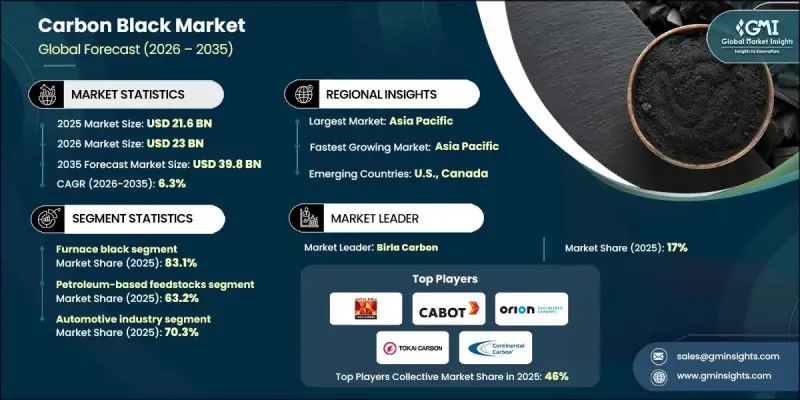
2025年全球炭黑市場價值為216億美元,預計到2035年將以6.3%的複合年成長率成長至398億美元。
市場成長主要受多個行業需求的推動。炭黑作為一種細小的碳顆粒,在橡膠製品(尤其是輪胎)中發揮著至關重要的增強作用,能夠顯著提升輪胎的強度、耐久性和耐磨性。汽車產量的激增,尤其是在發展中地區,是輪胎相關應用的關鍵促進因素。此外,炭黑也廣泛用作油漆、塗料和油墨的顏料,可提供深邃的黑色和優異的抗紫外線性能。隨著電動車和再生能源的發展,炭黑在電子、導電材料、電池和電磁屏蔽等領域的新興應用也日益增加。目前,針對特定工業用途的特種炭黑也在不斷研發中。同時,由於傳統製程會產生顆粒物排放和污染物,該產業正面臨採用環境永續生產方式的壓力。
| 市場範圍 | |
|---|---|
| 起始年份 | 2025 |
| 預測年份 | 2026-2035 |
| 起始值 | 216億美元 |
| 預測值 | 398億美元 |
| 複合年成長率 | 6.3% |
2025年,爐法炭黑市佔率達到83.1%,預計到2035年將以6.3%的複合年成長率成長。其成本效益和大規模生產能力使其成為應用最廣泛的炭黑形式。橡膠、塑膠、塗料和油墨產業是其主要消費產業,這主要受對耐用、高性能產品的需求所驅動。
2025年,石油基原料市佔率達到63.2%,預計2026年至2035年將以6.4%的複合年成長率成長。石油因其儲量豐富且經濟可行,仍是主要的原料。先進的煉製和加工技術正在被應用,以提高效率並減少排放。
預計到2025年,北美炭黑市佔率將達到14.8%。汽車、橡膠和包裝產業的成長,以及永續生產技術的應用,是推動市場成長的主要動力。美國和加拿大對綠色技術的投資以及嚴格的環境法規,促使製造商在保持高性能的同時,生產更清潔、生物基的炭黑。
目錄
第1章:方法論與範圍
第2章:執行概要
第3章:行業洞察
- 產業生態系分析
- 供應商格局
- 利潤率
- 每個階段的價值增加
- 影響價值鏈的因素
- 中斷
- 產業影響因素
- 成長促進因素
- 產業陷阱與挑戰
- 市場機遇
- 成長潛力分析
- 監管環境
- 北美洲
- 歐洲
- 亞太地區
- 拉丁美洲
- 中東和非洲
- 波特的分析
- PESTEL 分析
- 價格趨勢
- 按地區
- 按原料
- 未來市場趨勢
- 技術與創新格局
- 當前技術趨勢
- 新興技術
- 專利格局
- 貿易統計(HS編碼)(註:僅提供重點國家的貿易統計資料)
- 主要進口國
- 主要出口國
- 永續性和環境方面
- 永續實踐
- 減少廢棄物策略
- 生產中的能源效率
- 環保舉措
- 碳足跡考量
第4章:競爭格局
- 介紹
- 公司市佔率分析
- 按地區
- 北美洲
- 歐洲
- 亞太地區
- 拉丁美洲
- MEA
- 按地區
- 公司矩陣分析
- 主要市場參與者的競爭分析
- 競爭定位矩陣
- 關鍵進展
- 併購
- 合作夥伴關係與合作
- 新產品發布
- 擴張計劃
第5章:市場估算與預測:依製造流程分類,2022-2035年
- 爐黑
- 熱黑
- 乙炔黑
- 燈黑
- 頻道駭
第6章:市場估算與預測:依原料分類,2022-2035年
- 石油基原料
- 煤基原料
- 天然氣
- 生物基和可再生原料
第7章:市場估算與預測:依最終用途產業分類,2022-2035年
- 汽車產業
- 輪胎製造
- 非輪胎汽車橡膠
- 汽車塑膠
- 汽車塗料
- 建築業
- 屋頂材料
- 密封劑和黏合劑
- 地工膜防水材料
- 電纜和導管
- 工業製造
- 傳送帶
- 工業軟管和墊圈
- 機械橡膠製品
- 工業塗料
- 電學
- 電池製造
- 半導體
- 電線電纜絕緣
- 導電聚合物及複合材料
- 包裝產業
- 塑膠包裝
- 食品接觸材料
- 阻隔膜
- 印刷出版
- 印刷油墨
- 碳粉和噴墨墨水
- 紡織業
- 紡織品印染
- 纖維改性
- 特種布料
- 其他行業
第8章:市場估算與預測:依地區分類,2022-2035年
- 北美洲
- 美國
- 加拿大
- 歐洲
- 德國
- 英國
- 法國
- 西班牙
- 義大利
- 歐洲其他地區
- 亞太地區
- 中國
- 印度
- 日本
- 澳洲
- 韓國
- 亞太其他地區
- 拉丁美洲
- 巴西
- 墨西哥
- 阿根廷
- 拉丁美洲其他地區
- 中東和非洲
- 沙烏地阿拉伯
- 南非
- 阿拉伯聯合大公國
- 中東和非洲其他地區
第9章:公司簡介
- Asahi Carbon Co., Ltd.
- Birla Carbon India Private Limited
- Black Bear Carbon BV
- Cabot Corporation
- China Synthetic Rubber Corporation
- Continental Carbon
- Jinneng Science and Technology Company Limited
- Longxing Chemical Stock Co., Ltd.
- Mitsubishi Chemical Corporation
- Monolith Materials, Inc.
- OCI Company Ltd
- Omsk Carbon Group OOO
- Orion Engineered Carbons SA
- Phillips Carbon Black Limited
- Qingzhou Boao Carbon Black Co., Ltd.
- Shandong Huadong Rubber Materials Co., Ltd.
- Tokai Carbon Co., Ltd.
The Global Carbon Black Market was valued at USD 21.6 billion in 2025 and is estimated to grow at a CAGR of 6.3% to reach USD 39.8 billion by 2035.
The market is propelled by the expanding demand across multiple industries. Carbon black, as a finely divided form of carbon, plays a vital role as a reinforcing agent in rubber products, particularly tires, where it enhances strength, durability, and wear resistance. The surge in automotive production, especially in developing regions, is a key driver for tire-related applications. Additionally, carbon black is extensively used as a pigment in paints, coatings, and inks, offering deep black coloration and UV resistance. Emerging applications in electronics, conductive materials, batteries, and electromagnetic shielding align with the growth of electric vehicles and renewable energy. Specialty carbon blacks are also being developed for tailored industrial uses. At the same time, the industry is experiencing pressure to adopt environmentally sustainable manufacturing practices due to the particulate emissions and pollutants from conventional processes.
| Market Scope | |
|---|---|
| Start Year | 2025 |
| Forecast Year | 2026-2035 |
| Start Value | $21.6 Billion |
| Forecast Value | $39.8 Billion |
| CAGR | 6.3% |
The furnace black segment held an 83.1% share in 2025 and is projected to grow at a CAGR of 6.3% through 2035. Its cost-effectiveness and large-scale manufacturability make it the most widely used form of carbon black. The rubber, plastics, coatings, and ink industries are the primary consumers, driven by demand for durable, high-performance products.
The petroleum-based feedstocks segment held a 63.2% share in 2025 and is expected to grow at a CAGR of 6.4% from 2026 to 2035. Petroleum remains the dominant raw material due to its availability and economic feasibility. Advanced refining and processing technologies are being implemented to enhance efficiency and reduce emissions.
North America Carbon Black Market accounted for a 14.8% share in 2025. Growth is fueled by the automotive, rubber, and packaging industries, coupled with the adoption of sustainable production technologies. Investments in green technologies and strict environmental regulations in the U.S. and Canada are motivating manufacturers to produce cleaner, bio-based carbon blacks while maintaining high performance.
Major players in the Global Carbon Black Market include Continental Carbon, Black Bear Carbon BV, Mitsubishi Chemical Corporation, Birla Carbon India Private Limited, OCI Company Ltd, Asahi Carbon Co., Ltd., Jinneng Science and Technology Company Limited, Tokai Carbon Co., Ltd., Orion Engineered Carbons S.A., Phillips Carbon Black Limited, China Synthetic Rubber Corporation, Omsk Carbon Group OOO, Longxing Chemical Stock Co., Ltd., Shandong Huadong Rubber Materials Co., Ltd., and Monolith Materials, Inc. Companies in the Carbon Black Market are strengthening their market positions by investing in R&D to develop high-performance and specialty carbon blacks tailored for automotive, electronics, and industrial applications. Firms are focusing on sustainable production methods, including bio-based feedstocks and cleaner manufacturing technologies, to comply with environmental regulations and appeal to eco-conscious customers. Strategic partnerships with raw material suppliers and manufacturers enable secure supply chains and cost efficiency.
Table of Contents
Chapter 1 Methodology & Scope
- 1.1 Market scope and definition
- 1.2 Research design
- 1.2.1 Research approach
- 1.2.2 Data collection methods
- 1.3 Data mining sources
- 1.3.1 Global
- 1.3.2 Regional/Country
- 1.4 Base estimates and calculations
- 1.4.1 Base year calculation
- 1.4.2 Key trends for market estimation
- 1.5 Primary research and validation
- 1.5.1 Primary sources
- 1.6 Forecast model
- 1.7 Research assumptions and limitations
Chapter 2 Executive Summary
- 2.1 Industry 3600 synopsis
- 2.2 Key market trends
- 2.2.1 Regional
- 2.2.2 Manufacturing process
- 2.2.3 Feedstock
- 2.2.4 End use industry
- 2.3 TAM Analysis, 2026-2035
- 2.4 CXO perspectives: Strategic imperatives
- 2.4.1 Executive decision points
- 2.4.2 Critical success factors
- 2.5 Future Outlook and Strategic Recommendations
Chapter 3 Industry Insights
- 3.1 Industry ecosystem analysis
- 3.1.1 Supplier landscape
- 3.1.2 Profit margin
- 3.1.3 Value addition at each stage
- 3.1.4 Factor affecting the value chain
- 3.1.5 Disruptions
- 3.2 Industry impact forces
- 3.2.1 Growth drivers
- 3.2.2 Industry pitfalls and challenges
- 3.2.3 Market opportunities
- 3.3 Growth potential analysis
- 3.4 Regulatory landscape
- 3.4.1 North America
- 3.4.2 Europe
- 3.4.3 Asia Pacific
- 3.4.4 Latin America
- 3.4.5 Middle East & Africa
- 3.5 Porter's analysis
- 3.6 PESTEL analysis
- 3.7 Price trends
- 3.7.1 By region
- 3.7.2 By feedstock
- 3.8 Future market trends
- 3.9 Technology and Innovation landscape
- 3.9.1 Current technological trends
- 3.9.2 Emerging technologies
- 3.10 Patent Landscape
- 3.11 Trade statistics (HS code) ( Note: the trade statistics will be provided for key countries only)
- 3.11.1 Major importing countries
- 3.11.2 Major exporting countries
- 3.12 Sustainability and environmental aspects
- 3.12.1 Sustainable practices
- 3.12.2 Waste reduction strategies
- 3.12.3 Energy efficiency in production
- 3.12.4 Eco-friendly initiatives
- 3.13 Carbon footprint consideration
Chapter 4 Competitive Landscape, 2025
- 4.1 Introduction
- 4.2 Company market share analysis
- 4.2.1 By region
- 4.2.1.1 North America
- 4.2.1.2 Europe
- 4.2.1.3 Asia Pacific
- 4.2.1.4 LATAM
- 4.2.1.5 MEA
- 4.2.1 By region
- 4.3 Company matrix analysis
- 4.4 Competitive analysis of major market players
- 4.5 Competitive positioning matrix
- 4.6 Key developments
- 4.6.1 Mergers & acquisitions
- 4.6.2 Partnerships & collaborations
- 4.6.3 New Product Launches
- 4.6.4 Expansion Plans
Chapter 5 Market Estimates and Forecast, By Manufacturing Process, 2022-2035 (USD Billion) (Kilo Tons)
- 5.1 Key trends
- 5.2 Furnace black
- 5.3 Thermal black
- 5.4 Acetylene black
- 5.5 Lamp black
- 5.6 Channel black
Chapter 6 Market Estimates and Forecast, By Feedstock, 2022-2035 (USD Billion) (Kilo Tons)
- 6.1 Key trends
- 6.2 Petroleum-based feedstocks
- 6.3 Coal-based feedstocks
- 6.4 Natural gas
- 6.5 Bio-based & renewable feedstocks
Chapter 7 Market Estimates and Forecast, By End Use Industry, 2022-2035 (USD Billion) (Kilo Tons)
- 7.1 Key trends
- 7.2 Automotive industry
- 7.2.1 Tire manufacturing
- 7.2.2 Non-tire automotive rubber
- 7.2.3 Automotive plastics
- 7.2.4 Automotive coatings
- 7.3 Construction industry
- 7.3.1 Roofing materials
- 7.3.2 Sealants & adhesives
- 7.3.3 Geomembranes & waterproofing
- 7.3.4 Cables & conduits
- 7.4 Industrial manufacturing
- 7.4.1 Conveyor belts
- 7.4.2 Industrial hoses & gaskets
- 7.4.3 Mechanical rubber goods
- 7.4.4 Industrial coatings
- 7.5 Electronics & electrical
- 7.5.1 Battery manufacturing
- 7.5.2 Semiconductors
- 7.5.3 Wire & cable insulation
- 7.5.4 Conductive polymers & composites
- 7.6 Packaging industry
- 7.6.1 Plastics packaging
- 7.6.2 Food-contact materials
- 7.6.3 Barrier films
- 7.7 Printing & publishing
- 7.7.1 Printing inks
- 7.7.2 Toners & inkjet inks
- 7.8 Textile industry
- 7.8.1 Textile printing & dyeing
- 7.8.2 Fiber modification
- 7.8.3 Specialty fabrics
- 7.9 Other industries
Chapter 8 Market Estimates and Forecast, By Region, 2022-2035 (USD Billion) (Kilo Tons)
- 8.1 Key trends
- 8.2 North America
- 8.2.1 U.S.
- 8.2.2 Canada
- 8.3 Europe
- 8.3.1 Germany
- 8.3.2 UK
- 8.3.3 France
- 8.3.4 Spain
- 8.3.5 Italy
- 8.3.6 Rest of Europe
- 8.4 Asia Pacific
- 8.4.1 China
- 8.4.2 India
- 8.4.3 Japan
- 8.4.4 Australia
- 8.4.5 South Korea
- 8.4.6 Rest of Asia Pacific
- 8.5 Latin America
- 8.5.1 Brazil
- 8.5.2 Mexico
- 8.5.3 Argentina
- 8.5.4 Rest of Latin America
- 8.6 Middle East and Africa
- 8.6.1 Saudi Arabia
- 8.6.2 South Africa
- 8.6.3 UAE
- 8.6.4 Rest of Middle East and Africa
Chapter 9 Company Profiles
- 9.1 Asahi Carbon Co., Ltd.
- 9.2 Birla Carbon India Private Limited
- 9.3 Black Bear Carbon BV
- 9.4 Cabot Corporation
- 9.5 China Synthetic Rubber Corporation
- 9.6 Continental Carbon
- 9.7 Jinneng Science and Technology Company Limited
- 9.8 Longxing Chemical Stock Co., Ltd.
- 9.9 Mitsubishi Chemical Corporation
- 9.10 Monolith Materials, Inc.
- 9.11 OCI Company Ltd
- 9.12 Omsk Carbon Group OOO
- 9.13 Orion Engineered Carbons S.A.
- 9.14 Phillips Carbon Black Limited
- 9.15 Qingzhou Boao Carbon Black Co., Ltd.
- 9.16 Shandong Huadong Rubber Materials Co., Ltd.
- 9.17 Tokai Carbon Co., Ltd.

 炭黑市場:按類型、等級、物理形狀、製造流程、功能、應用、最終用途產業和分銷管道分類-全球市場預測(2026-2032 年)爐法炭黑市場:依等級、形態、通路和應用分類-2026-2032年全球市場預測鉛酸蓄電池市場中的炭黑:2026年至2032年全球市場預測(依產品類型、形態、電池類型、電池組件、應用、客戶類型和銷售管道)
 2026年全球黑火藥市場報告特種奈米碳管管粉末市場:依純度、類型、生產方法、功能、最終用途和應用分類-全球預測,2026-2032年
 全球炭黑市場(2026-2036)
 炭黑:市場佔有率分析、產業趨勢與統計、成長預測(2026-2031)全球炭黑市場規模、佔有率、趨勢和成長分析報告(2026-2034年)2026年全球炭黑市場報告2026年全球石墨化炭黑(GCB)市場報告