


 |
市場調查報告書
商品編碼
1892811
動物飼料酵素市場機會、成長促進因素、產業趨勢分析及預測(2026-2035年)Animal Feed Enzymes Market Opportunity, Growth Drivers, Industry Trend Analysis, and Forecast 2026 - 2035 |
||||||

2025年全球動物飼料酵素市場價值為18億美元,預計2035年將以7.2%的複合年成長率成長至36億美元。
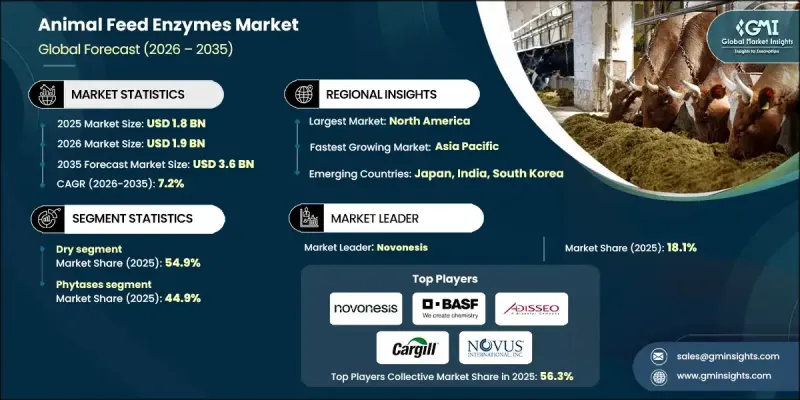
動物飼料酵素作為生物催化劑,能夠提高動物日糧中營養物質的消化率,進而促進動物生長、增強免疫力、維持整體健康並提高生產性能。隨著全球關注的重點從單純的組織營養儲存轉向最大限度地提高飼料轉換率,酵素正成為提升動物生產性能的關鍵工具。酵素能夠分解複雜的飼料成分,包括纖維、澱粉和植酸鹽,進而提高營養吸收率。飼料成本的上漲、肉類需求的成長以及人們對動物福利和健康的日益重視,進一步推動了市場對酵素的接受度。酵素有助於減少抗生素、荷爾蒙療法的使用以及廢物排放,這與各地對畜牧業抗生素使用日益嚴格的法規相符。此外,酵素製劑技術的不斷進步正在推動精準畜牧業的發展,使酵素成為永續高效動物生產不可或缺的工具。
| 市場範圍 | |
|---|---|
| 起始年份 | 2025 |
| 預測年份 | 2026-2035 |
| 起始值 | 18億美元 |
| 預測值 | 36億美元 |
| 複合年成長率 | 7.2% |
2025年,乾粉酶製劑市佔率達到54.9%,預計到2035年將以7.1%的複合年成長率成長。乾粉製劑之所以佔據主導地位,是因為它們易於操作、保存期限更長,並且在儲存和運輸過程中穩定性更好。與液體酵素相比,乾粉製劑不易變質和分解,從而為生產商和終端用戶節省成本。此外,將其添加到預混飼料配方中,既簡化了生產流程,又能確保酵素的均勻分佈。
到2025年,植酸酶市場佔有率預計將達到44.9%,這主要是因為它們可以解決牲畜日糧中的磷缺乏問題。植酸酶透過提高植物性飼料中磷的生物利用度,減少了對無機磷補充劑的依賴,從而既改善了動物營養,也降低了飼料配方成本。
預計2026年至2035年間,北美動物飼料酵素市場將以7.2%的複合年成長率成長。成長的主要驅動力是消費者對環境影響和動物福利意識的不斷提高,從而催生了對能夠提高飼料轉換率和減少浪費的酵素製劑的需求。針對特定牲畜需求的酵素製劑創新,以及精準農業實踐的結合,進一步促進了市場成長。此外,旨在促進永續農業實踐和減少溫室氣體排放的支持性法規也有助於推動區域內酵素製劑的普及應用。
目錄
第1章:方法論與範圍
第2章:執行概要
第3章:行業洞察
- 產業生態系分析
- 供應商格局
- 利潤率
- 每個階段的價值增加
- 影響價值鏈的因素
- 中斷
- 產業影響因素
- 成長促進因素
- 全球肉類消費量和蛋白質需求不斷成長
- 飼料成本最佳化與效率壓力
- 動物福利與性能提升重點
- 產業陷阱與挑戰
- 熱穩定性和儲存限制
- 來自替代飼料添加劑的競爭
- 市場機遇
- 有機和非基因改造酶的需求
- 個人化營養與精準餵養
- 成長促進因素
- 成長潛力分析
- 監管環境
- 北美洲
- 歐洲
- 亞太地區
- 拉丁美洲
- 中東和非洲
- 波特的分析
- PESTEL 分析
- 價格趨勢
- 按地區
- 配方
- 未來市場趨勢
- 技術與創新格局
- 當前技術趨勢
- 新興技術
- 專利格局
- 貿易統計(HS編碼)(註:僅提供重點國家的貿易統計資料)
- 主要進口國
- 主要出口國
- 永續性和環境方面
- 永續實踐
- 減少廢棄物策略
- 生產中的能源效率
- 環保舉措
- 碳足跡考量
第4章:競爭格局
- 介紹
- 公司市佔率分析
- 按地區
- 北美洲
- 歐洲
- 亞太地區
- 拉丁美洲
- MEA
- 按地區
- 公司矩陣分析
- 主要市場參與者的競爭分析
- 競爭定位矩陣
- 關鍵進展
- 併購
- 合作夥伴關係與合作
- 新產品發布
- 擴張計劃
第5章:市場估價與預測:依配方分類,2022-2035年
- 乾燥
- 粉末
- 顆粒狀
- 液體
第6章:市場估算與預測:依酵素類型分類,2022-2035年
- 植酸酶
- 3-植酸酶
- 6-植酸酶
- 共識植酸酶
- 蛋白酶
- 碳水化合物酶
- 澱粉分解酶(澱粉酶)
- 非澱粉多醣(NSP)酶
- 脂肪酶
- 其他
第7章:市場估計與預測:依畜牧業分類,2022-2035年
- 家禽
- 肉雞
- 層
- 火雞
- 其他
- 豬
- 仔豬和斷奶仔豬
- 種植者和育肥者
- 母豬
- 反芻動物
- 乳牛
- 肉牛
- 綿羊和山羊
- 其他
- 水產養殖
- 魚
- 蝦子和甲殼類動物
- 海洋物種
- 其他
- 寵物食品
- 馬科動物
- 其他
第8章:市場估算與預測:依地區分類,2022-2035年
- 北美洲
- 美國
- 加拿大
- 歐洲
- 德國
- 英國
- 法國
- 西班牙
- 義大利
- 歐洲其他地區
- 亞太地區
- 中國
- 印度
- 日本
- 澳洲
- 韓國
- 亞太其他地區
- 拉丁美洲
- 巴西
- 墨西哥
- 阿根廷
- 拉丁美洲其他地區
- 中東和非洲
- 沙烏地阿拉伯
- 南非
- 阿拉伯聯合大公國
- 中東和非洲其他地區
第9章:公司簡介
- BASF SE
- AB Enzymes
- Adisseo
- Alltech
- Cargill, Inc.
- Elanco Animal Health
- Foodchem International Corporation
- International Flavors & Fragrances, Inc.
- Kemin Industries
- Kerry Group
- Novonesis
- Novus International
The Global Animal Feed Enzymes Market was valued at USD 1.8 billion in 2025 and is estimated to grow at a CAGR of 7.2% to reach USD 3.6 billion by 2035.
Animal feed enzymes act as biological catalysts that enhance nutrient digestibility in animal diets, supporting growth, immunity, overall health, and productivity. With global priorities focused on maximizing feed conversion efficiency rather than just nutrient storage in tissues, enzymes are becoming a crucial tool for improving animal production. They break down complex feed components, including fibers, starches, and phytates, increasing nutrient absorption. Rising feed costs, growing meat demand, and heightened attention to animal welfare and health further drive market adoption. Enzymes help reduce the need for antibiotics, hormone therapies, and waste emissions, aligning with stricter regulations on livestock antibiotic use across various regions. Additionally, ongoing technological advancements in enzyme formulations are supporting precision livestock farming, making enzymes essential for sustainable and efficient animal production.
| Market Scope | |
|---|---|
| Start Year | 2025 |
| Forecast Year | 2026-2035 |
| Start Value | $1.8 Billion |
| Forecast Value | $3.6 Billion |
| CAGR | 7.2% |
The dry enzyme segment accounted for a 54.9% share in 2025 and is expected to grow at a CAGR of 7.1% through 2035. Dry formulations dominate due to their ease of handling, longer shelf life, and stability during storage and transportation. They are less prone to spoilage and degradation than liquid enzymes, offering cost-effectiveness for both manufacturers and end-users. Their integration into premixed feed formulations also simplifies manufacturing while ensuring uniform enzyme distribution.
The phytases segment held 44.9% share in 2025, primarily because they address phosphorus deficiencies in livestock diets. By improving phosphorus bioavailability in plant-based feeds, phytases reduce reliance on inorganic phosphorus supplements, supporting both animal nutrition and cost savings in feed formulations.
North America Animal Feed Enzymes Market is expected to grow at a CAGR of 7.2% between 2026 and 2035. Growth is driven by increasing consumer awareness of environmental impact and animal welfare, creating demand for enzyme solutions that improve feed efficiency and reduce waste. Innovation in enzyme formulations tailored to specific livestock needs, combined with precision farming practices, further strengthens market growth. Supportive regulations targeting sustainable farming practices and greenhouse gas reduction also contribute to regional adoption.
Key players in the Global Animal Feed Enzymes Market include BASF SE, AB Enzymes, Adisseo, Alltech, Cargill, Inc., Elanco Animal Health, Foodchem International Corporation, International Flavors & Fragrances, Inc., Kemin Industries, Kerry Group, Novonesis, and Novus International. Companies in the Global Animal Feed Enzymes Market are enhancing their presence through multiple strategies. They focus on R&D to develop enzyme formulations tailored for specific livestock species and feed types, improving efficiency and nutritional outcomes. Strategic partnerships, mergers, and acquisitions expand distribution networks and access to new geographies. Investments in precision livestock technologies and sustainable farming solutions help position brands as environmentally responsible and innovative. Firms also engage in educational campaigns for farmers, promoting enzyme benefits and adoption.
Table of Contents
Chapter 1 Methodology & Scope
- 1.1 Market scope and definition
- 1.2 Research design
- 1.2.1 Research approach
- 1.2.2 Data collection methods
- 1.3 Data mining sources
- 1.3.1 Global
- 1.3.2 Regional/Country
- 1.4 Base estimates and calculations
- 1.4.1 Base year calculation
- 1.4.2 Key trends for market estimation
- 1.5 Primary research and validation
- 1.5.1 Primary sources
- 1.6 Forecast model
- 1.7 Research assumptions and limitations
Chapter 2 Executive Summary
- 2.1 Industry 360° synopsis
- 2.2 Key market trends
- 2.2.1 Regional
- 2.2.2 Formulation
- 2.2.3 Enzyme type
- 2.2.4 Livestock
- 2.3 TAM Analysis, 2026-2035
- 2.4 CXO perspectives: Strategic imperatives
- 2.4.1 Executive decision points
- 2.4.2 Critical success factors
- 2.5 Future Outlook and Strategic Recommendations
Chapter 3 Industry Insights
- 3.1 Industry ecosystem analysis
- 3.1.1 Supplier landscape
- 3.1.2 Profit margin
- 3.1.3 Value addition at each stage
- 3.1.4 Factor affecting the value chain
- 3.1.5 Disruptions
- 3.2 Industry impact forces
- 3.2.1 Growth drivers
- 3.2.1.1 Rising global meat consumption & protein demand
- 3.2.1.2 Feed cost optimization & efficiency pressures
- 3.2.1.3 Animal welfare & performance enhancement focus
- 3.2.2 Industry pitfalls and challenges
- 3.2.2.1 Heat stability & storage limitations
- 3.2.2.2 Competition from alternative feed additives
- 3.2.3 Market opportunities
- 3.2.3.1 Organic & non-GMO enzyme demand
- 3.2.3.2 Personalized nutrition & precision feeding
- 3.2.1 Growth drivers
- 3.3 Growth potential analysis
- 3.4 Regulatory landscape
- 3.4.1 North America
- 3.4.2 Europe
- 3.4.3 Asia Pacific
- 3.4.4 Latin America
- 3.4.5 Middle East & Africa
- 3.5 Porter's analysis
- 3.6 PESTEL analysis
- 3.7 Price trends
- 3.7.1 By region
- 3.7.2 By formulation
- 3.8 Future market trends
- 3.9 Technology and innovation landscape
- 3.9.1 Current technological trends
- 3.9.2 Emerging technologies
- 3.10 Patent Landscape
- 3.11 Trade statistics (HS code)( Note: the trade statistics will be provided for key countries only)
- 3.11.1 Major importing countries
- 3.11.2 Major exporting countries
- 3.12 Sustainability and environmental aspects
- 3.12.1 Sustainable practices
- 3.12.2 Waste reduction strategies
- 3.12.3 Energy efficiency in production
- 3.12.4 Eco-friendly initiatives
- 3.13 Carbon footprint consideration
Chapter 4 Competitive Landscape, 2025
- 4.1 Introduction
- 4.2 Company market share analysis
- 4.2.1 By region
- 4.2.1.1 North America
- 4.2.1.2 Europe
- 4.2.1.3 Asia Pacific
- 4.2.1.4 LATAM
- 4.2.1.5 MEA
- 4.2.1 By region
- 4.3 Company matrix analysis
- 4.4 Competitive analysis of major market players
- 4.5 Competitive positioning matrix
- 4.6 Key developments
- 4.6.1 Mergers & acquisitions
- 4.6.2 Partnerships & collaborations
- 4.6.3 New Product Launches
- 4.6.4 Expansion Plans
Chapter 5 Market Estimates and Forecast, By Formulation, 2022-2035 (USD Billion) (Kilo Tons)
- 5.1 Key trends
- 5.2 Dry
- 5.2.1 Powder
- 5.2.2 Granular
- 5.3 Liquid
Chapter 6 Market Estimates and Forecast, By Enzyme Type, 2022-2035 (USD Billion) (Kilo Tons)
- 6.1 Key trends
- 6.2 Phytases
- 6.2.1 3-phytase
- 6.2.2 6-phytase
- 6.2.3 Consensus phytase
- 6.3 Proteases
- 6.4 Carbohydrases
- 6.4.1 Starch-degrading enzymes (amylases)
- 6.4.2 Non-starch polysaccharide (NSP) enzymes
- 6.5 Lipases
- 6.6 Others
Chapter 7 Market Estimates and Forecast, By Livestock, 2022-2035 (USD Billion) (Kilo Tons)
- 7.1 Key trends
- 7.2 Poultry
- 7.2.1 Broilers
- 7.2.2 Layers
- 7.2.3 Turkeys
- 7.2.4 Others
- 7.3 Swine
- 7.3.1 Piglets & weaners
- 7.3.2 Growers & finishers
- 7.3.3 Sows
- 7.4 Ruminants
- 7.4.1 Dairy cattle
- 7.4.2 Beef cattle
- 7.4.3 Sheep & goats
- 7.4.4 Others
- 7.5 Aquaculture
- 7.5.1 Fish
- 7.5.2 Shrimp & crustaceans
- 7.5.3 Marine species
- 7.6 Others
- 7.6.1 Pet food
- 7.6.2 Equine
- 7.6.3 Others
Chapter 8 Market Estimates and Forecast, By Region, 2022-2035 (USD Billion) (Kilo Tons)
- 8.1 Key trends
- 8.2 North America
- 8.2.1 U.S.
- 8.2.2 Canada
- 8.3 Europe
- 8.3.1 Germany
- 8.3.2 UK
- 8.3.3 France
- 8.3.4 Spain
- 8.3.5 Italy
- 8.3.6 Rest of Europe
- 8.4 Asia Pacific
- 8.4.1 China
- 8.4.2 India
- 8.4.3 Japan
- 8.4.4 Australia
- 8.4.5 South Korea
- 8.4.6 Rest of Asia Pacific
- 8.5 Latin America
- 8.5.1 Brazil
- 8.5.2 Mexico
- 8.5.3 Argentina
- 8.5.4 Rest of Latin America
- 8.6 Middle East and Africa
- 8.6.1 Saudi Arabia
- 8.6.2 South Africa
- 8.6.3 UAE
- 8.6.4 Rest of Middle East and Africa
Chapter 9 Company Profiles
- 9.1 BASF SE
- 9.2 AB Enzymes
- 9.3 Adisseo
- 9.4 Alltech
- 9.5 Cargill, Inc.
- 9.6 Elanco Animal Health
- 9.7 Foodchem International Corporation
- 9.8 International Flavors & Fragrances, Inc.
- 9.9 Kemin Industries
- 9.10 Kerry Group
- 9.11 Novonesis
- 9.12 Novus International


