


 |
市場調查報告書
商品編碼
1892790
分離機械市場機會、成長促進因素、產業趨勢分析及預測(2026-2035年)Separation Machinery Market Opportunity, Growth Drivers, Industry Trend Analysis, and Forecast 2026 - 2035 |
||||||

2025年全球分離機械市場價值為1,026億美元,預計到2035年將以7.2%的複合年成長率成長至2,031億美元。
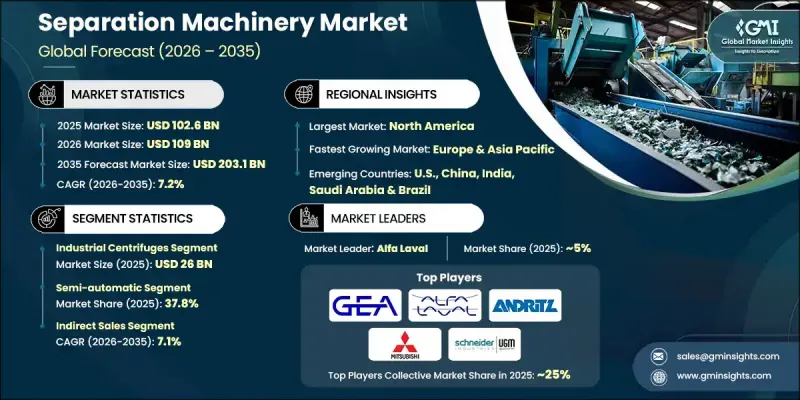
市場成長主要得益於製藥、化工、食品飲料、石油天然氣和採礦等行業的工業活動不斷擴張。隨著各行業規模的擴大,對能夠提升產品品質、實現資源回收並滿足嚴格環保法規要求的更高效分離製程的需求日益成長。亞太、拉丁美洲和非洲的快速工業化進程正在推動對離心機、過濾器和膜分離器等先進設備的投資。包括智慧感測器、人工智慧驅動的製程最佳化和新一代膜過濾技術在內的技術創新,正在提升營運效率、降低能耗並提高可靠性。模組化設備設計與支援預測性維護的數位化監控系統正與工業4.0標準接軌。永續發展措施和日益成長的城市化正在為新興市場的製造商創造新的機會。
| 市場範圍 | |
|---|---|
| 起始年份 | 2025 |
| 預測年份 | 2026-2035 |
| 起始值 | 1026億美元 |
| 預測值 | 2031億美元 |
| 複合年成長率 | 7.2% |
2025年,工業離心機市場規模達260億美元,預計2026年至2035年將以7.7%的複合年成長率成長。由於其精度高、處理能力強、性能卓越,這些系統在多個行業中用於固液分離,發揮至關重要的作用。製藥和生物技術產業對高純度產品的需求不斷成長,以及廢水管理和回收日益嚴格的環境法規,正在推動先進離心機技術的廣泛應用。
到2025年,間接銷售通路的市佔率將達到61.9%,預計到2035年將以7.1%的複合年成長率成長。間接通路提供捆綁式解決方案、融資方案和強大的區域網路,使中小企業更容易獲得設備。這些經銷商和通路合作夥伴作為策略盟友,提供整合服務,促進更快的市場滲透,同時確保對客戶需求的快速回應。
2025年美國分離機械市場規模達211億美元,預計2026年至2035年將以7.9%的複合年成長率成長。製藥、化學、食品飲料、石油天然氣和水處理等行業的快速工業化推動了對先進分離系統的需求。政府在永續發展、脫碳以及零液體排放(ZLD)、全氟烷基和多氟烷基物質(PFAS)去除和廢水回收利用等方面的舉措,加速了節能環保分離技術的應用。
目錄
第1章:方法論與範圍
第2章:執行概要
第3章:行業洞察
- 產業生態系分析
- 供應商格局
- 利潤率
- 每個階段的價值增加
- 影響價值鏈的因素
- 產業影響因素
- 成長促進因素
- 各領域的快速工業化
- 分離技術的創新
- 新興市場需求不斷成長
- 產業陷阱與挑戰
- 高昂的初始投資成本
- 日益嚴格的環境法規
- 成長促進因素
- 成長潛力分析
- 未來市場趨勢
- 技術與創新格局
- 當前技術趨勢
- 新興技術
- 價格趨勢
- 按地區
- 依產品類型
- 監管環境
- 標準和合規要求
- 區域監理框架
- 認證標準
- 貿易統計
- 主要進口國
- 主要出口國
- 波特的分析
- PESTEL 分析
第4章:競爭格局
- 介紹
- 公司市佔率分析
- 按地區
- 北美洲
- 歐洲
- 亞太地區
- 拉丁美洲
- 中東和非洲
- 按地區
- 公司矩陣分析
- 主要市場參與者的競爭分析
- 競爭定位矩陣
- 關鍵進展
- 併購
- 合作夥伴關係與合作
- 新產品發布
- 擴張計劃
第5章:市場估算與預測:依產品類型分類,2022-2035年
- 工業離心機
- 磁選機
- 膜分離器
- 階段分隔器
- 工業過濾器和篩子
- 蒸發器
- 其他(蒸餾塔、洗滌器)
第6章:市場估算與預測:依技術分類,2022-2035年
- 機械分離
- 膜分離
- 靜電分離
第7章:市場估算與預測:依營運模式分類,2022-2035年
- 自動的
- 半自動
- 手動的
第8章:市場估算與預測:依速度分類,2022-2035年
- 低轉速(低於 1000 轉/分)
- 中轉速(1000 - 5000 轉/分)
- 高轉速(5000 - 15000 轉/分)
第9章:市場估算與預測:依應用領域分類,2022-2035年
- 生命科學
- 水和廢水
- 運輸
- 暖通空調及環境
- 工業加工
- 其他
第10章:市場估價與預測:依配銷通路分類,2022-2035年
- 直銷
- 間接銷售
第11章:市場估計與預測:按地區分類,2022-2035年
- 北美洲
- 美國
- 加拿大
- 歐洲
- 德國
- 英國
- 法國
- 義大利
- 西班牙
- 亞太地區
- 中國
- 印度
- 日本
- 韓國
- 澳洲
- 印尼
- 馬來西亞
- 拉丁美洲
- 巴西
- 墨西哥
- 阿根廷
- MEA
- 沙烏地阿拉伯
- 阿拉伯聯合大公國
- 南非
第12章:公司簡介
- ACS Manufacturing
- Alfa Laval
- ANDRITZ
- CECO Environmental
- Ferrum
- Forsbergs
- GEA Group
- Gruppo Pieralisi
- Hiller Separation & Process
- Industriefabrik Schneider
- Mitsubishi Kakoki Kaisha
- Parkson Corporation
- Rotex
- Russell Finex
- SWECO
The Global Separation Machinery Market was valued at USD 102.6 billion in 2025 and is estimated to grow at a CAGR of 7.2% to reach USD 203.1 billion by 2035.
The market growth is driven by expanding industrial activity across sectors such as pharmaceuticals, chemicals, food and beverage, oil and gas, and mining. As industries scale up, there is an increasing demand for more efficient separation processes that improve product quality, enable resource recovery, and meet stringent environmental regulations. Rapid industrialization in the Asia Pacific, Latin America, and Africa is fueling investments in advanced machinery such as centrifuges, filters, and membranes. Technological innovations, including smart sensors, AI-driven process optimization, and next-generation membrane filtration, are enhancing operational efficiency, reducing energy consumption, and improving reliability. Modular equipment designs and digital monitoring systems supporting predictive maintenance are aligning with Industry 4.0 standards. Sustainability initiatives and rising urbanization are opening new opportunities for manufacturers in emerging markets.
| Market Scope | |
|---|---|
| Start Year | 2025 |
| Forecast Year | 2026-2035 |
| Start Value | $102.6 Billion |
| Forecast Value | $203.1 Billion |
| CAGR | 7.2% |
The industrial centrifuges segment accounted for USD 26 billion in 2025 and is expected to grow at a CAGR of 7.7% from 2026 to 2035. These systems are essential in separating solids from liquids across multiple industries due to their precision, high capacity, and superior performance. The rising demand for high-purity outputs in pharmaceuticals and biotechnology, along with stricter environmental regulations on wastewater management and recycling, is driving widespread adoption of advanced centrifuge technologies.
The indirect sales channel held a 61.9% share in 2025 and is projected to grow at a CAGR of 7.1% through 2035. Indirect channels provide bundled solutions, financing options, and robust regional networks, making it easier for small and medium-sized enterprises to acquire equipment. These distributors and channel partners act as strategic allies, offering integrated services and facilitating faster market penetration while ensuring responsiveness to customer requirements.
U.S. Separation Machinery Market generated USD 21.1 billion in 2025 and is forecasted to grow at a CAGR of 7.9% from 2026 to 2035. Rapid industrialization across pharmaceuticals, chemicals, food and beverage, oil and gas, and water treatment drives demand for advanced separation systems. Government initiatives focused on sustainability, decarbonization, and regulatory mandates on zero liquid discharge (ZLD), PFAS removal, and wastewater recycling have accelerated the adoption of energy-efficient and environmentally friendly separation technologies.
Key players in the Global Separation Machinery Market include Alfa Laval, Parkson Corporation, ANDRITZ, Rotex, CECO Environmental, Mitsubishi Kakoki Kaisha, SWECO, ACS Manufacturing, Gruppo Pieralisi, Hiller Separation & Process, Industriefabrik Schneider, Ferrum, Russell Finex, and Forsbergs. Companies are reinforcing their Separation Machinery Market presence by investing in R&D for energy-efficient, high-capacity, and technologically advanced equipment. Strategic partnerships with distributors and channel partners help expand reach in emerging markets. Firms are adopting modular designs and digital systems for faster deployment and predictive maintenance capabilities. Sustainability-focused production processes, compliance with environmental regulations, and product customization enhance competitiveness.
Table of Contents
Chapter 1 Methodology & Scope
- 1.1 Market scope and definition
- 1.2 Research design
- 1.2.1 Research approach
- 1.2.2 Data collection methods
- 1.3 Data mining sources
- 1.3.1 Global
- 1.3.2 Regional/Country
- 1.4 Base estimates and calculations
- 1.4.1 Base year calculation
- 1.4.2 Key trends for market estimation
- 1.5 Primary research and validation
- 1.5.1 Primary sources
- 1.6 Forecast model
- 1.7 Research assumptions and limitations
Chapter 2 Executive Summary
- 2.1 Industry 360° synopsis
- 2.2 Key market trends
- 2.2.1 Regional
- 2.2.2 Product type
- 2.2.3 Technology
- 2.2.4 Operation mode
- 2.2.5 Speed
- 2.2.6 Application
- 2.2.7 Distribution channel
- 2.3 CXO perspectives: Strategic imperatives
- 2.3.1 Key decision points for industry executives
- 2.3.2 Critical success factors for market players
- 2.4 Future outlook and strategic recommendations
Chapter 3 Industry Insights
- 3.1 Industry ecosystem analysis
- 3.1.1 Supplier landscape
- 3.1.2 Profit margin
- 3.1.3 Value addition at each stage
- 3.1.4 Factor affecting the value chain
- 3.2 Industry impact forces
- 3.2.1 Growth drivers
- 3.2.1.1 Rapid industrialization across various sectors
- 3.2.1.2 Innovations in separation technologies
- 3.2.1.3 Growing demand in emerging markets
- 3.2.2 Industry pitfalls & challenges
- 3.2.2.1 High initial investment costs
- 3.2.2.2 Increasingly stringent environmental regulations
- 3.2.1 Growth drivers
- 3.3 Growth potential analysis
- 3.4 Future market trends
- 3.5 Technology and innovation landscape
- 3.5.1 Current technological trends
- 3.5.2 Emerging technologies
- 3.6 Price trends
- 3.6.1 By region
- 3.6.2 By product type
- 3.7 Regulatory landscape
- 3.7.1 Standards and compliance requirements
- 3.7.2 Regional regulatory frameworks
- 3.7.3 Certification standards
- 3.8 Trade statistics
- 3.8.1 Major importing countries
- 3.8.2 Major exporting countries
- 3.9 Porter's analysis
- 3.10 PESTEL analysis
Chapter 4 Competitive Landscape, 2025
- 4.1 Introduction
- 4.2 Company market share analysis
- 4.2.1 By Region
- 4.2.1.1 North America
- 4.2.1.2 Europe
- 4.2.1.3 Asia Pacific
- 4.2.1.4 Latin America
- 4.2.1.5 Middle East & Africa
- 4.2.1 By Region
- 4.3 Company matrix analysis
- 4.4 Competitive analysis of major market players
- 4.5 Competitive positioning matrix
- 4.6 Key developments
- 4.6.1 Mergers & acquisitions
- 4.6.2 Partnerships & collaborations
- 4.6.3 New product launches
- 4.6.4 Expansion plans
Chapter 5 Market Estimates & Forecast, By Product Type, 2022 - 2035, (USD Billion) (Million Units)
- 5.1 Key trends
- 5.2 Industrial centrifuges
- 5.3 Magnetic separators
- 5.4 Membrane separators
- 5.5 Stage separators
- 5.6 Industrial strainers & sieves
- 5.7 Evaporators
- 5.8 Others (distillation columns, scrubbers)
Chapter 6 Market Estimates & Forecast, By Technology, 2022 - 2035, (USD Billion) (Million Units)
- 6.1 Key trends
- 6.2 Mechanical separation
- 6.3 Membrane separation
- 6.4 Electrostatic separation
Chapter 7 Market Estimates & Forecast, By Operation Mode, 2022 - 2035, (USD Billion) (Million Units)
- 7.1 Key trends
- 7.2 Automatic
- 7.3 Semi-automatic
- 7.4 Manual
Chapter 8 Market Estimates & Forecast, By Speed, 2022 - 2035, (USD Billion) (Million Units)
- 8.1 Key trends
- 8.2 Low (Below 1000 RPM)
- 8.3 Medium (1000 - 5000 RPM)
- 8.4 High (5000 - 15000 RPM)
Chapter 9 Market Estimates & Forecast, By Application, 2022 - 2035, (USD Billion) (Million Units)
- 9.1 Key trends
- 9.2 Life sciences
- 9.3 Water & wastewater
- 9.4 Transportation
- 9.5 HVAC & environmental
- 9.6 Industrial processing
- 9.7 Others
Chapter 10 Market Estimates & Forecast, By Distribution Channel, 2022 - 2035, (USD Billion) (Million Units)
- 10.1 Key trends
- 10.2 Direct sales
- 10.3 Indirect sales
Chapter 11 Market Estimates & Forecast, By Region, 2022 - 2035, (USD Billion) (Million Units)
- 11.1 Key trends
- 11.2 North America
- 11.2.1 U.S.
- 11.2.2 Canada
- 11.3 Europe
- 11.3.1 Germany
- 11.3.2 UK
- 11.3.3 France
- 11.3.4 Italy
- 11.3.5 Spain
- 11.4 Asia Pacific
- 11.4.1 China
- 11.4.2 India
- 11.4.3 Japan
- 11.4.4 South Korea
- 11.4.5 Australia
- 11.4.6 Indonesia
- 11.4.7 Malaysia
- 11.5 Latin America
- 11.5.1 Brazil
- 11.5.2 Mexico
- 11.5.3 Argentina
- 11.6 MEA
- 11.6.1 Saudi Arabia
- 11.6.2 UAE
- 11.6.3 South Africa
Chapter 12 Company Profiles
- 12.1 ACS Manufacturing
- 12.2 Alfa Laval
- 12.3 ANDRITZ
- 12.4 CECO Environmental
- 12.5 Ferrum
- 12.6 Forsbergs
- 12.7 GEA Group
- 12.8 Gruppo Pieralisi
- 12.9 Hiller Separation & Process
- 12.10 Industriefabrik Schneider
- 12.11 Mitsubishi Kakoki Kaisha
- 12.12 Parkson Corporation
- 12.13 Rotex
- 12.14 Russell Finex
- 12.15 SWECO

 實驗室離心分離機市場:依產品類型、轉速、應用及最終用戶分類-2026-2032年全球市場預測定量濃縮器市場:按產品類型、技術、樣品類型、部署模式、應用和最終用戶分類,全球預測,2026-2032年
 離心分離瓶市場規模、佔有率和成長分析:按產品類型、設計類型、容量、最終用戶、銷售管道和地區分類 - 2026-2033 年產業預測
 2026年全球實驗室離心機市場報告2026年全球沉澱離心機市場報告2026年全球醫用離心機市場報告
 實驗室離心機市場分析及預測(至2035年):依類型、產品類型、技術、應用、最終用戶、組件、製程及安裝類型分類
 全球等離子體分離設備市場規模、佔有率、趨勢和成長分析報告(2026-2034年)全球臥螺離心機市場規模、佔有率、趨勢和成長分析報告(2026-2034)
 實驗室離心機市場規模、佔有率、趨勢和預測:按產品類型、型號類型、轉子設計、應用、用途、最終用戶和地區分類,2026-2034年