

 |
市場調查報告書
商品編碼
1892781
溫泉水療及健康市場機會、成長促進因素、產業趨勢分析及預測(2025-2034年)Thermal Spa and Wellness Market Opportunity, Growth Drivers, Industry Trend Analysis, and Forecast 2025 - 2034 |
||||||

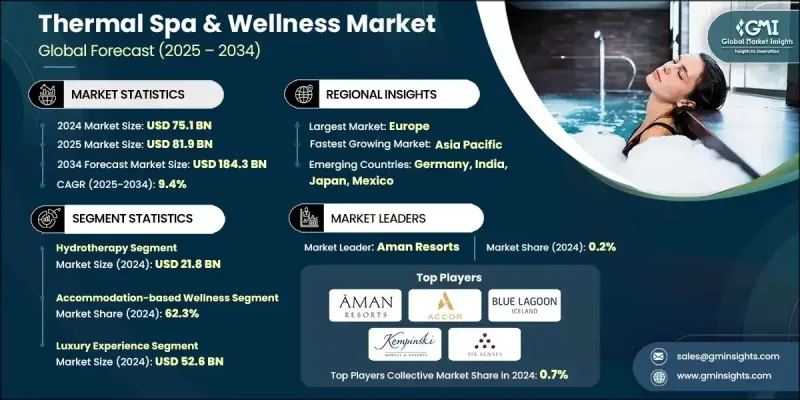
2024 年全球溫泉水療及健康市場價值為 751 億美元,預計到 2034 年將以 9.4% 的複合年成長率成長至 1843 億美元。
隨著人口老化,人們對健康體驗、延年益壽服務以及能夠促進身心健康的整體療法的需求持續成長。越來越多的45至64歲女性開始尋求輔助療法,凸顯了人們對更個人化、更全面的健康服務的需求正在上升。這種轉變推動了人們對水療、療癒之旅以及根據個人健康需求量身定做的健康計劃的濃厚興趣。該行業的營運商正日益融合先進技術、永續設計和客製化療法,以吸引那些尋求有意義且以健康為中心的體驗的消費者。人工智慧增強的皮膚分析工具和智慧水療系統正在提升水療環境的個人化水平,而以永續性為中心的設計選擇,包括節能供暖系統、環保建築和零浪費實踐,正成為新項目開發的核心。總而言之,這些趨勢鞏固了全球溫泉水療和健康產業的強勁發展勢頭,並預示著國內外健康旅行者對溫泉水療和健康產業的持續關注。
| 市場範圍 | |
|---|---|
| 起始年份 | 2024 |
| 預測年份 | 2025-2034 |
| 起始值 | 751億美元 |
| 預測值 | 1843億美元 |
| 複合年成長率 | 9.4% |
2024年,水療市場規模預計將達218億美元。由於水療的健康益處已得到證實,且其在治療性健康護理中的作用日益增強,消費者對水療的信任度持續上升。臨床研究表明,水療對某些疾病具有成本效益,這進一步提升了水療的接受度,並鞏固了水療服務在整體護理中的地位。
2024年,以住宿為基礎的健康中心市佔率達到62.3%。這些設施在入住率和客流量方面均優於傳統住宿,並提供全年吸引遊客的綜合健康項目。專注於健康的度假村和中心每年接待的客人數量始終高於獨立的溫泉度假勝地,進一步鞏固了其在整體市場中的地位。
2024年,美國溫泉水療及健康市場佔了88.5%的佔有率。美國擁有眾多頂級健康度假村、豪華飯店水療中心和特色溫泉目的地,提供先進的健康養生計畫。這些場所迎合了尋求預防保健、康復治療和精心設計的身心服務的本地和國際健康旅行者的需求。
目錄
第1章:方法論與範圍
第2章:執行概要
第3章:行業洞察
- 產業生態系分析
- 供應商格局
- 利潤率
- 每個階段的價值增加
- 影響價值鏈的因素
- 產業影響因素
- 成長促進因素
- 人口老化和注重健康的消費者行為
- 提高健康和保健意識
- 健康旅遊日益普及
- 產業陷阱與挑戰
- 高昂的營運和維護成本
- 季節性和地域性
- 機會
- 技術改進與個人化
- 與預防和醫療保健相結合
- 成長促進因素
- 成長潛力分析
- 未來市場趨勢
- 技術與創新格局
- 當前技術趨勢
- 新興技術
- 監管環境
- 標準和合規要求
- 區域監理框架
- 認證標準
- 差距分析
- 風險評估與緩解
- 波特的分析
- PESTEL 分析
- 消費者行為分析
- 購買模式
- 偏好分析
- 消費者行為的區域差異
- 電子商務對購買決策的影響
第4章:競爭格局
- 介紹
- 公司市佔率分析
- 按地區
- 公司矩陣分析
- 主要市場參與者的競爭分析
- 競爭定位矩陣
- 關鍵進展
- 併購
- 合作夥伴關係與合作
- 新產品發布
- 擴張計劃
第5章:市場估計與預測:依治療類型分類,2021-2034年
- 水療法
- 芳香療法
- 按摩療法
- 泥浴和裹敷
- 臉部和皮膚護理
- 其他
第6章:市場估算與預測:依設施類型分類,2021-2034年
- 獨立式溫泉水療設施
- 獨立日間水療中心
- 市政/公共熱力設施
- 溫泉療養中心
- 住宿式健康
- 健康度假村
- 水療飯店及精品養生飯店
- 提供住宿的健康靜養度假村
- 醫療/復健中心
- 復健中心
- 醫療水療中心
- 排毒和醫療保健
第7章:市場估計與預測:依年齡層別分類,2021-2034年
- 19歲以下
- 19至35歲
- 36至50
- 50歲以上
第8章:市場估算與預測:依消費者偏好分類,2021-2034年
- 奢華體驗
- 經濟實惠的體驗
第9章:市場估算與預測:依消費者群體分類,2021-2034年
- 男人
- 女性
第10章:市場估計與預測:依地區分類,2021-2034年
- 北美洲
- 美國
- 加拿大
- 歐洲
- 德國
- 法國
- 英國
- 義大利
- 西班牙
- 俄羅斯
- 亞太地區
- 中國
- 印度
- 日本
- 韓國
- 澳洲
- 拉丁美洲
- 巴西
- 墨西哥
- MEA
- 南非
- 沙烏地阿拉伯
- 阿拉伯聯合大公國
第11章:公司簡介
- Accor
- Aman Resorts
- Blue Lagoon
- Brenners Park-Hotel and Spa
- Champneys Health Resorts
- Chiva-Som International Health Resort
- Four Seasons Hotels
- Hyatt Hotels
- Kannewischer
- Kempinski Hotels
- Lanserhof
- Mandarin Oriental Hotel Group
- Ritz-Carlton Hotels
- Six Senses Hotels Resorts Spas
- Thermae Bath Spa
The Global Thermal Spa & Wellness Market was valued at USD 75.1 billion in 2024 and is estimated to grow at a CAGR of 9.4% to reach USD 184.3 billion by 2034.
Demand continues to rise as aging populations seek wellness-oriented experiences, longevity services, and holistic treatments that support both physical and emotional well-being. A growing number of women between the ages of 45 and 64 are turning to complementary health options, highlighting a shift toward more personalized and integrative wellness offerings. This shift is driving greater interest in spa therapies, restorative travel experiences, and wellness programs tailored to individual health needs. Operators in the sector are increasingly integrating advanced technology, sustainable design, and customized treatment approaches to appeal to consumers seeking meaningful and health-focused experiences. AI-enhanced skin analysis tools and smart hydrotherapy systems are elevating the level of personalization in spa environments, while sustainability-focused design choices, including energy-efficient heating systems, eco-friendly structures, and zero-waste practices, are becoming central to new project development. Collectively, these trends reinforce the strong trajectory of the global thermal spa and wellness landscape and signal continued interest from both domestic and international wellness travelers.
| Market Scope | |
|---|---|
| Start Year | 2024 |
| Forecast Year | 2025-2034 |
| Start Value | $75.1 Billion |
| Forecast Value | $184.3 Billion |
| CAGR | 9.4% |
The hydrotherapy segment generated USD 21.8 billion in 2024. Consumer trust in hydrotherapy continues to rise due to its documented health benefits and its expanding role in therapeutic wellness treatments. Clinical research demonstrating cost-effective outcomes for certain conditions has boosted acceptance and strengthened the positioning of hydrotherapy services in holistic care.
The accommodation-based wellness centers segment held a 62.3% share in 2024. These facilities outperform traditional lodging in terms of occupancy and client volume, offering integrated wellness programs that attract visitors year-round. Wellness-focused resorts and centers consistently serve more guests annually than standalone thermal sites, reinforcing their prominence in the broader market.
United States Thermal Spa & Wellness Market held an 88.5% share in 2024. The country features a large selection of premier wellness resorts, luxury hotel spas, and specialty thermal destinations that offer advanced health-focused programs. These locations cater to both local and international wellness travelers seeking preventive care, restorative treatments, and curated mind-body services.
Key companies operating in the Global Thermal Spa & Wellness Market include Accor, Aman Resorts, Blue Lagoon, Brenners Park-Hotel and Spa, Champneys Health Resorts, Chiva-Som International Health Resort, Four Seasons Hotels, Hyatt Hotels, Kannewischer, Kempinski Hotels, Lanserhof, Mandarin Oriental Hotel Group, Ritz-Carlton Hotels, Six Senses Hotels Resorts Spas, and Thermae Bath Spa. Companies in the Global Thermal Spa & Wellness Market are reinforcing their market presence by investing in personalized wellness programs, integrating advanced diagnostic and treatment technologies, and expanding facilities designed around holistic health experiences. Many operators are prioritizing sustainable construction, energy-efficient heating solutions, and eco-conscious operations to meet rising environmental expectations. Expanding partnerships with medical professionals and wellness specialists helps strengthen credibility and enhance treatment offerings. Brands are also focusing on elevated guest experiences through tailored therapies, data-driven wellness assessments, and digitally enhanced service models.
Table of Contents
Chapter 1 Methodology & Scope
- 1.1 Market scope and definition
- 1.2 Research design
- 1.2.1 Research approach
- 1.2.2 Data collection methods
- 1.3 Data mining sources
- 1.3.1 Global
- 1.3.2 Regional
- 1.4 Base estimates and calculations
- 1.4.1 Base year calculation
- 1.4.2 Key trends for market estimation
- 1.5 Primary research and validation
- 1.5.1 Primary sources
- 1.6 Forecast model
- 1.7 Research assumptions and limitations
Chapter 2 Executive Summary
- 2.1 Industry 3600 synopsis
- 2.2 Key market trends
- 2.2.1 Regional
- 2.2.2 Treatment type
- 2.2.3 Facility type
- 2.2.4 Age group
- 2.2.5 Consumer preferences
- 2.2.6 Consumer group
- 2.3 CXO perspectives: Strategic imperatives
- 2.3.1 Key decision points for industry executives
- 2.3.2 Critical success factors for market players
- 2.4 Future outlook and strategic recommendations
Chapter 3 Industry Insights
- 3.1 Industry ecosystem analysis
- 3.1.1 Supplier landscape
- 3.1.2 Profit margin
- 3.1.3 Value addition at each stage
- 3.1.4 Factor affecting the value chain
- 3.2 Industry impact forces
- 3.2.1 Growth drivers
- 3.2.1.1 Demographic aging and health-conscious consumer behavior
- 3.2.1.2 Increasing health and wellness awareness
- 3.2.1.3 Rising popularity of wellness tourism
- 3.2.2 Industry pitfalls & challenges
- 3.2.2.1 High operational & maintenance costs
- 3.2.2.2 Seasonality & location dependency
- 3.2.3 Opportunities
- 3.2.3.1 Technological enhancements & personalization
- 3.2.3.2 Integration with preventive & medical wellness
- 3.2.1 Growth drivers
- 3.3 Growth potential analysis
- 3.4 Future market trends
- 3.5 Technology and innovation landscape
- 3.5.1 Current technological trends
- 3.5.2 Emerging technologies
- 3.6 Regulatory landscape
- 3.6.1 Standards and compliance requirements
- 3.6.2 Regional regulatory frameworks
- 3.6.3 Certification standards
- 3.7 Gap analysis
- 3.8 Risk assessment and mitigation
- 3.9 Porter's analysis
- 3.10 PESTEL analysis
- 3.11 Consumer behaviour analysis
- 3.11.1 Purchasing patterns
- 3.11.2 Preference analysis
- 3.11.3 Regional variations in consumer behaviour
- 3.11.4 Impact of e-commerce on buying decisions
Chapter 4 Competitive Landscape, 2024
- 4.1 Introduction
- 4.2 Company market share analysis
- 4.2.1 By region
- 4.2.1.1 North America
- 4.2.1.2 Europe
- 4.2.1.3 Asia Pacific
- 4.2.1.4 Latin America
- 4.2.1.5 Middle East and Africa
- 4.2.1 By region
- 4.3 Company matrix analysis
- 4.4 Competitive analysis of major market players
- 4.5 Competitive positioning matrix
- 4.6 Key developments
- 4.6.1 Mergers & acquisitions
- 4.6.2 Partnerships & collaborations
- 4.6.3 New product launches
- 4.6.4 Expansion plans
Chapter 5 Market Estimates & Forecast, By Treatment Type, 2021-2034 (USD Billion)
- 5.1 Key trends
- 5.2 Hydrotherapy
- 5.3 Aromatherapy
- 5.4 Massage therapy
- 5.5 Mud baths and wraps
- 5.6 Facial and skin treatments
- 5.7 Others
Chapter 6 Market Estimates & Forecast, By Facility type, 2021-2034 (USD Billion)
- 6.1 Key trends
- 6.2 Standalone thermal spa facilities
- 6.2.1 Independent day spas
- 6.2.2 Municipal/public thermal facilities
- 6.2.3 Thermal spa complexes
- 6.3 Accommodation-based wellness
- 6.3.1 Wellness resorts
- 6.3.2 Spa hotels and boutique wellness
- 6.3.3 Wellness retreats with accommodation
- 6.4 Medical/therapeutic wellness centers
- 6.4.1 Rehabilitation centers
- 6.4.2 Medical spas
- 6.4.3 Detox and medical wellness
Chapter 7 Market Estimates & Forecast, By Age group, 2021-2034 (USD Billion)
- 7.1 Key trends
- 7.2 Below 19
- 7.3 19 to 35
- 7.4 36 to 50
- 7.5 Above 50
Chapter 8 Market Estimates & Forecast, By Consumer preference, 2021-2034 (USD Billion)
- 8.1 Key trends
- 8.2 Luxury experience
- 8.3 Budget-friendly experience
Chapter 9 Market Estimates & Forecast, By Consumer group, 2021-2034 (USD Billion)
- 9.1 Key trends
- 9.1.1 Men
- 9.1.2 Women
Chapter 10 Market Estimates & Forecast, By Region, 2021-2034 (USD Billion)
- 10.1 Key trends
- 10.2 North America
- 10.2.1 U.S.
- 10.2.2 Canada
- 10.3 Europe
- 10.3.1 Germany
- 10.3.2 France
- 10.3.3 UK
- 10.3.4 Italy
- 10.3.5 Spain
- 10.3.6 Russia
- 10.4 Asia Pacific
- 10.4.1 China
- 10.4.2 India
- 10.4.3 Japan
- 10.4.4 South Korea
- 10.4.5 Australia
- 10.5 Latin America
- 10.5.1 Brazil
- 10.5.2 Mexico
- 10.6 MEA
- 10.6.1 South Africa
- 10.6.2 Saudi Arabia
- 10.6.3 UAE
Chapter 11 Company Profiles
- 11.1 Accor
- 11.2 Aman Resorts
- 11.3 Blue Lagoon
- 11.4 Brenners Park-Hotel and Spa
- 11.5 Champneys Health Resorts
- 11.6 Chiva-Som International Health Resort
- 11.7 Four Seasons Hotels
- 11.8 Hyatt Hotels
- 11.9 Kannewischer
- 11.10 Kempinski Hotels
- 11.11 Lanserhof
- 11.12 Mandarin Oriental Hotel Group
- 11.13 Ritz-Carlton Hotels
- 11.14 Six Senses Hotels Resorts Spas
- 11.15 Thermae Bath Spa

 2034年全球心理健康消費品市場預測-按產品、健康重點領域、技術、通路和最終用戶分類的全球分析冥想和心理健康應用程式市場預測至2034年——按產品、定價模式、平台、部署模式、年齡層、最終用戶和地區分類的全球分析壓力緩解和心理健康專案市場預測至2034年-全球分析(按專案類型、服務類型、交付方式、技術、應用、最終用戶和地區分類)快速消費品市場預測:行動健康生活方式展望(至2034年)-全球分析(按產品類型、配方、包裝、消費者需求、分銷管道、應用、認證、最終用戶和地區分類)
 2026-2030年全球健康與保健市場
 醫療保健市場:按服務類型、應用程式、最終用戶群、交付管道和地區分類
 醫療保健市場報告:趨勢、預測和競爭分析(至2035年)
 數位療法與健康市場分析及預測(至2035年):按類型、產品、服務、技術、組件、應用、設備、部署和最終用戶分類
 2026-2030年高淨值人士的全球科技後勤部門平台市場
 健康與保健市場規模、佔有率、趨勢及預測:依產品類型、功能與地區分類,2026-2034年