

 |
市場調查報告書
商品編碼
1892729
行動支付整合平台市場機會、成長促進因素、產業趨勢分析及預測(2026-2035年)Mobility Payment Integration Platforms Market Opportunity, Growth Drivers, Industry Trend Analysis, and Forecast 2026 - 2035 |
||||||

全球行動支付整合平台市場預計在 2025 年達到 70 億美元,預計到 2035 年將以 14.5% 的複合年成長率成長至 267 億美元。
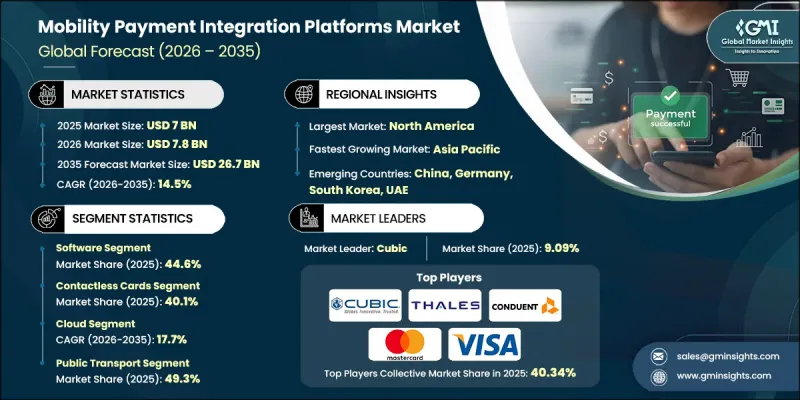
全球城市交通系統的快速數位轉型推動了這個市場的成長。交通管理部門正在加速向無現金收費模式轉型,以提高營運效率、降低實體處理成本,並滿足乘客對便利、快速、衛生出行體驗日益成長的期望。疫情後對非接觸式交易的重視進一步促進了先進支付整合技術的應用。城市越來越注重提供流暢的出行體驗,最大限度地減少登車延誤,並實現即時票價處理。對整合了交通網路支付、票務和驗證功能的集中式平台的日益依賴,也正在重塑競爭格局。這些平台正成為現代城市交通的關鍵數位基礎設施,為營運商提供數據驅動的票價管理、客戶個人化服務和長期成本最佳化。隨著各國政府優先發展智慧城市和永續交通,出行支付整合平台正在演變為策略工具,不僅支援更廣泛的數位旅遊生態系統,還能滿足日益精通技術的通勤者的需求。城市中心正積極將公共交通、共享出行、私人交通服務和停車系統整合到統一的「出行即服務」(MaaS)環境中。這種整合需要強大的支付引擎,能夠管理多模式票價結構、基於帳戶的計費以及跨營運商的自動票價上限。隨著統一出行應用的普及,能夠無縫銜接多種交通服務的平台需求日益成長。將共享旅遊選項納入城市支付生態系統,並正在擴大這些平台的功能範圍。這種整合有助於改善「最後一公里」出行,鼓勵環保出行,並使營運商能夠引入基於即時資料的靈活定價模式。
| 市場範圍 | |
|---|---|
| 起始年份 | 2025 |
| 預測年份 | 2026-2035 |
| 起始值 | 70億美元 |
| 預測值 | 267億美元 |
| 複合年成長率 | 14.5% |
預計2026年至2035年間,雲端市場將以17.7%的複合年成長率成長。雲端基礎設施因其可擴展性、較低的維護成本以及與基於帳戶的票務和出行即服務(MaaS)架構的高度契合性而備受青睞。雲端平台支援即時票價運算、進階分析、遠端系統更新以及第三方出行服務供應商的快速存取。人們對雲端安全框架的信任度不斷提高,加上符合合規要求的雲端服務和混合部署模式的普及,正在加速交通管理部門和旅遊營運商對雲端技術的採用。
公共運輸領域在2025年佔總營收的49.3%,預計2026年至2035年將以13.6%的複合年成長率成長。由於帳戶式票務、EMV相容支付和多模式票價整合的廣泛應用,該領域仍是最大的貢獻者。大眾運輸支付系統必須以近乎瞬時的速度處理極高的交易量,以維持客流。其他複雜因素還包括分層票價政策、轉乘規則、折扣結構、地鐵系統的離線功能以及跨多個機構和服務提供者的互通性。
2025年,歐洲行動支付整合平台市場規模達到18億美元,預計2035年將以13.7%的複合年成長率成長。歐洲在整合移動出行和基於帳戶的票價系統方面繼續引領全球。強而有力的監管架構促進了互通性,鼓勵各城市將各種交通服務整合到單一的支付生態系統中,包括跨境出行功能。非接觸式支付技術的高普及率,以及成熟的數位支付基礎設施,正在推動整個地區的快速應用和一致的用戶體驗。
目錄
第1章:方法論
第2章:執行概要
第3章:行業洞察
- 產業生態系分析
- 供應商格局
- 利潤率分析
- 成本結構
- 每個階段的價值增加
- 影響價值鏈的因素
- 中斷
- 產業影響因素
- 成長促進因素
- 都市化進程加速與公共運輸需求成長
- 消費者對非接觸式和行動支付的偏好
- 政府對開放支付系統和互通性的強制性要求
- 旅遊即服務 (MaaS) 平台激增
- 透過自動收費降低成本
- 產業陷阱與挑戰
- 系統升級需要較高的初始資本投入
- 遺留系統整合複雜性與技術債務
- 異質系統互通性挑戰
- 資料隱私與安全問題
- 市場機遇
- 基於區塊鏈的結算和智慧合約自動化
- 用於非接觸式車費支付的生物辨識認證
- 人工智慧驅動的動態定價與需求管理
- 與自動駕駛汽車支付系統整合
- 成長促進因素
- 成長潛力分析
- 監管環境
- 北美洲
- 電子資金轉帳法(E條例)
- FINTRAC MSB 法規
- 歐洲
- 2017年支付服務條例(PSRs)
- 一般資料保護條例
- 亞太地區
- 中華人民共和國網路安全法
- 日本支付服務法(PSA)
- 2007年印度支付與結算系統法案
- 拉丁美洲
- 孟加拉國中央銀行第3682號通函-支付機構規則
- 金融科技法(Ley para Regular las Instituciones de Tecnologia Financiera)2018
- MEA
- 阿布達比全球市場 - 金融服務與市場監管 (FSMR)
- 金融情報中心法案(FICA)
- 北美洲
- 波特的分析
- PESTEL 分析
- 技術與創新格局
- 當前技術趨勢
- 新興技術
- 專利分析
- 成本細分分析
- 成本細分分析
- 永續性和環境方面
- 永續實踐
- 減少廢棄物策略
- 生產中的能源效率
- 環保舉措
- 未來展望與機遇
- 新興科技趨勢
- 監理與政策演變
- 市場拓展機會
- 商業模式創新
- 市場參與者的策略要務
第4章:競爭格局
- 介紹
- 公司市佔率分析
- 北美洲
- 歐洲
- 亞太地區
- 拉丁美洲
- MEA
- 主要市場參與者的競爭分析
- 競爭定位矩陣
- 戰略展望矩陣
- 關鍵進展
- 併購
- 合作夥伴關係與合作
- 新產品發布
- 擴張計劃和資金
第5章:市場估算與預測:依組件分類,2022-2035年
- 軟體
- 硬體
- 驗證者
- NFC終端
- 服務
- 一體化
- 諮詢
第6章:市場估算與預測:依支付方式分類,2022-2035年
- 非接觸式卡
- 行動錢包
- NFC
- QR 圖碼
- 其他數位支付方式
第7章:市場估算與預測:依部署方式分類,2022-2035年
- 雲
- 現場
第8章:市場估算與預測:依應用領域分類,2022-2035年
- 大眾運輸
- 叫車
- 自行車共享
- 汽車共享
- 停車處
- 微移動性
第9章:市場估計與預測:依地區分類,2022-2035年
- 北美洲
- 美國
- 加拿大
- 歐洲
- 德國
- 英國
- 法國
- 義大利
- 西班牙
- 俄羅斯
- 北歐
- 葡萄牙
- 克羅埃西亞
- 亞太地區
- 中國
- 印度
- 日本
- 澳洲
- 韓國
- 新加坡
- 泰國
- 印尼
- 拉丁美洲
- 巴西
- 墨西哥
- 阿根廷
- MEA
- 南非
- 沙烏地阿拉伯
- 阿拉伯聯合大公國
- 土耳其
第10章:公司簡介
- 全球參與者
- Cubic Transportation Systems
- Visa
- Mastercard
- Thales
- IDEMIA
- Conduent
- HID Global
- NXP Semiconductors
- Worldline
- Indra Sistemas
- 區域玩家
- Masabi
- GMV Innovating
- Paragon ID
- INIT Innovation in Traffic Systems
- Scheidt & Bachmann
- Vix Technology
- Flowbird
- Trapeze
- AEP Ticketing
- Snapper Services
- 新興參與者
- Littlepay
- Token Transit
- Bytemark
- Moovit
The Global Mobility Payment Integration Platforms Market is estimated at USD 7 billion in 2025 and is estimated to grow at a CAGR of 14.5% to reach USD 26.7 billion by 2035.
This market growth is shaped by the rapid digital transformation of urban mobility systems worldwide. Transit authorities are accelerating the shift toward cashless fare collection models to improve operational efficiency, reduce physical handling costs, and meet rising passenger expectations for seamless, fast, and hygienic travel experiences. The post-pandemic emphasis on touch-free transactions has further intensified the adoption of advanced payment integration technologies. Cities are increasingly focused on delivering frictionless mobility journeys that minimize boarding delays while enabling real-time fare processing. The growing reliance on centralized platforms that unify payment, ticketing, and validation across transport networks is also reshaping the competitive landscape. These platforms are becoming critical digital infrastructure for modern urban mobility, enabling data-driven fare management, customer personalization, and long-term cost optimization for operators. As governments prioritize smart city initiatives and sustainable transportation, mobility payment integration platforms are evolving into strategic tools that support broader digital mobility ecosystems while meeting the demands of increasingly tech-savvy commuters. Urban centers are actively merging public transit, shared mobility, private transport services, and parking systems into cohesive Mobility-as-a-Service environments. This integration requires robust payment engines capable of managing multimodal fare structures, account-based billing, and automated fare caps across operators. As unified mobility applications gain traction, platforms that can function seamlessly across multiple transport services are witnessing growing demand. The inclusion of shared mobility options into citywide payment ecosystems is expanding the functional scope of these platforms. This integration supports improved last-mile connectivity, encourages environmentally responsible travel behavior, and allows operators to introduce flexible pricing models driven by real-time data.
| Market Scope | |
|---|---|
| Start Year | 2025 |
| Forecast Year | 2026-2035 |
| Start Value | $7 Billion |
| Forecast Value | $26.7 Billion |
| CAGR | 14.5% |
The cloud-based segment is expected to grow at a CAGR of 17.7% between 2026 and 2035. Cloud infrastructure is favored due to its scalability, reduced maintenance burden, and strong alignment with account-based ticketing and MaaS architectures. Cloud platforms support real-time fare computation, advanced analytics, remote system updates, and rapid onboarding of third-party mobility providers. Increasing trust in cloud security frameworks, combined with the availability of compliance-ready cloud services and hybrid deployment models, is accelerating adoption among transit authorities and mobility operators.
The public transportation segment accounted for a 49.3% share in 2025 and is forecast to grow at a CAGR of 13.6% from 2026 to 2035. This segment remains the largest contributor due to widespread implementation of account-based ticketing, EMV-compatible payments, and multimodal fare integration. Public transport payment systems must handle extremely high transaction volumes with near-instant processing speeds to maintain passenger flow. Additional complexities include layered fare policies, transfer rules, discount structures, offline functionality for underground systems, and interoperability across multiple agencies and service providers.
Europe Mobility Payment Integration Platforms Market generated USD 1.8 billion in 2025 and is expected to grow at a CAGR of 13.7% throughout 2035. Europe continues to lead global adoption of integrated mobility and account-based fare systems. Strong regulatory frameworks promoting interoperability are encouraging cities to unify various transport services under a single payment ecosystem, including cross-border travel capabilities. High penetration of contactless payment technologies, supported by a mature digital payments infrastructure, is enabling rapid adoption and consistent user experiences across the region.
Key companies operating in the Global Mobility Payment Integration Platforms Market include Mastercard, Cubic, Thales, Visa, Masabi, Siemens Mobility, Conduent, Scheidt & Bachmann, INIT Innovations, and NXP Semiconductors. Companies operating in the Mobility Payment Integration Platforms Market are strengthening their market position through continuous platform innovation, strategic partnerships, and geographic expansion. Leading players are investing heavily in cloud-native architectures, cybersecurity enhancements, and real-time analytics capabilities to support large-scale deployments. Collaboration with transit authorities, technology providers, and mobility operators is being used to accelerate multimodal integration and expand service offerings. Firms are also focusing on interoperability standards to ensure seamless deployment across diverse transport ecosystems.
Table of Contents
Chapter 1 Methodology
- 1.1 Market scope and definition
- 1.2 Research design
- 1.2.1 Research approach
- 1.2.2 Data collection methods
- 1.3 Data mining sources
- 1.3.1 Global
- 1.3.2 Regional/Country
- 1.4 Base estimates and calculations
- 1.4.1 Base year calculation
- 1.4.2 Key trends for market estimation
- 1.5 Primary research and validation
- 1.5.1 Primary sources
- 1.6 Forecast model
- 1.7 Research assumptions and limitations
Chapter 2 Executive Summary
- 2.1 Industry 3600 synopsis, 2022 - 2035
- 2.2 Key market trends
- 2.2.1 Regional
- 2.2.2 Component
- 2.2.3 Payment Mode
- 2.2.4 Deployment
- 2.2.5 Application
- 2.3 TAM Analysis, 2026-2035
- 2.4 CXO perspectives: Strategic imperatives
- 2.4.1 Executive decision points
- 2.4.2 Critical success factors
- 2.5 Future outlook and strategic recommendations
Chapter 3 Industry Insights
- 3.1 Industry ecosystem analysis
- 3.1.1 Supplier landscape
- 3.1.2 Profit margin analysis
- 3.1.3 Cost structure
- 3.1.4 Value addition at each stage
- 3.1.5 Factor affecting the value chain
- 3.1.6 Disruptions
- 3.2 Industry impact forces
- 3.2.1 Growth drivers
- 3.2.1.1 Accelerating Urbanization & Public Transit Demand
- 3.2.1.2 Consumer Preference for Contactless & Mobile Payments
- 3.2.1.3 Government Mandates for Open Payment Systems & Interoperability
- 3.2.1.4 Mobility-as-a-Service (MaaS) Platform Proliferation
- 3.2.1.5 Cost Reduction Through Automated Fare Collection
- 3.2.2 Industry pitfalls and challenges
- 3.2.2.1 High Initial Capital Investment for System Upgrades
- 3.2.2.2 Legacy System Integration Complexity & Technical Debt
- 3.2.2.3 Interoperability Challenges Across Heterogeneous Systems
- 3.2.2.4 Data Privacy & Security Concerns
- 3.2.3 Market opportunities
- 3.2.3.1 Blockchain-Based Settlement & Smart Contract Automation
- 3.2.3.2 Biometric Authentication for Touchless Fare Payment
- 3.2.3.3 AI-Powered Dynamic Pricing & Demand Management
- 3.2.3.4 Integration with Autonomous Vehicle Payment Systems
- 3.2.1 Growth drivers
- 3.3 Growth potential analysis
- 3.4 Regulatory landscape
- 3.4.1 North America
- 3.4.1.1 Electronic Fund Transfer Act (Reg E)
- 3.4.1.2 FINTRAC MSB Regulations
- 3.4.2 Europe
- 3.4.2.1 Payment Services Regulations 2017 (PSRs 2017)
- 3.4.2.2 General Data Protection Regulation (Regulation (EU) 2016/679)
- 3.4.3 Asia Pacific
- 3.4.3.1 Cybersecurity Law of the PRC
- 3.4.3.2 Payment Services Act (PSA) Japan
- 3.4.3.3 Indian Payment and Settlement Systems Act, 2007
- 3.4.4 LATAM
- 3.4.4.1 BCB Circular No. 3,682 - Payment Institutions Rules
- 3.4.4.2 FinTech Law (Ley para Regular las Instituciones de Tecnologia Financiera) 2018
- 3.4.5 MEA
- 3.4.6 ADGM - Financial Services & Markets Regulations (FSMR)
- 3.4.7 Financial Intelligence Centre Act (FICA)
- 3.4.1 North America
- 3.5 Porter's analysis
- 3.6 PESTEL analysis
- 3.7 Technology and innovation landscape
- 3.7.1 Current technological trends
- 3.7.2 Emerging technologies
- 3.8 Patent analysis
- 3.9 Cost breakdown analysis
- 3.10 Cost breakdown analysis
- 3.11 Sustainability and environmental aspects
- 3.11.1 Sustainable practices
- 3.11.2 Waste reduction strategies
- 3.11.3 Energy efficiency in production
- 3.11.4 Eco-friendly Initiatives
- 3.12 Future Outlook & Opportunities
- 3.12.1 Emerging Technology Trends
- 3.12.2 Regulatory & Policy Evolution
- 3.12.3 Market Expansion Opportunities
- 3.12.4 Business Model Innovation
- 3.12.5 Strategic Imperatives for Market Participants
Chapter 4 Competitive Landscape, 2025
- 4.1 Introduction
- 4.2 Company market share analysis
- 4.2.1 North America
- 4.2.2 Europe
- 4.2.3 Asia Pacific
- 4.2.4 LATAM
- 4.2.5 MEA
- 4.3 Competitive analysis of major market players
- 4.4 Competitive positioning matrix
- 4.5 Strategic outlook matrix
- 4.6 Key developments
- 4.6.1 Mergers & acquisitions
- 4.6.2 Partnerships & collaborations
- 4.6.3 New Product Launches
- 4.6.4 Expansion Plans and funding
Chapter 5 Market Estimates & Forecast, By Component, 2022 - 2035 (USD Mn)
- 5.1 Key trends
- 5.2 Software
- 5.3 Hardware
- 5.3.1 Validators
- 5.3.2 NFC terminals
- 5.4 Services
- 5.4.1 Integration
- 5.4.2 Consulting
Chapter 6 Market Estimates & Forecast, By Payment Mode, 2022 - 2035 (USD Mn)
- 6.1 Key trends
- 6.2 Contactless cards
- 6.3 Mobile wallets
- 6.4 NFC
- 6.5 QR
- 6.6 Other digital payment
Chapter 7 Market Estimates & Forecast, By Deployment, 2022 - 2035 (USD Mn)
- 7.1 Key trends
- 7.2 Cloud
- 7.3 On-premises
Chapter 8 Market Estimates & Forecast, By Application, 2022 - 2035 (USD Mn)
- 8.1 Key trends
- 8.2 Public transport
- 8.3 Ride-hailing
- 8.4 Bike-sharing
- 8.5 Car-sharing
- 8.6 Parking
- 8.7 Micromobility
Chapter 9 Market Estimates & Forecast, By Region, 2022 - 2035 (USD Mn)
- 9.1 Key trends
- 9.2 North America
- 9.2.1 US
- 9.2.2 Canada
- 9.3 Europe
- 9.3.1 Germany
- 9.3.2 UK
- 9.3.3 France
- 9.3.4 Italy
- 9.3.5 Spain
- 9.3.6 Russia
- 9.3.7 Nordics
- 9.3.8 Portugal
- 9.3.9 Croatia
- 9.4 Asia Pacific
- 9.4.1 China
- 9.4.2 India
- 9.4.3 Japan
- 9.4.4 Australia
- 9.4.5 South Korea
- 9.4.6 Singapore
- 9.4.7 Thailand
- 9.4.8 Indonesia
- 9.5 Latin America
- 9.5.1 Brazil
- 9.5.2 Mexico
- 9.5.3 Argentina
- 9.6 MEA
- 9.6.1 South Africa
- 9.6.2 Saudi Arabia
- 9.6.3 UAE
- 9.6.4 Turkey
Chapter 10 Company Profiles
- 10.1 Global Players
- 10.1.1 Cubic Transportation Systems
- 10.1.2 Visa
- 10.1.3 Mastercard
- 10.1.4 Thales
- 10.1.5 IDEMIA
- 10.1.6 Conduent
- 10.1.7 HID Global
- 10.1.8 NXP Semiconductors
- 10.1.9 Worldline
- 10.1.10 Indra Sistemas
- 10.2 Regional Players
- 10.2.1 Masabi
- 10.2.2 GMV Innovating
- 10.2.3 Paragon ID
- 10.2.4 INIT Innovation in Traffic Systems
- 10.2.5 Scheidt & Bachmann
- 10.2.6 Vix Technology
- 10.2.7 Flowbird
- 10.2.8 Trapeze
- 10.2.9 AEP Ticketing
- 10.2.10 Snapper Services
- 10.3 Emerging Players
- 10.3.1 Littlepay
- 10.3.2 Token Transit
- 10.3.3 Bytemark
- 10.3.4 Moovit

 數位支付市場-2026-2032年全球市場預測
 數位支付市場規模、佔有率和成長分析:按交易方式、部署基礎設施、最終用戶商業領域和地區分類-2026-2033年產業預測
 全球數位支付市場(至2035年):按解決方案類型、支付方式類型、交易類型、產業、地區、產業趨勢和預測分類
 數位支付市場:按支付方式、公司規模、最終用戶和地區分類
 AI轉型(2026):全球及區域應用、企業準備度與數位支付與電子商務的擴張挑戰
 全球數位支付市場規模、佔有率、趨勢和成長分析報告(2026-2034)
 醫療保健市場中的數位支付-全球產業規模、佔有率、趨勢、機會和預測:按組件、部署、組織規模、地區和競爭情況分類,2021-2031年中國電子商務生態系統中的人工智慧轉型:整合監管、基礎設施和數位支付(2025)全球電子商務與支付概覽(2025):第三卷:歐洲電子商務、支付與人工智慧轉型中東的AI市場 (2025年):引進趨勢,準備情形,風險形勢