


 |
市場調查報告書
商品編碼
1892727
拓樸絕緣體材料市場機會、成長促進因素、產業趨勢分析及預測(2025-2034年)Topological Insulator Materials Market Opportunity, Growth Drivers, Industry Trend Analysis, and Forecast 2025 - 2034 |
||||||

2024 年全球拓樸絕緣體材料市場價值為 6,460 萬美元,預計到 2034 年將以 10.8% 的複合年成長率成長至 1.805 億美元。
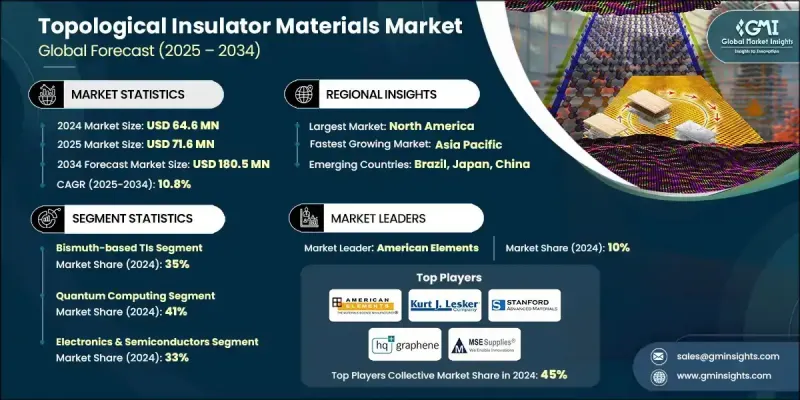
拓樸絕緣體是一類具有獨特電子特性的變革性量子材料。它們在體相中表現為電絕緣體,而在表面或邊緣則透過拓撲保護的表面態導電。這類材料的特徵在於強自旋軌道耦合和能帶反轉,從而形成能夠抵抗非磁性雜質散射的金屬表面態,實現近乎無損耗的電子傳輸。主要類別包括鉍基化合物、銻基化合物、四元合金、磁性摻雜變體以及將拓樸絕緣體與超導體或磁性材料整合的工程異質結構。拓樸絕緣體能夠實現精確的電子自旋控制,支援對量子運算至關重要的馬約拉納費米子態,並可用於探索高階量子現象。市場擴張主要由拓樸量子運算的興起所驅動,後者依賴這些材料來建構拓樸保護的量子位元,從而提供固有的糾錯能力和穩健的性能。
| 市場範圍 | |
|---|---|
| 起始年份 | 2024 |
| 預測年份 | 2025-2034 |
| 起始值 | 6460萬美元 |
| 預測值 | 1.805億美元 |
| 複合年成長率 | 10.8% |
鉍基拓樸絕緣體材料佔了35%的市場佔有率,預計到2034年將以8.2%的複合年成長率成長。這些材料,包括BiSe和BiTe,因其穩定的表面態和寬體能隙而備受青睞,使其能夠在更高的溫度下工作。該領域受益於廣泛的實驗驗證、成熟的合成方法、良好的基板相容性和天然的解理面,這些優勢既支持研究和商業規模化生產,也滿足安全和監管標準。
2024年,量子計算領域佔據41%的市場佔有率,預計到2034年將以11.2%的複合年成長率成長。拓樸絕緣體是開發下一代量子位元的關鍵材料,它透過拓樸絕緣體-超導體異質結構,利用拓樸穩定的量子態提供固有的糾錯能力。政府和私人投資,包括國家量子計畫和企業研發項目,正在推動量子計算技術在研究和工業領域的應用和商業化。
2024年,北美拓樸絕緣體材料市佔率達36%。該地區的成長得益於先進的量子運算基礎設施、集中的研究機構以及大量的政府投入。大學、國家實驗室和企業計畫積極參與拓樸材料研究,而強大的半導體製造能力則為市場擴張提供了支持。
目錄
第1章:方法論與範圍
第2章:執行概要
第3章:行業洞察
- 產業生態系分析
- 供應商格局
- 利潤率
- 每個階段的價值增加
- 影響價值鏈的因素
- 中斷
- 產業影響因素
- 成長促進因素
- 產業陷阱與挑戰
- 市場機遇
- 成長潛力分析
- 監管環境
- 北美洲
- 歐洲
- 亞太地區
- 拉丁美洲
- 中東和非洲
- 波特的分析
- PESTEL 分析
- 價格趨勢
- 按地區
- 依產品類型
- 未來市場趨勢
- 技術與創新格局
- 當前技術趨勢
- 新興技術
- 專利格局
- 貿易統計(HS編碼)(註:僅提供重點國家的貿易統計資料)
- 主要進口國
- 主要出口國
- 永續性和環境方面
- 永續實踐
- 減少廢棄物策略
- 生產中的能源效率
- 環保舉措
- 碳足跡考量
第4章:競爭格局
- 介紹
- 公司市佔率分析
- 按地區
- 北美洲
- 歐洲
- 亞太地區
- 拉丁美洲
- MEA
- 按地區
- 公司矩陣分析
- 主要市場參與者的競爭分析
- 競爭定位矩陣
- 關鍵進展
- 併購
- 合作夥伴關係與合作
- 新產品發布
- 擴張計劃
第5章:市場估算與預測:依材料類型分類,2021-2034年
- 鉍基拓樸絕緣體
- 硒化鉍(Bi2Se3)
- 碲化鉍(Bi2Te3)
- 碲化鉍硒化物(Bi2Te2Se)
- 基於銻的拓樸絕緣體
- 碲化銻 (Sb2Te3)
- 碲化銻硒化物 (Sb2Te2Se)
- 四元和合金拓樸絕緣體
- Bisbtes e (BSTS)
- Bisbte3
- 磁性摻雜的拓樸絕緣體合金(Cr、V、Mn摻雜的Bi/Sb-Te體系)
- 磁性強關聯拓樸絕緣體
- Mnb i2t e4(本徵磁 TI)
- 六硼化釤(SmB6;Kondo TI)
- 拓樸絕緣體異質結構
- TI-超導混合體(例如 Bi2Se3-Nb)
- TI-反鐵磁體混合材料
第6章:市場估算與預測:依應用領域分類,2021-2034年
- 量子計算
- 拓樸量子位元(基於馬約拉納效應)
- 混合量子位元系統
- 量子反常霍爾元件
- 量子相干邏輯電路
- 量子計量組件
- 自旋電子學
- SOT-MRAM元件
- 自旋場效電晶體
- 磁場感測器(TI奈米線感測器)
- 高效能自旋注入器/檢測器
- 熱電裝置
- 熱電發電機(TEG)
- 廢熱回收模組
- 穿戴式/軟性熱電片材
- 工業和汽車熱電系統
- 低功耗電子產品
- 拓樸電晶體
- 負電容TI場效電晶體
- 德州儀器 (TI)資料中心互連產品
- 下一代邏輯開關
- 太赫茲光子學
- 太赫茲頻率轉換器
- 太赫茲探測器
- 自旋電子太赫茲發射器
- 6G通訊組件
- 量子計量學
- 量子電阻標準
- 電壓校準裝置
- 無磁鐵QAH標準
- 隨身計量儀器
第7章:市場估算與預測:依最終用途產業分類,2021-2034年
- 電子和半導體
- 半導體研發實驗室
- 儲存設備製造商(SOT-MRAM)
- 邏輯元件製造商
- 感測器製造商
- 薄膜沉積和計量設備買家
- 量子運算產業
- 量子硬體開發商
- 低溫電子公司
- 量子計量儀器製造商
- 雲端量子服務供應商
- 研究聯盟(QED-C、NIST 設施)
- 航太與國防
- 國防研究機構(DARPA、AFRL)
- 國防承包商(洛克希德、諾斯羅普)
- 航太電子製造商
- 政府情報和安全通訊用戶
- 能源和電力
- 熱電模組製造商
- 廢熱回收系統整合商
- 再生能源解決方案供應商
- 電力電子製造商
- 研究和學術機構
- 國家實驗室(NIST、DOE、ORNL)
- 大學和研究中心
- 國際研究所(IMEC、馬克斯普朗克研究所、NIMS)
- 私人研發中心(IBM、微軟、Google)
- 電信業
- 6G系統開發商
- 太赫茲裝置製造商
- 量子通訊基礎設施提供商
第8章:市場估算與預測:依地區分類,2021-2034年
- 北美洲
- 美國
- 加拿大
- 歐洲
- 德國
- 英國
- 法國
- 西班牙
- 義大利
- 歐洲其他地區
- 亞太地區
- 中國
- 印度
- 日本
- 澳洲
- 韓國
- 亞太其他地區
- 拉丁美洲
- 巴西
- 墨西哥
- 阿根廷
- 拉丁美洲其他地區
- 中東和非洲
- 沙烏地阿拉伯
- 南非
- 阿拉伯聯合大公國
- 中東和非洲其他地區
第9章:公司簡介
- American Elements
- Kurt J. Lesker Company (KJLC)
- Stanford Advanced Materials (SAM)
- HQ Graphene BV
- MSE Supplies LLC
- Wuhan Tuocai Technology Co., Ltd.
- SixCarbon Technology (Shenzhen)
- Heeger Materials Inc.
- AEM Deposition
- Stanford Materials Corporation (SMC)
- Edgetech Industries LLC
- Cathay Materials
- ALB Materials Inc.
- QS Advanced Materials Inc. (QSAM)
- Alfa Chemistry (2D Materials Division)
The Global Topological Insulator Materials Market was valued at USD 64.6 million in 2024 and is estimated to grow at a CAGR of 10.8% to reach USD 180.5 million by 2034.
Topological insulators represent a transformative class of quantum materials with unique electronic characteristics. They act as electrical insulators in their bulk while conducting electricity along surfaces or edges through topologically protected surface states. These materials are defined by strong spin-orbit coupling and band inversion, creating metallic surface states resistant to scattering from non-magnetic impurities, enabling near-dissipationless electron transport. The primary categories include bismuth-based compounds, antimony-based compounds, quaternary alloys, magnetically doped variants, and engineered heterostructures integrating topological insulators with superconductors or magnetic materials. Topological insulators facilitate precise electron spin control, support Majorana fermion states crucial for quantum computing, and allow exploration of advanced quantum phenomena. The market expansion is largely driven by the rise of topological quantum computing, which relies on these materials for topologically protected qubits offering intrinsic error correction and robust performance.
| Market Scope | |
|---|---|
| Start Year | 2024 |
| Forecast Year | 2025-2034 |
| Start Value | $64.6 Million |
| Forecast Value | $180.5 Million |
| CAGR | 10.8% |
The bismuth-based topological insulators segment held a 35% share and is anticipated to grow at a CAGR of 8.2% by 2034. These materials, including BiSe and BiTe, are preferred for their robust surface states and wide bulk band gaps, allowing operation at higher temperatures. This segment benefits from extensive experimental validation, mature synthesis methods, substrate compatibility, and natural cleavage planes, supporting both research and commercial scalability while meeting safety and regulatory standards.
The quantum computing segment held a 41% share in 2024 and is expected to grow at a CAGR of 11.2% through 2034. Topological insulators are central to developing next-generation qubits via TI-superconductor heterostructures, providing inherent error protection through topologically stabilized quantum states. Government and private investments, including national quantum initiatives and corporate R&D programs, are driving adoption and commercialization across research and industrial sectors.
North America Topological Insulator Materials Market held a 36% share in 2024. The region's growth is fueled by advanced quantum computing infrastructure, concentrated research institutions, and significant government funding. Universities, national laboratories, and corporate programs actively contribute to topological materials research, while strong semiconductor manufacturing capabilities support market expansion.
Key players in the Global Topological Insulator Materials Market include Stanford Advanced Materials (SAM), HQ Graphene B.V., Kurt J. Lesker Company (KJLC), American Elements, Wuhan Tuocai Technology Co., Ltd., MSE Supplies LLC, SixCarbon Technology (Shenzhen), Heeger Materials Inc., AEM Deposition, Stanford Materials Corporation (SMC), Edgetech Industries LLC, Cathay Materials, ALB Materials Inc., QS Advanced Materials Inc. (QSAM), and Alfa Chemistry (2D Materials Division). Companies in the Topological Insulator Materials Market strengthen their presence by investing heavily in R&D to develop high-performance, scalable materials for quantum computing and advanced electronics. Strategic collaborations with research institutions and technology startups enable accelerated innovation and commercialization. Firms also focus on expanding manufacturing capabilities, ensuring consistent quality and reproducibility, while pursuing global distribution networks to reach emerging markets.
Table of Contents
Chapter 1 Methodology & Scope
- 1.1 Market scope and definition
- 1.2 Research design
- 1.2.1 Research approach
- 1.2.2 Data collection methods
- 1.3 Data mining sources
- 1.3.1 Global
- 1.3.2 Regional/Country
- 1.4 Base estimates and calculations
- 1.4.1 Base year calculation
- 1.4.2 Key trends for market estimation
- 1.5 Primary research and validation
- 1.5.1 Primary sources
- 1.6 Forecast model
- 1.7 Research assumptions and limitations
Chapter 2 Executive Summary
- 2.1 Industry 360° synopsis
- 2.2 Key market trends
- 2.2.1 Regional
- 2.2.2 Material type
- 2.2.3 Application
- 2.2.4 End Use industry
- 2.2.5 Region
- 2.3 TAM Analysis, 2025-2034
- 2.4 CXO perspectives: Strategic imperatives
- 2.4.1 Executive decision points
- 2.4.2 Critical success factors
- 2.5 Future Outlook and Strategic Recommendations
Chapter 3 Industry Insights
- 3.1 Industry ecosystem analysis
- 3.1.1 Supplier landscape
- 3.1.2 Profit margin
- 3.1.3 Value addition at each stage
- 3.1.4 Factor affecting the value chain
- 3.1.5 Disruptions
- 3.2 Industry impact forces
- 3.2.1 Growth drivers
- 3.2.2 Industry pitfalls and challenges
- 3.2.3 Market opportunities
- 3.3 Growth potential analysis
- 3.4 Regulatory landscape
- 3.4.1 North America
- 3.4.2 Europe
- 3.4.3 Asia Pacific
- 3.4.4 Latin America
- 3.4.5 Middle East & Africa
- 3.5 Porter's analysis
- 3.6 PESTEL analysis
- 3.7 Price trends
- 3.7.1 By region
- 3.7.2 By Product type
- 3.8 Future market trends
- 3.9 Technology and Innovation landscape
- 3.9.1 Current technological trends
- 3.9.2 Emerging technologies
- 3.10 Patent Landscape
- 3.11 Trade statistics (HS code) ( Note: the trade statistics will be provided for key countries only)
- 3.11.1 Major importing countries
- 3.11.2 Major exporting countries
- 3.12 Sustainability and environmental aspects
- 3.12.1 Sustainable practices
- 3.12.2 Waste reduction strategies
- 3.12.3 Energy efficiency in production
- 3.12.4 Eco-friendly initiatives
- 3.13 Carbon footprint consideration
Chapter 4 Competitive Landscape, 2024
- 4.1 Introduction
- 4.2 Company market share analysis
- 4.2.1 By region
- 4.2.1.1 North America
- 4.2.1.2 Europe
- 4.2.1.3 Asia Pacific
- 4.2.1.4 LATAM
- 4.2.1.5 MEA
- 4.2.1 By region
- 4.3 Company matrix analysis
- 4.4 Competitive analysis of major market players
- 4.5 Competitive positioning matrix
- 4.6 Key developments
- 4.6.1 Mergers & acquisitions
- 4.6.2 Partnerships & collaborations
- 4.6.3 New Product Launches
- 4.6.4 Expansion Plans
Chapter 5 Market Estimates and Forecast, By Material Type, 2021-2034 (USD Million) (Kilo Tons)
- 5.1 Key trends
- 5.2 Bismuth-based topological insulators
- 5.2.1 Bismuth selenide (Bi2Se3)
- 5.2.2 Bismuth telluride (Bi2Te3)
- 5.2.3 Bismuth telluride selenide (Bi2Te2Se)
- 5.3 Antimony-based topological insulators
- 5.3.1 Antimony telluride (Sb2Te3)
- 5.3.2 Antimony telluride selenide (Sb2Te2Se)
- 5.4 Quaternary and alloy topological insulators
- 5.4.1 Bisbtes e (BSTS)
- 5.4.2 Bisbte3
- 5.4.3 Magnetically doped TI alloys (Cr, V, Mn-doped Bi/Sb-Te systems)
- 5.5 Magnetic and strongly correlated topological insulators
- 5.5.1 Mnb i2t e4 (intrinsic magnetic TI)
- 5.5.2 Samarium hexaboride (SmB6; Kondo TI)
- 5.6 Topological insulator heterostructures
- 5.6.1 TI-superconductor hybrids (e.g., Bi2Se3-Nb)
- 5.6.2 TI-antiferromagnet hybrids
Chapter 6 Market Estimates and Forecast, By Application, 2021-2034 (USD Million) (Kilo Tons)
- 6.1 Key trends
- 6.2 Quantum computing
- 6.2.1 Topological qubits (Majorana-based)
- 6.2.2 Hybrid qubit systems
- 6.2.3 Quantum anomalous Hall devices
- 6.2.4 Quantum-coherent logic circuits
- 6.2.5 Quantum metrology components
- 6.3 Spintronics
- 6.3.1 SOT-MRAM devices
- 6.3.2 Spin-FETs
- 6.3.3 Magnetic field sensors (TI nanowire sensors)
- 6.3.4 High-efficiency spin injectors/detectors
- 6.4 Thermoelectric devices
- 6.4.1 Thermoelectric generators (TEGs)
- 6.4.2 Waste heat recovery modules
- 6.4.3 Wearable/flexible thermoelectric sheets
- 6.4.4 Industrial and automotive thermoelectric systems
- 6.5 Low-power electronics
- 6.5.1 Topological transistors
- 6.5.2 Negative-capacitance TI FETs
- 6.5.3 TI interconnects for data centers
- 6.5.4 Next-generation logic switches
- 6.6 Terahertz photonics
- 6.6.1 THz frequency converters
- 6.6.2 THz detectors
- 6.6.3 Spintronic THz emitters
- 6.6.4 6G communication components
- 6.7 Quantum metrology
- 6.7.1 Quantum resistance standards
- 6.7.2 Voltage calibration devices
- 6.7.3 Magnet-free QAH standards
- 6.7.4 Portable metrological instruments
Chapter 7 Market Estimates and Forecast, By End Use Industry, 2021-2034 (USD Million) (Kilo Tons)
- 7.1 Key trends
- 7.2 Electronics and semiconductors
- 7.2.1 Semiconductor R&D labs
- 7.2.2 Memory device manufacturers (SOT-MRAM)
- 7.2.3 Logic device manufacturers
- 7.2.4 Sensor manufacturers
- 7.2.5 Thin-film deposition and metrology equipment buyers
- 7.3 Quantum computing industry
- 7.3.1 Quantum hardware developers
- 7.3.2 Cryogenic electronics companies
- 7.3.3 Quantum metrology instrument makers
- 7.3.4 Cloud quantum service providers
- 7.3.5 Research consortia (QED-C, NIST facilities)
- 7.4 Aerospace and defense
- 7.4.1 Defense research agencies (DARPA, AFRL)
- 7.4.2 Defense contractors (Lockheed, Northrop)
- 7.4.3 Space electronics manufacturers
- 7.4.4 Government intelligence and secure communications users
- 7.5 Energy and power
- 7.5.1 Thermoelectric module manufacturers
- 7.5.2 Waste heat recovery system integrators
- 7.5.3 Renewable energy solution providers
- 7.5.4 Power electronics manufacturers
- 7.6 Research and academic institutions
- 7.6.1 National labs (NIST, DOE, ORNL)
- 7.6.2 Universities and research centers
- 7.6.3 International institutes (IMEC, Max Planck, NIMS)
- 7.6.4 Private R&D centers (IBM, Microsoft, Google)
- 7.7 Telecommunications industry
- 7.7.1 6G system developers
- 7.7.2 THz device manufacturers
- 7.7.3 Quantum communication infrastructure providers
Chapter 8 Market Estimates and Forecast, By Region, 2021-2034 (USD Million) (Kilo Tons)
- 8.1 Key trends
- 8.2 North America
- 8.2.1 U.S.
- 8.2.2 Canada
- 8.3 Europe
- 8.3.1 Germany
- 8.3.2 UK
- 8.3.3 France
- 8.3.4 Spain
- 8.3.5 Italy
- 8.3.6 Rest of Europe
- 8.4 Asia Pacific
- 8.4.1 China
- 8.4.2 India
- 8.4.3 Japan
- 8.4.4 Australia
- 8.4.5 South Korea
- 8.4.6 Rest of Asia Pacific
- 8.5 Latin America
- 8.5.1 Brazil
- 8.5.2 Mexico
- 8.5.3 Argentina
- 8.5.4 Rest of Latin America
- 8.6 Middle East and Africa
- 8.6.1 Saudi Arabia
- 8.6.2 South Africa
- 8.6.3 UAE
- 8.6.4 Rest of Middle East and Africa
Chapter 9 Company Profiles
- 9.1 American Elements
- 9.2 Kurt J. Lesker Company (KJLC)
- 9.3 Stanford Advanced Materials (SAM)
- 9.4 HQ Graphene B.V.
- 9.5 MSE Supplies LLC
- 9.6 Wuhan Tuocai Technology Co., Ltd.
- 9.7 SixCarbon Technology (Shenzhen)
- 9.8 Heeger Materials Inc.
- 9.9 AEM Deposition
- 9.10 Stanford Materials Corporation (SMC)
- 9.11 Edgetech Industries LLC
- 9.12 Cathay Materials
- 9.13 ALB Materials Inc.
- 9.14 QS Advanced Materials Inc. (QSAM)
- 9.15 Alfa Chemistry (2D Materials Division)

 量子運算市場:產業趨勢及2035年全球預測-依藥物發現服務類型、治療領域及主要地區劃分
 量子運算人工智慧最佳化市場規模、佔有率和趨勢分析報告:按組件、技術、應用、最終用途、地區和細分市場預測(2025-2033 年)
 2025年全球商業量子計算解決方案市場報告拓樸絕緣體市場規模、佔有率和趨勢分析報告:按類型、應用、地區和細分市場預測(2025-2033 年)
 企業量子運算市場:按組件、部署模式、技術、組織規模、應用領域和最終用戶產業分類-2025-2032年全球預測汽車量子運算市場:按組件、技術類型、部署類型、應用和最終用戶分類-全球預測,2025-2032年醫療保健領域量子運算市場:按組件、技術、應用和最終用戶分類-2025年至2032年全球預測量子戰市場:依服務、硬體和軟體分類-2025-2032年全球預測量子運算市場按技術類型、產品、部署模式、應用和產業分類-2025-2032年全球預測雲端基礎的量子運算市場:按組件、部署模式、應用、最終用戶產業、類型和組織規模分類 - 全球預測(2025-2032 年)