


 |
市場調查報告書
商品編碼
1892663
直流馬達市場機會、成長促進因素、產業趨勢分析及預測(2026-2035年)DC Motor Market Opportunity, Growth Drivers, Industry Trend Analysis, and Forecast 2026 - 2035 |
||||||

2025年全球直流馬達市值為362億美元,預計到2035年將以8.5%的複合年成長率成長至813億美元。
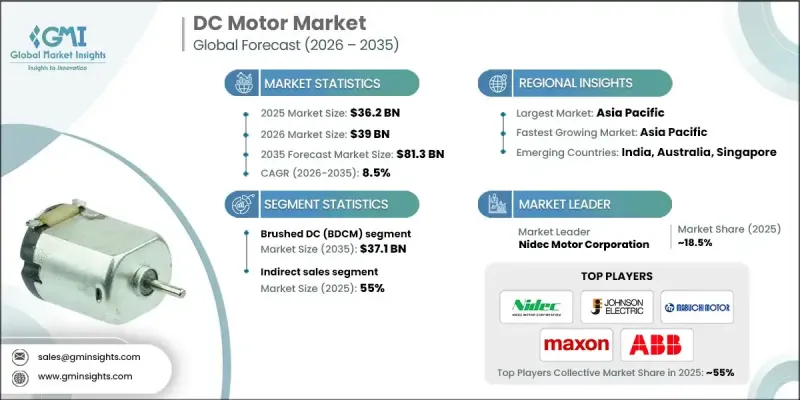
隨著監管壓力、環保意識的增強以及技術的不斷進步,電動車市場正在重塑整個產業格局,加速電動車的普及。電動汽車零件生產成本的降低以及對低速高扭矩、高效控制馬達的強勁需求,推動了有刷和無刷直流馬達在動力系統中的應用。充電網路和電池系統的持續進步進一步刺激了市場需求。工業自動化也成為直流馬達成長的主要驅動力,因為這些馬達是多個產業自動化機械的核心運作部件。直流馬達精確的調速性能以及與數位控制系統的無縫整合,使其成為對精度和適應性要求較高的應用的首選。機器人系統、先進搬運設備和精密工具的日益普及,凸顯了直流馬達在維持產品品質和生產效率方面的關鍵作用。
| 市場範圍 | |
|---|---|
| 起始年份 | 2025 |
| 預測年份 | 2026-2035 |
| 起始值 | 362億美元 |
| 預測值 | 813億美元 |
| 複合年成長率 | 8.5% |
2025年,有刷直流馬達(BDCM)市場規模達203億美元,預計2035年將成長至371億美元。由於其設計簡潔、結構經濟高效且製造流程簡單,該細分市場在消費性電子領域仍佔有重要地位。其機械換向系統使得產品易於製造商生產和維護,同時買家所需的初始投資也有限。這些優勢使得有刷直流馬達在那些價格因素比性能要求更為重要的市場中成為極具吸引力的選擇。
到2025年,間接銷售通路的銷售額將達到199億美元,佔總銷售額的55%。透過第三方供應商、經銷商和區域分銷商等合作夥伴進行間接分銷,能夠為企業提供更廣泛的市場准入和更快捷的交付能力。關鍵產業內完善的網路使製造商無需建造龐大的內部銷售基礎設施即可更有效率地擴大規模。預計在發展中地區,經銷商擁有豐富的本地經驗,能夠簡化產品部署和客戶服務流程,因此該通路將進一步拓展。
2025年美國直流馬達市場規模達54億美元,預計2026年至2035年將以7.7%的複合年成長率成長。美國電動車市場佔有率的持續成長(從2011年的0.2%成長至2021年的4.6%)為電動車系統中使用的直流馬達帶來了持續的成長動力。政府支持的旨在2030年部署數百萬輛電動車和充電站的基礎設施計畫預計將進一步刺激市場需求。隨著移動出行平台投資的增加,用於傳動系統部件、冷卻裝置、水泵和輔助系統的直流馬達預計將迎來顯著的市場擴張,使美國成為移動出行領域直流馬達應用成長最快的地區之一。
目錄
第1章:方法論與範圍
第2章:執行概要
第3章:行業洞察
- 產業生態系分析
- 供應商格局
- 利潤率
- 每個階段的價值增加
- 影響價值鏈的因素
- 產業影響因素
- 成長促進因素
- 產業陷阱與挑戰
- 機會
- 成長潛力分析
- 未來市場趨勢
- 監理框架
- 按地區
- 波特五力分析
- PESTEL 分析
第4章:競爭格局
- 介紹
- 公司市佔率分析
- 按地區
- 公司矩陣分析
- 主要市場參與者的競爭分析
- 競爭定位矩陣
- 產品組合基準測試
- 關鍵進展
- 併購
- 合作夥伴關係與合作
- 新產品發布
- 擴張計劃
第5章:市場估算與預測:依馬達類型分類 2022-2035 年
- 有刷直流馬達(BDCM)
- 無刷直流電(BLDC)
第6章:市場估算與預測:依功率等級分類,2022-2035年
- 6.2. 微型馬達(< 1W)
- 6.3. 小功率馬達(1W - 750W)
- 6.4. 整體式馬力馬達(750W - 75 kW)
- 6.5. 大型馬達(>75 kW)
第7章:市場估算與預測:依最終用途產業分類,2022-2035年
- 汽車
- 機器人技術
- 消費性電子和家電
- 工業自動化和製造
- 醫療器材和醫療保健
- 暖通空調和建築自動化
- 航太與國防
- 農業和建築業
- 海洋與造船
- 其他
第8章:市場估算與預測:依配銷通路分類,2022-2035年
- 直銷
- 間接銷售
第9章:市場估計與預測:依地區分類,2022-2035年
- 北美洲
- 美國
- 加拿大
- 歐洲
- 德國
- 英國
- 法國
- 義大利
- 西班牙
- 亞太地區
- 中國
- 印度
- 日本
- 韓國
- 澳洲
- 拉丁美洲
- 巴西
- 墨西哥
- 阿根廷
- MEA
- 阿拉伯聯合大公國
- 沙烏地阿拉伯
- 南非
第10章:公司簡介
- ABB
- AMETEK
- Allied Motion, Inc.
- ARC Systems Inc
- Continental AG
- DENSO Corporation
- Dunkermotoren GmbH
- Johnson Electric Holdings Limited.
- Mabuchi Motor
- Maxon Motor
- Minebea Mitsumi
- Nidec Motor Corporation
- ORIENTAL MOTOR CORP
- Robert Bosch
- Zhejiang Songtian Automotive Motor System Co., Ltd
The Global DC Motor Market was valued at USD 36.2 billion in 2025 and is estimated to grow at a CAGR of 8.5% to reach USD 81.3 billion by 2035.
The expanding electric vehicle landscape is reshaping the industry as regulatory pressures, rising environmental awareness, and steady technological improvements continue to accelerate EV adoption. Lower production costs for EV components and the strong need for high-torque, efficiently controlled motors at low speeds have increased the use of both brushed and brushless DC motors in propulsion systems. Ongoing advancements in charging networks and battery systems are further boosting demand. Industrial automation is also becoming a major contributor to DC motor growth, as these motors act as the operational core for automated machinery across multiple sectors. Their precise speed regulation and seamless integration with digital control systems make them the preferred choice for applications that require accuracy and adaptable performance. The growing utilization of robotic systems, advanced handling equipment, and precision tools highlights the essential role DC motors play in maintaining production quality and throughput.
| Market Scope | |
|---|---|
| Start Year | 2025 |
| Forecast Year | 2026-2035 |
| Start Value | $36.2 Billion |
| Forecast Value | $81.3 Billion |
| CAGR | 8.5% |
The brushed DC (BDCM) category reached USD 20.3 billion in 2025 and is forecast to rise to USD 37.1 billion by 2035. This segment remains influential across consumer electronics due to its straightforward design, cost-effective structure, and reduced manufacturing complexity. Their mechanical commutation systems allow for a product that is easy for manufacturers to produce and maintain, while also requiring limited initial investment from buyers. These attributes make BDCMs an appealing option in markets where pricing considerations outweigh enhanced performance requirements.
The indirect sales channel generated USD 19.9 billion in 2025, accounting for a 55% share. Indirect distribution through partners such as third-party vendors, dealers, and regional distributors provides companies with broader market access and faster delivery capabilities. Well-established networks within key sectors enable manufacturers to scale more efficiently without building extensive in-house sales infrastructures. This channel is expected to expand in developing regions where distributors possess strong local insight and can streamline product deployment and customer service.
U.S. DC Motor Market was valued at USD 5.4 billion in 2025 and is projected to achieve a CAGR of 7.7% from 2026 to 2035. The rising share of electric vehicles in the U.S., increasing from 0.2% in 2011 to 4.6% in 2021, has created consistent momentum for DC motors used in EV systems. Government-backed infrastructure plans aiming to deploy millions of EVs and charging stations by 2030 are expected to intensify demand. As investment increases across mobility platforms, DC motors used in drivetrain components, cooling units, pumps, and auxiliary systems are expected to see significant market expansion, positioning the U.S. as one of the fastest-growing regions for mobility-focused DC motor applications.
Key companies in the Global DC Motor Market include ABB, AMETEK, Allied Motion, Inc., ARC Systems Inc., Continental AG, DENSO Corporation, Dunkermotoren GmbH, Johnson Electric Holdings Limited, Mabuchi Motor, Maxon Motor, Minebea Mitsumi, Nidec Motor Corporation, ORIENTAL MOTOR CORP, Robert Bosch, and Zhejiang Songtian Automotive Motor System Co., Ltd. Companies competing in the Global DC Motor Market are implementing several strategies to strengthen their overall position. Many are investing in advanced motor design to enhance torque density, energy efficiency, and digital compatibility, supporting the shift toward automation and electrified mobility. Firms are also expanding manufacturing capacity and regional production hubs to meet rising global demand while reducing lead times. Strategic collaborations with EV manufacturers, industrial automation firms, and system integrators are helping companies secure long-term supply agreements. Organizations are diversifying product portfolios to serve emerging applications, while also adopting sustainability-driven practices to align with environmental regulations.
Table of Contents
Chapter 1 Methodology & Scope
- 1.1 Market scope and definition
- 1.2 Research design
- 1.2.1 Research approach
- 1.2.2 Data collection methods
- 1.3 Data mining sources
- 1.3.1 Global
- 1.3.2 Regional/Country
- 1.4 Base estimates and calculations
- 1.4.1 Base year calculation
- 1.4.2 Key trends for market estimation
- 1.5 Primary research and validation
- 1.5.1 Primary sources
- 1.6 Forecast model
- 1.7 Research assumptions and limitations
Chapter 2 Executive Summary
- 2.1 Industry 360° synopsis
- 2.2 Key market trends
- 2.2.1 Regional trends
- 2.2.2 Motor type trends
- 2.2.3 Power rating trends
- 2.2.4 End use industry trends
- 2.2.5 Distribution channel trends
- 2.3 CXO perspective: Strategic imperatives
- 2.3.1 Key decision points for industry executives
- 2.3.2 Critical success factors for market players
- 2.4 Future outlook and strategic recommendations
- 2.5 Strategic recommendations
- 2.5.1 Supply chain diversification strategy
- 2.5.2 Product portfolio enhancement
- 2.5.3 Partnership and alliance opportunities
- 2.5.4 Cost management and pricing strategy
- 2.6 Decision framework
- 2.6.1 Investment priority matrix
- 2.6.2 ROI analysis
Chapter 3 Industry Insights
- 3.1 Industry ecosystem analysis
- 3.1.1 Supplier Landscape
- 3.1.2 Profit Margin
- 3.1.3 Value addition at each stage
- 3.1.4 Factor affecting the value chain
- 3.2 Industry impact forces
- 3.2.1 Growth drivers
- 3.2.2 Industry pitfalls & challenges
- 3.2.3 Opportunities
- 3.3 Growth potential analysis
- 3.4 Future market trends
- 3.5 Regulatory framework
- 3.5.1 By region
- 3.6 Porter's five forces analysis
- 3.7 PESTEL analysis
Chapter 4 Competitive Landscape, 2025
- 4.1 Introduction
- 4.2 Company market share analysis
- 4.2.1 By Region
- 4.3 Company matrix analysis
- 4.4 Competitive analysis of major market players
- 4.5 Competitive positioning matrix
- 4.6 Product portfolio benchmarking
- 4.7 Key developments
- 4.7.1 Mergers & acquisitions
- 4.7.2 Partnerships & collaborations
- 4.7.3 New Product Launches
- 4.7.4 Expansion Plans
Chapter 5 Market Estimates & Forecast, By Motor Type 2022 - 2035 (USD Billion) (Million Units)
- 5.1 Key trends
- 5.2 Brushed DC (BDCM)
- 5.3 Brushless DC (BLDC)
Chapter 6 Market Estimates & Forecast, By Power Rating, 2022 - 2035 (USD Billion) (Million Units)
- 6.1 Key trends
- 6.2 Micro Motors (< 1W)
- 6.3 Fractional HP Motors (1W - 750W)
- 6.4 Integral HP Motors (750W - 75 kW)
- 6.5 Large Motors (>75 kW)
Chapter 7 Market Estimates & Forecast, By End Use Industry, 2022 - 2035 (USD Billion) (Million Units)
- 7.1 Key trends
- 7.2 Automotive
- 7.3 Robotics
- 7.4 Consumer Electronics and Appliance
- 7.5 Industrial Automation and Manufacturing
- 7.6 Medical Devices and Healthcare
- 7.7 HVAC and Building Automation
- 7.8 Aerospace and Defense
- 7.9 Agriculture and Construction
- 7.10 Marine and Shipbuilding
- 7.11 Others
Chapter 8 Market Estimates & Forecast, By Distribution Channel, 2022 - 2035, (USD Billion) (Million Units)
- 8.1 Key trends
- 8.2 Direct Sales
- 8.3 Indirect Sales
Chapter 9 Market Estimates & Forecast, By Region, 2022 - 2035, (USD Billion) (Million Units)
- 9.1 Key trends
- 9.2 North America
- 9.2.1 U.S.
- 9.2.2 Canada
- 9.3 Europe
- 9.3.1 Germany
- 9.3.2 U.K.
- 9.3.3 France
- 9.3.4 Italy
- 9.3.5 Spain
- 9.4 Asia Pacific
- 9.4.1 China
- 9.4.2 India
- 9.4.3 Japan
- 9.4.4 South Korea
- 9.4.5 Australia
- 9.5 Latin America
- 9.5.1 Brazil
- 9.5.2 Mexico
- 9.5.3 Argentina
- 9.6 MEA
- 9.6.1 UAE
- 9.6.2 Saudi Arabia
- 9.6.3 South Africa
Chapter 10 Company Profiles (Business Overview, Financial Data, Product Landscape, Strategic Outlook, SWOT Analysis)
- 10.1 ABB
- 10.2 AMETEK
- 10.3 Allied Motion, Inc.
- 10.4 ARC Systems Inc
- 10.5 Continental AG
- 10.6 DENSO Corporation
- 10.7 Dunkermotoren GmbH
- 10.8 Johnson Electric Holdings Limited.
- 10.9 Mabuchi Motor
- 10.10 Maxon Motor
- 10.11 Minebea Mitsumi
- 10.12 Nidec Motor Corporation
- 10.13 ORIENTAL MOTOR CORP
- 10.14 Robert Bosch
- 10.15 Zhejiang Songtian Automotive Motor System Co., Ltd

 直流馬達市場:2026-2032年全球市場預測(按馬達類型、額定電壓、應用和最終用途產業分類)碳刷市場:按材料、技術、應用和終端用戶產業分類-2026-2032年全球市場預測DC馬達市場:2026-2032年全球市場預測(依產品類型、額定功率、額定電壓、安裝方式、終端用戶產業及通路分類)永磁無刷無刷直流馬達市場:依最終用途產業、額定功率、電壓類型、控制類型、冷卻方式、安裝方式分類,全球預測,2026-2032年繞線式DC馬達市場:全球預測(2026-2032年),依馬達結構類型、額定功率、電壓等級、銷售管道、應用和最終用途分類小型無刷直流馬達市場:按額定功率、轉速、冷卻方式和應用分類-全球預測,2026-2032年直流減速馬達市場:按馬達類型、功率範圍、減速比、終端用戶產業、應用和銷售管道,全球預測(2026-2032年)
 直流馬達市場分析及預測(至2035年):依類型、產品類型、服務、技術、組件、應用、材質、最終用戶、功能、安裝類型分類直流馬達控制設備市場分析及預測(至2035年):依類型、產品、服務、技術、組件、應用、最終用戶、功能、安裝類型及設備分類
 全球直流馬達控制設備市場規模、佔有率、趨勢和成長分析報告(2026-2034年)