


 |
市場調查報告書
商品編碼
1885845
女性健康消費品市場機會、成長促進因素、產業趨勢分析及預測(2025-2034年)Womens Health Consumer Products Market Opportunity, Growth Drivers, Industry Trend Analysis, and Forecast 2025 - 2034 |
||||||

2024 年全球女性健康消費品市場價值 420 億美元,預計到 2034 年將以 5% 的複合年成長率成長至 682 億美元。
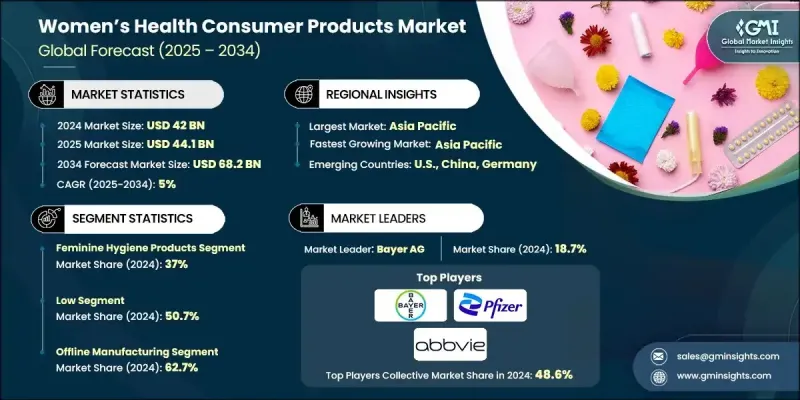
此估值涵蓋了透過醫院藥局、獨立藥局、藥局和線上零售平台銷售的處方藥和非處方女性健康產品。市場成長受人口結構變化、預防保健日益重視、健康素養提高以及鼓勵產品更廣泛供應的監管框架不斷完善等因素的影響。新興地區(尤其是亞太地區)收入成長和城市化發展進一步支撐了這一上升趨勢,這些地區對專業化和高品質健康解決方案的需求持續增強。市場規模反映了不同地區在定價、醫療服務可近性和購買行為方面的差異。北美和歐洲由於較高的健康意識和完善的醫療保健體系,人均支出較高;而拉丁美洲、中東和非洲以及亞太地區的市場則隨著基礎設施的改善和健康意識的提高而快速擴張。這些因素共同推動了全球市場的持續長期成長。
| 市場範圍 | |
|---|---|
| 起始年份 | 2024 |
| 預測年份 | 2025-2034 |
| 起始值 | 420億美元 |
| 預測值 | 682億美元 |
| 複合年成長率 | 5% |
2024年,女性衛生用品市佔率達到37%,預計2025年至2034年間將以5.2%的複合年成長率成長。此類別涵蓋經期護理和私密衛生用品,由於其持續的補充週期和日常衛生用品的必需性,仍保持著市場主導地位。材料和設計的進步不斷提升產品安全性、舒適性和環保性,以滿足消費者的需求。
2024年,低價女性健康產品市佔率達到50.75%,預計將以5.2%的複合年成長率成長。此細分市場涵蓋廣泛使用的個人健康用品、維生素、補充劑和日常衛生用品。由於這些產品購買頻率高,價格實惠仍是關鍵因素,尤其是在發展中經濟體和注重成本的消費者群體中,因此該細分市場保持領先地位。
2024年,北美女性健康消費品市佔率達到26.4%,預計到2034年將以5.2%的複合年成長率成長。高消費水準、強大的醫療保健體系和有利的監管環境是該地區保持領先地位的關鍵因素。北美仍是女性健康科技創新的中心,預計2024年,全球超過33%的女性健康科技企業將落腳北美。其中約20%的企業專注於懷孕和哺乳期解決方案,使該領域成為推動區域成長的最重要因素之一。
活躍於女性健康消費品市場的關鍵企業包括雅培實驗室、安進、安麗全球、拜耳、寶潔、Ferring製藥、GNC控股、康寶萊營養、強生、默克、雀巢、輝瑞、三得利控股、梯瓦製藥和喜馬拉雅藥品公司。領導企業正透過拓展營養健康、荷爾蒙平衡、生殖健康和日常衛生用品等產品組合,鞏固其在女性健康消費品市場的地位。許多公司正加大研發投入,推出以科學為依據的配方、清潔標籤成分和個人化解決方案,以滿足消費者日益成長的預防保健需求。包括遠距醫療整合、行動應用程式和定向線上管道在內的數位化互動策略,正在提升品牌知名度和可及性。此外,各公司也透過與藥局、電商平台和醫療服務供應商合作,擴大分銷管道,觸及更廣泛的客戶群。
目錄
第1章:方法論與範圍
第2章:執行概要
第3章:行業洞察
- 產業生態系分析
- 供應商格局
- 利潤率
- 每個階段的價值增加
- 影響價值鏈的因素
- 產業影響因素
- 成長促進因素
- 女性健康和慢性疾病發生率不斷上升
- 科技進步與數位健康/女性健康科技
- 提高公眾意識和支持性政策/政府舉措
- 產業陷阱與挑戰
- 污名、文化和取得障礙
- 監管、研究和臨床試驗的差距
- 資料隱私、產品類別片段化與成本壓力
- 機會
- 女性科技和數位健康解決方案的擴展
- 對預防性和整體健康產品的需求不斷成長
- 新興經濟體和細分市場中尚未開發的市場
- 成長促進因素
- 成長潛力分析
- 未來市場趨勢
- 技術與創新格局
- 當前技術趨勢
- 新興技術
- 價格趨勢
- 按地區
- 依產品類型
- 監管環境
- 標準和合規要求
- 區域監理框架
- 波特的分析
- PESTEL 分析
- 消費者行為分析
- 購買模式
- 偏好分析
- 消費者行為的區域差異
- 電子商務對購買決策的影響
第4章:競爭格局
- 介紹
- 公司市佔率分析
- 按地區
- 公司矩陣分析
- 主要市場參與者的競爭分析
- 競爭定位矩陣
- 關鍵進展
- 併購
- 合作夥伴關係與合作
- 新產品發布
- 擴張計劃
第5章:市場估算與預測:依產品類型分類,2021-2034年
- 主要趨勢
- 女性衛生用品
- 衛生棉
- 衛生棉條
- 月經杯
- 護墊
- 其他
- 孕期及產後護理產品
- 懷孕維生素
- 孕婦裝
- 妊娠紋霜
- 孕期補充劑
- 性健康產品
- 避孕藥
- 潤滑劑
- 私密健康產品
- 營養及膳食補充品
- 其他個人護理產品(護膚品、頭髮護理產品和保健產品)
第6章:市場估計與預測:依年齡層別分類(2021-2034年)
- 主要趨勢
- 青少年和年輕成年人
- 成年人
- 中老年女性
第7章:市場估計與預測:依價格分類,2021-2034年
- 主要趨勢
- 低的
- 中等的
- 高的
第8章:市場估算與預測:依配銷通路分類,2021-2034年
- 主要趨勢
- 線上平台
- 電子商務平台(亞馬遜、Flipkart 等)
- 品牌網站和訂閱盒
- 女性健康產品的行動應用程式
- 線下零售
- 超市和大型超市
- 藥局和藥局
- 專業健康與保健商店
第9章:市場估計與預測:依地區分類,2021-2034年
- 主要趨勢
- 北美洲
- 美國
- 加拿大
- 歐洲
- 英國
- 德國
- 法國
- 義大利
- 西班牙
- 俄羅斯
- 亞太地區
- 中國
- 印度
- 日本
- 澳洲
- 韓國
- 拉丁美洲
- 巴西
- 墨西哥
- 阿根廷
- MEA
- 阿拉伯聯合大公國
- 南非
- 沙烏地阿拉伯
第10章:公司簡介
- Abbott Laboratories
- Amgen
- Amway Global
- Bayer
- Blackmores
- Ferring Pharmaceuticals
- GNC Holdings
- Herbalife Nutrition
- Johnson & Johnson
- Merck & Co.
- Nestle
- Pfizer
- Suntory Holdings
- Teva Pharmaceutical Industries
- The Himalaya Drug Company
The Global Womens Health Consumer Products Market was valued at USD 42 billion in 2024 and is estimated to grow at a CAGR of 5% to reach USD 68.2 billion by 2034.
The valuation includes both prescription-based and over-the-counter women's health products sold through hospital pharmacies, independent pharmacies, drug stores, and digital retail platforms. Market growth is shaped by shifting demographics, rising focus on preventive care, increasing health literacy, and evolving regulatory frameworks that encourage wider product availability. The upward trend is further supported by rising incomes and urban development in emerging regions, particularly across the Asia Pacific, where demand for specialized and high-quality health solutions continues to strengthen. Market sizing reflects regional differences in pricing, access to care, and purchasing behaviors. North America and Europe demonstrate higher per-capita spending due to strong awareness levels and well-established healthcare systems, while markets in Latin America, the Middle East & Africa, and Asia Pacific are expanding rapidly as infrastructure improves and awareness broadens. Together, these dynamics contribute to consistent, long-term growth worldwide.
| Market Scope | |
|---|---|
| Start Year | 2024 |
| Forecast Year | 2025-2034 |
| Start Value | $42 Billion |
| Forecast Value | $68.2 Billion |
| CAGR | 5% |
The feminine hygiene products segment held a 37% share in 2024 and is forecast to grow at a CAGR of 5.2% during 2025-2034. This category includes menstrual care and intimate hygiene items and remains dominant due to constant replenishment cycles and the essential nature of routine hygiene products. Advances in materials and design continue to emphasize safety, comfort, and environmentally mindful solutions for consumers.
The low-price women's health products segment accounted for a 50.75% share in 2024 and is expected to grow at a CAGR of 5.2%. This segment encompasses widely used personal health items, vitamins, supplements, and everyday hygiene products. It maintains its leading share because many of these goods are purchased frequently, and affordability remains a critical factor, particularly in developing economies and among cost-conscious consumers.
North America Womens Health Consumer Products Market captured 26.4% share in 2024 and is projected to grow at a CAGR of 5.2% through 2034. High spending levels, strong healthcare systems, and supportive regulatory environments contribute to the region's leadership position. The area remains a hub for women's health technology innovation, with more than 33% of global femtech ventures based there in 2024. Approximately 20% of these ventures focus on pregnancy and nursing solutions, making this segment one of the most significant contributors to regional growth.
Key companies active in the Womens Health Consumer Products Market include Abbott Laboratories, Amgen, Amway Global, Bayer, Blackmores, Ferring Pharmaceuticals, GNC Holdings, Herbalife Nutrition, Johnson & Johnson, Merck & Co., Nestle, Pfizer, Suntory Holdings, Teva Pharmaceutical Industries, and The Himalaya Drug Company. Leading companies are strengthening their Womens Health Consumer Products Market presence by expanding product portfolios across nutritional health, hormonal wellness, reproductive care, and daily hygiene categories. Many firms are investing in R&D to introduce science-backed formulations, clean-label ingredients, and personalized solutions that align with rising consumer interest in preventive health. Digital engagement strategies, including telehealth integration, mobile apps, and targeted online channels, are improving brand visibility and accessibility. Companies are also widening distribution through partnerships with pharmacies, e-commerce platforms, and healthcare providers to reach a broader customer base.
Table of Contents
Chapter 1 Methodology and Scope
- 1.1 Market scope and definition
- 1.2 Research design
- 1.2.1 Research approach
- 1.3 Data collection methods
- 1.4 Data mining sources
- 1.4.1 Global
- 1.4.2 Regional/Country
- 1.5 Base estimates and calculations
- 1.5.1 Base year calculation
- 1.5.2 Key trends for market estimation
- 1.6 Primary research and validation
- 1.6.1 Primary sources
- 1.7 Forecast model
- 1.8 Research assumptions and limitations
Chapter 2 Executive Summary
- 2.1 Industry 360° synopsis
- 2.2 Key market trends
- 2.2.1 Regional
- 2.2.2 Product type
- 2.2.3 Age group
- 2.2.4 Price
- 2.2.5 Distribution channel
- 2.3 CXO perspectives: strategic imperatives
- 2.3.1 Key decision points for industry executives
- 2.3.2 Critical success factors for market players
- 2.4 Future outlook and strategic recommendations
Chapter 3 Industry Insights
- 3.1 Industry ecosystem analysis
- 3.1.1 Supplier landscape
- 3.1.2 Profit margin
- 3.1.3 Value addition at each stage
- 3.1.4 Factors affecting the value chain
- 3.2 Industry impact forces
- 3.2.1 Growth drivers
- 3.2.1.1 Growing incidence of women’s health and chronic conditions
- 3.2.1.2 Advancements in technology & digital health / femtech
- 3.2.1.3 Increasing awareness and supportive policy/government initiatives
- 3.2.2 Industry pitfalls & challenges
- 3.2.2.1 Stigma, cultural & access barriers
- 3.2.2.2 Regulatory, research and clinical trial gaps
- 3.2.2.3 Data privacy, fragmenting product categories, and cost pressures
- 3.2.3 Opportunities
- 3.2.3.1 Expansion of femtech and digital health solutions
- 3.2.3.2 Rising demand for preventive and holistic wellness products
- 3.2.3.3 Untapped markets in emerging economies and niche segments
- 3.2.1 Growth drivers
- 3.3 Growth potential analysis
- 3.4 Future market trends
- 3.5 Technology and innovation landscape
- 3.5.1 Current technological trends
- 3.5.2 Emerging technologies
- 3.6 Price trends
- 3.6.1 By region
- 3.6.2 By Product type
- 3.7 Regulatory landscape
- 3.7.1 standards and compliance requirements
- 3.7.2 Regional regulatory frameworks
- 3.8 Porter's analysis
- 3.9 PESTEL analysis
- 3.10 Consumer behavior analysis
- 3.10.1 Purchasing patterns
- 3.10.2 Preference analysis
- 3.10.3 Regional variations in consumer behavior
- 3.10.4 Impact of e-commerce on buying decisions
Chapter 4 Competitive Landscape, 2024
- 4.1 Introduction
- 4.2 Company market share analysis
- 4.2.1 By region
- 4.2.1.1 North America
- 4.2.1.2 Europe
- 4.2.1.3 Asia Pacific
- 4.2.1.4 Latin America
- 4.2.1.5 Middle East and Africa
- 4.2.1 By region
- 4.3 Company matrix analysis
- 4.4 Competitive analysis of major market players
- 4.5 Competitive positioning matrix
- 4.6 Key developments
- 4.6.1 Mergers & acquisitions
- 4.6.2 Partnerships & collaborations
- 4.6.3 New Product Launches
- 4.6.4 Expansion Plans
Chapter 5 Market Estimates & Forecast, By Product Type, 2021 - 2034 ($Bn, Thousand Units)
- 5.1 Key trends
- 5.2 Feminine hygiene products
- 5.2.1 Sanitary napkins
- 5.2.2 Tampons
- 5.2.3 Menstrual cups
- 5.2.4 Panty liners
- 5.2.5 Others
- 5.3 Maternity & pregnancy care products
- 5.3.1 Prenatal vitamins
- 5.3.2 Maternity wear
- 5.3.3 Stretch mark creams
- 5.3.4 Pregnancy supplements
- 5.4 Sexual wellness products
- 5.4.1 Contraceptives
- 5.4.2 Lubricants
- 5.4.3 Intimate health products
- 5.5 Nutritional & dietary supplements
- 5.6 Other personal care products (skincare, hair care, and wellness products)
Chapter 6 Market Estimates & Forecast, By Age Group 2021 - 2034 ($Bn, Thousand Units)
- 6.1 Key trends
- 6.2 Teenagers & young adults
- 6.3 Adults
- 6.4 Middle-aged & older women
Chapter 7 Market Estimates & Forecast, By Price, 2021 - 2034 ($Bn, Thousand Units)
- 7.1 Key trends
- 7.2 Low
- 7.3 Medium
- 7.4 High
Chapter 8 Market Estimates & Forecast, By Distribution channel, 2021 - 2034 ($Bn, Thousand Units)
- 8.1 Key trends
- 8.2 Online platforms
- 8.2.1 E-commerce marketplaces (Amazon, Flipkart, etc.)
- 8.2.2 Brand websites & subscription boxes
- 8.2.3 Mobile apps for Women’s health products
- 8.3 Offline retail
- 8.3.1 Supermarkets & hypermarkets
- 8.3.2 Pharmacies & drugstores
- 8.3.3 Specialty health & wellness stores
Chapter 9 Market Estimates & Forecast, By Region, 2021 - 2034 ($Bn, Thousand Units)
- 9.1 Key trends
- 9.2 North America
- 9.2.1 U.S.
- 9.2.2 Canada
- 9.3 Europe
- 9.3.1 UK
- 9.3.2 Germany
- 9.3.3 France
- 9.3.4 Italy
- 9.3.5 Spain
- 9.3.6 Russia
- 9.4 Asia Pacific
- 9.4.1 China
- 9.4.2 India
- 9.4.3 Japan
- 9.4.4 Australia
- 9.4.5 South Korea
- 9.5 Latin America
- 9.5.1 Brazil
- 9.5.2 Mexico
- 9.5.3 Argentina
- 9.6 MEA
- 9.6.1 UAE
- 9.6.2 South Africa
- 9.6.3 Saudi Arabia
Chapter 10 Company Profiles
- 10.1 Abbott Laboratories
- 10.2 Amgen
- 10.3 Amway Global
- 10.4 Bayer
- 10.5 Blackmores
- 10.6 Ferring Pharmaceuticals
- 10.7 GNC Holdings
- 10.8 Herbalife Nutrition
- 10.9 Johnson & Johnson
- 10.10 Merck & Co.
- 10.11 Nestle
- 10.12 Pfizer
- 10.13 Suntory Holdings
- 10.14 Teva Pharmaceutical Industries
- 10.15 The Himalaya Drug Company

 女性健康市場:按產品、分銷管道、應用和最終用戶分類的全球市場預測 – 2026-2032 年
 女性健康市場規模、佔有率、趨勢和預測:按年齡層、應用、分銷管道和地區分類,2026-2034 年女性健康治療市場:2026-2032年全球市場預測(依治療領域、產品類型、最終用戶和通路分類)陰道保濕劑和潤滑劑市場:按產品類型、配方、分銷管道和應用分類的全球市場預測,2026-2032年
 全球女性健康照護市場規模、佔有率、趨勢和成長分析報告(2026-2034)
 女性健康照護市場分析及預測(至2035年):依類型、產品類型、服務、技術、應用、最終使用者、設備、功能及解決方案分類
 全球女性健康市場:市場規模、佔有率和趨勢分析(按應用、藥物類別、年齡層和地區分類),細分市場預測(2026-2033 年)全球女性健康治療市場規模、佔有率、趨勢和成長分析報告(2026-2034)
 全球女性用荷爾蒙平衡和經期健康產品市場預測(至2032年):按產品、配方、成分類型、分銷管道、應用、最終用戶和地區分類
 女性健康市場-全球產業規模、佔有率、趨勢、機會及預測(按藥物、應用、地區和競爭格局分類,2021-2031年)