


 |
市場調查報告書
商品編碼
1885786
化學回收催化劑市場機會、成長促進因素、產業趨勢分析及預測(2025-2034年)Chemical Recycling Catalysts Market Opportunity, Growth Drivers, Industry Trend Analysis, and Forecast 2025 - 2034 |
||||||

2024 年全球化學回收催化劑市場價值為 9,200 萬美元,預計到 2034 年將以 24% 的複合年成長率成長至 8.189 億美元。
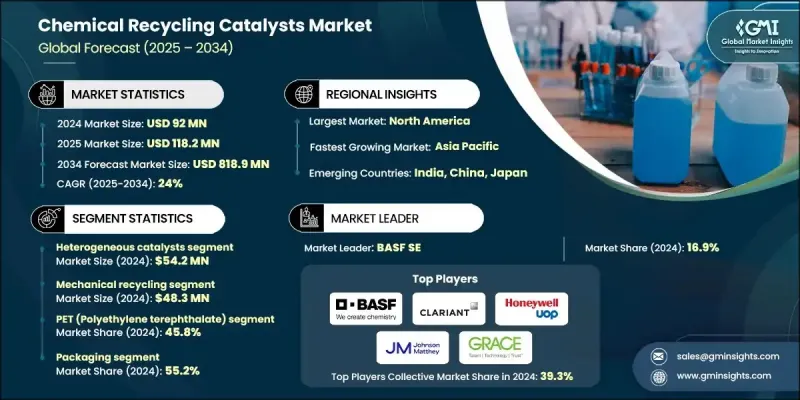
隨著這些催化劑能夠透過分子層面的轉化而非物理加工,將廢棄聚合物和塑膠轉化為單體或有價值的化合物,該市場正在不斷擴張。化學回收與傳統的機械方法不同,它能夠恢復材料的質量,而不是生產降級產品。日益成長的環保期望、更嚴格的監管以及對循環經濟模式的日益重視,推動了向先進回收技術的轉變。化學回收催化劑能夠降低斷裂聚合物鏈所需的反應能量,並支持熱解、水解和解聚等過程。催化劑性能的持續提升,以及全球範圍內為加強廢物回收和材料再利用所做的努力,正在對化學回收技術的長期應用起到至關重要的作用。
| 市場範圍 | |
|---|---|
| 起始年份 | 2024 |
| 預測年份 | 2025-2034 |
| 起始值 | 9200萬美元 |
| 預測值 | 8.189億美元 |
| 複合年成長率 | 24% |
2024年,非均相催化劑市場規模達5,420萬美元。其廣泛應用得益於其耐久性、成本效益以及反應後易於分離等優點。均相催化劑因其在選擇性轉化中的高效性而仍具有重要意義,但與固體催化劑相比,其成長受到分離難題和較高營運成本的限制。
2024年,PET催化劑市佔率達45.8%。由於PET在紡織品和包裝領域的廣泛應用,以及將PET轉化為高品質單體的趨勢日益成長,市場需求持續上升。糖解作用和水解等製程需要催化劑在受控條件下分解PET,使其能夠重新用於新材料的生產。聚烯烴(包括聚乙烯和聚丙烯)催化劑也仍然十分重要,因為新的創新技術有助於將這些塑膠轉化為可回收的碳氫化合物,從而推動循環經濟目標的實現。
2024年,美國化學回收催化劑市場規模達1,830萬美元。隨著北美各產業和研究夥伴攜手合作,提高回收效率,並推動更多試點和商業化回收項目,北美地區的催化劑應用持續成長。鼓勵減少廢棄物和改進回收系統的有利監管環境,間接促進了催化劑需求的成長和技術進步。
化學回收催化劑市場的主要活躍企業包括:Albemarle Corporation、巴斯夫公司 (BASF SE)、Agilyx Corporation、科萊恩公司 (Clariant AG)、Carbios、陶氏公司 (Dow Inc.)、Haldor Topsoe A/S、Grace Catalysts Technologies (WR Grace & Co.)、Eurecat、oopwlihot. Technologies、沙烏地基礎工業公司 (SABIC)、馬來西亞國家石油公司 (PETRONAS Chemicals Group Berhad)、殼牌公司 (Shell Plc)、道達爾能源公司 (TotalEnergies SE)、Plastic Energy、東曹株式會社 (Tosoh Corporation)、埃克森美孚公司 (ExxonMobil Corporation)、Zeolyst International 和 Pyrowave。這些企業正透過專注於技術進步、長期合作和擴大生產規模來拓展市場佔有率。許多企業正大力投資研發,以開發具有更高選擇性、更快反應速率和更低能耗的催化劑。催化劑製造商、回收設施和聚合物生產商之間的策略聯盟日益普遍,旨在加速商業化並確保可靠的終端用戶管道。各公司也在加強試點項目,以便在廣泛部署之前驗證流程效率。
目錄
第1章:方法論與範圍
第2章:執行概要
第3章:行業洞察
- 產業生態系分析
- 供應商格局
- 利潤率
- 每個階段的價值增加
- 影響價值鏈的因素
- 中斷
- 產業影響因素
- 成長促進因素
- 催化劑和回收技術的快速創新
- 高成長終端應用領域中聚合物應用的擴展
- 各行各業日益成長的監管壓力和永續發展要求
- 產業陷阱與挑戰
- 高昂的資本和營運成本
- 原料波動性和污染問題
- 市場機遇
- 多原料催化劑的開發
- 與再生能源和綠色化學品結合
- 新興市場塑膠消費量不斷成長
- 成長促進因素
- 成長潛力分析
- 監管環境
- 北美洲
- 歐洲
- 亞太地區
- 拉丁美洲
- 中東和非洲
- 波特的分析
- PESTEL 分析
- 技術與創新格局
- 當前技術趨勢
- 新興技術
- 價格趨勢
- 按地區
- 依產品類型
- 未來市場趨勢
- 專利格局
- 貿易統計(HS編碼)(註:僅提供重點國家的貿易統計資料)
- 主要進口國
- 主要出口國
- 永續性和環境方面
- 永續實踐
- 減少廢棄物策略
- 生產中的能源效率
- 環保舉措
- 碳足跡考量
第4章:競爭格局
- 介紹
- 公司市佔率分析
- 按地區
- 北美洲
- 歐洲
- 亞太地區
- 拉丁美洲
- MEA
- 按地區
- 公司矩陣分析
- 主要市場參與者的競爭分析
- 競爭定位矩陣
- 關鍵進展
- 併購
- 合作夥伴關係與合作
- 新產品發布
- 擴張計劃
第5章:市場估算與預測:依催化劑類型分類,2021-2034年
- 主要趨勢
- 非均相催化劑
- 沸石(ZSM-5、USY、NaY、Beta)
- FCC催化劑
- 金屬氧化物催化劑
- 負載型金屬催化劑(Pt、Pd、Rh、Ni、Fe、Co、Ru)
- 均相催化劑
- 金屬乙酸鹽和鹽
- 有機金屬配合物
- 離子液體
- 有機催化劑
- 酵素催化劑(生物催化劑)
- PETases
- 角質層
- 其他酯酶和脂肪酶
第6章:市場估算與預測:依製程分類,2021-2034年
- 主要趨勢
- 熱解催化劑
- 解聚催化劑
- 氣化催化劑
- 溶劑分解催化劑
第7章:市場估算與預測:依聚合物類型分類,2021-2034年
- 主要趨勢
- PET(聚對苯二甲酸乙二醇酯)催化劑
- 聚烯烴(PE/PP)催化劑
- 聚苯乙烯(PS)催化劑
- 混合塑膠催化劑
- 特種聚合物催化劑
- 尼龍(聚醯胺)
- 聚碳酸酯
- 聚氨酯
- PVC
第8章:市場估算與預測:依應用領域分類,2021-2034年
- 主要趨勢
- 包裝
- 汽車
- 紡織品和服裝
- 建築材料
- 電子產品及電子垃圾
- 其他
第9章:市場估計與預測:依地區分類,2021-2034年
- 主要趨勢
- 北美洲
- 美國
- 加拿大
- 墨西哥
- 歐洲
- 德國
- 英國
- 法國
- 西班牙
- 義大利
- 歐洲其他地區
- 亞太地區
- 中國
- 印度
- 日本
- 澳洲
- 韓國
- 亞太其他地區
- 拉丁美洲
- 巴西
- 墨西哥
- 阿根廷
- 拉丁美洲其他地區
- 中東和非洲
- 沙烏地阿拉伯
- 南非
- 阿拉伯聯合大公國
- 中東和非洲其他地區
第10章:公司簡介
- Agilyx Corporation
- Albemarle Corporation
- BASF SE
- Carbios
- Clariant AG
- Dow Inc.
- Eurecat
- Grace Catalysts Technologies (WR Grace & Co.)
- Haldor Topsoe A/S
- Honeywell UOP
- Ioniqa Technologies
- Johnson Matthey Plc
- Loop Industries
- PETRONAS Chemicals Group Berhad
- Plastic Energy
- SABIC
- Shell Plc
- TotalEnergies SE
- Tosoh Corporation
- ExxonMobil Corporation
- Zeolyst International
- Pyrowave
The Global Chemical Recycling Catalysts Market was valued at USD 92 million in 2024 and is estimated to grow at a CAGR of 24% to reach USD 818.9 million by 2034.
This market is expanding as these catalysts enable the conversion of discarded polymers and plastics into monomers or valuable chemical compounds through molecular-level transformations rather than physical processing. Chemical recycling differs from traditional mechanical methods because it restores material quality instead of producing downgraded products. The shift toward advanced recycling is fueled by rising environmental expectations, tighter regulations, and a growing emphasis on circular economic models. Chemical recycling catalysts lower the reaction energy needed to break polymer chains and support processes such as pyrolysis, hydrolysis, and depolymerization. Continued improvements in catalyst performance, along with global efforts to enhance waste recovery and material reuse, are playing a major role in shaping long-term adoption.
| Market Scope | |
|---|---|
| Start Year | 2024 |
| Forecast Year | 2025-2034 |
| Start Value | $92 Million |
| Forecast Value | $818.9 Million |
| CAGR | 24% |
The heterogeneous catalysts segment generated USD 54.2 million in 2024. Their widespread use is tied to their durability, cost efficiency, and straightforward separation after reactions. Homogeneous catalysts remain relevant due to their effectiveness in highly selective transformations, although their growth is limited by separation challenges and higher operational expenses compared with solid catalysts.
The catalysts for the PET segment held a 45.8% share in 2024. Demand continues to rise due to the broad use of PET in textiles and packaging and the growing movement to convert PET back into high-quality monomers. Processes such as glycolysis and hydrolysis rely on catalysts to break down PET under controlled conditions, enabling its reintegration into new materials. Catalysts for polyolefins, including polyethylene and polypropylene, also remain significant as new innovations help convert these plastic streams into reusable hydrocarbons and advance circularity goals.
U.S. Chemical Recycling Catalysts Market generated USD 18.3 million in 2024. Adoption continues to increase across North America as industries and research partners work together to boost recycling efficiency and move more pilot-level and commercial recycling programs forward. Supportive regulatory environments that encourage waste reduction and improved recycling systems indirectly contribute to higher catalyst demand and technological progress.
Key companies active in the Chemical Recycling Catalysts Market include Albemarle Corporation, BASF SE, Agilyx Corporation, Clariant AG, Carbios, Dow Inc., Haldor Topsoe A/S, Grace Catalysts Technologies (W.R. Grace & Co.), Eurecat, Honeywell UOP, Loop Industries, Johnson Matthey Plc, Ioniqa Technologies, SABIC, PETRONAS Chemicals Group Berhad, Shell Plc, TotalEnergies SE, Plastic Energy, Tosoh Corporation, ExxonMobil Corporation, Zeolyst International, and Pyrowave. Companies in the Chemical Recycling Catalysts Market are expanding their presence by focusing on technological advancement, long-term collaborations, and scaling production capabilities. Many players are investing heavily in R&D to develop catalysts that offer higher selectivity, faster reaction rates, and lower energy use. Strategic alliances between catalyst manufacturers, recycling facilities, and polymer producers are becoming more common to accelerate commercialization and secure reliable end-use channels. Firms are also enhancing pilot programs to validate process efficiency before broad deployment.
Table of Contents
Chapter 1 Methodology & Scope
- 1.1 Market scope and definition
- 1.2 Research design
- 1.2.1 Research approach
- 1.2.2 Data collection methods
- 1.3 Data mining sources
- 1.3.1 Global
- 1.3.2 Regional/Country
- 1.4 Base estimates and calculations
- 1.4.1 Base year calculation
- 1.4.2 Key trends for market estimation
- 1.5 Primary research and validation
- 1.5.1 Primary sources
- 1.6 Forecast model
- 1.7 Research assumptions and limitations
Chapter 2 Executive Summary
- 2.1 Industry 3600 synopsis
- 2.2 Key market trends
- 2.2.1 Catalyst type
- 2.2.2 Process
- 2.2.3 Polymer type
- 2.2.4 Application
- 2.2.5 Regional
- 2.3 TAM Analysis, 2025-2034
- 2.4 CXO perspectives: Strategic imperatives
- 2.4.1 Executive decision points
- 2.4.2 Critical success factors
- 2.5 Future outlook and strategic recommendations
Chapter 3 Industry Insights
- 3.1 Industry ecosystem analysis
- 3.1.1 Supplier landscape
- 3.1.2 Profit margin
- 3.1.3 Value addition at each stage
- 3.1.4 Factor affecting the value chain
- 3.1.5 Disruptions
- 3.2 Industry impact forces
- 3.2.1 Growth drivers
- 3.2.1.1 Rapid innovation in catalyst and recycling technologies
- 3.2.1.2 Expansion of polymer use in high growth end use sectors
- 3.2.1.3 Growing regulatory pressure and sustainability mandates across industries
- 3.2.2 Industry pitfalls and challenges
- 3.2.2.1 High capital and operational costs
- 3.2.2.2 Feedstock variability and contamination issues
- 3.2.3 Market opportunities
- 3.2.3.1 Development of multi-feedstock catalysts
- 3.2.3.2 Integration with renewable energy and green chemicals
- 3.2.3.3 Emerging markets with growing plastic consumption
- 3.2.1 Growth drivers
- 3.3 Growth potential analysis
- 3.4 Regulatory landscape
- 3.4.1 North America
- 3.4.2 Europe
- 3.4.3 Asia Pacific
- 3.4.4 Latin America
- 3.4.5 Middle East & Africa
- 3.5 Porter's analysis
- 3.6 PESTEL analysis
- 3.7 Technology and innovation landscape
- 3.7.1 Current technological trends
- 3.7.2 Emerging technologies
- 3.8 Price trends
- 3.8.1 By region
- 3.8.2 By product type
- 3.9 Future market trends
- 3.10 Patent landscape
- 3.11 Trade statistics (HS code) (Note: the trade statistics will be provided for key countries only)
- 3.11.1 Major importing countries
- 3.11.2 Major exporting countries
- 3.12 Sustainability and environmental aspects
- 3.12.1 Sustainable practices
- 3.12.2 Waste reduction strategies
- 3.12.3 Energy efficiency in production
- 3.12.4 Eco-friendly initiatives
- 3.13 Carbon footprint consideration
Chapter 4 Competitive Landscape, 2024
- 4.1 Introduction
- 4.2 Company market share analysis
- 4.2.1 By region
- 4.2.1.1 North America
- 4.2.1.2 Europe
- 4.2.1.3 Asia Pacific
- 4.2.1.4 LATAM
- 4.2.1.5 MEA
- 4.2.1 By region
- 4.3 Company matrix analysis
- 4.4 Competitive analysis of major market players
- 4.5 Competitive positioning matrix
- 4.6 Key developments
- 4.6.1 Mergers & acquisitions
- 4.6.2 Partnerships & collaborations
- 4.6.3 New product launches
- 4.6.4 Expansion plans
Chapter 5 Market Estimates and Forecast, By Catalyst Type, 2021-2034 (USD Million) (Kilo Tons)
- 5.1 Key trends
- 5.2 Heterogeneous catalysts
- 5.2.1 Zeolites (ZSM-5, USY, NaY, Beta)
- 5.2.2 FCC catalysts
- 5.2.3 Metal oxide catalysts
- 5.2.4 Supported metal catalysts (Pt, Pd, Rh, Ni, Fe, Co, Ru)
- 5.3 Homogeneous catalysts
- 5.3.1 Metal acetates & salts
- 5.3.2 Organometallic complexes
- 5.3.3 Ionic liquids
- 5.3.4 Organocatalysts
- 5.4 Enzymatic catalysts (biocatalysts)
- 5.4.1 PETases
- 5.4.2 Cutinases
- 5.4.3 Other esterases & lipases
Chapter 6 Market Estimates and Forecast, By Process, 2021-2034 (USD Million) (Kilo Tons)
- 6.1 Key trends
- 6.2 Pyrolysis catalysts
- 6.3 Depolymerization catalysts
- 6.4 Gasification catalysts
- 6.5 Solvolysis catalysts
Chapter 7 Market Estimates and Forecast, By Polymer Type, 2021-2034 (USD Million) (Kilo Tons)
- 7.1 Key trends
- 7.2 PET (polyethylene terephthalate) catalysts
- 7.3 Polyolefin (PE/PP) catalysts
- 7.4 Polystyrene (PS) catalysts
- 7.5 Mixed plastics catalysts
- 7.6 Specialty polymer catalysts
- 7.6.1 Nylon (polyamides)
- 7.6.2 Polycarbonate
- 7.6.3 Polyurethanes
- 7.6.4 PVC
Chapter 8 Market Estimates and Forecast, By Application, 2021-2034 (USD Million) (Kilo Tons)
- 8.1 Key trends
- 8.2 Packaging
- 8.3 Automotive
- 8.4 Textiles & apparel
- 8.5 Construction & building materials
- 8.6 Electronics & e-waste
- 8.7 Others
Chapter 9 Market Estimates and Forecast, By Region, 2021-2034 (USD Million) (Kilo Tons)
- 9.1 Key trends
- 9.2 North America
- 9.2.1 U.S.
- 9.2.2 Canada
- 9.2.3 Mexico
- 9.3 Europe
- 9.3.1 Germany
- 9.3.2 UK
- 9.3.3 France
- 9.3.4 Spain
- 9.3.5 Italy
- 9.3.6 Rest of Europe
- 9.4 Asia Pacific
- 9.4.1 China
- 9.4.2 India
- 9.4.3 Japan
- 9.4.4 Australia
- 9.4.5 South Korea
- 9.4.6 Rest of Asia Pacific
- 9.5 Latin America
- 9.5.1 Brazil
- 9.5.2 Mexico
- 9.5.3 Argentina
- 9.5.4 Rest of Latin America
- 9.6 Middle East and Africa
- 9.6.1 Saudi Arabia
- 9.6.2 South Africa
- 9.6.3 UAE
- 9.6.4 Rest of Middle East and Africa
Chapter 10 Company Profiles
- 10.1 Agilyx Corporation
- 10.2 Albemarle Corporation
- 10.3 BASF SE
- 10.4 Carbios
- 10.5 Clariant AG
- 10.6 Dow Inc.
- 10.7 Eurecat
- 10.8 Grace Catalysts Technologies (W.R. Grace & Co.)
- 10.9 Haldor Topsoe A/S
- 10.10 Honeywell UOP
- 10.11 Ioniqa Technologies
- 10.12 Johnson Matthey Plc
- 10.13 Loop Industries
- 10.14 PETRONAS Chemicals Group Berhad
- 10.15 Plastic Energy
- 10.16 SABIC
- 10.17 Shell Plc
- 10.18 TotalEnergies SE
- 10.19 Tosoh Corporation
- 10.20 ExxonMobil Corporation
- 10.21 Zeolyst International
- 10.22 Pyrowave


