


 |
市場調查報告書
商品編碼
1876555
穿戴式汗液分析設備市場機會、成長促進因素、產業趨勢分析及預測(2025-2034年)Wearable Sweat Analysis Device Market Opportunity, Growth Drivers, Industry Trend Analysis, and Forecast 2025 - 2034 |
||||||

2024 年全球穿戴式汗液分析設備市場價值為 5,920 萬美元,預計到 2034 年將以 33.6% 的複合年成長率成長至 11 億美元。
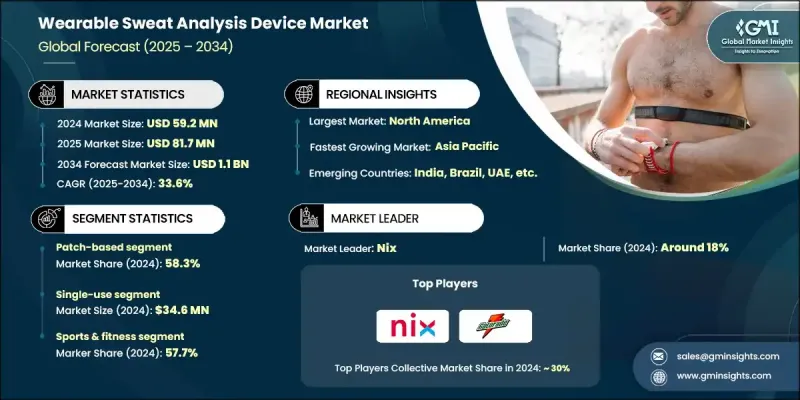
受非侵入式診斷工具需求成長、穿戴式科技在健身和醫療保健領域日益普及以及感測器小型化技術的重大進步的推動,市場正經歷快速成長。軟性電子、奈米材料和微流控系統的發展提高了基於汗液的監測設備的精度、舒適性和整合度。這些創新使得感測器能夠嵌入小型貼片或輕巧的穿戴式設備中,同時保持高資料準確性和性能。憑藉同時分析多種生物標記的能力,這些設備在消費者健康追蹤和臨床診斷方面變得越來越重要。個人化、即時健康洞察和資料連接性的結合,使汗液分析穿戴式裝置成為現代醫療保健和運動表現監測領域的變革性工具。隨著技術的進步,這些設備的易用性、準確性和經濟性有望進一步加速其在全球健身、醫療和研究領域的應用。
| 市場範圍 | |
|---|---|
| 起始年份 | 2024 |
| 預測年份 | 2025-2034 |
| 起始值 | 5920萬美元 |
| 預測值 | 11億美元 |
| 複合年成長率 | 33.6% |
穿戴式汗液感測器在運動健身領域的日益普及是推動市場擴張的最強勁動力之一。運動員和健身愛好者依靠這些設備在訓練或比賽期間評估水分含量、電解質平衡和疲勞程度。隨著全球活躍人群數量的不斷成長,此類先進穿戴裝置的普及率持續攀升。這些設備不僅能夠提供運動表現的洞察,還能在預防脫水和最佳化恢復方案方面發揮關鍵作用。
2024年,貼片式設備市佔率達58.3%。這些軟性、可貼附於皮膚的穿戴式設備內建微流控通道和生化感測器,能夠即時分析汗液成分。其輕盈的一次性設計使其成為運動和醫療環境中短期監測的理想選擇。除了提供即時資料外,許多此類貼片還提供視覺指示器和無線連接功能,可與行動健康應用程式無縫同步。這些設備的簡便性和舒適性使其在尋求快速且方便的運動表現追蹤解決方案的消費者中廣受歡迎。
2024年,可重複使用型汗液監測器市佔率達41.7%。這些耐用型設備專為長期使用而設計,通常整合到智慧型穿戴裝置中,例如腕帶、臂帶和頭帶。它們配備了強大的感測器系統,能夠在多個訓練階段持續監測汗水情況。其持久耐用和資料可靠性使其非常適合用於慢性病管理、專業運動訓練和遠距醫療監測。
2024年,北美穿戴式汗液分析設備市佔率達到70.4%,預計2034年將維持強勁成長。該地區的領先地位源於消費者的高度認知、蓬勃發展的健康科技新創企業生態系統以及對研發創新的大力投入。先進的醫療基礎設施和預防性健康技術的廣泛應用進一步推動了市場擴張。穿戴式汗液感測器在運動、健康和醫療領域的應用日益普及,反映了北美對個人化和數據驅動型健康監測的高度重視。
全球穿戴式汗液分析設備市場的主要參與者包括 Epicore Biosystems、FLOWBIO、佳得樂、hDrop、Nix、Onalabs 和 Xsensio。這些公司致力於創新、合作和整合,以提升自身的競爭力。許多公司加大研發投入,開發靈敏度更高、電池續航力更長、生物相容性更好的感測器。與運動品牌、醫療機構和科技公司建立策略合作夥伴關係,有助於加速產品驗證和市場滲透。此外,各公司也著重以使用者為中心的設計,在確保即時生物標記追蹤準確性的同時,提升產品的舒適度、美觀性和易用性。
目錄
第1章:方法論與範圍
第2章:執行概要
第3章:行業洞察
- 產業生態系分析
- 產業影響因素
- 成長促進因素
- 對穿戴式個人化健康監測設備的需求不斷成長
- 感測器小型化技術進步
- 體育健身產業的採用率不斷提高
- 對非侵入性診斷的需求激增
- 產業陷阱與挑戰
- 臨床驗證有限及準確性問題
- 監理複雜性和核准挑戰
- 機會
- 多分析物感測器的開發
- 與數位健康平台整合
- 成長促進因素
- 成長潛力分析
- 監管環境
- 北美洲
- 歐洲
- 技術與創新格局
- 當前技術趨勢
- 新興技術
- 投資和融資情況
- 汗液生物標記概況
- 永續材料創新
- 新進入者的市場進入策略
- 波特的分析
- PESTEL 分析
- 差距分析
- 未來市場趨勢
第4章:競爭格局
- 介紹
- 公司矩陣分析
- 公司市佔率分析
- 全球的
- 北美洲
- 歐洲
- 主要市場參與者的競爭分析
- 競爭定位矩陣
- 關鍵進展
- 併購
- 合作夥伴關係與合作
- 新產品發布
- 擴張計劃
第5章:市場估算與預測:依產品類型分類,2021-2034年
- 主要趨勢
- 基於補丁
- 穿戴式裝置
第6章:市場估算與預測:依類別分類,2021-2034年
- 主要趨勢
- 一次使用
- 可重複使用的
第7章:市場估計與預測:依應用領域分類,2021-2034年
- 主要趨勢
- 運動與健身
- 醫療保健與臨床
- 消費者健康
第8章:市場估算與預測:依地區分類,2021-2034年
- 主要趨勢
- 北美洲
- 美國
- 加拿大
- 歐洲
- 德國
- 英國
- 法國
- 西班牙
- 義大利
- 荷蘭
- 亞太地區
- 中國
- 日本
- 印度
- 澳洲
- 韓國
- 世界其他地區
第9章:公司簡介
- Epicore Biosystems
- FLOWBIO
- Gatorade
- hDrop
- Nix
- Onalabs
- Xsensio
The Global Wearable Sweat Analysis Device Market was valued at USD 59.2 million in 2024 and is estimated to grow at a CAGR of 33.6% to reach USD 1.1 billion by 2034.
The market is experiencing rapid growth driven by increasing demand for non-invasive diagnostic tools, growing adoption of wearable technology in fitness and healthcare, and major advancements in sensor miniaturization. The development of flexible electronics, nanomaterials, and microfluidic systems has enhanced the precision, comfort, and integration of sweat-based monitoring devices. These innovations have made it possible for sensors to be embedded into compact patches or lightweight wearables while maintaining high data accuracy and performance. With their ability to analyze multiple biomarkers simultaneously, these devices are becoming increasingly relevant for both consumer wellness tracking and clinical diagnostics. The combination of personalization, real-time health insights, and data connectivity is positioning sweat analysis wearables as a transformative tool in modern healthcare and sports performance monitoring. As technology evolves, the usability, accuracy, and affordability of these devices are expected to further accelerate their global adoption across fitness, medical, and research applications.
| Market Scope | |
|---|---|
| Start Year | 2024 |
| Forecast Year | 2025-2034 |
| Start Value | $59.2 Million |
| Forecast Value | $1.1 Billion |
| CAGR | 33.6% |
The growing use of wearable sweat sensors in the sports and fitness sector is one of the strongest drivers of market expansion. Athletes and fitness enthusiasts rely on these devices to assess hydration levels, electrolyte balance, and fatigue during workouts or competitions. With a rising number of active individuals globally, the adoption of such advanced wearables continues to surge. These devices not only provide insights into physical performance but also play a key role in preventing dehydration and optimizing recovery routines.
The patch-based devices segment held a 58.3% share in 2024. These flexible, skin-mounted wearables feature microfluidic channels and biochemical sensors that analyze sweat composition in real time. Their lightweight, disposable design makes them ideal for short-term monitoring in both athletic and medical environments. In addition to providing real-time data, many of these patches offer visual indicators and wireless connectivity for seamless synchronization with mobile health applications. The simplicity and comfort of these devices have made them highly popular among consumers seeking quick and convenient performance tracking solutions.
The reusable segment held a 41.7% share in 2024. Designed for long-term use, these durable devices are commonly integrated into smart wearables like wristbands, armbands, and headbands. Equipped with robust sensor systems, they are capable of continuous sweat monitoring across multiple sessions. Their long-lasting nature and data reliability make them well-suited for chronic disease management, professional sports training, and telehealth-based remote monitoring.
North America Wearable Sweat Analysis Device Market held 70.4% share in 2024 and is expected to maintain strong growth through 2034. The region's leadership stems from high consumer awareness, a thriving health tech startup ecosystem, and heavy investment in research and innovation. The advanced healthcare infrastructure and widespread adoption of preventive health technologies further support market expansion. Wearable sweat sensors are increasingly embraced across sports, wellness, and medical applications, reflecting North America's strong emphasis on personalized and data-driven health monitoring.
Prominent players in the Global Wearable Sweat Analysis Device Market include Epicore Biosystems, FLOWBIO, Gatorade, hDrop, Nix, Onalabs, and Xsensio. Companies in the Wearable Sweat Analysis Device Market are focusing on innovation, collaboration, and integration to enhance their competitive standing. Many are investing in R&D to develop sensors with higher sensitivity, longer battery life, and better biocompatibility. Strategic partnerships with sports brands, medical institutions, and technology firms help accelerate product validation and market penetration. Firms are also emphasizing user-centric design to improve comfort, aesthetics, and usability while ensuring accurate real-time biomarker tracking.
Table of Contents
Chapter 1 Methodology and Scope
- 1.1 Market scope and definition
- 1.2 Research design
- 1.2.1 Research approach
- 1.2.2 Data collection methods
- 1.3 Data mining sources
- 1.3.1 Global
- 1.3.2 Regional/Country
- 1.4 Base estimates and calculations
- 1.4.1 Base year calculation
- 1.4.2 Key trends for market estimation
- 1.5 Primary research and validation
- 1.5.1 Primary sources
- 1.6 Forecast model
- 1.7 Research assumptions and limitations
Chapter 2 Executive Summary
- 2.1 Industry 360° synopsis
- 2.2 Key market trends
- 2.2.1 Regional trends
- 2.2.2 Product type trends
- 2.2.3 Category trends
- 2.2.4 Application trends
- 2.3 CXO perspectives: Strategic imperatives
- 2.3.1 Key decision points for industry executives
- 2.3.2 Critical success factors for market players
- 2.4 Future outlook and strategic recommendations
Chapter 3 Industry Insights
- 3.1 Industry ecosystem analysis
- 3.2 Industry impact forces
- 3.2.1 Growth drivers
- 3.2.1.1 Rising demand for wearable personalized health monitoring devices
- 3.2.1.2 Technological advancements in sensor miniaturization
- 3.2.1.3 Increasing adoption in the sports & fitness industry
- 3.2.1.4 Surging demand for non-invasive diagnostics
- 3.2.2 Industry pitfalls and challenges
- 3.2.2.1 Limited clinical validation & accuracy concerns
- 3.2.2.2 Regulatory complexity & approval challenges
- 3.2.3 Opportunities
- 3.2.3.1 Development of multi-analyte sensors
- 3.2.3.2 Integration with digital health platforms
- 3.2.1 Growth drivers
- 3.3 Growth potential analysis
- 3.4 Regulatory landscape
- 3.4.1 North America
- 3.4.2 Europe
- 3.5 Technology and innovation landscape
- 3.5.1 Current technological trends
- 3.5.2 Emerging technologies
- 3.6 Investment and funding scenario
- 3.7 Sweat biomarker landscape
- 3.8 Sustainable material innovation
- 3.9 Market entry strategies for new players
- 3.10 Porter's analysis
- 3.11 PESTEL analysis
- 3.12 Gap analysis
- 3.13 Future market trends
Chapter 4 Competitive Landscape, 2024
- 4.1 Introduction
- 4.2 Company matrix analysis
- 4.3 Company market share analysis
- 4.3.1 Global
- 4.3.2 North America
- 4.3.3 Europe
- 4.4 Competitive analysis of major market players
- 4.5 Competitive positioning matrix
- 4.6 Key developments
- 4.6.1 Mergers & acquisitions
- 4.6.2 Partnerships & collaborations
- 4.6.3 New product launches
- 4.6.4 Expansion plans
Chapter 5 Market Estimates and Forecast, By Product Type, 2021 - 2034 ($ Mn)
- 5.1 Key trends
- 5.2 Patch-based
- 5.3 Wearable device
Chapter 6 Market Estimates and Forecast, By Category, 2021 - 2034 ($ Mn)
- 6.1 Key trends
- 6.2 Single-use
- 6.3 Reusable
Chapter 7 Market Estimates and Forecast, By Application, 2021 - 2034 ($ Mn)
- 7.1 Key trends
- 7.2 Sports & fitness
- 7.3 Healthcare & clinical
- 7.4 Consumer wellness
Chapter 8 Market Estimates and Forecast, By Region, 2021 - 2034 ($ Mn)
- 8.1 Key trends
- 8.2 North America
- 8.2.1 U.S.
- 8.2.2 Canada
- 8.3 Europe
- 8.3.1 Germany
- 8.3.2 UK
- 8.3.3 France
- 8.3.4 Spain
- 8.3.5 Italy
- 8.3.6 Netherlands
- 8.4 Asia Pacific
- 8.4.1 China
- 8.4.2 Japan
- 8.4.3 India
- 8.4.4 Australia
- 8.4.5 South Korea
- 8.5 Rest of the World
Chapter 9 Company Profiles
- 9.1 Epicore Biosystems
- 9.2 FLOWBIO
- 9.3 Gatorade
- 9.4 hDrop
- 9.5 Nix
- 9.6 Onalabs
- 9.7 Xsensio

 光電容積脈搏波描記法 (PPG) 市場規模、佔有率和成長分析:按產品組合、測量技術、應用領域、最終用戶和地區分類 - 產業預測,2026-2033 年
 皮膚分析系統市場:按核心技術、測量參數、應用和最終用戶分類-2026-2032年全球市場預測心率監測器市場:依產品類型、技術、最終用戶、通路分類,全球預測(2026-2032年)3D步態和運動分析系統市場(按組件、最終用戶、技術、應用、部署模式和通路分類),全球預測(2026-2032)
 心率監測器市場規模、佔有率和成長分析:按產品類型、最終用戶、應用和地區分類 - 2026-2033 年產業預測
 人工智慧病理分析系統市場規模、佔有率和成長分析:按組件、技術、部署模式、用例、最終用途和地區分類-產業預測(2026-2033 年)
 2026年全球心率監測設備市場報告呼吸頻率監測儀市場按產品類型、最終用戶、技術、應用、連接方式和分銷管道分類,全球預測(2026-2032年)
 全球心率監測器市場:市場規模、佔有率、成長率、產業分析、依類型、應用和地區劃分的分析以及未來預測(2026-2034)
 人工智慧病理分析系統市場機會、成長促進因素、產業趨勢分析及預測(2025-2034年)