


 |
市場調查報告書
商品編碼
1871315
食品安全檢測市場機會、成長促進因素、產業趨勢分析及預測(2025-2034年)Food Safety Testing Market Opportunity, Growth Drivers, Industry Trend Analysis, and Forecast 2025 - 2034 |
||||||

2024 年全球食品安全檢測市場價值為 242 億美元,預計到 2034 年將以 6.7% 的複合年成長率成長至 454 億美元。
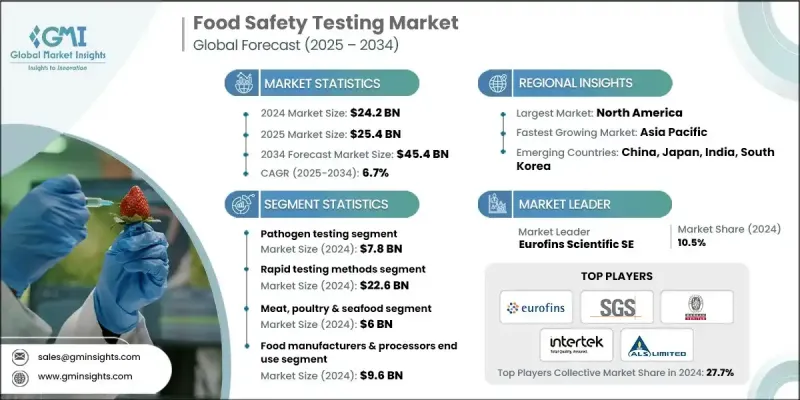
受全球食源性疾病發生率上升和污染問題日益嚴重的影響,市場正經歷顯著成長。接觸有害病原體、毒素和化學殘留物的案例不斷增加,促使監管機構和食品業加強檢測流程。消費者食品衛生意識的提高也加速了食品生產、加工和包裝等各環節安全檢測技術的應用。美國食品藥物管理局(FDA)、歐洲食品安全局(EFSA)和印度食品安全與標準局(FSSAI)等機構實施了更為嚴格的全球食品安全法規,強制要求對多種食品類別進行檢測,從而擴大了檢查的頻率和範圍。企業正大力投資建造先進的實驗室和自動化系統,以符合認證標準和國際品質法規。全球食品供應鏈日益複雜,跨境貿易也加劇了運輸和儲存過程的污染風險。因此,為了確保食品分銷流程各個環節的安全標準一致,對第三方驗證、可追溯性解決方案和國際認可實驗室的需求激增。
| 市場範圍 | |
|---|---|
| 起始年份 | 2024 |
| 預測年份 | 2025-2034 |
| 起始值 | 242億美元 |
| 預測值 | 454億美元 |
| 複合年成長率 | 6.7% |
2024年,病原體檢測市場規模達78億美元,預計2025年至2034年間將以6.9%的複合年成長率成長。隨著製造商將消費者健康和遵守監管規範放在首位,食品安全檢測市場在病原體和過敏原檢測領域持續穩定成長。加工食品和即食食品中微生物污染事件的增加,推動了病原體檢測需求的激增。同樣,隨著更嚴格的標籤要求和公眾對食物過敏意識的提高,過敏原檢測也呈現出成長勢頭,促使企業尋求更快、更精準的檢測方法,以提供快速準確的結果。
預計到2024年,快速檢測方法市場規模將達到226億美元,並預計到2034年將以6.7%的複合年成長率成長。採用先進免疫分析和PCR技術的快速檢測解決方案因其能夠快速、準確、同時檢測多種污染物而廣泛應用。 ELISA和PCR等技術正逐漸成為識別各種食品中病原體、過敏原和基因改造成分的首選工具。這些技術的可擴展性和可靠性使其成為大量品質保證和製程檢測的理想選擇,尤其適用於對準確性和速度要求極高的大型食品生產企業。
2024年北美食品安全檢測市場規模達91億美元,預計在預測期內將維持強勁成長。該地區對食品安全合規性和消費者意識的高度重視顯著推動了市場擴張。美國食品藥物管理局(FDA)和美國農業部(USDA)等機構實施的嚴格監管架構促使食品生產商採用更快、更精準的檢測技術。與微生物和化學污染相關的產品召回事件日益增多,加上包裝食品和即食食品消費量的成長,持續推動美國和加拿大對食品安全檢測的需求。
全球食品安全檢測市場的主要參與者包括Intertek Group PLC、Eurofins Scientific SE、Bureau Veritas、SGS SA、ALS Limited等。這些領先企業正採取一系列策略性舉措,以擴大其全球影響力並提升競爭力。例如,Eurofins Scientific SE、Intertek Group PLC和Bureau Veritas等公司正致力於透過新建實驗室和建立區域合作夥伴關係來擴大產能。它們大力投資自動化、人工智慧驅動的分析以及新一代分子診斷平台,以提高檢測速度和精確度。併購仍是加強市場准入和拓展服務組合的關鍵策略。
目錄
第1章:方法論
- 市場範圍和定義
- 研究設計
- 研究方法
- 資料收集方法
- 資料探勘來源
- 全球的
- 地區/國家
- 基準估算和計算
- 基準年計算
- 市場估算的關鍵趨勢
- 初步研究和驗證
- 原始資料
- 預測模型
- 研究假設和局限性
第2章:執行概要
第3章:行業洞察
- 產業生態系分析
- 供應商格局
- 利潤率
- 每個階段的價值增加
- 影響價值鏈的因素
- 中斷
- 產業影響因素
- 成長促進因素
- 產業陷阱與挑戰
- 供應鏈的複雜性
- 市場機遇
- 成長潛力分析
- 監管環境
- 北美洲
- 歐洲
- 亞太地區
- 拉丁美洲
- 中東和非洲
- 波特的分析
- PESTEL 分析
- 價格趨勢
- 按地區
- 依產品
- 未來市場趨勢
- 技術與創新格局
- 當前技術趨勢
- 新興技術
- 專利格局
- 貿易統計(註:僅提供重點國家的貿易統計)
- 主要進口國
- 主要出口國
- 永續性和環境方面
- 永續實踐
- 減少廢棄物策略
- 生產中的能源效率
- 環保舉措
第4章:競爭格局
- 介紹
- 公司市佔率分析
- 按地區
- 北美洲
- 歐洲
- 亞太地區
- 拉丁美洲
- MEA
- 按地區
- 公司矩陣分析
- 主要市場參與者的競爭分析
- 競爭定位矩陣
- 關鍵進展
- 併購
- 合作夥伴關係與合作
- 新產品發布
- 擴張計劃
第5章:市場估算與預測:依檢測類型分類,2021-2034年
- 主要趨勢
- 病原體檢測
- 過敏原檢測
- 化學物質和污染物檢測
- 基因改造生物(GMO)檢測
- 營養標示驗證
- 保存期限和穩定性測試
第6章:市場估計與預測:依技術分類,2021-2034年
- 主要趨勢
- 傳統方法
- 基於文化
- 顯微鏡
- 快速檢測方法
- 免疫測定法(例如,ELISA)
- 基於PCR(聚合酶鍊式反應)
- 色譜法(例如,高效液相層析法、氣相層析法)
- 光譜學(例如,質譜學)
- 生物感測器
- 下一代定序(NGS)
第7章:市場估計與預測:依食品類型分類,2021-2034年
- 主要趨勢
- 肉類、家禽和海鮮
- 乳製品
- 烘焙食品和糖果
- 水果和蔬菜
- 加工食品
- 穀物
- 飲料
- 酗酒者
- 非酒精性
- 其他食物
第8章:市場估算與預測:依最終用途分類,2021-2034年
- 主要趨勢
- 食品生產商和加工商
- 零售商和分銷商
- 政府和監管機構
- 實驗室和測試設施
- 餐廳及餐飲服務
第9章:市場估計與預測:依地區分類,2021-2034年
- 主要趨勢
- 北美洲
- 美國
- 加拿大
- 歐洲
- 德國
- 英國
- 法國
- 義大利
- 西班牙
- 歐洲其他地區
- 亞太地區
- 中國
- 印度
- 日本
- 澳洲
- 韓國
- 亞太其他地區
- 拉丁美洲
- 巴西
- 墨西哥
- 阿根廷
- 拉丁美洲其他地區
- 中東和非洲
- 沙烏地阿拉伯
- 南非
- 阿拉伯聯合大公國
- 中東和非洲其他地區
第10章:公司簡介
- SGS SA
- NSF International
- Bureau Veritas
- Eurofins Scientific SE
- Intertek Group PLC
- Thermo Fisher Scientific Inc.
- Merieux Nutrisciences
- TUV SUD
- UL LLC
- AsureQuality Ltd
- Agilent Technologies, Inc.
- QIAGEN
- Bio-Rad Laboratories, Inc.
- ALS Limited
The Global Food Safety Testing Market was valued at USD 24.2 billion in 2024 and is estimated to grow at a CAGR of 6.7% to reach USD 45.4 billion by 2034.
The market is witnessing substantial growth driven by the rising incidence of foodborne diseases and contamination concerns worldwide. Increasing cases of exposure to harmful pathogens, toxins, and chemical residues have pushed both regulatory authorities and the food industry to strengthen testing protocols. Growing awareness among consumers about food hygiene has also accelerated the adoption of safety testing technologies across food production, processing, and packaging stages. The implementation of stricter global food safety regulations by organizations such as the FDA, EFSA, and FSSAI has made testing mandatory across several food categories, thereby expanding the frequency and scope of inspections. Companies are heavily investing in advanced laboratories and automated systems to comply with certification standards and international quality regulations. The growing complexity of the global food supply chain, coupled with cross-border trade, has heightened contamination risks during transport and storage. As a result, demand for third-party verification, traceability solutions, and internationally accredited laboratories has surged to ensure consistent safety standards across all stages of the food distribution process.
| Market Scope | |
|---|---|
| Start Year | 2024 |
| Forecast Year | 2025-2034 |
| Start Value | $24.2 Billion |
| Forecast Value | $45.4 Billion |
| CAGR | 6.7% |
The pathogen testing segment was valued at USD 7.8 billion in 2024 and is projected to grow at a CAGR of 6.9% between 2025 and 2034. The food safety testing market continues to grow steadily across pathogen and allergen testing categories, as manufacturers prioritize consumer well-being and compliance with regulatory norms. Pathogen testing demand has surged due to increased microbial contamination incidents in processed and ready-to-eat products. Similarly, allergen testing is gaining momentum as stricter labeling requirements and rising public awareness of food allergies push companies toward faster and more precise detection methods that deliver rapid and accurate results.
The rapid testing methods segment reached USD 22.6 billion in 2024 and is estimated to register a CAGR of 6.7% through 2034. Rapid testing solutions using advanced immunoassay and PCR-based technologies are being widely adopted because of their ability to provide quick, accurate, and simultaneous detection of multiple contaminants. Techniques like ELISA and PCR are becoming preferred tools for identifying pathogens, allergens, and genetically modified ingredients across various food types. Their scalability and dependability make them ideal for high-volume quality assurance and in-process testing, especially in large-scale food manufacturing setups where accuracy and speed are essential.
North America Food Safety Testing Market was valued at USD 9.1 billion in 2024 and is projected to record robust growth during the forecast period. The region's strong emphasis on food safety compliance and consumer awareness has significantly boosted market expansion. Stringent regulatory frameworks enforced by bodies such as the FDA and USDA have encouraged food producers to adopt faster and more precise testing technologies. The increasing number of product recalls linked to microbial and chemical contamination, coupled with the growing consumption of packaged and ready-to-eat foods, continues to drive testing demand in the U.S. and Canada.
Major players in the Global Food Safety Testing Market include Intertek Group PLC, Eurofins Scientific SE, Bureau Veritas, SGS S.A., ALS Limited, and others. Leading companies in the food safety testing market are adopting a mix of strategic initiatives to expand their global presence and enhance competitiveness. Firms such as Eurofins Scientific SE, Intertek Group PLC, and Bureau Veritas are focusing on capacity expansion through new laboratory establishments and regional partnerships. They are investing heavily in automation, AI-driven analytics, and next-generation molecular diagnostic platforms to increase testing speed and precision. Mergers and acquisitions remain key strategies to strengthen market access and broaden service portfolios.
Table of Contents
Chapter 1 Methodology
- 1.1 Market scope and definition
- 1.2 Research design
- 1.2.1 Research approach
- 1.2.2 Data collection methods
- 1.3 Data mining sources
- 1.3.1 Global
- 1.3.2 Regional/Country
- 1.4 Base estimates and calculations
- 1.4.1 Base year calculation
- 1.4.2 Key trends for market estimation
- 1.5 Primary research and validation
- 1.5.1 Primary sources
- 1.6 Forecast model
- 1.7 Research assumptions and limitations
Chapter 2 Executive Summary
- 2.1 Industry 3600 synopsis
- 2.2 Key market trends
- 2.2.1 Regional
- 2.2.2 Testing Type
- 2.2.3 Technology
- 2.2.4 Food Type
- 2.2.5 End Use
- 2.3 TAM Analysis, 2025-2034
- 2.4 CXO perspectives: Strategic imperatives
- 2.4.1 Executive decision points
- 2.4.2 Critical success factors
- 2.5 Future Outlook and Strategic Recommendations
Chapter 3 Industry Insights
- 3.1 Industry ecosystem analysis
- 3.1.1 Supplier Landscape
- 3.1.2 Profit Margin
- 3.1.3 Value addition at each stage
- 3.1.4 Factor affecting the value chain
- 3.1.5 Disruptions
- 3.2 Industry impact forces
- 3.2.1 Growth drivers
- 3.2.2 Industry pitfalls and challenges
- 3.2.2.1 Supply chain complexity
- 3.2.3 Market opportunities
- 3.3 Growth potential analysis
- 3.4 Regulatory landscape
- 3.4.1 North America
- 3.4.2 Europe
- 3.4.3 Asia Pacific
- 3.4.4 Latin America
- 3.4.5 Middle East & Africa
- 3.5 Porter's analysis
- 3.6 PESTEL analysis
- 3.7 Price trends
- 3.7.1 By region
- 3.7.2 By product
- 3.8 Future market trends
- 3.9 Technology and Innovation landscape
- 3.9.1 Current technological trends
- 3.9.2 Emerging technologies
- 3.10 Patent Landscape
- 3.11 Trade statistics (Note: the trade statistics will be provided for key countries only)
- 3.11.1 Major importing countries
- 3.11.2 Major exporting countries
- 3.12 Sustainability and Environmental Aspects
- 3.12.1 Sustainable Practices
- 3.12.2 Waste Reduction Strategies
- 3.12.3 Energy Efficiency in Production
- 3.12.4 Eco-friendly Initiatives
Chapter 4 Competitive Landscape, 2024
- 4.1 Introduction
- 4.2 Company market share analysis
- 4.2.1 By region
- 4.2.1.1 North America
- 4.2.1.2 Europe
- 4.2.1.3 Asia Pacific
- 4.2.1.4 LATAM
- 4.2.1.5 MEA
- 4.2.1 By region
- 4.3 Company matrix analysis
- 4.4 Competitive analysis of major market players
- 4.5 Competitive positioning matrix
- 4.6 Key developments
- 4.6.1 Mergers & acquisitions
- 4.6.2 Partnerships & collaborations
- 4.6.3 New Product Launches
- 4.6.4 Expansion Plans
Chapter 5 Market Estimates and Forecast, By Testing Type, 2021 - 2034 (USD Billion, Million Tests)
- 5.1 Key trends
- 5.2 Pathogen testing
- 5.3 Allergen testing
- 5.4 Chemical & contaminant testing
- 5.5 Genetically modified organism (GMO) testing
- 5.6 Nutritional labeling verification
- 5.7 Shelf-life & stability testing
Chapter 6 Market Estimates and Forecast, By Technology, 2021 - 2034 (USD Billion, Million Tests)
- 6.1 Key trends
- 6.2 Traditional methods
- 6.2.1 Culture-based
- 6.2.2 Microscopy
- 6.3 Rapid testing methods
- 6.3.1 Immunoassay (e.g., ELISA)
- 6.3.2 PCR-based (Polymerase Chain Reaction)
- 6.3.3 Chromatography (e.g., HPLC, GC)
- 6.3.4 Spectroscopy (e.g., Mass Spectrometry)
- 6.3.5 Biosensors
- 6.3.6 Next-generation sequencing (NGS)
Chapter 7 Market Estimates and Forecast, By Food Type, 2021 - 2034 (USD Billion, Million Tests)
- 7.1 Key trends
- 7.2 Meat, poultry & seafood
- 7.3 Dairy products
- 7.4 Bakery & confectionery
- 7.5 Fruits & vegetables
- 7.6 Processed foods
- 7.7 Cereals & grains
- 7.8 Beverages
- 7.8.1 Alcoholic
- 7.8.2 Non-alcoholic
- 7.9 Other foods
Chapter 8 Market Estimates and Forecast, By End Use, 2021 - 2034 (USD Billion, Million Tests)
- 8.1 Key trends
- 8.2 Food manufacturers & processors
- 8.3 Retailers & distributors
- 8.4 Government & regulatory bodies
- 8.5 Laboratories & testing facilities
- 8.6 Restaurants & catering services
Chapter 9 Market Estimates and Forecast, By Region, 2021 - 2034 (USD Billion, Million Tests)
- 9.1 Key trends
- 9.2 North America
- 9.2.1 U.S.
- 9.2.2 Canada
- 9.3 Europe
- 9.3.1 Germany
- 9.3.2 UK
- 9.3.3 France
- 9.3.4 Italy
- 9.3.5 Spain
- 9.3.6 Rest of Europe
- 9.4 Asia Pacific
- 9.4.1 China
- 9.4.2 India
- 9.4.3 Japan
- 9.4.4 Australia
- 9.4.5 South Korea
- 9.4.6 Rest of Asia Pacific
- 9.5 Latin America
- 9.5.1 Brazil
- 9.5.2 Mexico
- 9.5.3 Argentina
- 9.5.4 Rest of Latin America
- 9.6 Middle East & Africa
- 9.6.1 Saudi Arabia
- 9.6.2 South Africa
- 9.6.3 UAE
- 9.6.4 Rest of Middle East & Africa
Chapter 10 Company Profiles
- 10.1 SGS S.A.
- 10.2 NSF International
- 10.3 Bureau Veritas
- 10.4 Eurofins Scientific SE
- 10.5 Intertek Group PLC
- 10.6 Thermo Fisher Scientific Inc.
- 10.7 Merieux Nutrisciences
- 10.8 TUV SUD
- 10.9 UL LLC
- 10.10 AsureQuality Ltd
- 10.11 Agilent Technologies, Inc.
- 10.12 QIAGEN
- 10.13 Bio-Rad Laboratories, Inc.
- 10.14 ALS Limited

 食品真實性檢測市場分析及預測(至2035年):依類型、產品、服務、技術、應用、最終用戶、流程及模式分類
 食品安全檢測市場規模、佔有率、成長及全球產業分析:按類型、應用和地區分類,並提供2026-2034年的洞察和預測全球食品安全檢測市場規模、佔有率、趨勢和成長分析報告(2026-2034年)消費品安全測試市場-2026-2031年預測
 食品接觸材料測試市場 - 全球產業規模、佔有率、趨勢、機會及預測(按類型、應用、地區和競爭格局分類,2020-2030 年預測)肉類和家禽檢驗市場-2025-2030年預測
 全球快速食品安全檢測市場(至 2030 年):按測試目標、測試食品、技術、最終用戶和地區分類食品安全檢測市場-全球產業規模、佔有率、趨勢、機會及預測(按技術、檢測食品、檢測目標、地區及競爭細分,2020-2030 年)
 全球食品安全檢測分子生物學方法市場
 食品安全檢測市場:產業趨勢及全球預測(~2035年):依檢測目標、檢測食品類型、技術、應用、食品檢測類型、公司規模及主要地區