


 |
市場調查報告書
商品編碼
1871234
自修復黏合劑市場機會、成長促進因素、產業趨勢分析及預測(2025-2034年)Self-healing Adhesives Market Opportunity, Growth Drivers, Industry Trend Analysis, and Forecast 2025 - 2034 |
||||||

2024 年全球自修復黏合劑市場價值為 6 億美元,預計到 2034 年將以 12.6% 的複合年成長率成長至 21 億美元。
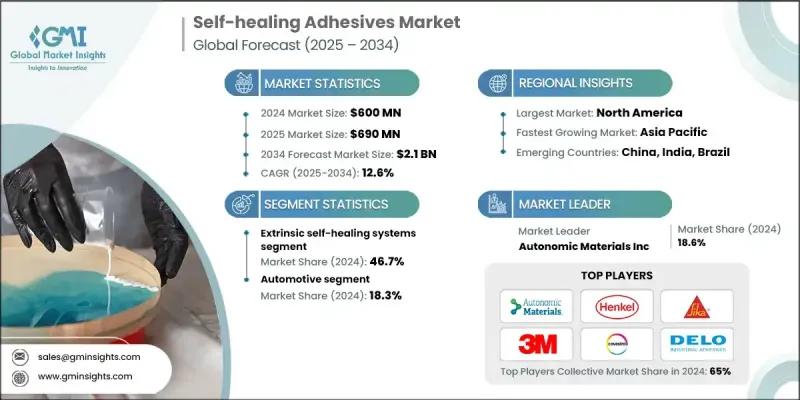
建築、汽車和電子產業對高性能、高耐用性黏接解決方案的需求不斷成長,推動了市場的強勁成長。降低維護成本、延長產品壽命的日益重視也進一步促進了自修復黏合劑的應用。隨著各行業對能夠自動修復損傷和恢復結構的材料的日益需求,自修復黏合劑在整體市場擴張中貢獻了近7%的佔有率。這項技術在航太應用中尤其關鍵,因為維持結構完整性和複合材料修復效率至關重要。然而,人們對長期性能可靠性的擔憂以及有限的現場資料阻礙了其更廣泛的應用。諸如修復劑容量受限以及機械應力下不可逆的修復過程等技術挑戰也延緩了商業化進程。持續的研究創新已開始透過改進修復動力學、機械恢復和重複性來解決這些障礙。先進奈米材料的整合實現了數分鐘內的快速強度恢復,標誌著新一代自修復黏合劑性能的顯著提升。
| 市場範圍 | |
|---|---|
| 起始年份 | 2024 |
| 預測年份 | 2025-2034 |
| 起始值 | 6億美元 |
| 預測值 | 21億美元 |
| 複合年成長率 | 12.6% |
2024年,固有自修復系統市佔率達到31.7%,預計將以13.9%的複合年成長率成長。利用動態共價鍵和超分子鍵結機制的可逆化學技術日益受到青睞,正在重塑產品開發格局。這些系統無需外部修復劑,即可實現連續、可重複的修復循環,且不會損害材料完整性。分子設計和化學技術的進步顯著拓寬了工作溫度範圍,並提升了整體修復性能。由於其製造流程簡單,且適用於各種需要持續機械修復的工業應用,製造商正擴大採用這種方法。
2024年,建築和基礎設施應用領域佔據18%的市場佔有率,預計到2034年將以9.3%的複合年成長率成長。該領域反映了成熟的應用趨勢,這主要得益於自修復材料在防風雨、結構加強和裂縫修復方面的應用。持續的基礎設施現代化以及人們對全生命週期成本效益意識的提高,不斷增強了市場需求。自修復混凝土添加劑和黏合劑在橋樑、隧道等關鍵基礎設施中的日益廣泛應用,凸顯了該技術在維護結構安全性和韌性方面的長期價值。
2024年美國自修復黏合劑市場規模為1.872億美元,預計到2034年將達到6.674億美元。美國在北美市場佔據主導地位,這主要得益於航太製造商對先進複合材料修復技術的強勁需求。汽車原始設備製造商(OEM)也是重要的市場貢獻者,他們在電動車的電池組裝和熱管理方面廣泛採用自修復黏合劑。不斷擴展的電動車生態系統以及領先汽車製造商的電氣化努力持續推動創新。此外,電子產業也見證了主要科技品牌對軟性穿戴裝置黏合劑需求的不斷成長,這反映了強勁的國內消費和研發活動。
全球自修復膠合劑市場的主要企業包括西卡(Sika)、3M公司、漢高股份及兩合公司(Henkel AG & Co. KGaA)、科思創股份公司(Covestro AG)、Autonomic Materials Inc.和德樂工業膠合劑公司(DELO Industrial Adhesives)。這些市場領導者正積極推行策略舉措,以提升競爭力並鞏固其全球佈局。各企業大力投資研發,致力於開發具有更高修復效率、更強重複性和更優異耐環境性能的配方。與科研機構和材料科學公司的策略合作,推動了聚合物化學和奈米技術融合的進步。此外,製造商也專注於擴大產能,並拓展應用領域,涵蓋建築、航太和電子等產業。
目錄
第1章:方法論與範圍
第2章:執行概要
第3章:行業洞察
- 產業生態系分析
- 供應商格局
- 利潤率
- 每個階段的價值增加
- 影響價值鏈的因素
- 中斷
- 產業影響因素
- 成長促進因素
- 產業陷阱與挑戰
- 市場機遇
- 成長潛力分析
- 監管環境
- 北美洲
- 歐洲
- 亞太地區
- 拉丁美洲
- 中東和非洲
- 波特的分析
- PESTEL 分析
- 價格趨勢
- 按地區
- 未來市場趨勢
- 技術與創新格局
- 當前技術趨勢
- 新興技術
- 專利格局
- 貿易統計(HS編碼)(註:僅提供重點國家的貿易統計資料)
- 主要進口國
- 主要出口國
- 永續性和環境方面
- 永續實踐
- 減少廢棄物策略
- 生產中的能源效率
- 環保舉措
- 碳足跡考量
第4章:競爭格局
- 介紹
- 公司市佔率分析
- 按地區
- 北美洲
- 歐洲
- 亞太地區
- 拉丁美洲
- 中東和非洲
- 按地區
- 公司矩陣分析
- 主要市場參與者的競爭分析
- 競爭定位矩陣
- 關鍵進展
- 併購
- 合作夥伴關係與合作
- 新產品發布
- 擴張計劃
第5章:市場規模及預測:依治療機制分類,2021-2034年
- 主要趨勢
- 內在自癒系統
- 外在自癒系統
- 混合型自癒系統
第6章:市場規模及預測:依應用領域分類,2021-2034年
- 主要趨勢
- 航太與國防
- 複合材料修復系統
- 保護塗層
- 汽車
- 電動汽車電池密封和熱管理
- 結構黏合與車身組裝
- 電子元件保護
- 電子與半導體
- 裝置組裝與封裝
- 熱界面材料
- 軟性電子產品和穿戴式設備
- 建築與基礎設施
- 結構修復系統
- 防風雨和密封
- 維護與翻新
- 醫療器材
- 海洋與近海
- 其他
第7章:市場規模及預測:依材料類型分類,2021-2034年
- 主要趨勢
- 環氧樹脂基體系
- 聚氨酯基體系
- 矽基系統
- 丙烯酸基系統
- 生物基系統
第8章:市場規模及預測:依地區分類,2021-2034年
- 主要趨勢
- 北美洲
- 美國
- 加拿大
- 歐洲
- 英國
- 德國
- 法國
- 義大利
- 西班牙
- 歐洲其他地區
- 亞太地區
- 中國
- 印度
- 日本
- 韓國
- 澳洲
- 亞太其他地區
- 拉丁美洲
- 巴西
- 墨西哥
- 阿根廷
- 拉丁美洲其他地區
- 中東和非洲
- 南非
- 沙烏地阿拉伯
- 阿拉伯聯合大公國
- 中東和非洲其他地區
第9章:公司簡介
- Autonomic Materials
- Henkel AG
- 3M Company
- DowDuPont
- Arkema Group
- Covestro AG
- DELO Industrial Adhesives
- Fraunhofer
- HB Fuller Company
- Lohmann-koester GmbH
- Sika
- WACKER Chemie
- WEICON GmbH
The Global Self-healing Adhesives Market was valued at USD 600 million in 2024 and is estimated to grow at a CAGR of 12.6% to reach USD 2.1 Billion by 2034.
Rising demand for high-performance and durable bonding solutions across the construction, automotive, and electronics sectors is driving strong market growth. The growing focus on reducing maintenance expenses while extending product lifespan is further encouraging adoption. Self-healing adhesives contribute nearly 7% to overall market expansion, as industries increasingly seek materials capable of automatic damage repair and structural recovery. The technology is particularly critical in aerospace applications where maintaining structural integrity and composite repair efficiency is essential. However, concerns surrounding long-term performance reliability and limited field data have hindered broader adoption. Technical challenges such as restricted healing agent capacity and irreversible repair processes under mechanical stress have also slowed commercialization. Ongoing research innovations have started to address these barriers by improving healing kinetics, mechanical recovery, and repeatability. The integration of advanced nanomaterials has enabled rapid strength recovery within minutes, marking a significant leap in the performance of next-generation self-healing adhesives.
| Market Scope | |
|---|---|
| Start Year | 2024 |
| Forecast Year | 2025-2034 |
| Start Value | $600 Million |
| Forecast Value | $2.1 Billion |
| CAGR | 12.6% |
The intrinsic self-healing systems segment held 31.7% share in 2024 and is forecast to grow at a CAGR of 13.9%. The growing preference for reversible chemistry-based technologies that utilize dynamic covalent and supramolecular bonding mechanisms is reshaping product development. These systems eliminate the need for external healing agents and enable continuous, repeatable repair cycles without compromising material integrity. The advancement in molecular design and chemistry has significantly expanded operating temperature ranges and enhanced overall healing performance. Manufacturers are increasingly adopting this approach due to its manufacturing simplicity and suitability for various industrial applications requiring consistent mechanical recovery.
The construction and infrastructure applications segment held 18% share in 2024 and is expected to grow at a 9.3% CAGR through 2034. This segment reflects a mature adoption trend driven by self-healing materials for weatherproofing, structural reinforcement, and crack mitigation. Ongoing infrastructure modernization, combined with rising awareness about lifecycle cost efficiency, continues to strengthen market demand. The growing application of self-healing concrete additives and bonding agents in critical infrastructure such as bridges and tunnels underscores the technology's long-term value in maintaining structural safety and resilience.
U.S. Self-healing Adhesives Market was valued at USD 187.2 million in 2024 and is estimated to reach USD 667.4 million by 2034. The United States dominates the North American landscape, supported by substantial demand from aerospace manufacturers that require advanced composite repair technologies. Automotive OEMs are also major contributors, with strong adoption of self-healing adhesives for battery assembly and thermal management in electric vehicles. The expanding EV ecosystem, alongside the electrification efforts of leading carmakers, continues to drive innovation. Additionally, the electronics sector is witnessing rising use of flexible and wearable device adhesives from major technology brands, reflecting strong domestic consumption and R&D activity.
Prominent companies operating in the Global Self-healing Adhesives Market include Sika, 3M Company, Henkel AG & Co. KGaA, Covestro AG, Autonomic Materials Inc., and DELO Industrial Adhesives. Leading participants in the Global Self-healing Adhesives Market are pursuing strategic initiatives to enhance competitiveness and strengthen their global footprint. Companies are heavily investing in R&D to develop formulations with improved healing efficiency, repeatability, and environmental resistance. Strategic collaborations with research institutions and material science firms are enabling advancements in polymer chemistry and nanotechnology integration. Manufacturers are also focusing on expanding production capacities and diversifying application portfolios across construction, aerospace, and electronics.
Table of Contents
Chapter 1 Methodology & Scope
- 1.1 Market scope and definition
- 1.2 Research design
- 1.2.1 Research approach
- 1.2.2 Data collection methods
- 1.3 Data mining sources
- 1.3.1 Global
- 1.3.2 Regional/Country
- 1.4 Base estimates and calculations
- 1.4.1 Base year calculation
- 1.4.2 Key trends for market estimation
- 1.5 Primary research and validation
- 1.5.1 Primary sources
- 1.6 Forecast model
- 1.7 Research assumptions and limitations
Chapter 2 Executive Summary
- 2.1 Industry 360° synopsis
- 2.2 Key market trends
- 2.2.1 Healing Mechanism
- 2.2.2 Application
- 2.2.3 Material Base
- 2.3 TAM analysis, 2025-2034
- 2.4 CXO perspectives: Strategic imperatives
- 2.4.1 Executive decision points
- 2.4.2 Critical success factors
- 2.5 Outlook and strategic recommendations
Chapter 3 Industry Insights
- 3.1 Industry ecosystem analysis
- 3.1.1 Supplier landscape
- 3.1.2 Profit margin
- 3.1.3 Value addition at each stage
- 3.1.4 Factor affecting the value chain
- 3.1.5 Disruptions
- 3.2 Industry impact forces
- 3.2.1 Growth drivers
- 3.2.2 Industry pitfalls and challenges
- 3.2.3 Market opportunities
- 3.3 Growth potential analysis
- 3.4 Regulatory landscape
- 3.4.1 North America
- 3.4.2 Europe
- 3.4.3 Asia Pacific
- 3.4.4 Latin America
- 3.4.5 Middle East & Africa
- 3.5 Porter's analysis
- 3.6 PESTEL analysis
- 3.6.1 Technology and innovation landscape
- 3.6.2 Current technological trends
- 3.6.3 Emerging technologies
- 3.7 Price trends
- 3.7.1 By region
- 3.8 Future market trends
- 3.9 Technology and innovation landscape
- 3.9.1 Current technological trends
- 3.9.2 Emerging technologies
- 3.10 Patent landscape
- 3.11 Trade statistics (HS code) (Note: the trade statistics will be provided for key countries only)
- 3.11.1 Major importing countries
- 3.11.2 Major exporting countries
- 3.12 Sustainability and environmental aspects
- 3.12.1 Sustainable practices
- 3.12.2 Waste reduction strategies
- 3.12.3 Energy efficiency in production
- 3.12.4 Eco-friendly initiatives
- 3.13 Carbon footprint considerations
Chapter 4 Competitive Landscape, 2024
- 4.1 Introduction
- 4.2 Company market share analysis
- 4.2.1 By region
- 4.2.1.1 North America
- 4.2.1.2 Europe
- 4.2.1.3 Asia Pacific
- 4.2.1.4 Latin America
- 4.2.1.5 Middle East & Africa
- 4.2.1 By region
- 4.3 Company matrix analysis
- 4.4 Competitive analysis of major market players
- 4.5 Competitive positioning matrix
- 4.6 Key developments
- 4.6.1 Mergers & acquisitions
- 4.6.2 Partnerships & collaborations
- 4.6.3 New product launches
- 4.6.4 Expansion plans
Chapter 5 Market Size and Forecast, By Healing Mechanism, 2021-2034 (USD Million) (Kilo Tons)
- 5.1 Key trends
- 5.2 Intrinsic self-healing systems
- 5.3 Extrinsic self-healing systems
- 5.4 Hybrid self-healing systems
Chapter 6 Market Size and Forecast, By Application, 2021-2034 (USD Million) (Kilo Tons)
- 6.1 Key trends
- 6.2 Aerospace & defense
- 6.2.1 Composite repair systems
- 6.2.2 Protective coatings
- 6.3 Automotive
- 6.3.1 EV battery sealing & thermal management
- 6.3.2 Structural bonding & body assembly
- 6.3.3 Electronic component protection
- 6.4 Electronics & semiconductors
- 6.4.1 Device assembly & encapsulation
- 6.4.2 Thermal interface materials
- 6.4.3 Flexible electronics & wearables
- 6.5 Construction & infrastructure
- 6.5.1 Structural repair systems
- 6.5.2 Weatherproofing & sealing
- 6.5.3 Maintenance & renovation
- 6.6 Medical devices
- 6.7 Marine & offshore
- 6.8 Others
Chapter 7 Market Size and Forecast, By Material Base, 2021-2034 (USD Million) (Kilo Tons)
- 7.1 Key trends
- 7.2 Epoxy-based systems
- 7.3 Polyurethane-based systems
- 7.4 Silicone-based systems
- 7.5 Acrylic-based systems
- 7.6 Bio-based systems
Chapter 8 Market Size and Forecast, By Region, 2021-2034 (USD Million) (Kilo Tons)
- 8.1 Key trends
- 8.2 North America
- 8.2.1 U.S.
- 8.2.2 Canada
- 8.3 Europe
- 8.3.1 UK
- 8.3.2 Germany
- 8.3.3 France
- 8.3.4 Italy
- 8.3.5 Spain
- 8.3.6 Rest of Europe
- 8.4 Asia Pacific
- 8.4.1 China
- 8.4.2 India
- 8.4.3 Japan
- 8.4.4 South Korea
- 8.4.5 Australia
- 8.4.6 Rest of Asia Pacific
- 8.5 Latin America
- 8.5.1 Brazil
- 8.5.2 Mexico
- 8.5.3 Argentina
- 8.5.4 Rest of Latin America
- 8.6 Middle East & Africa
- 8.6.1 South Africa
- 8.6.2 Saudi Arabia
- 8.6.3 UAE
- 8.6.4 Rest of Middle East & Africa
Chapter 9 Company Profiles
- 9.1 Autonomic Materials
- 9.2 Henkel AG
- 9.3 3M Company
- 9.4 DowDuPont
- 9.5 Arkema Group
- 9.6 Covestro AG
- 9.7 DELO Industrial Adhesives
- 9.8 Fraunhofer
- 9.9 H.B. Fuller Company
- 9.10 Lohmann-koester GmbH
- 9.11 Sika
- 9.12 WACKER Chemie
- 9.13 WEICON GmbH

 2026年全球醫用皮膚黏附感測器市場報告2026年全球醫用黏合劑市場報告
 醫用皮膚黏合劑市場-全球產業規模、佔有率、趨勢、機會、預測:按類型、產品、最終用戶、地區和競爭格局分類,2021-2031年醫用黏合劑市場-全球產業規模、佔有率、趨勢、機會和預測:按技術、樹脂類型、天然樹脂類型、合成及半合成樹脂類型、應用、地區和競爭格局分類,2021-2031年
 醫療穿戴式裝置黏合劑市場:按化學成分、形態、穿戴式裝置類型、應用和最終用戶分類,全球預測(2026-2032年)眼科黏合劑和密封劑市場按產品類型、劑型、給藥途徑、應用、最終用戶和分銷管道分類-2025-2032年全球預測醫用黏合劑和密封劑市場按類型、應用、劑型、包裝和技術分類-全球預測,2025-2032年醫用黏合劑市場:按產品類型、原料、應用和最終用戶 - 2025-2032 年全球預測
 全球眼科黏合劑和密封劑市場眼部黏合劑和密封劑市場-全球產業規模、佔有率、趨勢、機會和預測(按產品、應用、最終用戶、地區和競爭細分,2020 年至 2030 年)