


 |
市場調查報告書
商品編碼
1844292
腐植酸和黃腐酸市場機會、成長動力、產業趨勢分析及 2025 - 2034 年預測Humic and Fulvic Acids Market Opportunity, Growth Drivers, Industry Trend Analysis, and Forecast 2025 - 2034 |
||||||

2024 年全球腐植酸和黃腐酸市場價值為 14 億美元,預計到 2034 年將以 10.9% 的複合年成長率成長至 38 億美元。
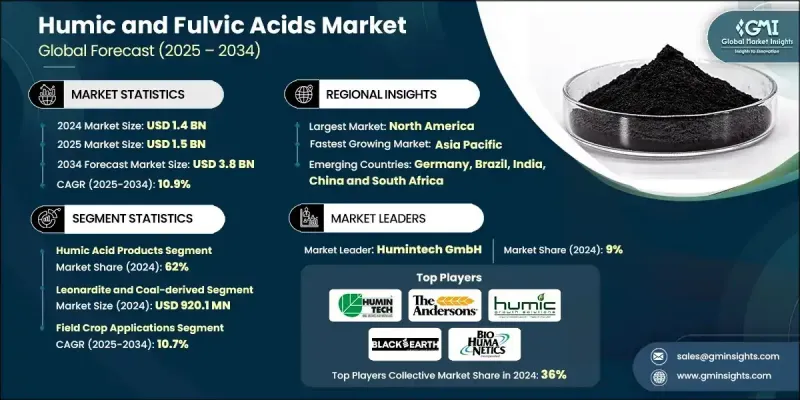
這一成長的動力源於農業領域普遍轉向更永續的土壤改良方法,並減少對合成肥料的依賴。腐植酸和黃腐酸在改善土壤品質、提高養分吸收和植物生產力方面發揮著至關重要的作用,在日益成長的環境問題中,這一點尤其重要。隨著對再生農業的重視程度不斷提高,這些物質正日益成為環保作物投入策略的核心組成部分。監管支持、人們對生物基土壤添加劑日益成長的興趣以及氣候智慧型農業的廣泛應用,持續推動需求。將腐植酸和黃腐酸融入精準施肥系統的先進農業技術進一步推動了其應用。透過水肥一體化、葉面施肥和數位監測等方法,使用者可以對施用方法進行微調,以實現作物效率的最大化。北美仍然是最大的市場,由於其完善的農業基礎設施和對永續技術的持續投資,腐殖酸和黃腐酸在傳統和有機農業體系中的應用都保持了強勁成長勢頭。
| 市場範圍 | |
|---|---|
| 起始年份 | 2024 |
| 預測年份 | 2025-2034 |
| 起始值 | 14億美元 |
| 預測值 | 38億美元 |
| 複合年成長率 | 10.9% |
腐植酸產品細分市場在2024年佔據62%的市場佔有率,預計到2034年將以10.7%的複合年成長率成長。腐植酸產品因其在改善土壤質地、維持養分和促進植物生長方面的顯著效果而廣泛應用。這些產品有液體、粉末和顆粒形式,支持多種農業環境的多樣化使用。黃腐酸產品雖然仍佔市場佔有率的一小部分,但由於其增強的養分螯合能力,尤其是在灌溉施肥系統和葉面施肥中,其應用正在加速成長。這種吸收率的提高有助於提高植物的復原力和養分效率。
2024年,風化褐煤和煤基資源市場規模達9.201億美元,複合年成長率將達10.7%。由於其腐殖化程度高且品質穩定,是萃取濃縮腐植質的理想選擇。北美和歐洲等地區的風化褐煤礦床廣泛應用於農業和環境領域,其高碳含量和優異的性能推動了生物促效劑級和土壤改良劑產品的擴張。
2024年,北美腐植酸和黃腐酸市場佔有38.2%的佔有率。再生農業、有機種植和生態標籤農業投入品的興起,持續提升了對天然土壤改良劑的需求。在環境友善農業文化的薰陶下,農民和農業企業擴大轉向使用腐植酸和黃腐酸產品來提高作物產量和土壤活力。消費者對採用清潔、永續投入種植的食品的偏好進一步強化了這一趨勢。
塑造全球腐植酸和黃腐酸市場競爭格局的關鍵參與者包括Humatech, Inc.、加拿大Humalite International Inc.、山東創新腐殖酸科技有限公司、Humintech GmbH、Grow More, Inc.、Horizon Ag-Products, LLC、Omnia Specialities Australia Pty Ltd.、The Andersons, Inc., Nvi Technologiesxx離子科技公司Inc.、Jiloca Industrial, SA、Black Earth Humic LP、Bio Huma Netics, Inc.和Humatech, Inc.。為了鞏固更強大的市場地位,腐植酸和黃腐酸行業的公司正在投資先進的配方技術,以提高產品功效和易用性。許多公司正在擴展顆粒、液體和可溶性產品線,以滿足不同的應用方式。
目錄
第1章:方法論與範圍
第2章:執行摘要
第3章:行業洞察
- 產業生態系統分析
- 供應商格局
- 利潤率
- 每個階段的增值
- 影響價值鏈的因素
- 中斷
- 產業衝擊力
- 成長動力
- 更重視土壤健康與再生農業
- 環境永續性和氣候變遷緩解
- 有機農業的成長與消費者需求
- 作物增產、品質改善
- 產業陷阱與挑戰
- 消費者和農民的意識和教育有限
- 與傳統肥料和改良劑相比成本較高
- 市場機會
- 新興市場農業發展與投資
- 精準農業與技術整合
- 碳權與環境服務市場
- 政府激勵措施和永續發展計劃
- 成長動力
- 成長潛力分析
- 監管格局
- 北美洲
- 歐洲
- 亞太地區
- 拉丁美洲
- 中東和非洲
- 波特的分析
- PESTEL分析
- 價格趨勢
- 按地區
- 依產品類型
- 未來市場趨勢
- 技術和創新格局
- 當前的技術趨勢
- 新興技術
- 專利態勢
- 貿易統計(HS編碼)
(註:僅提供重點國家的貿易統計)
- 主要進口國
- 主要出口國
- 永續性和環境方面
- 永續實踐
- 減少廢棄物的策略
- 生產中的能源效率
- 環保舉措
- 碳足跡考慮
第4章:競爭格局
- 介紹
- 公司市佔率分析
- 按地區
- 北美洲
- 歐洲
- 亞太地區
- 拉丁美洲
- 多邊環境協定
- 按地區
- 公司矩陣分析
- 主要市場參與者的競爭分析
- 競爭定位矩陣
- 關鍵進展
- 併購
- 夥伴關係與合作
- 新產品發布
- 擴張計劃
第5章:市場估計與預測:依產品類型,2021-2034
- 主要趨勢
- 腐植酸產品
- 液體腐植酸配方
- 固體腐植酸產品
- 黃腐酸產品
- 液體黃腐酸溶液
- 固體黃腐酸產品
- 腐植酸和黃腐酸混合產品
- 均衡配方
- 增強型和強化型產品
- 特殊和功能性產品
- 植物生長促效劑
- 抗壓力配方
第6章:市場估計與預測:依來源資料,2021-2034
- 主要趨勢
- 風化褐煤和煤衍生
- 風化褐煤礦產資源
- 煤炭開採
- 堆肥有機物
- 堆肥糞肥來源
- 植物性堆肥
- 泥炭和有機土壤來源
- 泥炭沼澤提取
- 有機土壤和腐植質
第7章:市場估計與預測:按應用,2021-2034
- 主要趨勢
- 大田作物應用
- 穀物和穀類作物
- 油籽和豆類作物
- 水果和蔬菜生產
- 樹果和果園
- 蔬菜和行栽作物
- 特色高價值作物
- 釀酒葡萄和葡萄園
- 咖啡和多年生作物
- 草坪和裝飾應用
- 高爾夫球場和運動場草坪
- 住宅和商業景觀美化
第8章:市場估計與預測:按地區,2021-2034
- 主要趨勢
- 北美洲
- 美國
- 加拿大
- 歐洲
- 德國
- 英國
- 法國
- 西班牙
- 義大利
- 歐洲其他地區
- 亞太地區
- 中國
- 印度
- 日本
- 澳洲
- 韓國
- 亞太其他地區
- 拉丁美洲
- 巴西
- 墨西哥
- 阿根廷
- 拉丁美洲其他地區
- 中東和非洲
- 沙烏地阿拉伯
- 南非
- 阿拉伯聯合大公國
- 中東和非洲其他地區
第9章:公司簡介
- Bio Huma Netics, Inc.
- Black Earth Humic LP
- Canadian Humalite International Inc.
- Grow More, Inc.
- Horizon Ag-Products, LLC
- Humatech, Inc.
- Humic Growth Solutions, Inc.
- Humintech GmbH
- Inner Mongolia Yili Humic Acid Ecological Technology Co., Ltd.
- Jiloca Industrial, SA
- Novihum Technologies GmbH
- Omnia Specialities Australia Pty Ltd.
- Shandong Chuangxin Humic Acid Technology Co., Ltd.
- The Andersons, Inc.
The Global Humic and Fulvic Acids Market was valued at USD 1.4 billion in 2024 and is estimated to grow at a CAGR of 10.9% to reach USD 3.8 billion by 2034.
This growth is fueled by a widespread shift in agriculture toward more sustainable soil enhancement methods and reduced dependency on synthetic fertilizers. Humic and fulvic acids play a vital role in improving soil quality, nutrient absorption, and plant productivity, which is increasingly important amid rising environmental concerns. As the emphasis on regenerative farming intensifies, these substances are gaining traction as core components of eco-friendly crop input strategies. Regulatory support, growing interest in bio-based soil additives, and a broader movement toward climate-smart agriculture continue to drive demand. Adoption is further supported by advanced farming techniques integrating humic and fulvic acids into precision application systems. Through methods such as fertigation, foliar feeding, and digital monitoring, users can fine-tune application for maximum crop efficiency. North America remains the largest market, benefiting from a well-established agriculture infrastructure and increased investment in sustainable technologies, giving humic and fulvic acids strong momentum in both conventional and organic farming systems.
| Market Scope | |
|---|---|
| Start Year | 2024 |
| Forecast Year | 2025-2034 |
| Start Value | $1.4 billion |
| Forecast Value | $3.8 billion |
| CAGR | 10.9% |
The humic acid products segment held 62% share in 2024 and is expected to grow at a CAGR of 10.7% through 2034. Their widespread use stems from strong results in enhancing soil texture, retaining nutrients, and fostering plant development. Available in liquid, powder, and granular formats, these products support diverse usage across multiple agricultural settings. Fulvic acid products, while still a smaller segment, are witnessing accelerated adoption due to their enhanced nutrient chelation abilities, particularly in fertigation systems and foliar applications. This increased uptake is helping improve plant resilience and nutrient efficiency.
In 2024, the leonardite and coal-derived sources segment reached USD 920.1 million and will grow at a CAGR of 10.7% due to their rich humification levels and consistent quality, making them ideal for extracting concentrated humic substances. Deposits from regions like North America and Europe are widely used in agricultural and environmental applications, with their high carbon content and performance capabilities fueling the expansion of biostimulant-grade and soil amendment products.
North America Humic and Fulvic Acids Market held 38.2% share in 2024. The rise in regenerative farming, organic cultivation, and eco-labeled agricultural inputs continues to elevate demand for natural soil conditioners. With a strong culture around environmentally responsible farming, farmers and agribusinesses are increasingly turning to humic and fulvic acid products to enhance crop yield and soil vitality. The trend is further reinforced by consumer preference for food grown with clean, sustainable inputs.
Key players shaping the competitive landscape of the Global Humic And Fulvic Acids Market include Humatech, Inc., Canadian Humalite International Inc., Shandong Chuangxin Humic Acid Technology Co., Ltd., Humintech GmbH, Grow More, Inc., Horizon Ag-Products, LLC, Omnia Specialities Australia Pty Ltd., The Andersons, Inc., Novihum Technologies GmbH, Inner Mongolia Yili Humic Acid Ecological Technology Co., Ltd., Humic Growth Solutions, Inc., Jiloca Industrial, S.A., Black Earth Humic LP, Bio Huma Netics, Inc., and Humatech, Inc. To secure stronger market positioning, companies in the humic and fulvic acids sector are investing in advanced formulation technologies to enhance product efficacy and ease of use. Many are expanding product lines across granular, liquid, and soluble forms to cater to varied application methods.
Table of Contents
Chapter 1 Methodology & Scope
- 1.1 Market scope and definition
- 1.2 Research design
- 1.2.1 Research approach
- 1.2.2 Data collection methods
- 1.3 Data mining sources
- 1.3.1 Global
- 1.3.2 Regional/Country
- 1.4 Base estimates and calculations
- 1.4.1 Base year calculation
- 1.4.2 Key trends for market estimation
- 1.5 Primary research and validation
- 1.5.1 Primary sources
- 1.6 Forecast model
- 1.7 Research assumptions and limitations
Chapter 2 Executive Summary
- 2.1 Industry 3600 synopsis
- 2.2 Key market trends
- 2.2.1 Regional
- 2.2.2 Product type
- 2.2.3 Source material
- 2.2.4 Application
- 2.3 TAM Analysis, 2025-2034
- 2.4 CXO perspectives: Strategic imperatives
- 2.4.1 Executive decision points
- 2.4.2 Critical success factors
- 2.5 Future Outlook and Strategic Recommendations
Chapter 3 Industry Insights
- 3.1 Industry ecosystem analysis
- 3.1.1 Supplier landscape
- 3.1.2 Profit margin
- 3.1.3 Value addition at each stage
- 3.1.4 Factor affecting the value chain
- 3.1.5 Disruptions
- 3.2 Industry impact forces
- 3.2.1 Growth drivers
- 3.2.1.1 Increasing focus on soil health and regenerative agriculture
- 3.2.1.2 Environmental sustainability and climate change mitigation
- 3.2.1.3 Organic agriculture growth and consumer demand
- 3.2.1.4 Crop yield enhancement and quality improvement
- 3.2.2 Industry pitfalls and challenges
- 3.2.2.1 Limited consumer and farmer awareness and education
- 3.2.2.2 Higher cost vs traditional fertilizers and amendments
- 3.2.3 Market opportunities
- 3.2.3.1 Emerging market agricultural development and investment
- 3.2.3.2 Precision agriculture and technology integration
- 3.2.3.3 Carbon credit and environmental service markets
- 3.2.3.4 Government incentives and sustainability programs
- 3.2.1 Growth drivers
- 3.3 Growth potential analysis
- 3.4 Regulatory landscape
- 3.4.1 North America
- 3.4.2 Europe
- 3.4.3 Asia Pacific
- 3.4.4 Latin America
- 3.4.5 Middle East & Africa
- 3.5 Porter’s analysis
- 3.6 PESTEL analysis
- 3.7 Price trends
- 3.7.1 By region
- 3.7.2 By product type
- 3.8 Future market trends
- 3.9 Technology and Innovation landscape
- 3.9.1 Current technological trends
- 3.9.2 Emerging technologies
- 3.10 Patent Landscape
- 3.11 Trade statistics (HS code)
( Note: the trade statistics will be provided for key countries only)
- 3.11.1 Major importing countries
- 3.11.2 Major exporting countries
- 3.12 Sustainability and environmental aspects
- 3.12.1 Sustainable practices
- 3.12.2 Waste reduction strategies
- 3.12.3 Energy efficiency in production
- 3.12.4 Eco-friendly initiatives
- 3.13 Carbon footprint consideration
Chapter 4 Competitive Landscape, 2024
- 4.1 Introduction
- 4.2 Company market share analysis
- 4.2.1 By region
- 4.2.1.1 North America
- 4.2.1.2 Europe
- 4.2.1.3 Asia Pacific
- 4.2.1.4 LATAM
- 4.2.1.5 MEA
- 4.2.1 By region
- 4.3 Company matrix analysis
- 4.4 Competitive analysis of major market players
- 4.5 Competitive positioning matrix
- 4.6 Key developments
- 4.6.1 Mergers & acquisitions
- 4.6.2 Partnerships & collaborations
- 4.6.3 New product launches
- 4.6.4 Expansion Plans
Chapter 5 Market Estimates and Forecast, By Product Type, 2021-2034 (USD Million & Tons)
- 5.1 Key trends
- 5.2 Humic acid products
- 5.2.1 Liquid humic acid formulations
- 5.2.2 Solid humic acid products
- 5.3 Fulvic acid products
- 5.3.1 Liquid fulvic acid solutions
- 5.3.2 Solid fulvic acid products
- 5.4 Combined humic and fulvic products
- 5.4.1 Balanced formulations
- 5.4.2 Enhanced and fortified products
- 5.5 Specialty and functional products
- 5.5.1 Plant growth stimulants
- 5.5.2 Stress resistance formulations
Chapter 6 Market Estimates and Forecast, By Source Material, 2021-2034 (USD Million & Tons)
- 6.1 Key trends
- 6.2 Leonardite and coal-derived
- 6.2.1 Leonardite mining sources
- 6.2.2 Coal-based extraction
- 6.3 Composted organic matter
- 6.3.1 Composted manure sources
- 6.3.2 Plant-based compost
- 6.4 Peat and organic soil sources
- 6.4.1 Peat bog extraction
- 6.4.2 Organic soil and muck
Chapter 7 Market Estimates and Forecast, By Application, 2021-2034 (USD Million & Tons)
- 7.1 Key trends
- 7.2 Field crop applications
- 7.2.1 Cereal and grain crops
- 7.2.2 Oilseed and legume crops
- 7.3 Fruit and vegetable production
- 7.3.1 Tree fruit and orchards
- 7.3.2 Vegetable and row crops
- 7.4 Specialty and high-value crops
- 7.4.1 Wine grape and vineyard
- 7.4.2 Coffee and perennial crops
- 7.5 Turf and ornamental applications
- 7.5.1 Golf course and sports turf
- 7.5.2 Residential and commercial landscaping
Chapter 8 Market Estimates and Forecast, By Region, 2021-2034 (USD Million & Tons)
- 8.1 Key trends
- 8.2 North America
- 8.2.1 U.S.
- 8.2.2 Canada
- 8.3 Europe
- 8.3.1 Germany
- 8.3.2 UK
- 8.3.3 France
- 8.3.4 Spain
- 8.3.5 Italy
- 8.3.6 Rest of Europe
- 8.4 Asia Pacific
- 8.4.1 China
- 8.4.2 India
- 8.4.3 Japan
- 8.4.4 Australia
- 8.4.5 South Korea
- 8.4.6 Rest of Asia Pacific
- 8.5 Latin America
- 8.5.1 Brazil
- 8.5.2 Mexico
- 8.5.3 Argentina
- 8.5.4 Rest of Latin America
- 8.6 Middle East and Africa
- 8.6.1 Saudi Arabia
- 8.6.2 South Africa
- 8.6.3 UAE
- 8.6.4 Rest of Middle East and Africa
Chapter 9 Company Profiles
- 9.1 Bio Huma Netics, Inc.
- 9.2 Black Earth Humic LP
- 9.3 Canadian Humalite International Inc.
- 9.4 Grow More, Inc.
- 9.5 Horizon Ag-Products, LLC
- 9.6 Humatech, Inc.
- 9.7 Humic Growth Solutions, Inc.
- 9.8 Humintech GmbH
- 9.9 Inner Mongolia Yili Humic Acid Ecological Technology Co., Ltd.
- 9.10 Jiloca Industrial, S.A.
- 9.11 Novihum Technologies GmbH
- 9.12 Omnia Specialities Australia Pty Ltd.
- 9.13 Shandong Chuangxin Humic Acid Technology Co., Ltd.
- 9.14 The Andersons, Inc.


