


 |
市場調查報告書
商品編碼
2158078
長期儲能、電網、資料中心、微電網:市場、技術、2027-2047 年Long Duration Energy Storage, Grid, Datacenter, Microgrid: Markets, Technology 2027-2047 |
||||||

概要
要了解長期儲能(LDES)領域的機遇,我們必須克服一些限制,例如人工智慧無法獲取未公開的專家見解、長期儲能理事會只追求成員公司銷售額最大化,以及人們思維局限在電網框架和最低指標之外。在這方面,Zhar Research新發表的499頁報告「長期儲能、電網、資料中心、微電網:市場、技術,2027-2047」從商業性觀點提供了解決方案。
情況已經改變了。
本報告揭示了在低能耗儲能系統(LDES)面臨成本挑戰的情況下,替代方案正被積極採用。報告用一個章節詳細說明了這些替代方案。鑑於情勢不斷變化,報告深入探討了截至2026年的研究和措施。太陽能和風能與低能耗儲能系統結合,將在許多1-200兆瓦的人工智慧資料中心和大型微電網中得到應用,因為它們能夠在不犧牲性能的前提下實現最低成本。在九種低能耗儲能系統技術(每種技術包含許多正在研究的子技術)中,一些技術能夠從單一設施提供短期和長期儲能。目前,低能耗儲能系統正被領先用於季節性儲能,以彌補冬季太陽能發電量不足的問題,而建立國家戰略能源儲備正被認真考慮作為最終目標。
確定獲勝者
從關鍵的20年長期觀點來看,九大技術體系中哪一種會佔新興的、規模龐大的低壓配電系統(LDES)市場的大部分佔有率?本文將揭示抽水蓄能水力發電(包括利用礦井、水下、海水和重水的新型蓄能方式)仍將是低壓配電系統黃金標準的11個原因。先前不為人知的缺點也將被揭露。哪種方案效率最低、安全性最差,對全球暖化的影響最大?在儲能壽命延長和容量增加的背景下,哪種方案會因嚴重的自洩漏、性能下降或缺乏擴充性而失敗——僅僅批量採購就足夠了嗎?
目錄
第1章:摘要整理與結論
- 本報告的目的和範圍
- 本分析的調查方法
- 主要結論及資訊圖,闡述為什麼PHES是「黃金標準」,而LDES是「補救措施」。
- 抽水蓄能(PHES)是低密度電力系統(LDES)黃金標準的11個理由
- 目前實施案例和未來展望
- 2027-2047年併網低密度電力系統規避策略-3類,15種方案
- LDES需求互聯互通與延遲減熱案例研究:英國、挪威、丹麥、義大利、希臘、新加坡(附SWOT分析)
- 2027-2047 年「電轉電」型 LDES 的關鍵候選技術
- 關於LDES參數和投資的主要結論
- 針對特定需求,最優的LDES會隨時間而改變。
- 10 種技術的潛在 LDES 效能(以 19 列顯示)
- 根據現有知識,2027-2047 年的三種 LDES 規模以及每種規模下將占主導地位的技術。
- 適合地點:依技術分類的數量(2027-2047 年)
- 當前和新興的低壓差分電磁系統:運作壽命與可用功率之間的關係
- 簡化版 - 詳情請見下一頁
- 將各項目及13種技術的運作時間(小時)及電源供應情況進行比較
- 2027-2047年10家LDES科技公司的SWOT分析
- 投資趨勢、高市值公司和重要地區
- 值得關注的公司
- LDES藍圖,2027-2047年
- 涵蓋 21 個項目的市場預測,附圖表和說明,2027-2047 年
- LDES 市場總規模(顯示微電網市場佔有率的擴張)預計在 2027-2047 年期間達到。
- 表格、圖表和說明,按八個技術類別分類的 LDES 市場(2026-2047 年,單位:十億美元)。
- LDES製造商的實際數量和預測數量:RFB與其他製造商的比較、產業重組,2027-2047年
- 2027-2047 年三種規模類別 LDES 總市場價值佔有率(表格、圖表、說明)
- 2027-2047 年四個地區 LDES 市場規模的區域市場佔有率(%)(表格、圖表、說明)
- 2027-2047年釩、鐵及其他液流電池在液態二硫化碳(LDES)市場的銷售佔有率(%)及技術策略
第2章:LDES的必要性與設計原則
- 能源基礎知識
- 成本快速下降推動向可再生能源的快速轉型:2025 年的統計數據和趨勢
- 太陽能發電的興起及其間歇性運作的挑戰
- 長時間運作的 LDES 的引入是由於風能和太陽能發電比例的增加以及成本的降低。
- LDES的定義與必要性
- 結論
- 電網整合能源儲存系統
- 英國政府報告:電網系統迫切需要低能耗分散式能源系統(LDES)的例證
- 2026 年至 2046 年間,併網型低密度能源供應系統 (LDES) 和離網型低密度能源供應系統 (LDES) 的需求將有顯著差異。
- 持續時間與產出比較:三個需要不同技術的標量部門
- LDES評估指標
- LDES項目,2025-2026年:關鍵技術子集
- 2027 年正在進行且已完成的部署:運作與產出和需求趨勢
- 2025-2026 年重大專案:詳情、關鍵技術子集與趨勢
- LDES的障礙、替代方案和投資環境
- LDES 工具包
- 概述
- LDES方案比較
- 電化學LDES選項的說明
- 最新的獨立技術性能評估
- 電池運作力超過 8 小時就會出問題。
- 2025-2045年離網型低排放能源系統詳細報告及其他參考資料
第3章:擺脫低收入群體教育的策略
- 大局
- 資訊圖表:擺脫離網式低密度能源系統 (LDES) 的途徑 - 3 個類別,15 個選擇,2027-2047 年
- 互聯線路和供熱延遲導致 LDES 需求下降的案例研究:英國、挪威、丹麥、希臘、新加坡、中國和美國(附 SWOT 分析)
- 太空太陽能發電、超高工程化垂直太陽能發電、核融合發電、海洋發電
- 持續從太空進行太陽能發電
- 太陽能發電和垂直太陽能發電的過度設計,即使在黎明、黃昏和冬季也能提供強大的電力供應。
- 連續核融合能
- 間歇性降低的海洋發電
- 對 LDES 逃生路線的調查,2026 年
- 互連線路
- AI 資料中心中的輕量級運算需要低功耗或 LDES。
- 間歇性降低的太陽能發電
- 適用於間歇性供電的家庭能源管理系統
第4章 抽水蓄能水力發電:傳統抽水蓄能系統
- 概述
- 三種選擇
- 歷史沿革、環境方面、實施期、候選地點以及美國能源局(DOE) 的評估。
- 位置並非受限於適當的拓樸結構數量,而主要受限於環境因素。
- 分析問題、利用抽水蓄能電站減少排放的措施、對景觀、用水量和成本的影響。
- 來自單一設施的短期PHES和LDES
- 調查進度及前景展望可從以下幾點看出。
- 世界各地的項目和計劃
- 地理
- 世界各地的大型抽水蓄能水力發電廠項目
- 經濟效率
- 政策建議
- 常規抽水蓄能水力發電廠(PHES)參數評估
- 傳統抽水蓄能水力發電(PHES)的SWOT分析
第5章 先進抽水蓄能水力發電(APHES)
- 概述和SWOT分析
- 廢棄礦場的再利用
- 可能性
- 調查進展
- 地下受壓彈性岩體:Quidnet Energy(美國)
- 山區重水利用:RheEnergise(英國)
- 概述
- RheEnergise安裝進展(2025-2026)
- 對礦山和其他目標的電力供應及其前景進行評估。
- 海水和其他鹽水的利用
- 概述
- 美國洞穴能源公司鹽洞內的鹽水
- 陸上海水抽水蓄能發電的SWOT分析
- 2026 年調查進展
- Sizeable Energy(義大利)、StEnSea(德國)、Ocean Grazer(荷蘭)
- 概述
- 義大利大型能源公司
- StEnSea(德國)
- 荷蘭海洋格雷澤
- 低密度儲能(LDES)水下儲能的SWOT分析
- 混合技術:2024 年研究進展
- 調查進展
- APHES SWOT 分析
第6章壓縮空氣儲能系統
- 概述
- 基礎
- 系統設計
- 調查進展
- CAES的市場定位
- 低度開發地區壓縮空氣儲能系統 (CAES) 的 SWOT 分析和參數比較。
- CAES技術選項
- 動態
- 等容或等壓儲存
- 就冷卻方法而言,絕熱法正逐漸成為主流。
- CAES計畫、子系統製造商、目標以及2025年以後的研究
- 概述:最大的項目位於中國。
- 延長壓縮空氣儲能系統的儲存和放電時間
- 2025年起在英國和歐盟開展調查
- 根據Zhar Research的評估,CAES公司的進展
- ALCAES Switzerland
- APEX CAES USA
- Augwind Energy Israel
- Keep Energy Systems UK formerly Cheesecake
- Huaneng Group China
- Hydrostor Canada
- Storelectric UK
- Terrastor Energy Corporation USA
第7章 氧化還原液流電池(RFB)
- 概述
- RFB的研究重點轉向LDES。
- RFB概述及其在LDES中的潛力
- 資訊圖表:RFB 的成就及 2027-2047 年展望
- RFB研究進展
- 2027年至2047年,氧化還原液流電池技術在液態二苯乙烯(LDES)領域的優勢
- RFB在LDES中的SWOT分析與參數比較
- 45 家 RFB 公司根據八項標準進行比較(公司名稱、品牌、技術、技術成熟度、對離網地區的關注、對 LDES 的關注以及評論)。
- RFB技術在研究方面取得了進展:
- 傳統型或混合型,它們的化學體系,以及關鍵的商業化技術。
- 標準與混合 SWOT 分析
- 按材料分類的具體設計:釩、鐵及其變體、其他金屬配體、鹵素、有機化合物、錳(包括最新研究),以及三項 SWOT 分析。
- 釩液流電池的設計及SWOT分析
- 全日本製鋼所及其衍生公司的RFB設計及SWOT分析
- 使用其他金屬配體的RFB
- 鹵素基和鋅基液流電池的設計
- 有機射頻電池的設計
- 錳基射頻電池
- 併網和離網模式下競爭的射頻流電池範例。
- RFB製造商概覽:領導企業與創新企業
第8章:固體重力儲能(SGES)
- 概述,包括以下調查
- 概述
- 操作的三個階段
- 三種形狀
- 三種儲能系統方案與抽水重力儲能的比較
- 基礎知識
- 固體重力儲能(SGES)在低密度儲能(LDES)中的SWOT分析
- 低密度儲能(LDES)固體重力儲能(SGES)參數評估。
- 資本支出的挑戰
- 持續成本帶來的挑戰
- 抽沙的可能性
- 液壓活塞升降機取代鋼索升降機:2025 年模型展望
- 其他SGES調查評估
- Energy Vault在瑞士、美國、中國和印度擁有授權公司。
- 綠色重力(澳洲)
第9章:先進常規結構電池(ACCB)
- 摘要包括以下進展
- 8 家 ACCB 製造商比較:8 項標準:公司名稱、品牌、技術、技術成熟度、對離網應用的關注、對低度開發地區 (LDES) 的關注以及評論。
- ACCB在LDES中的參數評估與SWOT分析
- 參數評估
- ACCB對LDES的SWOT分析
- 調查評估:2026 年進展狀況
- 金屬空氣電池
- 鐵空氣電池的SWOT分析:Form Energy(美國)
- 鋁空氣電池:Phinergy(以色列)
- 鋅空氣電池的SWOT分析:E-Zinc、AZA Battery、Zinc8(Abound)
- 高溫電池
- 熔融鈣銻電池:Ambri(美國)停止運營,SWOT分析
- 鈉或鋰硫電池:NGK/BASF(日本/德國),其他,研究將於 2025 年開始,SWOT 分析。
- 金屬離子電池,包括 Inlyte、Altris、HiNa、Tiamat、Natron 和 Faradion Reliance。
- 鈉離子電池(附SWOT分析)
- 鹵化鋅:EOS Energy Enterprises(美國),附SWOT分析
- 鋅離子電池:Enerpoly、Urban Electric Power(美國)、NextEra(美國)
- 鎳氫電池:EnerVenue(美國),附 SWOT 分析。
第10章 液化氣體儲能(LGES):液態空氣(LAES)或二氧化碳
- 概述
- 液態空氣 LAES、LDES
- 技術和研究的進步
- LAES與LDES的參數比較
- LAES在LDES中的SWOT分析
- 典型的雷射消融系統、安裝面積和運行參數
- 調查進展
- 中國中力儲能技術有限公司(CGDG)
- Highview Energy 英國及其合作夥伴公司(住友、森特理克、力拓等)
- 麻省理工學院在美國實施雷射輔助發射系統(LAES)可行性的研究
- Phelas,一家德國公司
- 液態和壓縮二氧化碳(LDES)
- 概述
- LDES CO2參數比較
- LDES用液態二氧化碳的SWOT分析
- 調查進展
- 義大利能源穹頂
- 中國和哈薩克
第11章:用於平衡電力需求的儲熱技術(ETES)
- 根據以下調查得出的結論
- 電熱儲能(ETES)參數評估
- ETES對LDES的SWOT分析
- 熱機方法的進展:Echogen USA
- 利用極端溫度和太陽能轉換
- Antora USA
- 第四力量(美國)
- 銷售來自同一發電廠的延遲熱能和電力。
- 概述
- MGA Thermal Australia
- Malta Inc Germany
第12章:利用氫氣和其他化學中間體的低排放能源(LDES)
- 概述(包括調查進展),2025-2026 年
- 概述
- 雖然 LDES 為化學中間體提供了最佳條件,但有安全隱患。
- 主流調查,2025-2026 年
- 利基市場研究結果,2025-2026年
- 氫損失複雜機制的研究
- 對導致全球暖化的氫氣洩漏展開調查
- 2025-2026年氫氣儲存技術進步實例
- LDES中氫氣儲存的參數評估
- LDES中氫氣、甲烷和氨的SWOT分析
- 實際項目數量很少。
- 美國卡利斯託加韌性中心的48小時微電網
- 德國烏爾姆大學微電網示範計畫(2025-2027)
- 中國計劃
- 愛爾蘭拉思拉什能源園提案
Summary
To understand your LDES opportunities, we must get beyond AI unable to access unpublished expert insights, the LDES Council seeking to maximise members’ sales, and those unable to think beyond LDES for grids and minimal metrics. To the rescue comes the new, commercially-oriented 499-page Zhar Research report, “Long Duration Energy Storage, Grid, Datacenter, Microgrid: Markets, Technology 2027-2047”.
The situation has changed
It reveals that, faced with LDES affordability problems, there is strong adoption of escape routes. It provides a full chapter on them. It deeply examines research and initiatives through 2026 because the situation has changed. Many 1-200MW AI datacenters and large microgrids will adopt solar and wind with LDES, as they offer lowest cost without compromise. Some of the nine LDES technology families (each with many examined subsets) will provide short- and long-duration from one facility. We now have serious consideration of the eventual creation of national strategic electricity reserves, preceded by LDES for seasonal storage covering solar weak in winter.
Winners identified
Which technology families out of the nine will take most of the large, emerging LDES value market on the important twenty-year view? See eleven reasons why pumped hydro – including emerging new forms of it using mines, underwater, seawater, heavier water – will remain the gold standard of LDES. Suppressed negatives are surfaced. Which option is least efficient, least safe and causes global warming? With the trend to longer duration and larger capacity, which options will be crippled by poor self-leakage, fade or lack of scalability - you just buy more of everything?
It is not all about grids
Learn how you can create a $1 billion LDES business just for microgrids. The report finds that datacenters and microgrids will, take over 20% of the LDES value market, but they must prioritise different LDES technologies from grids. Which? When? Uniquely balanced and thorough, the report has 22 SWOT appraisals, prospects for 17 LDES parameters and reality checks such as, graphed, the duration, power and capacity of a large number of actual and planned LDES projects.
Report coverage
The Executive Summary and Conclusions (53 pages) is sufficient in itself for those with limited time. It has the basics, 11 of the SWOT appraisals, 15 LDES escape routes in three categories, 17 key conclusions, roadmaps and 23 new forecast lines 2027-2047 as easily understood infograms, graphs and tables with explanation. Chapter 2. LDES Need and Design Principles (38 pages) briefly explains the race into renewables and why solar is winning. Then you see adoption of LDES of increasing duration driven by increased wind/solar percentage and cost reduction but how LDES is also needed for every other energy option. Curtailment is discussed – not always a bad thing. LDES will be adopted only when and where it is cost-effective. LDES definitions and specific needs are introduced, including LDES integrated with renewable energy sources and detail on the difference between grid and beyond-grid LDES needs. In this chapter and all following, there is a close look at research 2025 through 2026, references leading you to further reading, including a Zhar Research drill-down on datacenter and microgrid LDES.
Chapter 3. LDES Escape Routes is 18 pages including a SWOT and much 2026 research. The world will not spend a significant part of its GDP on LDES. Engineers do workarounds, so this chapter explains 15 options in three categories, most of which are already happening somewhere because they save money or are more practicable. They are business opportunities for you. Some of the outstanding versions are international electricity interconnectors spanning time and weather zones, differential pricing and generation combinations and types that are far less intermittent than solar or wind. It is concluded that LDES market potential remains large even when at least halved by these escapes.
Chapters on each LDES technology begin with Chapter 4. Pumped Hydro: Conventional PHES (33 pages) responsible for 94% of stationary storage. Arriving PHES projects set records such as longest duration, power, capacity and life. Variable speed turbines are successful. As in the other chapters, there are SWOT appraisals, parameter summaries and advances promised by quoted research through 2026 and earlier. Yes, these giants generate carbon dioxide in manufacture of their concrete but that then lasts over 100 years. PHES is now being multipurposed, such as acting as backup fresh water supplies and adding floating solar that reduces evaporation, increases income. PHES is increasingly specified for short-duration and LDES from one facility, promising further reduction in its already-excellent Levelised Cost of Storage LCOS.
Much more to come
That naturally leads to Chapter 5. Advanced Pumped Hydro APHES (48 pages) revealing the huge significance of trials of such options as using seawater, heavier water up mere hills, underground and other options with their strong research pipeline. It is found that these may extend 100 times the number of sites and some are of interest for datacenters and large microgrids. Then comes strongest rival as Chapter 6. Compressed Air CAES (47 pages) with the second-largest duration-power output achievements, a 15% learning curve driving down to reach PHES LCOS figures. Six companies are profiled.
Chapter 7. Redox Flow Batteries RFB (88 pages) compares these technologies as they slowly eliminate expensive materials such as vanadium that must be recovered and adding hybrid forms that are smaller for microgrids but not as scalable in size. RGB has niche grid potential but could dominate large microgrid LDES for reasons given. 47 RFB manufacturers are compared in eight columns and many profiled. Realise that massive four-hour versions in China will easily be converted to LDES when the need arises.
Chapter 8. Solid Gravity Energy Storage SGES (25 pages) explains how lifting blocks promises no self-leakage, little fade, longest duration but suppliers departing. Latest arrival Green Energy Australia uses mines. Chapter 9. Advanced Conventional Construction Batteries ACCB (44 pages and 6 SWOTs) appraises many options and companies, with Form Energy iron-air the most successful, its many grid projects promising 100 hours. We await actual data for these.
Chapter 10. Liquefied Gas Energy Storage LGES: Liquid air LAES or CO2 (37 pages) describes options that have success in the middle ground without needing major earthworks. Will late-starter CO2 overtake? The report then closes with Chapter 12. Hydrogen and Other Chemical Intermediary LDES (27 pages) which assesses the small number of projects and the claims that it is the only way to go for seasonal storage and strategic electricity reserves.
The new report, “Long Duration Energy Storage, Grid, Datacenter, Microgrid: Markets, Technology 2027-2047” is your essential guide to success.
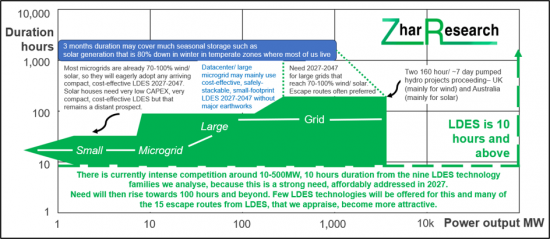
CAPTION: Actual installations 2027: LDES duration vs power deliverable, simplified version. Current LDES situation in green with trends as text. Source: Zhar Research report, “Long Duration Energy Storage, Grid, Datacenter, Microgrid: Markets, Technology 2027-2047”.
Table of Contents
1. Executive summary and conclusions
- 1.1 Purpose and unique scope of this report
- 1.2 Methodology of this analysis
- 1.3 Key conclusions with infograms on why PHES is gold standard and LDES escape routes
- 1.3.1 11 reasons why pumped hydro energy storage is the gold standard for LDES
- 1.3.2 Examples of current installations and potential
- 1.3.3 Escape routes from grid LDES 2027-2047 – 3 categories, 15 options
- 1.4 Interconnector and delayed heat examples reducing LDES needs: UK, Norway, Denmark, Italy, Greece, Singapore, with SWOT
- 1.5 Main technology candidates for electricity-to-electricity LDES 2027-2047
- 1.6 Key conclusions concerning LDES parameters and investment
- 1.7 Optimal LDES for a given need changes over time
- 1.8 Potential LDES performance by ten technologies in 19 columns
- 1.9 Three LDES sizes, with different technology winners 2027-2047 on current evidence
- 1.10 Acceptable sites: numbers by technology 2027-2047
- 1.11 Current and emerging LDES: duration vs power deliverable in
- 1.11.1 Simplified version – detail on next page
- 1.11.2 Duration hours vs power delivered by project and 13 technologies in
- 1.12 SWOT appraisals of ten LDES technologies for 2027-2047
- 1.13 Investment trends, value market winners, important regions
- 1.14 Companies to watch
- 1.15 LDES roadmap 2027-2047
- 1.16 Market forecasts in 21 lines 2027-2047 with graphs and explanation
- 1.16.1 LDES total value market showing microgrid gaining share 2027-2047
- 1.16.2 LDES market in 8 technology categories $ billion 2026-2047 table, graphs, explanation
- 1.16.3 Number of LDES actual and putative manufacturers: RFB vs Other showing shakeout 2027-2047
- 1.16.4 Total LDES value market % in three size categories 2027-2047 table, graph, explanation
- 1.16.5 Regional share of LDES value market % in four regions 2027-2047 table, graph, explanation
- 1.16.6 Vanadium vs iron vs other RFB LDES market % value sales with technology strategies 2027-2047
2. LDES need and design principles
- 2.1 Energy fundamentals
- 2.2 Racing into renewables with rapid cost reduction: 2025 statistics and trends
- 2.3 Solar winning and the intermittency challenge
- 2.4 Adoption of LDES of increasing duration driven by increased wind/solar percentage and cost reduction
- 2.5 LDES definitions and needs
- 2.5.1 General
- 2.5.2 Integrated energy storage systems for grids
- 2.5.3 Example of urgent need for grid LDES – UK government report
- 2.5.4 Very different needs for grid vs beyond-grid LDES 2026-2046
- 2.5.5 Duration vs power showing three size sectors needing different technologies
- 2.6 LDES metrics
- 2.7 LDES projects in 2025-6 showing leading technology subsets
- 2.7.1 Installations in progress and complete 2027: duration vs power and trend in need
- 2.7.2 Leading projects in 2025-6 showing detail and leading technology subsets, trend
- 2.8 LDES impediments, alternatives and investment climate
- 2.9 LDES toolkit
- 2.9.1 Overview
- 2.9.2 LDES choices compared
- 2.9.3 Electrochemical LDES options explained
- 2.10 Latest independent assessments of performance by technology
- 2.11 Batteries that struggle above 8-hour duration
- 2.12 Drill down report on beyond-grid LDES 2025-2045 and other reading
3. LDES escape routes
- 3.1 General situation
- 3.2 Infogram: Escape routes from grid LDES 2027-2047 – 3 categories, 15 options
- 3.3 Interconnector and delayed heat examples reducing LDES needs: UK, Norway, Denmark, Greece, Singapore, China, USA with SWOT
- 3.4 Solar-from-space, over-specification and vertical solar, fusion power, ocean power
- 3.4.1 Continuous solar from space
- 3.4.2 Solar over-specification and vertical solar give strong power even at dawn, dusk, winter
- 3.4.3 Continuous fusion power
- 3.4.4 Less-intermittent ocean power
- 3.5 2026 research on LDES escape routes
- 3.5.1 Interconnectors
- 3.5.1 AI datacenter light computing needs little power or LDES
- 3.5.2 Solar with reduced intermittency
- 3.5.3 Home Energy Management Systems coping with intermittent supply
4. Pumped hydro: conventional PHES
- 4.1 Overview
- 4.1.1 Three options
- 4.1.2 History, environmental, timescales, potential sites, DOE appraisal
- 4.1.3 Site-limited primarily due environmental concerns not number of appropriate topologies
- 4.1.4 Problem analysis, actions to reduce PHES emissions, ugliness, water use, cost
- 4.1.5 PHES for short-duration and LDES from one facility
- 4.2 Research advances and view of potential through
- 4.3 Projects and intentions across the world
- 4.3.1 Geographical
- 4.3.2 Large pumped hydro schemes worldwide
- 4.4 Economics
- 4.5 Policy recommendations
- 4.6 Parameter appraisal of conventional pumped hydro PHES
- 4.7 SWOT appraisal of conventional pumped hydro PHES
5. Advanced pumped hydro APHES
- 5.1 Overview with SWOT appraisal
- 5.2 Repurposing mining sites
- 5.2.1 Potential
- 5.2.2 Research advances in
- 5.3 Pressurised sprung rocks underground: Quidnet Energy USA
- 5.4 Using heavier water up mere hills: RheEnergise UK
- 5.4.1 General
- 5.4.2 RheEnergise installation progress 2025-6
- 5.4.3 Power for mines and other targets with appraisal of prospects
- 5.5 Using seawater or other brine
- 5.5.1 General
- 5.5.2 Brine in salt caverns Cavern Energy USA
- 5.5.3 SWOT appraisal of seawater pumped hydro on land
- 5.5.4 2026 research advances
- 5.6 Sizeable Energy Italy, StEnSea Germany, Ocean Grazer Netherlands
- 5.6.1 General
- 5.6.2 Sizable Energy Itay
- 5.6.3 StEnSea Germany
- 5.6.4 Ocean Grazer Netherlands
- 5.6.5 SWOT appraisal of underwater energy storage for LDES
- 5.7 Hybrid technologies: research advances in 2024 and
- 5.8 Research advances in
- 5.9 SWOT appraisal of APHES
6. Compressed air CAES
- 6.1 Overview
- 6.1.1 Basics
- 6.1.2 System design
- 6.1.3 Research advances in
- 6.2 Market positioning of CAES
- 6.3 SWOT appraisal and parameter comparison of CAES for LDES
- 6.4 CAES technology options
- 6.4.1 Thermodynamic
- 6.4.2 Isochoric or isobaric storage
- 6.4.3 Adiabatic choice of cooling is winning
- 6.5 CAES projects, subsystem manufacturers, objectives, research 2025 onwards
- 6.5.1 Overview: largest projects are in China
- 6.5.2 Increasing the CAES storage time and discharge duration
- 6.5.3 Research in UK and European Union 2025 onwards
- 6.6 Profiles of CAES company progress with Zhar Research appraisals
- 6.6.1 ALCAES Switzerland
- 6.6.2 APEX CAES USA
- 6.6.3 Augwind Energy Israel
- 6.6.4 Keep Energy Systems UK formerly Cheesecake
- 6.6.5 Huaneng Group China
- 6.6.6 Hydrostor Canada
- 6.6.7 Storelectric UK
- 6.6.8 Terrastor Energy Corporation USA
7. Redox flow batteries RFB
- 7.1 Overview
- 7.2 RFB research pivoting to LDES
- 7.2.1 Overview of RFB and its potential for LDES
- 7.2.2 Infogram: RFB achievements and aspirations 2027-2047
- 7.2.3 RFB research advances in
- 7.3 Winning LDES redox flow battery technologies 2027-2047
- 7.4 SWOT appraisal and parameter comparison of RFB for LDES
- 7.5 45 RFB companies compared in 8 columns: name, brand, technology, tech. readiness, beyond grid focus, LDES focus, comment
- 7.6 RFB technologies with research advances through
- 7.6.1 Regular or hybrid, their chemistries and the main ones being commercialised
- 7.6.2 SWOT appraisals of regular vs hybrid options
- 7.7 Specific designs by material: vanadium, iron and variants, other metal ligand, halogen-based, organic, manganese with latest research, three SWOT appraisals
- 7.7.1 Vanadium RFB design and SWOT appraisal
- 7.7.2 All-iron and variants RFB design and SWOT appraisal
- 7.7.3 Other metal ligand RFB
- 7.7.4 Halogen-based and zinc-based RFB design
- 7.7.5 Organic RFB design
- 7.7.6 Manganese-based RFB
- 7.7.7 Examples of RFB competing on-grid and off-grid
- 7.8 RFB manufacturer profiles: some leaders and some innovators
8. Solid gravity energy storage SGES
- 8.1 Overview including research in
- 8.1.1 General
- 8.1.2 Three stages of operation
- 8.1.3 Three geometries
- 8.1.4 Pumped hydro gravity storage compared to the three SGES options
- 8.1.5 Basics
- 8.1.6 SWOT appraisal of solid gravity storage SGES for LDES
- 8.1.7 Parameter appraisal of solid gravity energy storage SGES for LDES
- 8.1.8 CAPEX challenge
- 8.1.9 Challenge of ongoing expenses
- 8.1.10 Possibility of pumping sand
- 8.1.11 Hydraulic piston lift instead of cable: 2025 modelling
- 8.1.12 Appraisal of other SGES research
- 8.2 Energy Vault Switzerland, USA and China, India licensees
- 8.3 Green Gravity Australia
9. Advanced conventional construction batteries ACCB
- 9.1 Overview including advances through
- 9.2 Eight ACCB manufacturers compared: 8 columns: name, brand, technology, tech. readiness, beyond-grid focus, LDES focus, comment
- 9.3 Parameter appraisal and SWOT appraisal of ACCB for LDES
- 9.3.1 Parameter appraisal
- 9.3.2 SWOT appraisal of ACCB for LDES
- 9.3.3 Research appraisal: 2026 advances
- 9.4 Metal-air batteries
- 9.4.1 Iron-air with SWOT : Form Energy USA
- 9.4.2 Aluminium-air : Phinergy Israel
- 9.4.3 Zinc-air with SWOT: E-Zinc, AZA battery, Zinc8 (Abound)
- 9.5 High temperature batteries
- 9.5.1 Molten calcium antimony: Ambri USA out of business, SWOT
- 9.5.2 Sodium or lithium sulfur: NGK/ BASF Japan/ Germany, others, research in 2025, SWOT
- 9.6 Metal-ion batteries including Inlyte, Altris, HiNa, Tiamat, Natron, Faradion Reliance
- 9.6.1 Sodium-ion with SWOT
- 9.6.2 Zinc halide EOS Energy Enterprises USA with SWOT
- 9.6.3 Zinc-ion Enerpoly, Urban Electric Power USA, NextEra USA
- 9.7 Nickel hydrogen batteries: EnerVenue USA with SWOT
10. Liquefied gas energy storage LGES: Liquid air LAES or CO2
- 10.1 Overview
- 10.2 Liquid air LAES LDES
- 10.2.1 Technology and research advances
- 10.2.2 Parameter comparison of LAES for LDES
- 10.2.3 SWOT appraisal of LAES for LDES
- 10.2.4 Indicative LAES systems, footprints and operating parameters
- 10.2.5 Research advances in
- 10.2.6 CGDG, Zhongli Zhongke Energy Storage Technology Co China
- 10.2.7 Highview Energy UK and partners Sumitomo, Centrica, Rio Tinto and others
- 10.2.8 MIT study of LAES viability in USA
- 10.2.9 Phelas Germany
- 10.3 Liquid and compressed carbon dioxide LDES
- 10.3.1 Overview
- 10.3.2 Parameter comparison of CO2 for LDES
- 10.3.3 SWOT appraisal of liquid CO2 for LDES
- 10.3.4 Research advances in
- 10.3.5 Energy Dome Italy
- 10.3.6 China and Kazakhstan
11. Thermal energy storage for delayed electricity ETES
- 11.1 Overview with research through
- 11.2 Parameter appraisal of electric thermal energy storage ETES
- 11.3 SWOT appraisal of ETES for LDES
- 11.4 The heat engine approach proceeds: Echogen USA
- 11.5 Use of extreme temperatures and photovoltaic conversion
- 11.5.1 Antora USA
- 11.5.2 Fourth Power USA
- 11.6 Marketing delayed heat and electricity from one plant
- 11.6.1 Overview
- 11.6.2 MGA Thermal Australia
- 11.6.3 Malta Inc Germany
12. Hydrogen and other chemical intermediary LDES
- 12.1 Overview with research progress in 2025-6
- 12.1.1 Overview
- 12.1.2 Sweet spot for chemical intermediary LDES but safety issues
- 12.1.3 Mainstream research through 2025-6
- 12.1.4 Research dreaming of niches through 2025-6
- 12.1.5 Research on complex mechanisms for hydrogen loss
- 12.1.6 Research on hydrogen leakage causing global warming
- 12.1.7 Examples of hydrogen storage advances 2025-6
- 12.2 Parameter appraisal of hydrogen storage for LDES
- 12.3 SWOT appraisal of hydrogen, methane, ammonia for LDES
- 12.4 The small number of actual projects
- 12.4.1 Calistoga Resiliency Centre USA 48-hour microgrid
- 12.4.2 Ulm University microgrid trial Germany 2025-2027
- 12.4.3 China plans in
- 12.4.4 Rathrush Energy Park Ireland proposal

 微電網市場預測至2034年-按電網類型、連接方式、電源、組件、應用、所有權模式和區域分類的全球分析
 微型直流伺服馬達市場:全球市場預測,2026-2032年
 機場微電網市場規模、佔有率、成長、全球產業分析、區域趨勢及2026年至2034年預測
 微型DC馬達市場報告:趨勢、預測和競爭分析(至2035年)植絨整合網格磨料布市場報告:趨勢、預測與競爭分析(至2035年)磁親和性和分離顆粒市場報告:趨勢、預測和競爭分析(至2035年)面向人工智慧資料中心的微電網市場規模、佔有率和成長預測(2026-2032 年)
 氫能微電網技術市場分析及預測(至2035年):依類型、產品、服務、技術、組件、應用、部署、最終用戶、功能及安裝類型分類超本地化微電網解決方案市場分析與預測(至2035年):類型、產品、服務、技術、組件、應用、部署模式、最終用戶、功能、解決方案P2P(P2P) 能源交易平台市場:全球產業分析、市場規模、市場佔有率以及 2026-2033 年按平台類型、交易模式、能源來源、最終用戶、國家和地區分類的預測。