


 |
市場調查報告書
商品編碼
2059553
離子凝膠與共聚凝膠的新興市場機會:科技與市場(2026-2046 年)Ionogel and Eutectogel Emerging Opportunities: Technology, Markets 2026-2046 |
||||||

概括
憑藉離子凝膠的卓越性能,新的研究成果不斷湧現,一個龐大的市場正在形成。眾多公司也紛紛進入這一領域。本報告內容全面且具有商業導向,揭示了包括材料和裝置製造商、投資者以及終端用戶在內的眾多市場相關人員的商機。本報告不僅涵蓋離子凝膠,還涉及共熔凝膠。與離子凝膠類似,共熔凝膠也是離子導電且揮發性較低的凝膠材料,但其特徵是使用低共熔深共熔溶劑(DES)而非離子液體作為支撐基質。預計這將帶來新的優勢,例如提高生物分解性和降低成本。
報告的第一作者、Zhar Research執行長Peter Harrop博士表示:「我們的研究表明,離子凝膠具有非常廣泛的優勢。尤其值得一提的是,它們是新型離子電子軟性電子設備的基礎技術,這些設備在醫療領域備受關注。離子凝膠所展現的巨型離子席貝克效應有望顯著推動熱電能量回收技術的發展。此外,具有巨磁阻抗特性的離子凝結塞貝克效應有望顯著推動熱電能源回收技術的發展。此外,具有巨磁阻抗特性的離子凝結塞貝克效應有望顯著推動熱電能量回收技術的發展。此外,具有巨電阻特性的離子凝結膠有望應用於下一代人機面積( 二氧化碳捕集 ) 。
目前預期應用中約有40%與水凝膠已應用或正在考慮引入的領域相關。然而,它們凝膠因其不易乾燥、不易凍結且能承受許多應用所需的工作電壓等特性,正在蠶食水凝膠的市場佔有率。此外,許多新型離子凝膠和超導電凝膠的應用範圍已遠遠超出這些傳統用途,進入了能夠同時發揮多種優異性能的先進技術領域。
目錄
第1章:摘要整理與結論
第2章:引言
- 定義、特徵和新應用
- 離子凝膠的八大卓越特性
- 兩張資訊圖比較主要凝膠類型
- 離子凝膠與共晶凝膠之間的密切關係
- 離子凝膠、水凝膠、有機凝膠、電凝膠和金屬凝膠的比較
- 離子凝膠的種類和用途
- 離子電導率的重要性以及離子凝膠的性能權衡
- 離子凝膠製備實例
- 結果、優勢、挑戰
- 離子凝膠的SWOT分析
第3章:離子凝膠的選擇:依基質材料分類
- 基質化學普遍性的概述與分析
- 離子凝膠基質材料的主要選擇
- 離子聚合物橋聯選項
- 為什麼纖維素基離子凝膠備受關注
- 2025 年範例
第4章 離子凝膠和共晶凝膠性能的最佳化:2025年和2026年的關鍵進展
- 沾黏:外科手術及其他
- 抗菌
- 生物相容性
- 螢光特性
- 自癒
- 強度、抗衝擊性和韌性均提高
- 兆赫控制
- 透明度
第5章:離子凝膠裝置製造商、供應鏈、產品規格和製造技術的演變
- 概述和製造商分析:按地區分類
- 離子凝膠原料的生產商和化學品供應商
- 離子凝膠基設備的製造商:現有製造商和潛在製造商
- Utecgel 的製造商
- 離子凝膠相容組件和設備的製造商
- 離子凝膠裝置及組件的製造技術
- 複合離子凝膠:配方與生產趨勢
第6章:離子凝膠和超導電凝膠在離子電子學、軟性電子產品和人機介面中的應用
- 概述包括 2025 年和 2026 年的主要進展。
- 離子電子學和軟性電子產品
- 執行器和人機介面
- 離子凝膠膜
- 離子凝膠感測器和人機介面
- 離子凝膠光學元件
第7章 電池和超級電容中的離子凝膠
- 概述:需要離子凝膠、超級電容及其衍生物的電池
- 候選離子凝膠半固體電解質的SWOT分析
- 鋰離子電池和鈉離子電池
- 超級電容
- LIC 和其他電池超級電容混合元件 (BSH)
- 利用離子凝膠或共晶凝膠的超級電容和BSH
- 到2025年,離子凝膠和超導電凝膠在電池領域的應用將取得顯著進展。
- 這是基於 2025 年和 2026 年取得重大進展的假設(詳情如下)。
- 固態電池用離子凝膠的SWOT分析
- 氧化物固體電解質
- 硫化物固體電解質
- 硫銀礦離子凝膠
- 氮化物和鹵化物基固體電解質
- 聚合物基電解質
- 採用離子凝膠的鈉電池
第8章:用於能源採集和冷卻的離子凝膠和共晶凝膠
- 概述
- 能源採集和離子凝膠
- 零能耗設備的能源採集技術:13 種類型的比較。
- 利用功率輸出進行能源採集的應用
- 離子凝膠在三種能源採集方法中的評估(5 列)
- 熱電能源採集
- 離子凝膠和共晶凝膠的基礎知識
- 離子凝膠熱電材料及相關材料的應用實例。
- 2025年及2026年研究進展迅速
- 熱電和熱離子凝膠感測器、致動器和發生器
- 離子凝膠和UTect凝膠的摩擦電能源採集
- 摩擦電能源採集:TENG運行原理及結構
- 試運行
- 利用離子凝膠摩擦奈米發電機的研究進展
- 壓電離子能源採集
- 冷卻離子凝膠:滿足市場需求的機會
第9章 醫用離子凝膠:2026 年的進展與趨勢
- 概述
- 醫用離子凝膠的SWOT分析
- 多功能性
- 醫療生物電子學和離子電子學正在迅速發展。
- 醫用級離子凝膠可改善質地、強度和環境耐受性。
- 用於摩擦電和生物電子界面的離子凝膠電極的最新進展
- 在 2026 年之前,效能和可回收性之間的權衡將取得進展。
- 離子凝膠作為抗菌劑
- 離子凝膠作為藥物傳遞系統(DDS)的應用
- 創傷治療離子凝膠敷料和治療方法。
- 用於組織工程的離子凝膠
- 離子凝膠智慧肌膚
- 視覺時間顯示
- 合成視覺離子凝膠
- 用於未來人機融合智慧的可拉伸神經型態電子裝置
第10章:離子凝膠在二氧化碳捕集、重金屬去除和合成染料去除的應用
- 概述:二氧化碳捕集
- 用於碳回收和轉化的離子凝膠
- 水處理
Summary
Ionogel virtuosity is creating large markets powered by a flood of new research advances and companies are entering the field. The new 380-page, “Ionogel and eutectogel emerging opportunities: technology, markets 2026-2046” report reveals your opportunities from material or device supplier, investor, through to user. It is comprehensive, and commercially-oriented. It includes eutectogels, another family of ionic-conductive, non-volatile gels but with deep eutectic solvents instead of ionic liquids in their supporting matrix. This expands the capability in aspects such as biodegradability, and cost reduction.
Primary author Dr Peter Harrop, CEO of Zhar Research says, “We find that ionogels bring a formidable range of benefits, including being the basis of the new iontronics flexible electronics exciting the medical community. Ionogel giant ionic Seebeck effect will boost thermoelectric energy harvesting. Ionogels offering giant magnetoimpedance are proposed for next human-machine interfaces. Ionogel is a formidable contender for the leak-free, higher-performance electrolytes for batteries. Add new, self-powered sensors, artificial muscles, drug delivery, soft robotics, better, wider X-ray scintillator film, smart textiles and windows, neuromorphic computing, water purification, carbon capture and much more.”
About 40% of the applications are where hydrogels are used or proposed, with ionogels taking share because they do not dry out or freeze and only they meet the typically-required voltages of operation. However, most of the emerging ionogel and eutectogel applications go way beyond, typically exploiting multiple benefits. Uniquely, the report clarifies often obscure science and initiatives into roadmaps, market forecasts, SWOT appraisals, infograms, pie charts, identified gaps in the market and comparison tables, with a glossary of terms.
The Executive Summary and Conclusions (50 pages) is sufficient for those with limited time. It explains how ionogels are a class of electrically-conductive, soft materials comprising a three-dimensional network matrix (organic or inorganic) that immobilizes ionic liquids (ILs). They have drawn considerable attention due to a suite of exceptional and tunable physicochemical properties, such as nonvolatility, excellent thermal and electrochemical stability, adjustable mechanical strength and high ionic conductivity. Frequently, we can add to that self-healing, non-flammable, self-adhesive, stretchable, transparent, recyclable and tunable in physical and chemical properties to a huge variety of applications. There is even more capability than that emerging. See all the SWOT appraisals, roadmaps and forecasts after understanding the basics in pie charts, SWOT appraisals and comparison tables here. 35 key conclusions are presented.
The Introduction (38 pages) gives definitions and context, presenting 25 ionogel market sectors as examples and where hydrogels compete. Applications of ionogels by seven types of composition are compared in a table and eight properties of ionogels attracting attention are shown in an infogram. Specifics such as wearable ionogels - flexible and fabric – and ionogel smart windows are described to bring the subject alive, followed by more examples analysed fully in later chapters. The design and manufacturing issues for ionogels are introduces and then there is a SWOT appraisal of ionogels.
The following chapters give the detail, fortified by a large number of 2026 and 2025 research papers and company activities being analysed. Chapter 3. Ionogel options by matrix material (24 pages) explains why the matrix, rather than the trapped ionic liquid, controls most of the desired properties and why certain materials are particularly popular in major advances recently. Chapter 4. Optimising specific ionogel and eutectogel attributes: major advances in 2025 and 2026 (28 pages) addresses optimisation, where required, of adhesion: surgical and other, antibacterial, biocompatible, fluorescent, self-healing, strengthening, terahertz manipulation and transparency capability.
By now you have a grasp of how to make the best ionogel and eutectogel materials but who does it and how will they make the required formats such as complex 3D and 2D shapes, fibers and fabrics? Chapter 5. Evolving ionogel device manufacturers, supply chain, formats, fabrication technologies (32 pages) answers these questions, identifies the best and the future trends. It ends with composite forms including magnetic ionogels.
Chapter 6. Ionogels and eutectogels in iontronics, flexible electronics and human interfaces (52 pages) introduces ionogel-enabled iontronics, an emerging interdisciplinary field that uses ions instead of electrons as the primary signal carriers to bridge the gap between solid-state electronics and biological systems. It provides sensing, computing, and actuation. The advances in ionogel sensing, including e-skin, are both large and potentially impactful so that gets a major part of this chapter. Also see electragel ionogels, a transparent, and highly adhesive ionogel passively absorbing and screening static charges and potentially for energy harvesting. Ionogel membranes are a strong trend. See membranes for gas separation, energy storage and conversion with SWOT, human interfaces and many optical devices, all with analysis of remarkable advances in 2025 and 2026.
Chapter 7. Ionogels in batteries and supercapacitors (47 pages) presents five SWOT appraisals as it examines batteries, supercapacitors and variants needing ionogels. It finds that battery-supercapacitor hybrids and batteries have the largest value market potential for using ionogels as semi-solid-state electrolytes but there is competition. Even sodium-ion batteries partly replacing lithium may use ionogels and major advances in 2025 and 2026 are explained.
Chapter 8. Ionogels and eutectogels for energy harvesting and cooling (28 pages) finds that the giant ionic Seebeck effect they provide will have considerable success as stronger, wider-area thermoelectric harvesting. See the strong research pipeline including in 2026. It finds a gap in the market for the reverse – ionogel thermoelectric cooling. It cautions about piezoelectric and triboelectric ionogel harvesting options but fully explains them.
Chapter 9. Medical ionogels: 2026 advances and trends (52 pages) advises that this sector will be one of the most important in years to come, with a superb research pipeline and company initiatives already. Of course, earlier chapters have inevitably touched on medical and other healthcare opportunities but here the focus is a SWOT appraisal and explanation of the remarkable versatility of medical ionogels. That is followed by explanation of medical bioelectronics and iontronics advancing rapidly through 2026 and then the detail. That includes texture, strength and environmental resilience advances, ionogel electrodes for triboelectric and bioelectronic interfaces and antibacterial agents. A large section then covers ionogels as drug delivery systems because these show exceptional advances and potential. Further sections present wound healing ionogel dressings and treatments, tissue engineering, smart skin, synthetic vision, visual time indicators – all very promising and with important 2026 advances in support. The chapter ends with stretchable neuromorphic electronics for future human-integrated intelligence advancing in 2026.
Chapter 10. Ionogels for carbon capture, removing heavy metals and synthetic dyes (12 pages) finds that these opportunities are more uncertain and less broadly based than medical but they are worth watching. Capturing carbon for the whole planet is probably a bridge too far but carbon capture and even conversion at origin, using ionogels, is in prospect, with strong new research. Then there is water treatment, including removal of heavy metals but that has a weaker ionogel research pipeline. Hydrogel competition is appraised. The report, “Ionogel and eutectogel emerging opportunities: technology, markets 2026-2046” www.zharresearch. com and www.giiresearch.com.
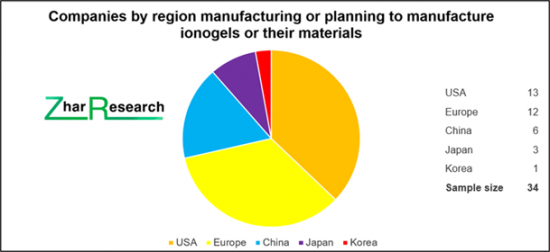
CAPTION: Companies by region manufacturing or planning to manufacture ionogels or their materials. Source: “Ionogel and eutectogel emerging opportunities: technology, markets 2026-2046” Zhar Research 2026.
Table of Contents
1. Executive summary and conclusions
- 1.1 Purpose of this report
- 1.2 Methodology of this analysis
- 1.3 Why ionogels?
- 1.4 Infogram: Primary types of gel compared
- 1.5 Examples of ionogel formulation and potential
- 1.5.1 Some ionogel types and applications being addressed
- 1.5.2 Some materials and functions involved
- 1.5.3 Stimuli‐responsive properties of ionogels
- 1.6 Ionogel SWOT appraisals
- 1.6.1 Ionogels in general SWOT
- 1.6.2 SWOT appraisal of medical ionogels
- 1.6.3 SWOT appraisal of ionogels for solid-state batteries
- 1.6.4 SWOT appraisal of ionogel proton exchange membranes
- 1.6.5 SWOT appraisal of cellulose ionogels
- 1.7 SWOT appraisal of candidates for using ionogel semi-solid electrolytes
- 1.7.1 SWOT appraisal of lithium and sodium-ion batteries
- 1.7.3 SWOT appraisal of lithium-ion capacitors LIC and other battery-supercapacitor hybrids BSH
- 1.8 35 key conclusions
- 1.8.1 Conclusions: markets for ionogel and related materials
- 1.8.2 Conclusions: ionogel technology trends
- 1.8.3 Conclusions: ionogel devices
- 1.8.4 Conclusions: Ionogel manufacturers and supply chain
- 1.9 Ionogel market, technology and industry roadmap 2026-2046
- 1.10 Roadmaps for self-healing materials in healthcare and ionogel competitor hydrogel 2026-2046
- 1.11 Ionogel market forecasts in 26 lines 2026-2046
- 1.11.1 Ionogel and allied market $ billion for three application categories 2026-2046
- 1.11.2 Ionogel value market by four regions 2026-2046
- 1.11.3 Energy storage device market battery vs batteryless $ billion 2025-2046
- 1.11.4 Batteryless storage for pulse and fastest response $ billion 2025-2046 in 7 technology lines
- 1.11.5 Battery supercapacitor hybrid BSH value market % by two Wh categories 2026-2046
- 1.11.6 BSH product life years and life of equipment to which it is fitted years 2014-2046
- 1.11.7 Self-healing materials for all applications: value market 2026-2046
- 1.11.8 Self-healing materials for healthcare value market $ billion 2026-2046
- 11.11.9 Medical hydrogel market 2026 and 2046 $ billion in 12 categories showing where ionogels compete.
2. Introduction
- 2.1 Definition, attributes and emerging uses
- 2.1.1 Definition and context
- 2.1.2 25 ionogel market sectors as examples and where hydrogels compete
- 2.1.3 Applications of ionogels by seven types of composition
- 2.1.4 Wearable ionogels: flexible and fabric
- 2.1.5 Ionogel smart windows
- 2.2 Eight properties of ionogels attracting attention
- 2.3 Primary types of gel compared in two infograms
- 2.4 Close relationship of ionogels and eutectogels
- 2.5 Ionogel, hydrogel, organogel, electragel and metallogel comparison
- 2.6 Some types and applications of ionogels in
- 2.7 Significance of ionic conductivity of ionogels and performance compromises
- 2.7.1 Overview
- 2.7.2 Choice of ionic liquids in ionogels, leakage, toxicity prevention in
- 2.7.3 Optimising ionic conductivity for electrical, electronic, ionotronics applications
- 2.8 Ionogel preparation with examples in
- 2.8.1 Overview and example
- 2.8.2 Direct mixing
- 2.8.3 Physical blending of inorganic hydrogels
- 2.8.4 In situ polymerization/gelation for ultra-strong adhesive, transparent and other forms
- 2.8.5 Solvent exchange
- 2.9 Some results, benefits and challenges
- 2.10 Ionogel SWOT appraisal
3. Ionogel options by matrix material
- 3.1 Overview with matrix chemistry popularity analysis
- 3.2 Table: Ionogel matrices simply compared
- 3.3 Infogram: Ionomers by host structure (solid matrix) in detail
- 3.4 Primary choices of ionogel matrix material
- 3.5 Ionomer cross-linking options
- 3.6 Why cellulose ionogels are popular
- 3.6.1 Overview
- 3.6.2 SWOT appraisal of cellulose ionogels
- 3.6.3 Cellulose ionogel matrices in 2025 and 2026 research advances
- 3.7 Some other examples in 2025 and
4. Optimising specific ionogel and eutectogel attributes: major advances in 2025 and 2026
- 4.1 Adhesion: surgical and other
- 4.2 Antibacterial
- 4.3 Biocompatible
- 4.4 Fluorescent
- 4.5 Self-healing
- 4.6 Strong: robust, impact resistant, toughening procedures
- 4.7 Terahertz manipulation
- 4.8 Transparent
5. Evolving ionogel device manufacturers, supply chain, formats, fabrication technologies
- 5.1 Overview and manufacturer regional analysis
- 5.2 Ionogel raw material manufacturers & chemical suppliers
- 5.3 Manufacturers of ionogel-based devices - actual and potential
- 5.4 Eutectogel manufacturers
- 5.5 Manufacturers of ionogel-enabled parts and devices
- 5.6 Ionogel device and parts manufacturing technologies including important 2025 and 2026 advances
- 5.6.1 Additive manufacturing increasingly favoured
- 5.6.2 Technology options for ionogel parts manufacture and formats produced
- 5.6.3 Fiber, fabric and wearable ionogels
- 5.6.4 3D and 4D printing of ionogels
- 5.6.5 2D and other printing and coating: screen, inkjet, aerosol, other
- 5.7 Composite ionogels: formulation and fabrication trends including important 2025 and 2026 advances
- 5.7.1 Overview
- 5.7.2 Applications
- 5.7.3 Fabrication trends
- 5.7.4 Magnetic ionogels
- 5.7.5 Multifunctional ionogels and eutectogels
6. Ionogels and eutectogels in iontronics, flexible electronics and human interfaces
- 6.1 Overview including major advances in 2025 and
- 6.2 Iontronics and flexible electronics
- 6.3 Actuators and human interfaces
- 6.4 Ionogel membranes
- 6.4.1 Basics
- 6.4.2 Proton Exchange Membranes PEM with SWOT appraisal
- 6.5 Ionogel sensors and human interfaces
- 6.5.1 Overview of sensors
- 6.5.2 Flexible and wearable sensors and latest advances in ionogels for these
- 6.5.3 Ionogel e-skin
- 6.5.4 Pressure, strain, temperature, imaging and other sensing with ionogels
- 6.6 Ionogel optical devices
- 6.6.1 Electrochromic
- 6.6.2 Birefringent
- 6.6.3 Light-emitting
7. Ionogels in batteries and supercapacitors
- 7.1 Overview: batteries, supercapacitors and variants needing ionogels
- 7.2 SWOT appraisal of candidates for using ionogel semi-solid electrolytes
- 7.2.1 SWOT appraisal of lithium and sodium-ion batteries
- 7.2.2 SWOT appraisal of supercapacitors
- 7.2.3 SWOT appraisal of lithium-ion capacitors LIC and other battery-supercapacitor hybrids BSH
- 7.3 Supercapacitors and battery-supercapacitor hybrids using ionogels or eutectogels
- 7.4 Ionogels and eutectogels in batteries with major advances in 2025 and
- 7.4.1 Basis with many several major advances in 2025 and 2026 (more later)
- 7.4.2 SWOT appraisal of ionogels for solid-state batteries
- 7.4.3 Oxide-based solid-state electrolytes
- 7.4.4 Sulfide-based solid-state electrolytes
- 7.4.5 Argyrodite ionogels
- 7.4.6 Nitride- and halide-based solid-state electrolytes
- 7.4.7 Polymer-based electrolytes
- 7.5 Sodium batteries adopting ionogels
8. Ionogels and eutectogels for energy harvesting and cooling
- 8.1 Overview
- 8.1.1 Energy harvesting and ionogels
- 8.1.2 13 energy harvesting technologies for zero energy devices compared
- 8.1.3 Energy harvesting applications by power output
- 8.1.4 Ionogel appraisal in five columns for three forms of energy harvesting
- 8.2 Thermoelectric energy harvesting
- 8.2.1 Basics with ionogels and eutectogels
- 8.2.2 Some targetted applications of ionogel thermoelectrics and allied materials
- 8.2.3 Surge of research advances in 2025 and 2026 analysed
- 8.2.4 Thermoelectric and thermal ionogel sensors, actuators and generators
- 8.3 Ionogel and eutectogel triboelectric energy harvesting
- 8.3.1 Triboelectric energy harvesting of motion: TENG operating principle, construction
- 8.3.2 Applications trialled
- 8.3.3 Research advances with ionogel TENG in 2026 and
- 8.4 Piezoelectric ionogel energy harvesting
- 8.5 Ionogels for cooling ? gap in the market that you can address
9. Medical ionogels: 2026 advances and trends
- 9.1 Overview
- 9.2 SWOT appraisal of medical ionogels
- 9.3 Versatility
- 9.4 Medical bioelectronics and iontronics advancing rapidly in
- 9.5 Texture, strength and environmental resilience advances with medical ionogels
- 9.6 Ionogel electrodes for triboelectric and bioelectronic interfaces advancing in
- 9.7 Performance-recyclability trade-off advances in 2026 and earlier
- 9.8 Ionogels as antibacterial agents
- 9.10 Ionogels as drug delivery systems DDS: many advances in 2026 and
- 9.10.1 Rationale and examples
- 9.10.2 Oral drug delivery
- 9.10.3 Buccal (cheeks or mouth) drug delivery
- 9.10.4 Transdermal drug delivery
- 9.10.5 Local drug delivery
- 9.10.6 Nose-to-brain drug delivery
- 9.11 Wound healing ionogel dressings and treatments with major advances in
- 9.12 Tissue engineering ionogels 2026 and earlier
- 9.13 Ionogel smart skin
- 9.14 Visual time indicators
- 9.16 Synthetic vision ionogels
- 9.16 Stretchable neuromorphic electronics for future human-integrated intelligence in
10. Ionogels for carbon capture, removing heavy metals and synthetic dyes
- 10.1 Overview: carbon capture
- 10.2 Ionogels for carbon capture and conversion: considerable advances in 2026 and
- 10.3 Water treatment
- 10.3.1 Ongoing challenges
- 10.3.2 Membrane filtration can be improved with ionogels
- 10.3.3 Ionogels to remove heavy metals

